
This started as a small scene I couldn’t shake — two strangers sharing a table just before Christmas, both carrying more than they planned to talk about.
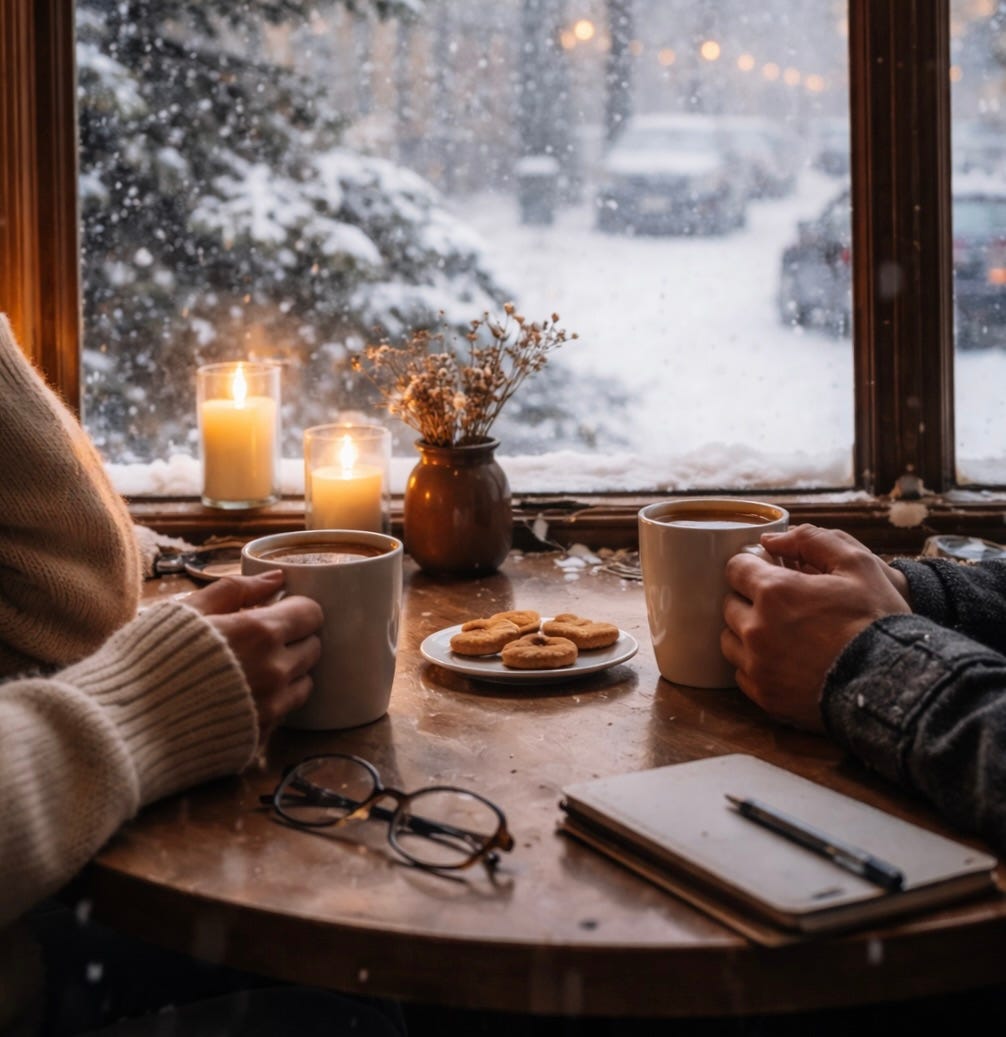
She was in her mid-forties, with curly hair the color of molten copper, unbrushed that morning. Except for a random flash from the blinking lights on the Christmas tree, I might not have noticed the tear slowly marching down her cheek.
The café was unusually crowded for mid-morning — too late for anyone headed to work. Early holiday shoppers filled most of the tables; gaily wrapped packages and overstuffed shopping bags occupied many of the chairs.
My feet ached from a night-shift security job that meant miles of marching through long, darkened corridors. I just wanted to sit and drink my mocha latte. I considered the veranda, but icy snowflakes had started spitting down from the sky. I scanned the room again, hoping someone was about to leave.
That’s when I noticed a small table tucked into an alcove behind a gaudy Christmas tree, nearly hidden from view.
I hesitated, then squeezed around the tree. Her fleeting glare put me on notice.
“Mind if I share your table?”
She tilted her head toward the empty chair, wiping her cheek with the cuff of her sweater.
“It’s a free country.” No eye contact.
“At least for now.”
She squinted at me, taking me in from head to toe. Her icy stare matched the wind coming off Lake Michigan.
Leaning forward to read the name tag on my uniform, she said, “Odd costume for a fucking comedian.” Her eyes held mine in a steady challenge — unexpectedly peaceful, emerald green.
“Sorry,” I said. “No offence meant. Long night. I’ll keep my mouth shut.”
She looked away, then back again. This time there was a flicker of something softer.
“My bad,” she said with a sigh. “Didn’t mean to be a bitch.” She glanced around the café. “It’s almost Christmas… again. We’re supposed to be jolly, right?”
I hung my coat over the chair and sat down harder than I meant to. I tried my coffee and burned my tongue.
“Ouch,” she said. “Yeah — mine was too hot, too.”
I smiled, then turned toward the tree, keeping my promise.
After a moment, she leaned forward. “I wasn’t really crying.”
I nodded, studying my cup as if it required concentration.
“I know you saw,” she continued. “It was a Christmas movie last night. There’s this scene — I always wait for the question. When she asks it, I want to plug my ears and look away. But I don’t.”
When I met her eyes again, I noticed the fine lines around them. She wore no makeup. A small, tentative smile lifted one corner of her mouth.
“You mean Love Actually,” I said. “The scene after the school play.”
Her face opened. “You know it.”
“Yeah.”
“I can’t watch it without crying,” she said. “It’s like an emotional rollercoaster.”
“I don’t know why it isn’t everyone’s favorite,” I said. “Maybe it is.”
She looked past me for a moment, at something only she could see. Then she reached across the table and patted my hand.
“But it is the season of hope,” she said.
We met again three days later.
Same café. Same crooked Christmas tree. She was already there when I arrived, coat folded neatly beside her cup, as if she’d learned something since last time — or decided something.
She looked up when I hesitated near the counter.
“You,” she said, not smiling yet.
“Me.”
She gestured with her chin toward the alcove. “I figured if you didn’t show, I’d at least get the table.”
I slid into the chair across from her. “I wasn’t sure you’d want company.”
She studied me for a beat. “I wasn’t sure either.”
Outside, the snow had given up pretending to be gentle. The windows rattled faintly. Christmas music drifted from somewhere overhead, tinny and out of tune.
We drank for a moment without speaking.
“So,” she said finally, wrapping both hands around her mug. “You always work nights?”
“Mostly.”
“And always in uniform?”
I hesitated just long enough for her to notice.
“Usually.”
Her eyes flicked to the patch on my shoulder. She squinted again, the way she had before. “You know,” she said carefully, “when you walked in just now, I thought—”
“I know.”
“You do?”
“People have been thinking that a lot lately.”
“That you’re—” She lowered her voice. “ICE?”
I tried to smile, but it didn’t quite reach my eyes. “Depends who’s asking.”
She leaned back slightly, reassessing the room, the exits, the distance between tables.
“I almost didn’t come,” she said.
“Because of me?”
“Because of what you might represent.”
I nodded. “Fair.”
“I’ve got friends who won’t even leave their apartments right now,” she said. “People who’ve been here twenty years. Paid taxes. Raised kids who sound more American than I do.”
“And?”
“And then there’s my cousin,” she added. “Did everything by the book. Waited. Paid lawyers. Years of limbo. So when people say ‘just let everyone stay,’ I don’t know how to answer that either.”
I stirred my coffee, watching the milk cloud and settle.
“It’s like cutting the line at a movie theatre,” I said. “You can feel bad for the people stuck outside, freezing. But you also can’t tell the ones who waited an hour that their time didn’t matter.”
She looked at me, surprised. “That’s… exactly how it feels.”
We sat with that for a moment.
“You know what kills me?” she said. “We act like this mess just appeared. Like no one ever tried to fix it.”
“McCain–Kennedy,” I said. “2006. Comprehensive. Dead.”
“And the Gang of Eight,” she said. “Passed the Senate.”
“But never brought to the floor,” I finished. “Some people need a problem more than a solution.”
She studied me again, slower this time. “You don’t sound like a slogan.”
“I don’t get paid to chant.”
“So what happens,” she asked, “if ICE just… melts? Gone.”
I didn’t answer right away.
“You don’t get to pretend the law never existed,” I said. “You don’t get to punish people who followed it. And you don’t get to keep millions in permanent fear because politicians need a monster.”
She didn’t agree. But she recognised something.
“And you?” she asked. “What do you get out of it?”
“That depends.”
“On what?”
“On whether you’re asking because you’re curious,” I said, “or because you’re deciding whether to trust me.”
The Christmas lights blinked behind her, briefly illuminating the space between our cups.
She leaned forward, not touching me — just close enough.
“Same question,” she said. “For both of us.”
By the third time they met, it had become a habit rather than a coincidence.
Same café. Same crooked Christmas tree blinking like it was unsure of itself. She was already there again, coat folded, hands around her mug as if warming them from something deeper than the cold.
“You’re late,” she said.
“I had to take the long way.”
She smiled — the kind that assumed a shared joke without needing to hear it. That had become their thing: stepping briefly away from the day, as if the world had agreed to carry on without them for an hour.
They talked about small things. Movies half-remembered. Songs that meant more when they were younger. How Christmas made everything feel louder than it needed to be.
“At some point,” she said, “I realized I was coming here to not think.”
“Same.”
When she told him about Rosa’s brother, he listened.
Her phone had buzzed just after dawn.
She read the message twice, thumb hovering as if a reply might fix it.
Rosa’s brother didn’t come home.
When he stood to leave, she tried to stop him. He went anyway.
That night, the brother came home.
No record. No hold. A call made into a crack.
The next morning, she didn’t pretend.
“That was you.”
“I know where the cracks are,” he said. “And sometimes they’re wide enough.”
“And you’re not afraid?”
“I am,” he said. “That’s how I know it matters.”
She took his hand this time. He didn’t pull away.
“What do you want me to see you as?” she asked.
He thought for a moment. “Someone who stays.”
Outside, snow fell thick and quiet, muting the city.
For a moment, the world narrowed to the space between their hands.
They sat there, fingers intertwined, letting Christmas pass them by — not as an obligation, but as a pause.
Not an escape.
A choice.
Thanks for reading Dante’s Descent! This post is public so feel free to share it.
I wrote this because I’m tired of how loud everything has become, and how rarely we slow down long enough to see the person across the table.
I’ve lived on both sides of borders. Most of what matters doesn’t show up in arguments or headlines — it shows up in small moments, a conversation, a risk quietly taken for someone else.
Sometimes the most radical thing we can do is stay at the table a little longer.
Comments
Nothing yet. Say the first thing.
Sign in to join the conversation.