
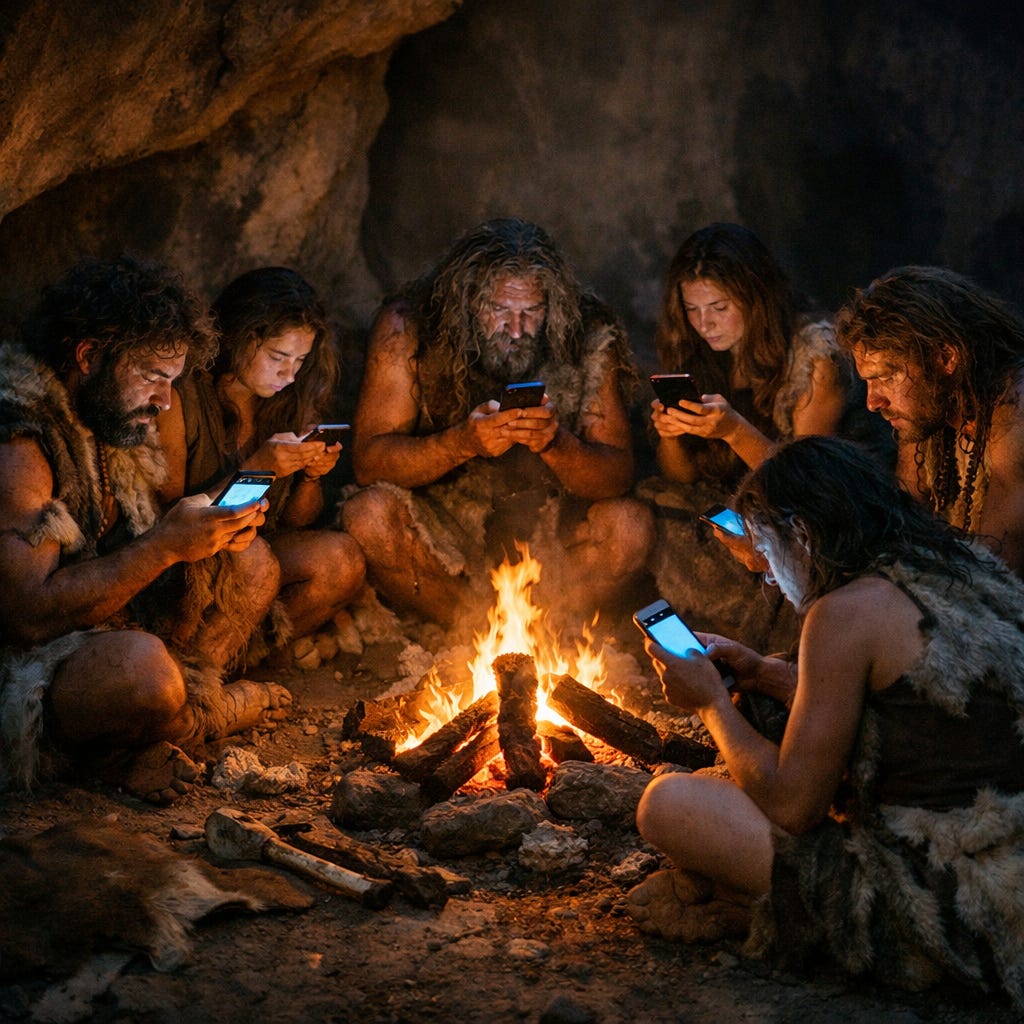
Somewhere near half a million years ago, far from the Americas, a young child awoke. Cold and hungry, the scent the familiar bodies beside them gifted a reassurance older than thought itself. Fear and excitement moved together in the pale light creeping into a rocky shelter, neither yet distinct, both necessary. Close your eyes now — listen to the wind, let it summon what sleeps in your bones. That child is in you still, carried through blood and through memory. Remember — try to remember.
In the First Age, before memory had shape, humans walked the world like shadows among the beasts. Imagine waking as that child, with no words yet to measure morning and no symbols to anchor meaning to sound or sight, only sensation and the constant negotiation with survival. You knew others first by sound: low murmurs of comfort, sharp cries of warning, laughter quick and bright as birds at dawn. The wind carried messages of change, while the wild spoke in rustle, footfall, and the sudden silence that followed the passing of predators. Minds learned slowly, step by careful step, to read a world without signs.
We spoke first with glance and gesture, with hunger and fear guiding what little meaning could travel between us. Night belonged entirely to darkness until, in a time beyond record, a spark leapt from stone to tinder. Fire was claimed, and we gathered close as shadows shifted across cave walls like thought itself beginning to move. Flame softened meat, warmed cold bone, and drew us into circles of trust, where meaning traveled not yet as words but as rhythm, presence, and shared attention. Fire did more than keep us alive; it gathered us long enough to begin remembering.
It was the first magic.
The First Age gave us fire, but the Second gave us seed, and with it a different relationship to time. With one we survived the night; with the other we learned to stay, pressing grain into the earth and waiting, trusting soil and sky to answer. Food no longer fled across open plains but rose from familiar ground, and camps gathered near rivers until they slowly became villages. Footsteps slowed, and the long migrations of our ancestors ended beneath steady trees and repeating stars.
Stillness brought abundance, as harvest filled baskets and clay jars lined hearth walls against winter’s edge. Children no longer trailed wandering camps but grew where they were born, tracing the same riverbank year after year while songs of sowing replaced the hunter’s cry. A settled life offered safety, a circle of firelight that did not move with the seasons and promised endurance even when the world beyond remained uncertain.
But stored grain carried weight beyond hunger, because someone held the key to the granary and with it the power to decide who slept full and who slept hungry. Lines formed that were not carved in soil but drawn in obligation, in custom, and in who commanded and who obeyed. Most bent their backs to the fields while a few guarded stores, set boundaries, and conjured the gods. Hierarchy crept in like ivy on a wall, harmless at first and almost beautiful, until it mattered who held the key.
Still, life flourished. Fields shimmered green in the morning wind, mothers sang over grindstones, and though freedom was traded for security, most accepted the bargain. The old horizon still sang of freedom, but a full granary hums sweeter when the icy wind howls.
In time, animals stepped from fear into partnership as wolves lingered at the camp’s edge, drawn by scraps and warmth, and slowly became guardians. Goats and cattle followed, no longer quarry but possession, as herds became wealth that could be counted, traded, and stolen. Food walked on four legs now, and ownership took shape, so that where hunger once drove us onward, protection and territory began to hold us still.
But change rode swifter and closer when the horse arrived from the wide grasslands, restless and fierce, wind-boned and alert. First it was food, and then we climbed onto its back, and in that moment the world changed. A rider could outrun storm or famine, cross borders once measured in seasons, and arrive at a neighbor’s hearth long before warning. While trade brought color and story even as envy hardened into boundary and pride grew where territory mattered.
What grain had gathered, hoofbeats might divide, as tribes met in days rather than generations and stories crossed rivers alongside raiders and rascals. Speed became power, power demanded order, and order demanded allegiance. Words sharpened into claims of river, herd, blood, and belonging. Beneath the hoofbeats of progress, the first sparks of war began to flicker.
Even so, wonder lived in the widening world. Children watched stallions rear at dawn, elders smiled as beasts shared the burdens. Riding felt like catching lightning — dangerous, trembling, and irresistible to those who dared. And the he wind tasted different when you could chase it. Now, peace and conflict shared the same road, but many thought speed a blessing.
From hoof and herd came more burden; grain needed hauling, goods needed storing, and distance demanded solutions beyond muscle alone. A potter’s wheel smoothed clay beneath steady hands, and soon that turning circle found another purpose when wood met axle and a cart rolled forward. The wheel arrived quietly, without miracle or announcement, and nothing would remain simple after that.
Roads followed, pressed into earth by foot and hoof, linking villages like beads on a cord as trade lengthened its reach and carried with it influence, obligation, and debt. Where abundance gathered, ambition gathered beside it, and ambition needed memory that was more durable than breath and more reliable than trust alone.
Marks appeared in clay, symbols became sounds, sounds became words, and thought itself became visible. For the first time, a story could wait for its reader, a command could cross mountains, and a lineage could outlast bone. The scribe’s hand held more than reed and ink; it held the past, the future, and a new kind of power.
Language, once born around fire for comfort and story, now drew borders in the mind as clearly as rivers did on land. Words settled disputes and ignited them, carrying praise, decree, rumor, and threat, while memory no longer vanished with death but hardened into record. Knowledge grew, and so did authority, and beneath record and rule, empire stirred.
Stone rose where soil once ruled as villages swelled into cities ringed with walls and temples climbed skyward, while leaders who had once been elders beside the hearth now wore titles carved in rock. Story hardened into myth, myth hardened into law, and the spoken word became command.
Roads stretched outward carrying armies and tribute, bronze flashed beneath banners, and drums summoned men as power gathered weight and demanded structure. Bureaucracy was born, along with systems that could outlast any single ruler.
Yet empire also gave shape to wonder, as libraries filled with scroll and clay, scribes mapped stars and seasons, and painters ground pigments that outlived their hands. Markets hummed with spice and cloth, and a stranger could walk a great city and hear many tongues before noon, as culture flourished brilliant and dense.
But order carried a cost. Beyond the gates lay hunger and conquest, conquered peoples learned the language of their rulers or vanished from the record, and the same script that preserved wisdom justified domination. What stood tallest cast the longest shadow.
Ink began as prayer and record, but imagination wrote between the lines as presses turned like mill wheels and words multiplied beyond the control of temples and crowns. Books traveled in saddlebags and cargo holds, slipped beneath cloaks, and passed hand to hand as knowledge escaped gates and guards alike.
People read scripture in their own tongue, finding comfort or questions, as faith and doubt began to share the same pew. Pamphlets stirred crowds, decrees met resistance in margins and footnotes, and kings learned to fear printers more than swords, for swords only killed men while pamphlets killed allegiance.
Still, wonder lived here as well, as science unfolded like a new map, artists painted light itself, and ideas collided in cafés and parlors. Ink remembered what speech forgot and spread what power wished to silence, making history harder to erase.
Industry roared as rails stitched nations together and telegraph wire carried thought at the speed of lightning, collapsing distance so that news arrived before rumor could settle. Newspapers told millions what to fear and praise, while war found new drums in posters and slogans and a single voice could reach crowds it would never meet.
Radio braided families across oceans and carried music into darkened rooms, offering comfort and deception alike, as information no longer crept but flooded and truth traveled beside propaganda. Science and spectacle shared the same stage, and though we had never been closer, we had never been easier to divide.
We could cast a single voice across the world and discovered how few paused to truly hear.
Fire once gathered us close, but screens scattered us in light as signals replaced breath and distance vanished. Libraries fit in pockets, and knowledge poured freely, faster than reflection could follow, so that at first the change felt like wonder.
Anyone could speak and anyone could listen, but without gates came confusion, as voices multiplied faster than understanding. News outran context while anger outran restraint. Algorithms fed us what moved us most, not what steadied us, and reflection grew harder to hold.
Still, beauty lived here, as kindness crossed oceans in seconds, strangers learned from one another, and art found its audience without permission. Yet loneliness lingered in crowded rooms, because connection without presence remained hunger and voice without listening became echo.
Fire gathered us, but language bound us together. Writing extended memory beyond breath. Print taught us how to think across distance and time — returning to a page, revisiting an argument, letting understanding grow instead of emotional flare.
Now we live inside a digital circus. Language shouts, flashes, performs. Attention fractures. Emotion sets the pace. Beneath the spectacle runs an unseen machinery — systems designed not merely to carry our words, but to keep us watching, clicking, reacting. Algorithms learn what stirs us and feed it back, refined, relentless. What feels like choice is often someone else’s design.
A rumor outruns its correction. A sentence torn from context ignites outrage before the fuller story arrives. Language is engineered for engagement. The mind is rewarded for reaction, trained away from patience. We are hurried — and deliberately distracted.
Yet the older capacities remain. The ability to read deeply and to sit with complexity and to listen past discomfort. These are not obsolete skills — they are human ones.
Fire was the first gift, but it mattered only because we gathered around it. Language followed — not to overwhelm the world, but to make sense of it together. Reading taught us patience. Writing taught us memory. Listening taught us restraint.
None of these capacities are gone. They wait, as they always have, for time, for quiet, for the willingness to stay with a thought long enough to be changed by it. To gather around something smaller and steadier than the glare of a thousand screens, and recover the quiet wisdom, one that once traveled face to face, breath to breath, in the firelight.
Comments
Nothing yet. Say the first thing.
Sign in to join the conversation.