
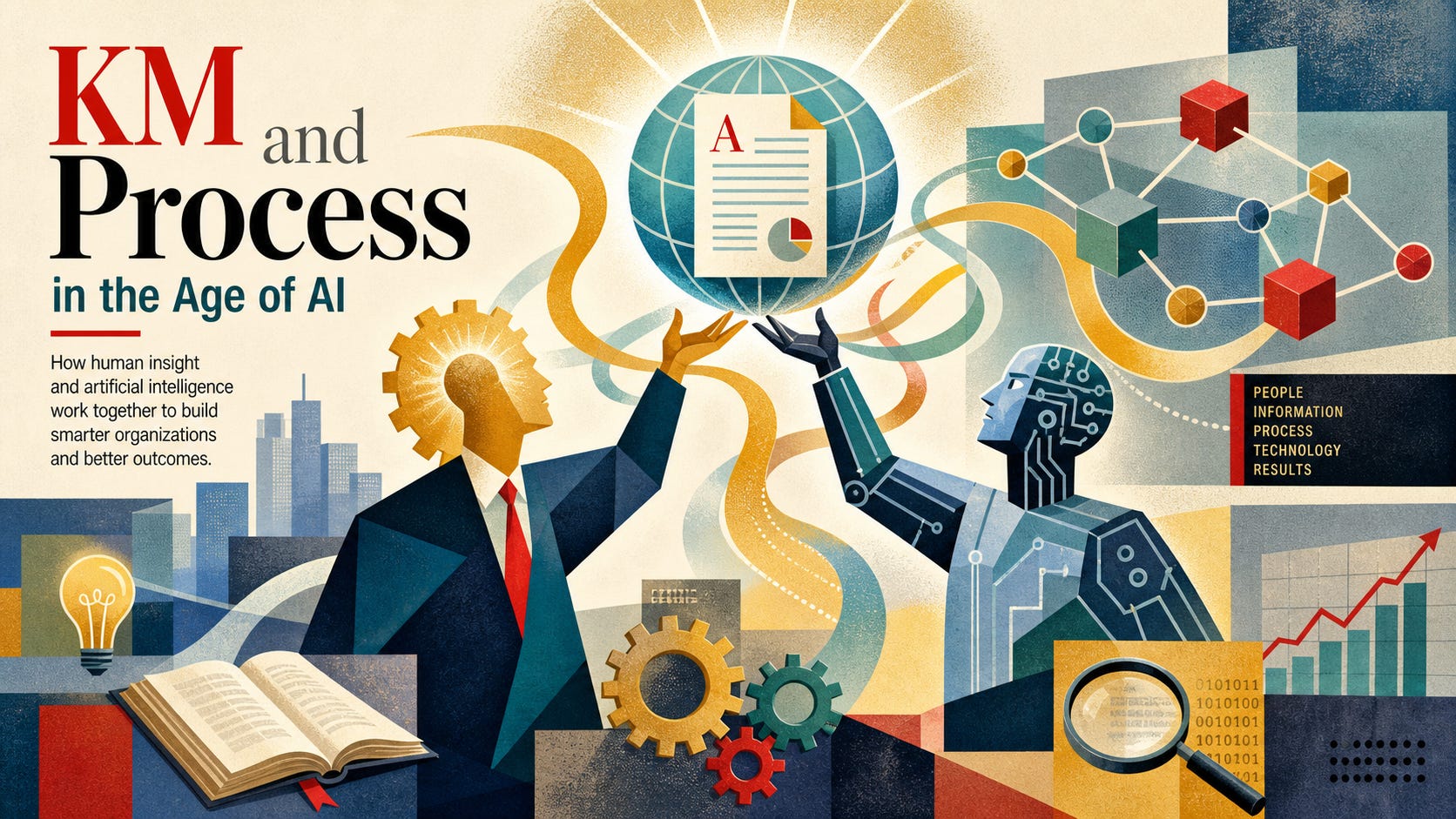
To design a sustainable and high-performing knowledge management (KM) program, organizations must recognize KM as the interrelationship between people, process, technology, and social capital. As much as AI suggests magic, engineering remains a key element for the success of KM and AI. KM is an organizational capability, and its process components require people to think through approaches and tactics, to remediate exceptions and recognize when a process needs improvement or no longer serves a purpose.
I have always perceived process as the poor stepchild of KM. As much as we discuss community and culture, we often relegate process and workflow to separate channels, conferences and conversations. I think process should always be referred to as process knowledge—the embodiment of the how part of knowledge, which is often, in my experience in manufacturing, the majority of the knowledge that must be developed and nurtured.
KM embraces a number of processes itself. Stan Garfield’s 16 Process Components of Knowledge Management (Knowledge Nuggets) provide an exceptional baseline for structuring these activities. However, by synthesizing his work with other core KM methodologies, such as Bergeron’s 8-step KM Lifecycle (Essentials of Knowledge Management), Bukowitz & Williams’ Tactical-Strategic Framework (The Knowledge Management Fieldbook), and Nonaka & Takeuchi’s SECI spiral (The Knowledge Creating Company), we can build an extended, end-to-end framework.
Artificial intelligence, then, belongs inside the ecosystem; it does not replace it. AI can help people retrieve, classify, summarize, translate, compare, and draft from large bodies of content. It can also scale stale material, expose overshared information, erase context, or generate a plausible statement that no source supports. NIST calls this last risk confabulation and warns that fabricated logic or citations can increase misplaced trust (NIST, Artificial Intelligence Risk Management Framework: Generative Artificial Intelligence Profile, 2024).
Beyond process in service to other KM efforts, it is crucial to apply these disciplines to process itself. These are the same concepts I’m writing about elsewhere when it comes to agent-driven processes, because agents are just another actor in a process. They require instruction. They require determined sequences, and they require a definition of what good looks like.
The practical question is therefore not, ‘Where can we add a chatbot?’ It is, ‘At which KM step can AI reduce friction while preserving source provenance, access controls, human accountability, and the ability to correct or retire knowledge?’ The following framework treats AI as a supporting mechanism inside the KM process.
This post provides a comprehensive overview of the extended KM process ecosystem, detailing how each process operates.
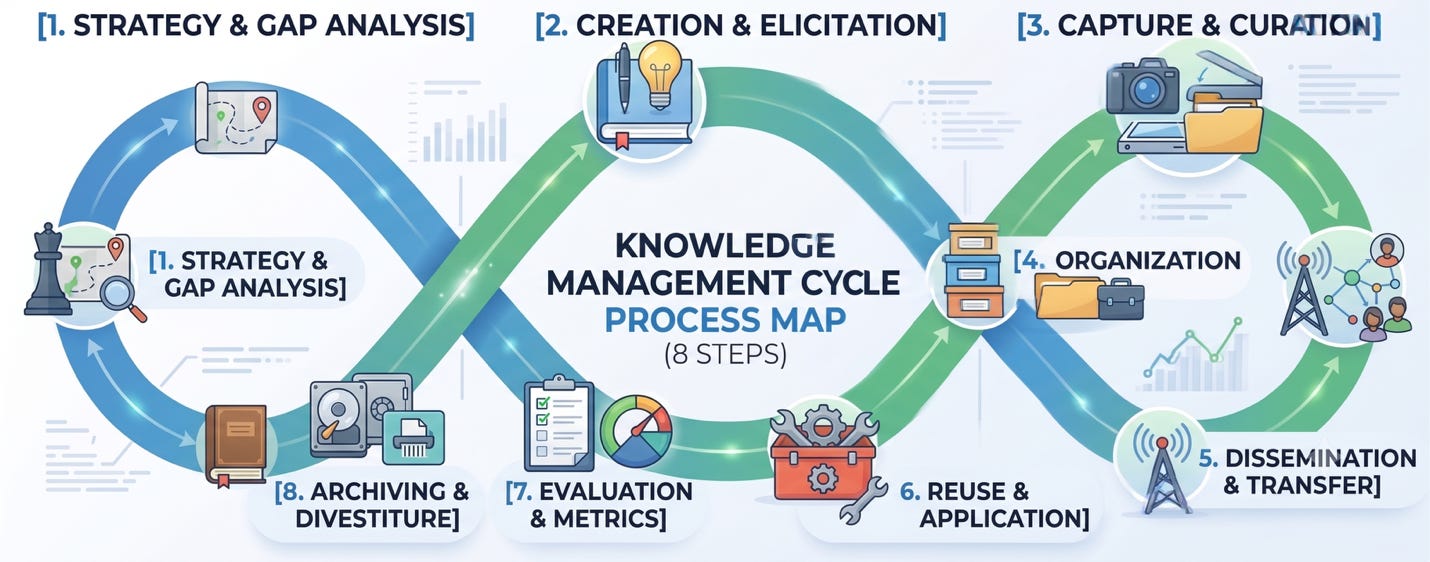
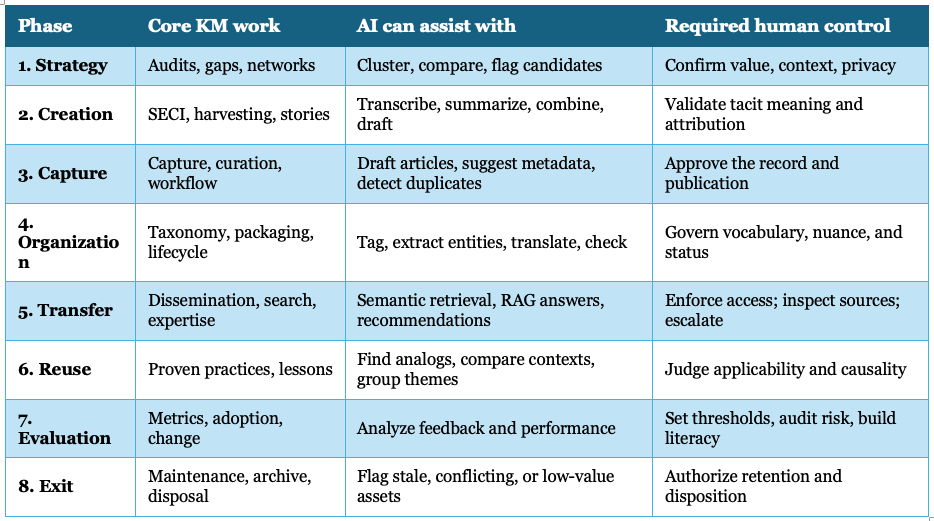
Managing knowledge as a strategic resource requires a coordinated set of processes. The eight lifecycle phases below extend Garfield’s core list with established KM methods and explicit controls for AI-assisted work.
A language model is not a knowledge base. For knowledge-intensive questions, retrieval-augmented generation (RAG) combines a language model with external, inspectable sources (Lewis et al., 2020). That architecture makes sources easier to update and inspect, but it does not make every answer correct. A responsible KM implementation applies five operating rules:
Ground the output. Use approved, current repositories and expose the passages or documents used to formulate an answer.
Preserve permissions. Retrieval must honor the user’s access rights; AI should not become a shortcut around information governance.
Keep provenance. Record the source, owner, version, review date, and transformation history for AI-assisted knowledge assets.
Make the status visible. Label AI output as a draft, recommendation, or answer - not as an approved record - until an accountable person validates it.
Evaluate with real work. Test retrieval quality, citation support, omissions, security behavior, and usefulness on representative tasks before broad deployment.
Before collecting content or deploying AI, a KM program must define the decisions, risks, capabilities, and outcomes it intends to support. Skipping this step produces expensive systems that answer many questions but solve few important problems.
Overview: Identify critical knowledge assets, map where they reside, assign ownership, and uncover gaps that create operational bottlenecks or risk.
Strategic purpose: Separate mission-critical knowledge from accumulated content, then address gaps through training, hiring, process redesign, partnerships, or targeted acquisition.
Where AI can assist: Entity extraction, document clustering, topic comparison, and metadata analysis can produce candidate maps of duplicated, missing, or aging knowledge. These are investigative leads, not conclusions about employee competence or strategic value.
Overview: Map the informal relationships and trust pathways through which information actually flows, rather than relying only on the formal organization chart.
Strategic purpose: Identify knowledge brokers, isolated groups, and potential bottlenecks so the KM team can strengthen connections without overloading a few people.
Where AI can assist: Network analytics can surface interaction patterns in collaboration metadata. Privacy review, data minimization, consent where appropriate, and bias checks are essential; message volume is not a reliable proxy for expertise, trust, or value.
Overview: Identify people or teams that achieve exceptional outcomes under comparable constraints and study the practices behind their results.
Strategic purpose: Harvest and scale what is already working instead of treating every KM intervention as a repair project.
Where AI can assist: Pattern analysis can help find candidate cases and compare narratives, metrics, and artifacts. People still have to determine whether the result reflects a transferable practice, a local condition, or a misleading correlation.
Knowledge creation is generative in the organizational sense: people develop new ideas, test them, interpret experience, and expand intellectual capital. Generative AI can contribute language and combinations, but novelty in wording is not the same as validated new knowledge.
Overview: Nonaka and Takeuchi describe knowledge creation as a continuing conversion between tacit, experience-based knowledge and explicit, codified knowledge.
Four modes: Socialization shares experience directly; externalization expresses tacit insight; combination reorganizes explicit material; internalization turns codified knowledge into practiced capability.
Where AI can assist: Speech-to-text, summarization, comparison, and drafting can reduce the effort required for externalization and combination. AI cannot observe all the situational judgment, embodied skill, relationships, or meaning that make tacit knowledge useful; experts must review what was lost or distorted.
Overview: Use structured interviews, observation, artifacts, and follow-up questions to elicit critical expertise before it becomes unavailable.
Strategic purpose: Reduce knowledge-loss risk while avoiding the fiction that a transcript turns unique competence into a complete corporate asset.
Where AI can assist: With permission, AI can transcribe interviews, draft summaries and playbooks, flag unanswered questions, and compare interviews for recurring themes. The knowledge holder and a trained interviewer should validate the resulting artifact, including exceptions and boundary conditions.
Overview: Use stories to communicate context-rich experience, turning points, tradeoffs, and lessons in a memorable form.
Strategic purpose: Preserve the human context that procedures and data often omit, while making clear which parts are evidence, interpretation, or metaphor.
Where AI can assist: AI can outline interview material, create audience-specific drafts, or translate a story into a case, checklist, or briefing. The original narrator and an editor should protect voice, intent, attribution, confidentiality, and factual sequence.
Once knowledge is generated or elicited, it must be captured, validated, and integrated into work. AI is most useful here when it converts an existing, reviewable event or artifact into a draft - not when it invents a record after the fact.
Overview: Document and refine knowledge through editing, access controls, source linking, versioning, and approval so that it is reliable and usable.
Strategic purpose: Filter raw inputs before the repository becomes a digital junkyard.
Where AI can assist: AI can summarize a resolved case, suggest a draft knowledge article, detect near-duplicates, and propose metadata. ServiceNow, for example, documents a workflow in which Now Assist generates a draft article from a case or incident and then directs the agent to review and edit it before publishing. The review step is the KM control, not an optional courtesy.
Overview: Embed capture and reuse into routine work so that KM does not become a separate task that busy employees can ignore.
Strategic purpose: Collect knowledge close to the moment of use, when sources and context are still available.
Where AI can assist: Meeting, incident, project, and service workflows can trigger a transcript, summary, proposed action list, or draft article. The trigger should be transparent, scoped, secure, and connected to an owner and approval path rather than becoming ambient surveillance.
A repository is useful only when people and systems can interpret its content. AI raises the value of good organization because retrieval depends on clean sources; it also raises the cost of poor organization because an authoritative-sounding answer can blend contradictory documents.
Overview: Define a controlled vocabulary, taxonomy, and metadata schema that describe an asset’s subject, context, owner, sensitivity, status, and validity.
Strategic purpose: Create consistent pathways for navigation, filtering, access control, analytics, and search.
Where AI can assist: Classifiers and language models can propose tags, entities, synonyms, relationships, and candidate taxonomy updates at scale. A taxonomy owner should approve changes, monitor drift, and use reviewer feedback to improve rules and examples.
Overview: Translate specialized knowledge into formats and language that other audiences can understand and act upon.
Strategic purpose: Prevent cognitive disconnects across organizational boundaries without stripping away necessary technical, legal, or cultural nuance.
Where AI can assist: AI can produce summaries, translations, glossaries, FAQs, role-specific explanations, and draft training material. Subject-matter review is essential whenever simplification could alter scope, safety conditions, obligations, or meaning.
Overview: Manage documented assets from draft through review, approval, publishing, maintenance, and retirement.
Strategic purpose: Keep the active knowledge base current, credible, traceable, and aligned with corporate standards.
Where AI can assist: Automated checks can flag broken links, inconsistent terms, missing owners, near-duplicates, sensitive content, and review dates. These signals prioritize editorial work; they do not establish truth or authorize publication.
This phase gets the right knowledge to the right people at the point of need through both push and pull mechanisms. A widely cited 2012 McKinsey analysis estimated that interaction workers spent 19 percent of their week searching for and gathering information. That figure is a dated baseline, not a universal current measure, but the friction it describes remains central to KM.
Overview: Move tacit and explicit knowledge across time, distance, and organizational boundaries through coaching, communities, briefings, learning, messaging, and repositories.
Strategic purpose: Spread solutions and know-how while preserving the context needed to apply them safely.
Where AI can assist: Recommendation and generation systems can suggest relevant content, draft role-specific briefings, and create practice questions. People should be able to see why an item was recommended and still reach human experts, especially when the question is novel or consequential.
Overview: Use enterprise search, semantic retrieval, directories, and communities to help people find both documented knowledge and human expertise.
Strategic purpose: Reduce search time, improve reuse, and connect seekers to people who can interpret ambiguous or tacit knowledge.
Where AI can assist: Semantic search can retrieve conceptually related material even when the query and source use different words. RAG can then synthesize retrieved passages into a conversational answer with source links. Microsoft documents this pattern in Microsoft 365 Copilot, which grounds responses in Microsoft Graph content the signed-in user is permitted to access. Grounding improves relevance; it does not eliminate unsupported claims, so citations and an honest ‘not enough evidence’ response remain essential.
The test of KM is not how much content the organization stores or how many answers an AI system generates. It is whether people apply appropriate knowledge to improve performance, avoid repeat mistakes, and learn when circumstances change.
Overview: Adapt previous deliverables, replicate proven practices, and reuse standardized procedures where the context supports doing so.
Strategic purpose: Reduce reinvention without turning yesterday’s solution into today’s unquestioned rule.
Where AI can assist: AI can retrieve analogous cases, compare conditions, propose a starting template, and highlight differences. The accountable practitioner decides whether the precedent applies and documents any adaptation.
Overview: Use after-action reviews and retrospectives to capture what happened, why participants believe it happened, and what future teams should test or change.
Strategic purpose: Institutionalize organizational memory while treating lessons as context-dependent hypotheses, not timeless facts.
Where AI can assist: AI can transcribe a review, group recurring themes, retrieve similar lessons, and draft actions. It should preserve disagreement and uncertainty rather than manufacture consensus or causal certainty.
A useful empirical example comes from customer support. Brynjolfsson, Li, and Raymond studied an AI assistant used by more than 5,000 agents and reported a 15 percent average productivity increase, with larger gains for novice and lower-skill workers (2025). The evidence is consistent with AI helping disseminate patterns embodied in previous interactions. It does not prove that the same result will appear in every KM process, workforce, or task.
KM and AI both require continuous evaluation. A pilot that impresses in a demonstration can still fail on access control, rare queries, changing content, or the tasks that matter most.
Overview: Track KM performance through goal, operational, learning, risk, and business-impact measures.
Strategic purpose: Show whether the program changes decisions, cycle time, quality, resilience, learning, or cost - not merely whether people opened a portal.
Where AI changes the metrics: Add retrieval precision, source coverage, citation relevance, groundedness, correction rates, sensitive-data exposure, answer abstention, freshness, latency, and human escalation. Measure time saved and outcome quality separately; faster wrong answers are not productivity.
Overview: Manage the cultural and behavioral shifts required for open sharing, responsible reuse, and appropriate trust in AI-assisted work.
Strategic purpose: Create adoption without confusing compliance, speed, or novelty with learning.
Where AI changes the work: Build AI literacy, role-specific guidance, feedback channels, escalation paths, and time for experts to curate what the system uses. Research with 758 consultants found strong gains on tasks inside the model’s capability frontier but emphasized that performance varies by task - the ‘jagged technological frontier’ (Dell’Acqua et al., 2026). KM governance must therefore be task-specific.
Knowledge becomes stale when it is not maintained. AI-assisted retrieval makes lifecycle management more important, not less: obsolete content can be rediscovered and fluently restated long after people have stopped opening the original file.
Overview: Review, update, archive, and secure older explicit content while maintaining its provenance and retention status.
Strategic purpose: Keep active search paths clear and reduce the chance that people or AI systems rely on outdated, conflicting sources.
Where AI can assist: AI and rules can flag low-use items, expired review dates, version conflicts, broken links, and material that contradicts a newer approved source. An owner should decide whether to update, supersede, restrict, or archive it.
Overview: Purposefully destroy, prune, license, sell, or decline to maintain knowledge assets that are obsolete, risky, duplicative, or no longer strategically aligned.
Strategic purpose: Remove zombie knowledge while meeting legal holds, records schedules, intellectual-property obligations, and evidence requirements.
Where AI can assist: AI can prioritize candidates and assemble evidence for review. It should never be the sole authority for deletion, divestiture, or records disposition; those actions require accountable owners and applicable legal, security, and records-management approval.
An agent should not sit outside the KM process. It is another actor with delegated access to knowledge, tools, and decisions. The workflow, instructions, examples, permissions, memory, and escalation rules that guide it all become process knowledge—and must be managed accordingly.
KM disciplines should therefore govern the agent’s entire operating environment:
Align: Define the outcome, scope, constraints, and accountable owner.
Ground: Limit retrieval to approved, current, permission-appropriate sources.
Capture: Record inputs, outputs, sources, transformations, decisions, and exceptions.
Curate: Treat instructions and agent-created artifacts as versioned assets with owners and review dates.
Evaluate: Test performance against real cases, including ambiguity, conflicting sources, security boundaries, and failure conditions.
Escalate and retire: Specify when human judgment is required and remove obsolete instructions, tools, sources, and agent-generated knowledge.
The goal is not to make agents understandable, correctable, and governable. If a traditional process requires ownership, evidence, review, and lifecycle management, its agent-enabled counterpart requires the same controls, usually more explicitly.
AI can make KM more conversational, responsive, multilingual, and usable in the flow of work. It can lower the cost of turning a case into a draft article, an interview into a playbook, or a question into a source-linked answer. Those are meaningful improvements.
But AI does not rescue an organization from missing ownership, weak permissions, stale content, absent review, or a culture that withholds context. It amplifies the process it enters. Put it inside a disciplined KM lifecycle and it can expand access to organizational knowledge. Put it on top of a digital junkyard and it will make the junk easier to retrieve, remix, and trust.
National Institute of Standards and Technology. (2024). Artificial Intelligence Risk Management Framework: Generative Artificial Intelligence Profile (NIST AI 600-1). DOI and full report.
Lewis, P., et al. (2020). Retrieval-Augmented Generation for Knowledge-Intensive NLP Tasks. NeurIPS 2020. Paper.
Brynjolfsson, E., Li, D., & Raymond, L. R. (2025). Generative AI at Work. The Quarterly Journal of Economics, 140(2), 889-942. DOI.
Dell’Acqua, F., et al. (2026). Navigating the Jagged Technological Frontier: Field Experimental Evidence of the Effects of AI on Knowledge Worker Productivity and Quality. Organization Science, 37(2), 403-423. DOI.
McKinsey Global Institute. (2012). The Social Economy: Unlocking Value and Productivity Through Social Technologies. Full report. The report’s 19 percent figure describes searching and gathering information, not a current universal measure of time lost.
Microsoft. (updated 2026). Microsoft 365 Copilot architecture and how it works. Microsoft Learn.
ServiceNow. (updated 2026). Generate a Knowledge article from the Now Assist panel. Product documentation. This is a documented product workflow, not independent evidence of effectiveness.
Bergeron, B. (2003). Essentials of Knowledge Management. Wiley.
Bukowitz, W. R., & Williams, R. L. (1999). The Knowledge Management Fieldbook. Financial Times/Prentice Hall.
Nonaka, I., & Takeuchi, H. (1995). The Knowledge-Creating Company. Oxford University Press.
No posts
Comments
Nothing yet. Say the first thing.
Sign in to join the conversation.