

When organizations embark on a knowledge management journey, their first instinct is often to buy something. A new platform. A better search engine. An AI assistant. A repository into which the organization can finally pour everything it knows.
This is understandable. Technology is visible, purchasable, and relatively easy to put on a project plan. Policy, practice and how we use space are none of those things. Some call it culture; I try to avoid that term and focus on the levers that enable it, and empower people to behave positively, whatever positive means to the target organization.
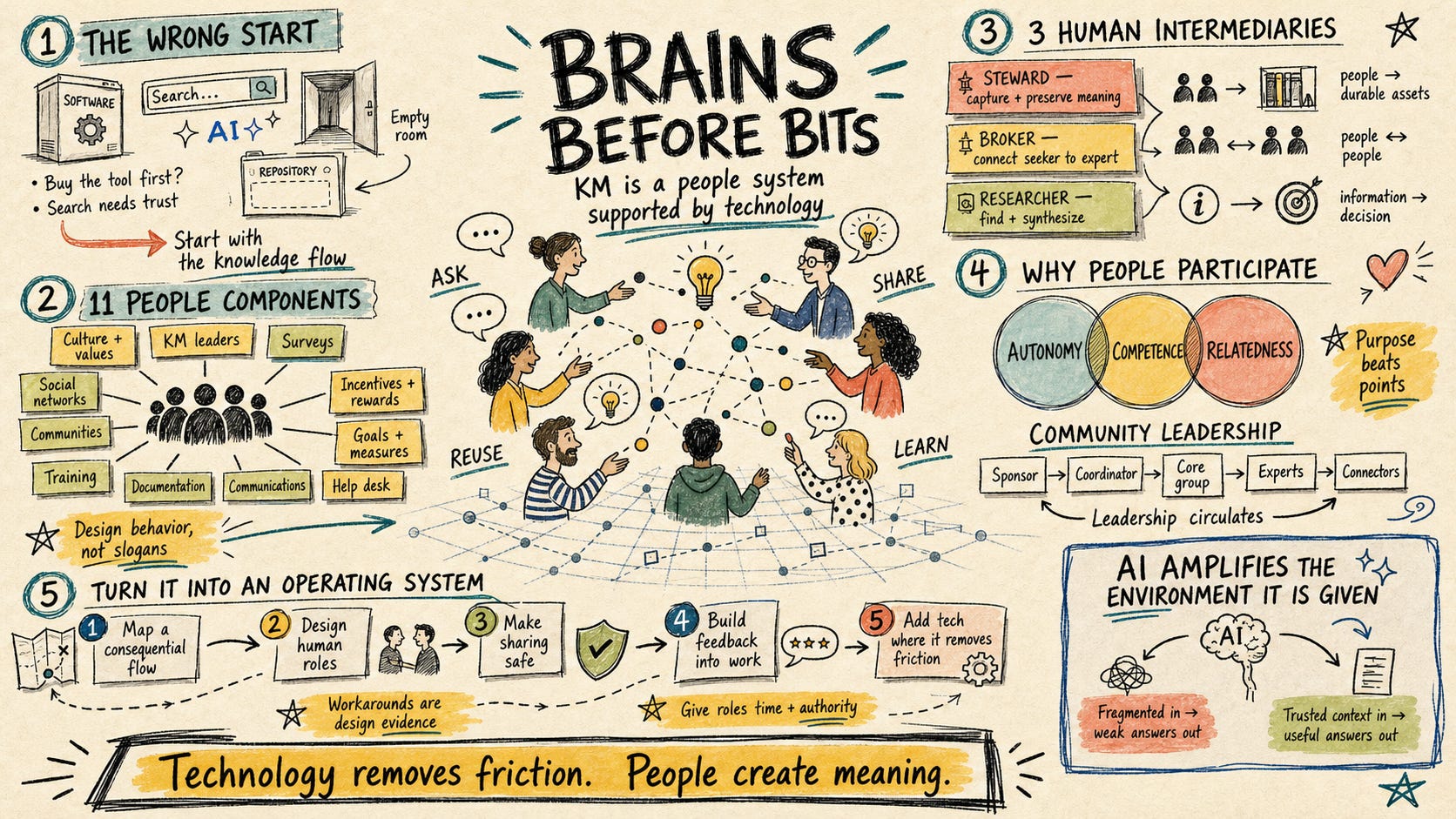
But knowledge management is not primarily a system installation. It is an attempt to change how people seek help, share experience, make decisions, learn from mistakes, and preserve what matters to people and to the organization.
Technology can reduce friction and lower barriers to capture. It cannot determine what is worth knowing, supply missing context, or create the trust required to share experience.
A repository without contributors is an empty room. Search without trust produces guarded answers. An expertise directory is useless if asking for help is interpreted as weakness. Generative AI can synthesize whatever an organization has captured, but it cannot recover the experience people were never given the time or safety to share.
The real unit of knowledge management is not the document. It is the human interaction that creates, tests, transfers, and applies knowledge.
That makes KM a people system supported by technology.
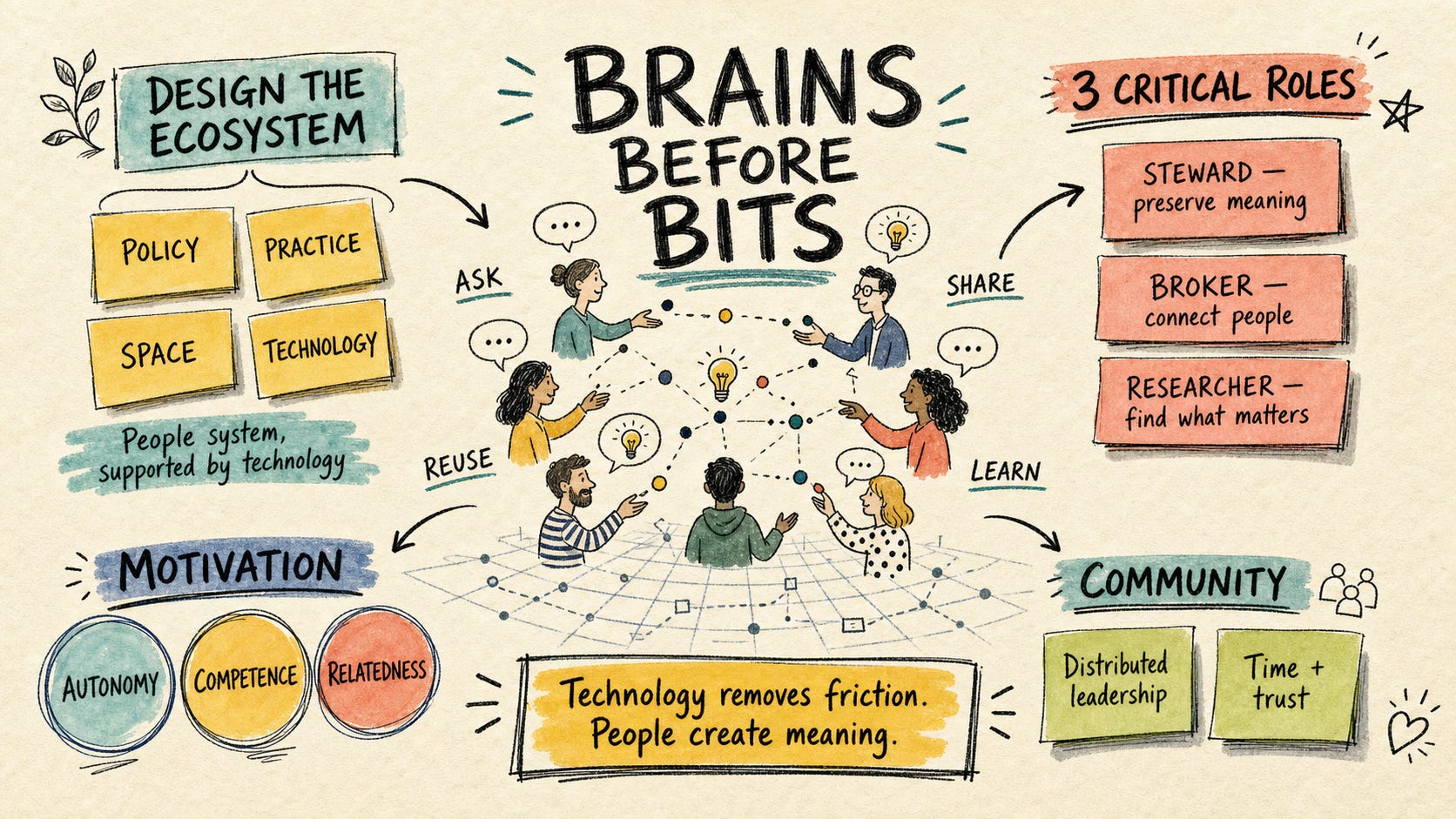
Stan Garfield’s KM framework identifies eleven people components that organizations should intentionally design and manage. Together, they provide a useful baseline for the human side of a KM program.
Culture is the accumulated answer to a simple question: What happens here when someone shares what they know? I see this as encapsulated in policy, practice, space, and yes, technology- not any technology, but specific technology aimed at that question.
Are people thanked or ignored? Does admitting uncertainty invite help or judgment? Are lessons from failure used to improve the system or identify someone to blame?
Posters about collaboration cannot overcome incentives, management practices, and promotion decisions that reward individual knowledge hoarding. A knowledge-sharing culture emerges when everyday behavior demonstrates that asking, contributing, reusing, and learning are valued.
KM requires people who can translate organizational goals into knowledge flows.
Their work includes setting strategy, building governance, supporting communities, facilitating knowledge capture, improving findability, measuring outcomes, and connecting KM activity to business performance.
This is not repository administration with a more fashionable title. A capable knowledge manager works across organizational boundaries and understands enough about people, process, content, technology, and change to not just hold the system together, but to inspire its use.
KM teams frequently measure what their platforms can count: page views, downloads, searches, posts, and active users.
Those measures describe activity and often fail to capture value.
Surveys and interviews can reveal whether people are finding answers faster, avoiding repeated work, making better decisions, and experiencing less frustration. They can also expose what dashboards miss: distrust of the content, difficulty knowing what is current, reluctance to ask questions, or the belief that contributing is someone else’s job.
The most useful survey question may be the simplest: What gets in the way of doing your work?
The organization chart shows reporting relationships. It does not show how knowledge actually moves.
Employees rely on informal networks of trusted colleagues: the person who remembers why a decision was made, the veteran who knows which procedure does not work in practice, or the connector who can locate an expert in another part of the organization.
KM should make these networks easier to navigate without trying to bureaucratize every relationship. Social and organizational network analysis can help identify connectors, isolated teams, overburdened experts, and dangerous single points of dependency.
Communities of practice bring together people who share a professional domain and want to improve their practice.
A good community is not merely a distribution list or a monthly presentation. It is a place where members can compare experience, solve problems, develop shared approaches, and gradually expand the organization’s collective capability.
Communities need a clear domain, an active core group, useful activity, and enough autonomy to respond to members’ needs. They also require time. A community cannot thrive indefinitely on volunteer labor squeezed into the margins of the working day.
See for more:
KM training should teach more than which button to press to assign metadata.
Employees need to know how to formulate a useful question, identify reusable knowledge, distinguish evidence from opinion, document context, assess the credibility of a source, and adapt someone else’s experience to a new situation.
In an AI-enabled workplace, these capabilities become even more important, not less. Employees must be able to ask questions with intent, evaluate generated answers, inspect sources, recognize uncertainty, and know when human expertise is required.
People need concise guidance explaining how the KM environment works.
This includes overviews, contribution standards, governance policies, role descriptions, templates, and practical “how-to” material. Documentation should answer the questions users actually have, in language they recognize, at the moment they need help.
The irony of unreadable KM documentation should not be lost on us.
In the world of AI, this is a perfect starting point for a partnership. The KM team can reimagine their content for AI ingestion. They will find this is not a trivial activity. That experience can then be applied to other projects as they help teams ready their knowledge content for easier and more accurate generative AI retrieval.
KM must be continually explained through examples of value.
A successful communication program does more than announce features. It tells stories: how one team reused another team’s work, how an expert connection prevented a mistake, how a community shortened the learning curve, or how a captured lesson changed a decision.
These stories make an abstract capability concrete. They also help employees see KM as part of the work rather than another corporate program competing with it. And they help those holding the budget strings think twice, especially when the story includes real numbers for savings or new revenue.
Search is not always enough.
Sometimes the seeker does not know the correct terminology. Sometimes the knowledge is fragmented. Sometimes the answer exists only in someone’s experience. A knowledge help desk, “ask the expert” service, or research function can turn a dead end into a useful connection.
The goal should not be to answer every question centrally. It should be to ensure that questions reach the right content, community, or person—and that recurring questions improve the knowledge environment.
Again, this is a great place to start with AI. Learn how to teach AI to answer these questions effectively. That doesn’t mean the help desk gets retired, just that the people can focus on better answers and tackle emergent questions for which no documentation yet exists.
KM goals should describe changes in organizational performance and behavior, not simply the production of content.
Useful measures might include time saved locating expertise, reduction in repeated mistakes, speed to competence for new employees, reuse of proven practices and the related increase in quality, response time to questions, or the number of decisions improved by access to prior experience.
Counting contributions is easy. Demonstrating that knowledge changed an outcome is harder—and much more important.
Recognition matters, but incentive design requires care.
If employees are rewarded for the number of documents they upload, the organization will receive more documents. It may not receive more useful knowledge.
Recognition should emphasize usefulness, reuse, responsiveness, mentoring, and contribution to collective outcomes. It can be formal, but often the most powerful reward is professional reputation: becoming known as someone who helps others succeed.
Garfield’s eleven components form a strong structural foundation. But structure alone does not fully explain who performs the work, why people participate, or how human systems remain healthy over time. Three additional dimensions complete the picture.
“Knowledge manager” is often used as an umbrella term for very different kinds of work.
Research associated with IBM’s early knowledge-management programs distinguished among several forms of knowledge intermediation. Three are especially useful when designing KM roles.
Knowledge stewards capture, organize, maintain, and improve knowledge assets.
They interview experts, observe work, facilitate after-action reviews, identify reusable practices, and turn experience into forms other people can understand. They also ensure that important material has an owner, context, review date, and retirement path.
Their job is not simply to collect information. It is to preserve meaning.
Some knowledge is too contextual, nuanced, or “sticky” to be separated from the person who holds it.
Knowledge brokers connect people rather than attempting to document everything. They understand enough about the organization to recognize who should speak with whom, make the introduction, and help frame the exchange.
Their product is not a document. It is a productive conversation.
Knowledge researchers find and synthesize information in response to a need.
They search internal and external sources, evaluate credibility, identify emerging developments, and push relevant intelligence to decision-makers. Librarians, competitive-intelligence professionals, and information specialists often perform this role particularly well. In a corporate setting, librarianship, competitive intelligence, and information research should be explicitly connected to the organization’s KM operating model.
These three archetypes support different movements of knowledge:
Stewards move knowledge from people into durable assets.
Brokers move knowledge between people.
Researchers move relevant information toward a problem or decision.
Expecting one generic “KM person” to perform all three functions equally well usually leads first to role-design failure, and then failure of the knowledge management system that poor person was expected to support.
Organizations often assume that people will share knowledge if they are instructed, reminded, or rewarded.
Human motivation is more complicated.
Self-determination theory offers a useful lens. It suggests that people are more likely to sustain a behavior when three psychological needs are supported: autonomy, competence, and relatedness. Research applying the theory to knowledge sharing similarly points toward the importance of self-directed, internalized motivation rather than mere compliance.
For KM, that means:
Autonomy: Give people meaningful choice in how they contribute. Do not turn every insight into a mandatory form with nineteen required fields.
Competence: Help employees feel capable of contributing something useful. Provide examples, coaching, templates, editorial support, and constructive feedback.
Relatedness: Make contribution part of belonging to a professional community. People share more readily when they trust the audience and believe their contribution will help someone they recognize.
This does not mean abandoning goals or recognition. It means avoiding incentives that crowd out the reason people most want to share: to solve a problem, help a colleague, improve the practice, and be valued for what they know.
A points system may produce activity. Purpose produces commitment.
Communities of practice are often described as self-organizing. This is sometimes misinterpreted to mean self-sustaining.
They are not the same thing.
Healthy communities require leadership, but not necessarily traditional hierarchical leadership. The European Commission’s Communities of Practice Playbook, for example, emphasizes both internal community leadership and organizational sponsorship.
Several roles are usually present:
A sponsor creates legitimacy, protects time, and removes organizational barriers.
A community leader or coordinator connects members and maintains momentum.
A core group shares responsibility for direction and programming.
Subject-matter experts deepen the practice.
Connectors bring in people and ideas from adjacent networks.
Members move between peripheral and active participation as their needs and circumstances change.
Leadership should therefore be distributed and dynamic. The person who convenes the community does not have to provide all its expertise. The most active members today may become less active tomorrow. New leaders should be cultivated rather than treating the founding coordinator as a permanent source of energy.
A community is resilient when leadership can circulate.
The temptation at this point is to turn the people ecosystem into another large implementation program.
I would start smaller.
Choose a business problem where knowledge matters: onboarding, customer escalation, proposal development, equipment maintenance, product delivery, or the loss of experienced employees.
Map what currently happens.
Where does the question begin? Who is asked? What can be found? Where does the process stall? Which expert becomes a bottleneck? What is repeatedly recreated? What knowledge disappears when the work ends?
This gives the KM effort an operational purpose. Interestingly, this is the same advice I give to organizations seeking to create and deploy AI-powered agentic workflows. Agents become another tool that can shape the design, not a replacement for the documentation or the workflow.
Decide who will steward critical knowledge, broker connections, conduct research, lead communities, sponsor the effort, and maintain the supporting environment.
Give these roles explicit time and authority. “Do this when you can” is not a role description.
Make it safe to ask questions and admit uncertainty. Reduce the effort required to contribute. Provide editorial and facilitation support. Show employees where their contributions were reused.
Most importantly, ensure that managers do not publicly endorse knowledge sharing while privately rewarding only individual utilization and delivery.
Combine system data with interviews, surveys, stories, and operational measures.
Watch what people do when they need an answer, not only what they say they do. Repeated workarounds are not user failures. They are design evidence.
Once the knowledge flow, roles, and behaviors are understood, technology choices become clearer.
The organization may need better search, a community platform, an expertise locator, workflow integration, knowledge analytics, or an AI assistant. But the tool is now being selected to support an ecosystem, not being selected as the framework for defining a new ecosystem forced on users by the tool’s capabilities.
Leaders who want a knowledge-sharing organization should ask themselves:
Do people have time to share and reuse knowledge?
Is asking for help treated as responsible behavior?
Are experts rewarded for enabling others, or only for their individual output?
Can employees locate a person when the answer cannot be documented?
Does important knowledge have a steward?
Do communities have active leadership and sponsorship?
Are lessons used for learning or blame?
Are KM measures connected to business outcomes?
Would employees still participate if the points, badges, and campaigns disappeared?
The answers reveal more about KM readiness than a technology inventory ever will.
The central lesson is simple: knowledge does not flow because a platform exists. It flows when people have a reason to share, a safe place to do it, a practical way to connect, and evidence that their contribution matters.
The future of knowledge management will undoubtedly include more powerful search, analytics, automation, and artificial intelligence. But these technologies will amplify the knowledge environment they are given.
If that environment is fragmented, distrustful, and poorly maintained, AI will make the fragmentation easier to query, but it will not return better answers.
If it is connected, curious, well-stewarded, and generous, technology can amplify the accumulated knowledge.
Perhaps the path is not really from bits to brains. It runs in the other direction. Knowledge begins with people—with their experience, judgment, relationships, and questions. Technology can capture and amplify some of it, but the sequence matters.
Brains before bits.
No posts
Comments
Nothing yet. Say the first thing.
Sign in to join the conversation.