
Hello, if this is your first time here, I’m Daniel, and I’ve spent 12 years living and working in Japan, leading Customer Experience and Conversational AI for some of Japan’s biggest companies. I write about what gets lost when technology moves fast, and what Japanese service culture can teach us about bringing it back.
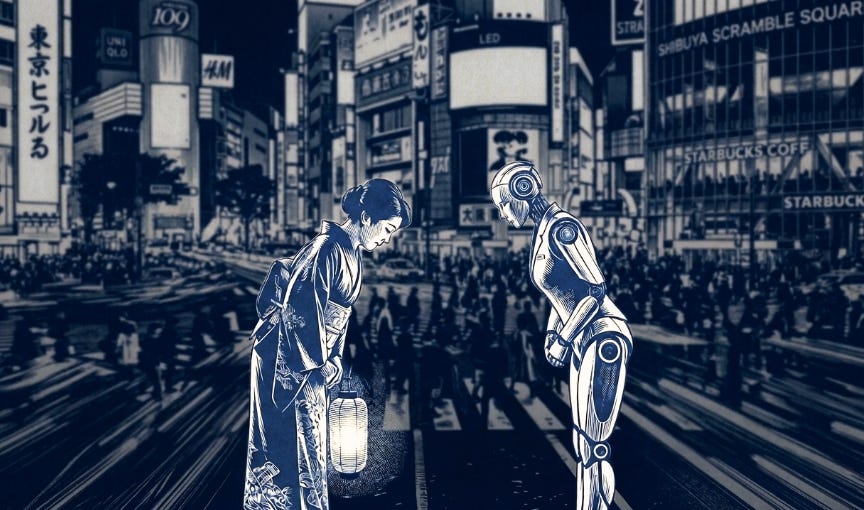
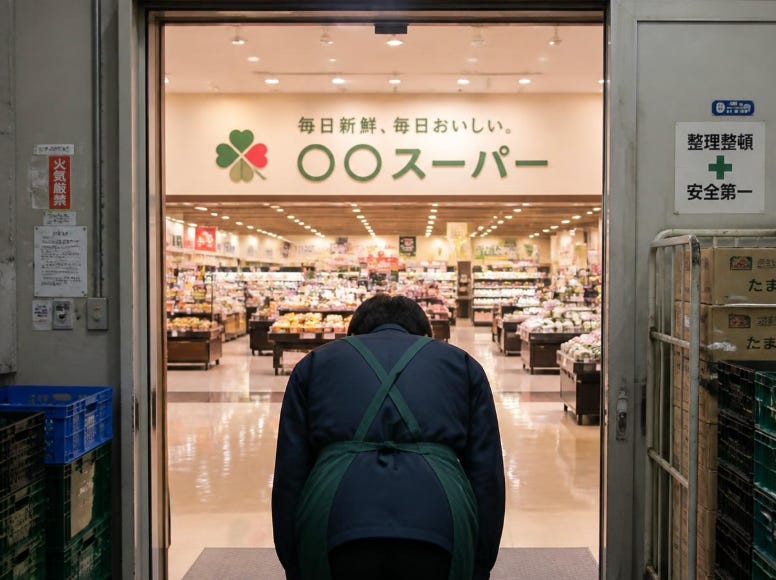
It was my first week working inside a Japanese supermarket when my supervisor stopped me at the warehouse entrance.
“You have to bow,” she said.
I looked around. The warehouse was empty. There were no customers, no colleagues, and no one watching.
“To who?” I asked.
“To the genba [the supermarket floor],” she said. As if that explained everything.
It didn’t. Not yet.
I bowed anyway, not entirely sure what I was doing.
And then I bowed again on the way out. Every time. Empty room or full room, it didn’t matter. I always bowed regardless.
It took me a while to understand what I was actually being taught. It wasn’t a ritual. It wasn’t politeness for its own sake. It was something much more fundamental, that care is not a performance for an audience. It is a standard you hold whether anyone is watching or not.
That single moment in an empty warehouse explains more about what is broken in AI customer experience than any research paper I have ever read.
AI shows up when you trigger it. It responds when asked, deflects when it can, and does nothing in between. There is no bow to an empty room. There is no standard that exists when nobody is watching.
With AI, we fixed the efficiency problem. Then we broke something else.
I have been living in Japan for over twelve years. And every time I look for the answer to what we broke, I find it in the same place. Not in a better model. Not in a smarter prompt.
In a Japanese philosophy that has been thinking about the human side of service for centuries, long before any of us had a chatbot to complain about.
It’s called omotenashi. And I think it’s the missing piece.
Here’s what’s interesting about Japan: this culture has been grappling with a version of the human-service problem for centuries. Not through technology, but through a set of deeply held values about what it means to truly serve another person, values refined through generations of practice in hospitality, retail, and everyday interaction.
Omotenashi is often translated as “Japanese hospitality,” which I believe undersells it. It isn’t about being polite or following a script. It’s a philosophy that places the other person’s experience at the absolute center, not their transaction, not their ticket, not their query. The person.
To be clear: Japan is not a frictionless service utopia. Anyone who’s tried to cancel a contract here, navigate a bureaucratic form, or deal with a system that cannot deviate from its rules knows that rigidity is real. Japan can make you feel very processed when processes are involved.
But underneath the rigidity, there is an orientation, particularly in human service interactions, toward the other person’s well-being that goes beyond efficiency. That’s the part worth paying attention to. And it’s exactly what AI keeps leaving out.
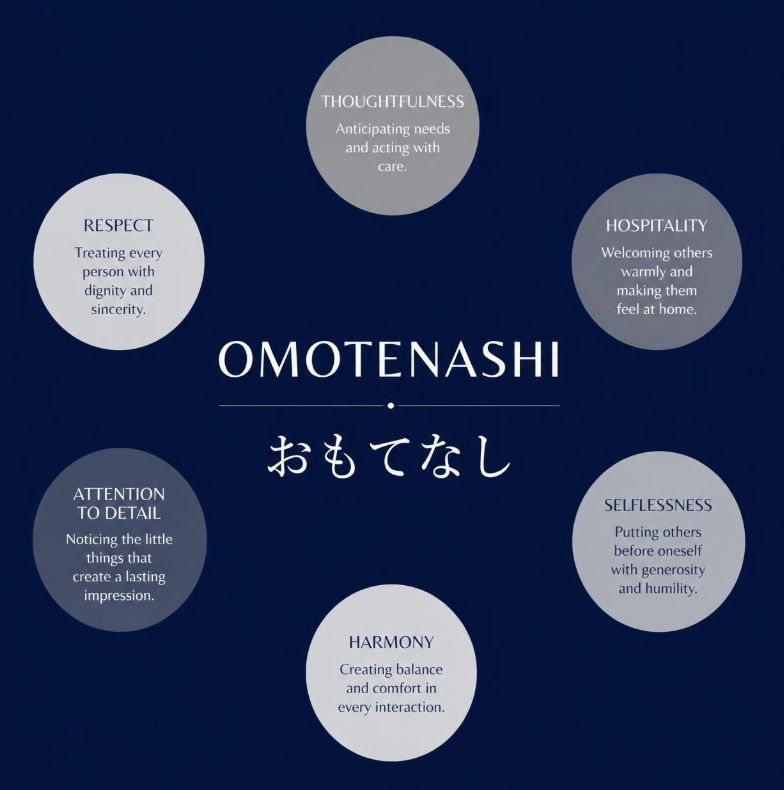
Below I explore 3 of the main principles that drive Omotenashi that I always think back to when I see that AI went wrong:
Kikubari is the practice of noticing what someone needs before they ask. In a traditional Japanese inn, your tea appears just as you’re thinking about wanting it. In customer experience terms, it means reaching a customer before they have to file a complaint. Today’s AI is almost entirely reactive, it waits for input. Kikubari is proactive. It asks “what will this person need next?” not “how do I respond to what they just said?”
In Japan, the care given to a space before a guest arrives matters as much as the interaction itself. The temperature of the room, the placement of an object, what’s visible and what isn’t. In digital terms, this is the difference between an AI that technically answers a question and one that makes the entire interaction feel effortless. It shows up in edge cases handled gracefully, in context remembered across channels, in a system that doesn’t make you repeat yourself.
Literally “reading the air.” Japan has a deep cultural practice of sensing the emotional state beneath an interaction, the hesitation, the frustration hiding inside a polite phrase, the thing someone needs but hasn’t found the words for yet. Most AI treats an angry customer and a calm one with exactly the same cadence. That’s not a technical limitation anymore. It’s a design choice. And it’s the wrong one.
In the next three articles, I’m going to take each of these values, go deep, and provide practical frameworks for anyone building or leading customer experience in the age of AI.
What does it actually look like to design for kikubari? How do you build shitsurai into a conversational system? And what would it mean for an AI to genuinely read the air?
Technology nowadays is impressive. What it’s missing is an orientation toward the person, not the ticket.
We have the speed. What we need now is the soul.
End.

This is the first article in a series about Omotenashi and how this Japanese customer service philosophy can be the answer to a more human-centric AI. If you want to follow where it goes, subscribe below, and you won’t miss the next one.
In the meantime, these articles might be worth your time:
Or we can also connect on LinkedIn. I talk about these topics there too.

Comments
Nothing yet. Say the first thing.
Sign in to join the conversation.