
Japan is famous for having the best customer service in the world. So why does it score -52 on the global NPS ranking, the lowest of any country studied? I've spent 12 years leading CX in Tokyo, and the answer changed how I think about everything.

In Japan, there is a phrase that shapes every service interaction before it even begins: okyakusama wa kamisama desu. The customer is God.
Not “the customer is always right,” which is a business policy. Not “customer satisfaction is our priority,” which is a corporate value statement. God. A word that carries completely different weight, and signals something about how Japanese service culture was built from the ground up, not as a competitive advantage, but as a philosophy.
If you have visited Japan, even as a tourist for a week, you have probably felt this. The department store staff who bows as the elevator doors close, whether or not anyone is watching. The konbini cashier who places your change in your hand with both hands. The restaurant that brings you a warm oshibori towel before you have had a chance to ask for anything. Small moments, each unremarkable on their own, that accumulate into something you struggle to describe when you get home.
“Japanese service doesn’t ask what you need. It tries to know before you do.”
I have lived and worked in Tokyo for over twelve years. I have led customer experience teams and spoken internationally about what Japan understands about service that most global companies miss. And I still get surprised. Not because the service is always perfect (anyone who has tried to open a bank account here will confirm that) but because the intention behind it is so consistent that even the imperfections feel considered.
So the question I want to explore in this article is both simple and important for anyone building products or services in Japan: are Japanese customers actually as demanding as the reputation suggests? What does the data tell us that the reputation alone doesn’t? And what does Omotenashi (Japanese Customer Service) have to do with this?
Here is a data point that stops most CX professionals when they first see it.
Japan’s Net Promoter Score, the widely used metric where customers are asked how likely they are to recommend a company to a friend, sits at -52. That is not a typo. According to SurveyMonkey’s global NPS study, which surveyed consumers across nine countries, Japan sits at the very bottom of the global ranking. Brazil leads with a score of +62. India follows at +51. Japan, the country globally celebrated for its service culture, scores lower than every other nation in the study by a wide margin.
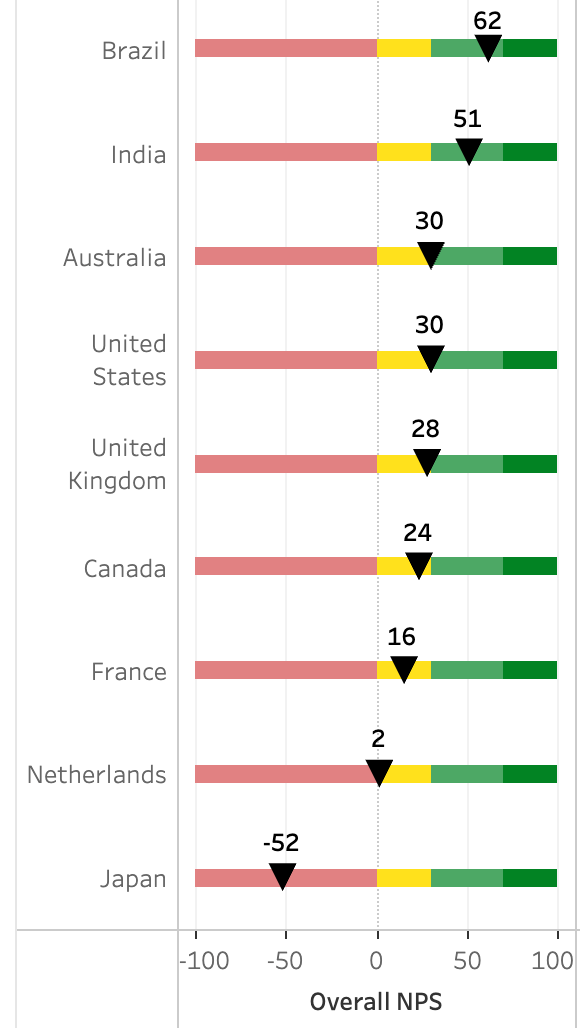
By any conventional benchmark, that score would trigger an emergency board meeting.
So is Japanese customer service actually terrible? Obviously not. The explanation is cultural, and understanding it is one of the most important things any global company entering Japan can do.
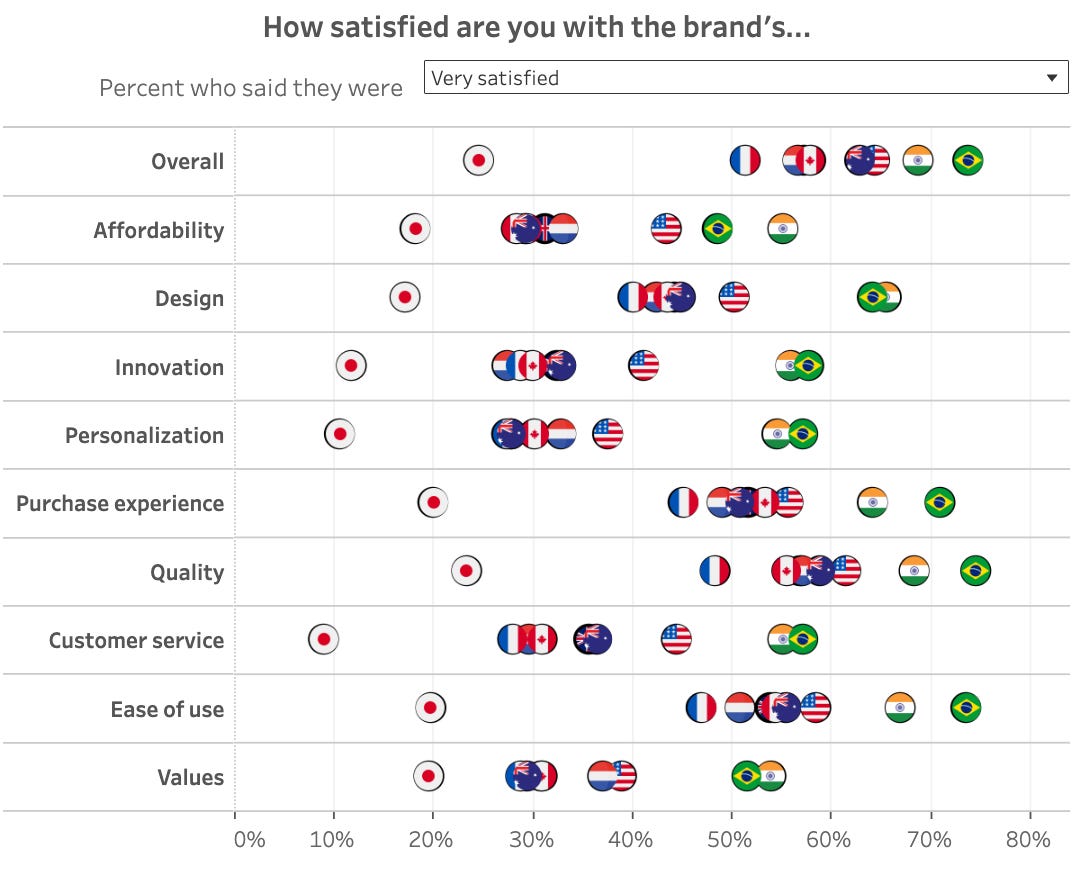
Based on the same study by SurveyMonkey, Japan consistently shows the lowest scores when asking customers about their satisfaction on different aspects of the Customer Experience.
HubSpot’s research on international NPS puts it like this:
“In Japan, it is considered poor etiquette to rate any provider too highly or too poorly, regardless of their performance.”
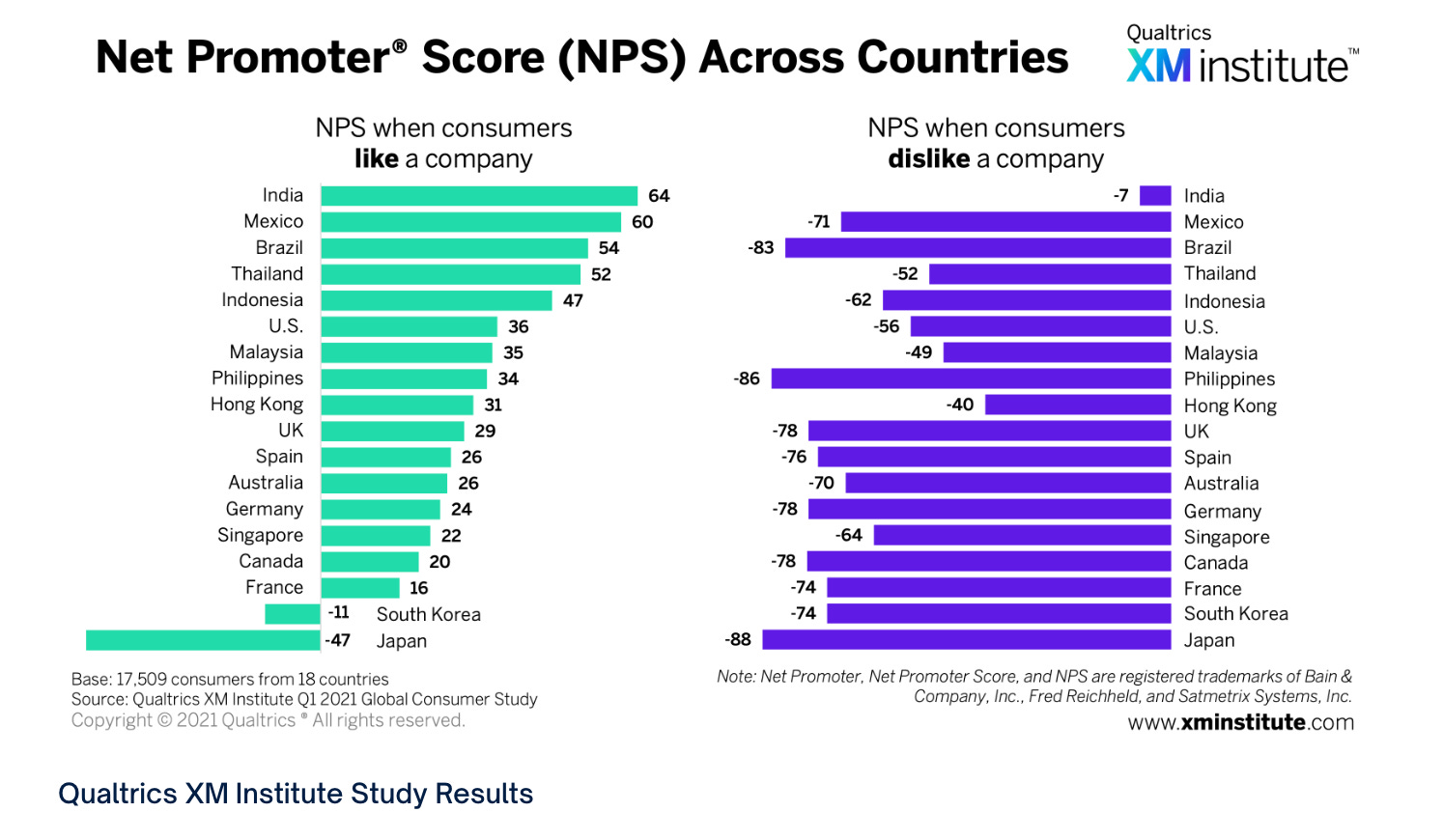
And other analysis, this time from Qualtrics, also shows Japan as the country with the lowest NPS on average.
Japanese consumers tend to answer surveys the way they navigate most social situations, carefully, modestly, and without extreme positions in either direction.
This is not just a quirk. It is deeply structural. As Wayfinder Japan’s analysis of Japanese survey behavior explains, Japanese respondents tend to anchor their answers toward the middle of any scale, because they compare their response to what they think others would say. The same phenomenon appears in restaurant reviews: on Tabelog, Japan’s most trusted dining platform, 97% of restaurants score 3.5 or below out of 5, and only the top 3% reach between 3.5 and 4. A 3.8 on Tabelog signals exceptional quality. The same score on Google would make you wonder if the kitchen had an off day.
“If you measure Japanese customers with Western tools, you will always misread them.”
The SurveyMonkey study reinforces this, noting that fewer than one in three Japanese consumers share about their purchases or brand interactions publicly, compared to only 10% of consumers globally who keep entirely silent. Japanese customers process their experiences inwardly. They do not broadcast them. That makes the standard CX measurement toolkit, built around recommendations, reviews, and vocal feedback, a genuinely poor fit for this market.
Here is where the picture becomes more complicated, and more consequential.
Japanese customers are not loud complainers. They do not leave aggressive reviews. They do not call to escalate. As Rikkyo University researcher Shunichi Nozaki has noted, reported by NextShark, Japanese customers would rather move on to a competitor than confront a company about a poor experience. And they move on fast.
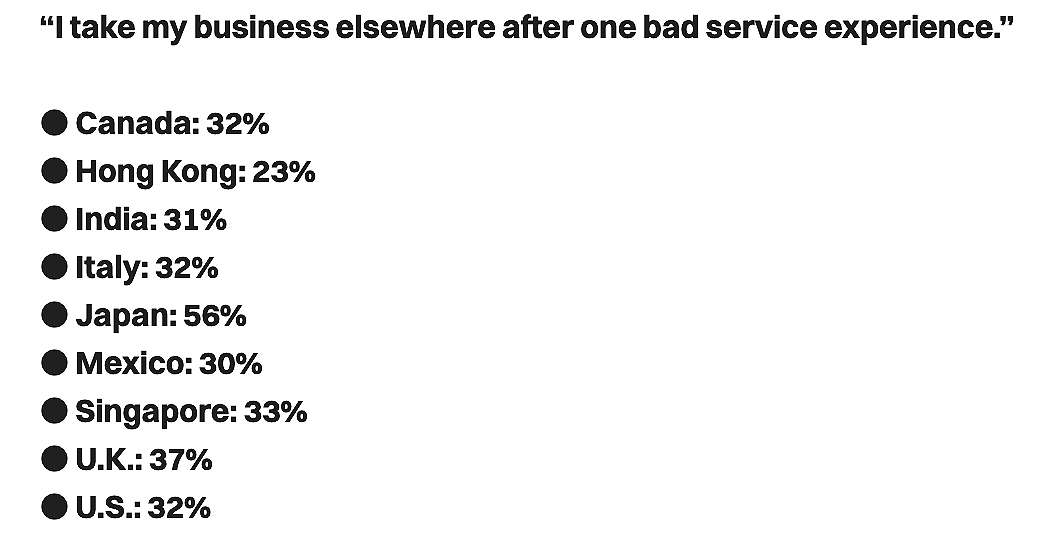
The same American Express survey reported by NextShark found that 56% of Japanese consumers said they would take their business elsewhere after just one bad customer service experience, the highest proportion of any country in the study. To put that in context: the equivalent figure for the US was 32%. For the UK it was 37%. Japan was not slightly ahead, it was in a different category entirely.
Think about what that means in practice. You will not get a warning. There will be no angry email, no escalation call, no one-star review explaining exactly what went wrong. The customer will simply not return. And because Japanese culture values discretion, they probably will not tell anyone else why either, at least not publicly.
“The most dangerous customer in Japan is not the one who complains. It’s the one who doesn’t.”
There is one more layer worth understanding here. The same Wayfinder Japan analysis points out that Japan showed the smallest gap in NPS between companies that are liked and companies that are disliked. Elsewhere in the world, there is a dramatic difference between how people rate brands they love versus brands they tolerate. In Japan, that gap is narrow. Customers hold back both the enthusiasm and the frustration. What this means for businesses is that there are very few visible warning signs before a customer quietly exits for good.
Have you ever left a brand in Japan without saying why?
So if Japanese customers are difficult to read, quiet when unhappy, and quick to leave, what do they actually respond to positively?
The answer from the data is consistent, and it is not what most technology companies prioritize when they build for efficiency.
A Genesys survey of 5,000 consumers across six countries, including Japan, Germany, the US, the UK, Australia, and New Zealand, found that a full third of Japanese respondents believed customer service had become less personalized in recent years. That was the highest proportion of any country surveyed. While German and British consumers largely felt service had improved with technology, Japanese consumers felt it was moving in the wrong direction.
On empathy specifically, the Genesys study found that only 40% of Japanese consumers said the companies they deal with show genuine empathy when resolving issues. The US figure was 58%. In a country where empathy is not considered a differentiator but a baseline expectation, that gap is not small.
This has direct consequences for AI deployment. An article on Japanese customer support culture from Delight notes that Japan has historically shown slower adoption of automation in customer service precisely because of this emphasis on retaining the human touch. A chatbot that resolves queries efficiently but feels cold or scripted is not seen as a neutral tool in Japan. It is experienced as a step backwards from what the customer expected.
“In Japan, efficiency without warmth is not service. It is just processing.”
And because Japanese customers won’t complain when a service falls short of their expectations, they will simply leave, a poorly implemented AI solution creates a particularly dangerous situation: invisible, silent churn that is nearly impossible to diagnose after the fact.
All of this data points back to a single concept that has no direct translation in English, and that is precisely why it is so often misunderstood by companies entering Japan.
Omotenashi.
It is usually translated as Japanese hospitality, but that flattens it considerably. It is more accurate to describe it as the practice of anticipating what someone needs before they know they need it, and delivering it without expectation of recognition or reward. No transaction. No performance review. No feedback survey. Just genuine care expressed through sustained attention.
It is why the train conductor bows to an empty carriage. Not because it is in the service manual. Because it reflects who they are.
Japanese service prioritizes building trust and fostering long-term relationships through empathy and thorough problem resolution, in direct contrast to Western approaches, which tend to focus on efficient resolution and meeting defined service level agreements.
What the data in this article reveals, taken together, is something that should inform every CX strategy built for Japan, and honestly, every CX strategy built for anywhere. Japanese customers do not loudly demand more. They quietly expect better. They will not punish you with a complaint. They will reward you with loyalty if you earn it, or remove themselves without explanation if you don’t.
“The countries building the most sophisticated AI have the most to learn from the country that never forgot the human.”
Japan is not perfect at this. Rigid processes, bureaucratic friction, and cautious digital adoption create real pain points that any long-term resident here knows well. But the underlying orientation, toward anticipation, care, and the dignity of the person being served, is something the rest of the world is only beginning to realize it needs urgently.
As AI takes over more of the surface layer of customer interaction, what remains distinctly human becomes not a soft add-on but a competitive necessity. Japan has been practicing that for centuries. The rest of us are still figuring out what we gave away.
Now the natural question we can ask ourselves is:
So what?
If I am a company considering providing services to the Japanese market and providing an AI that will directly face customers, what does it mean to know that Japanese customers will be more demanding and have high expectations? How can you prepare for it?
This, exactly, is what we will be exploring in the next articles.
Hello and thanks for reading. If this is your first time here, I’m Daniel, and I’ve spent 12 years living and working in Japan, leading Customer Experience and Conversational AI for some of Japan’s biggest companies. I write about what gets lost when technology moves fast, and what Japanese service culture can teach us about bringing it back.
This is the second article in a series about Omotenashi and how this Japanese customer service philosophy can be the answer to a more human-centric AI. If you want to follow where it goes, subscribe below, and you won’t miss the next one.
In the meantime, these articles might be worth your time:
Or we can also connect on LinkedIn. I talk about these topics there too.

Comments
Nothing yet. Say the first thing.
Sign in to join the conversation.