
Greetings from finals week at John Brown University. I’m currently putting the finishing touches on my 10th year (or 20 semesters) in Northwest Arkansas, and I can confidently report that while the respite of summer is appealing, I am not looking forward to saying farewell to this class of graduating seniors. They’re a special group.
A couple of Sundays ago I was fortunate to publish an essay for The Dispatch, which they titled, “A State Church Isn’t a Panacea for Cultural Problems.” In the essay, I respond to a social media dustup over the wisdom of religious establishment, grounding my argument in social science research that clearly finds a positive relationship between religious nonestablishment and religious vitality.
I begin by referencing a story I think about quite often:
You may have heard the story of the two fish swimming along when they encounter a third fish. “Hello, boys,” the third fish says. “Nice water today.” He keeps swimming and the two fish pause, confused. One looks at the other and asks, “What the heck is water?”
This is how I describe nonestablishment and freedom of religion in the United States. We have gotten so used to the First Amendment’s positive contribution to American civic and spiritual life that we are prone to forget it, downplay it, or even wish it replaced with something different—something, we assume, better. Swimming in a sea of nonestablishment, we are fish not noticing the water around us.
Then, I turn to the research, which can be summarized as follows:
Contrary to the norm of religious establishment in many European countries, American churches and traditions have no such support or constraints. Instead, these traditions’ survival depends on how they present themselves to potential adherents. In The Churching of America, Stark and Finke argued that the religious marketplace and lack of established church in early America led to the explosion of denominations, the legacy of which we see even today. Simply put, America’s relatively flourishing religious landscape has occurred not in spite of disestablishment, but because of it.
I conclude:
It may be tempting for people of faith to look at the imperfections of nonestablishment with a yearning toward the supposed security of religious establishment; when the state is for you, one might ask, who can be against you? The scientific study of religion, along with nearly 250 years of American history, has found plenty of reasons to reject this temptation. People of faith should feel confident doing the same.
I’m including a gift link to the article here, though I’m not sure how many people can access it. Good luck, I guess?
A colleague in the discipline (Colorado State University’s Kyle Saunders) recently shared some fascinating data on the landscape of 1,500+ colleges and universities. These institutions are plotted along x- and y-axes, with the x axis measuring “institutional resilience” and the y-axis measuring “post-college market position” for graduates. “Institutions above the median on both axes are High Capacity; below both, High Stress,” Saunders writes. “The other two quadrants — Market Misaligned and Structurally Exposed — capture institutions with mixed structural positions.”
For example, here is Stanford University’s position on the graph, in green:
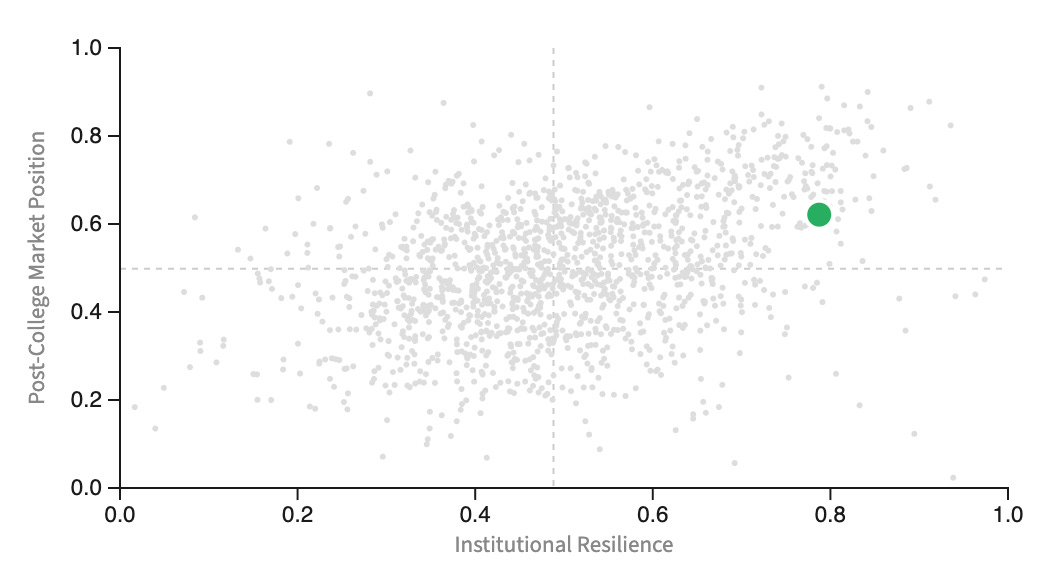
Institutions in the upper right quadrant are seen to be both institutionally resilient (in terms of their endowment, selectivity, and enrollment trends) and preparing their graduates well for their post-college careers (in terms of graduation rate, earnings potential versus debt, and exposure to AI technology), while institutions in the lower left quadrant struggle on both axes, suggesting troubling times ahead.
Of course, I looked up John Brown, and was pleasantly surprised:
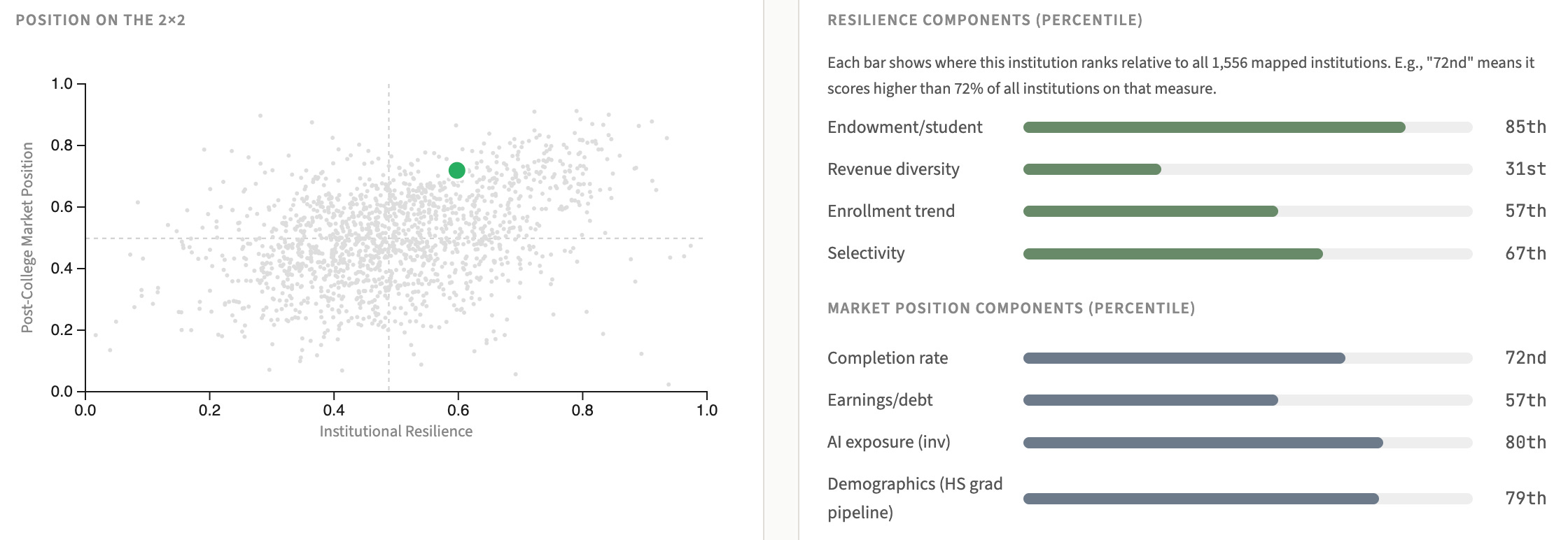
According to this data, JBU prepares students quite well for their post-college lives, and only takes a hit on the y-axis because of its “revenue diversity.”
Of course, this is just one measure and depiction of a university’s health; surely there are other considerations. Nevertheless, you can play around in the dataset and related map here — where does your alma mater or current institution land?
No posts
Comments
Nothing yet. Say the first thing.
Sign in to join the conversation.