

Optical stocks surged across the board in today’s premarket session following reports that the United States is preparing restrictions on imports of Chinese optical transceivers used in data centers.
The companies most directly exposed to the news are $COHR, $LITE, and $AAOI, which compete with Chinese suppliers in optical transceivers and critical optical components.
$FN could benefit from growing demand for optical manufacturing capacity outside China, while $MRVL supplies the optical DSPs used inside transceivers. The potential benefits for $AEHR and $POET are more indirect and longer term, through semiconductor and photonics testing for $AEHR and optical engine platforms for $POET.
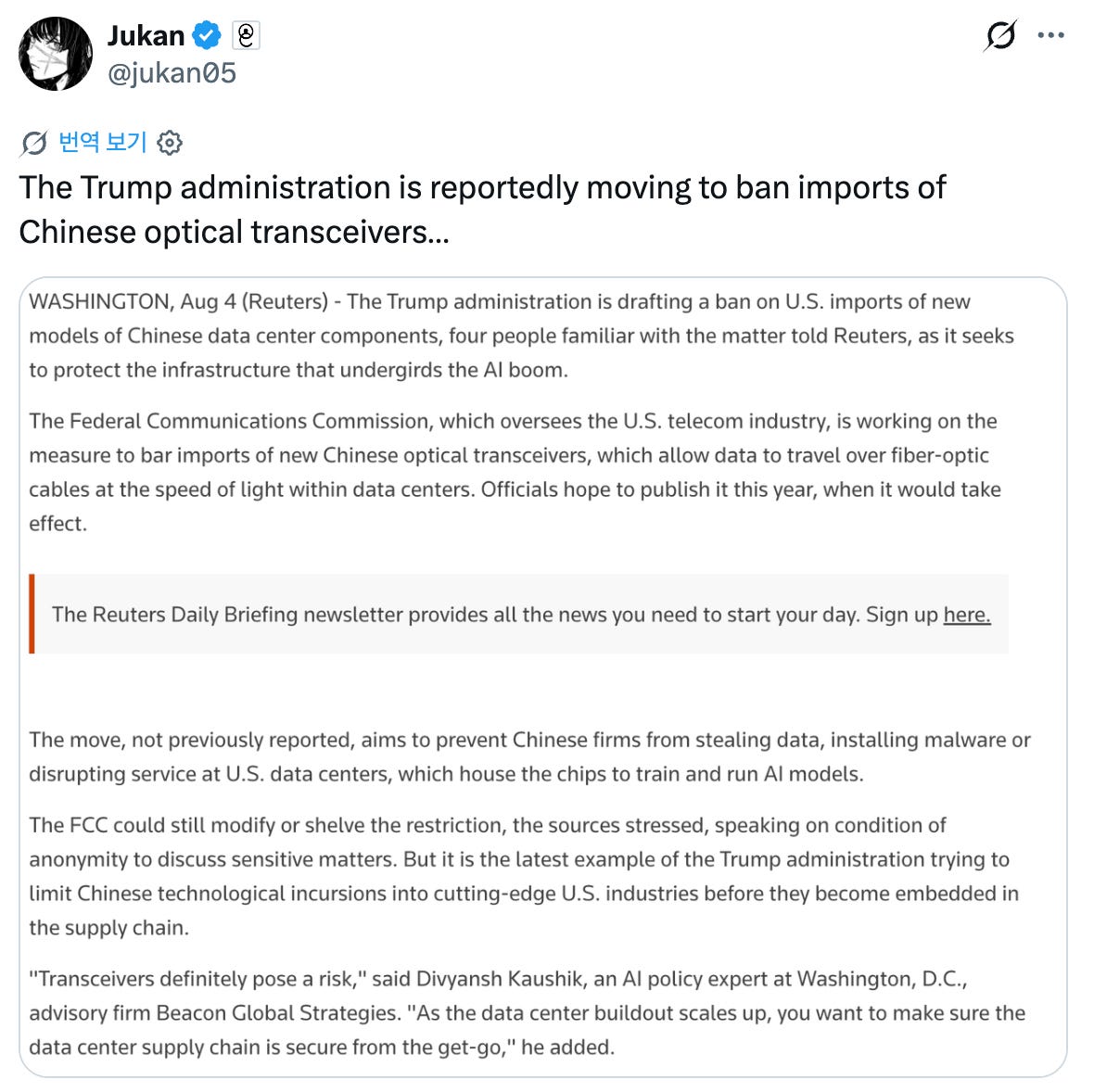
According to Reuters, the Trump administration is drafting a plan that could block imports of newly introduced Chinese data center components into the United States.
The company with the most obvious exposure would be China’s Zhongji Innolight.
Innolight is estimated to hold roughly 27% of the global market for data center optical transceivers, with approximately 90% of its revenue coming from outside China. Reuters also noted that while $COHR and $LITE possess competitive technology, they may not currently have enough capacity to replace Chinese suppliers’ total volume in a short period.
Nvidia provides a useful example.
Innolight is widely understood to be a major supplier to global AI infrastructure customers, including Nvidia and Google.
Optical transceivers are not completely interchangeable commodity components that can simply be removed and replaced with another product offering the same transmission speed. They require customer qualification, reliability testing, and compatibility validation with switches, DSPs, and broader network architectures.
Abruptly removing an already qualified supplier could delay the construction of AI clusters.
The US government is unlikely to want restrictions on Chinese supply chains to unintentionally slow data center expansion by American hyperscalers.
Given Innolight’s substantial market share, immediately banning existing products could create shortages and push transceiver prices higher because $COHR, $LITE, and other non-Chinese suppliers may not have enough capacity to replace the displaced volume immediately.
Reuters also noted that such restrictions could increase costs for US cloud providers such as AWS.
For that reason, I believe the most realistic scenario would be to allow products that have already been qualified and deployed to remain in use for a transition period, while restricting newly qualified products and future generations.
For example, instead of immediately removing every existing 800G transceiver, regulators could focus on new 800G revisions, 1.6T products, and later generations, encouraging customers to prioritize non-Chinese suppliers in new designs.
This is my interpretation based on the reported proposal, not an announced policy.
However, given the scale of the existing supply chain and the time required for customer qualification, a gradual transition beginning with new designs appears much more realistic than an immediate comprehensive ban.
I have been waiting for phase two of the optical investment cycle since $AEHR reported earnings.
Interestingly, the actual trigger was not a new optical technology announcement or a major customer order. It was a geopolitical development.
Perhaps that is not surprising.
Most market participants already understand that optical connectivity demand will increase as AI clusters become larger. The transition from 800G to 1.6T, followed by even higher transmission speeds, is not a new story.
The argument that optics, lasers, and related components could become bottlenecks in AI infrastructure is also already well understood.
The market may not have needed another explanation of why optical demand would grow.
What it needed was an event that could change which suppliers capture that demand.
This news does not create new end demand for optical transceivers by itself. Instead, it raises the possibility that some of the future volume previously expected to go to Chinese suppliers could shift toward $COHR, $LITE, $AAOI, and other suppliers operating outside China.
The market reacted more strongly to the potential redistribution of volume than to another forecast of overall demand growth.
Today’s premarket move was triggered by a policy headline.
For the rally to continue, however, upcoming earnings reports must confirm that the underlying optical market remains strong.
The first company to watch will be $AAOI, which is scheduled to report earnings on August 6.
It will not be enough for management to simply say that AI demand remains strong. Investors should look for evidence that expanded 800G and 1.6T capacity is translating into actual shipments.
It will also be important to understand how much of the company’s new capacity is being allocated to internally produced lasers and optical components versus complete transceiver modules.
Another key question is whether customers are purchasing components from $AAOI, finished transceivers, or both.
$LITE is expected to report on August 11.
For $LITE, investors should focus on whether supply remains tight for data center lasers and optical components, how quickly expanded capacity is improving lead times, and whether strong 800G and 1.6T demand is producing higher margins as well as higher revenue.
Even if transceiver assembly shifts away from Chinese suppliers, the structure of the underlying laser and optical component supply chain may not change in exactly the same way.
The company assembling the finished transceiver could change while some of the critical component suppliers remain the same. Therefore, the investment case for $LITE must ultimately be supported by higher content and stronger positioning in next-generation optical sources, not merely by a shift in final module assembly.
$COHR is expected to report on August 12.
Because $COHR is one of the companies most directly connected to the potential replacement of Chinese suppliers, investors should pay close attention to how much available capacity it has to absorb incremental orders.
Important areas include production capacity for 800G and 1.6T modules, indium phosphide lasers, customer qualification progress, backlog, and margins.
The market treated $COHR today as a potential substitute for Chinese suppliers. Its earnings report must demonstrate that the company has both the scale and execution capability to play that role.
$FN is expected to report on August 17.
For $FN, the key question will be whether customers are increasingly shifting optical module manufacturing outside China, particularly toward its production platform in Thailand.
Investors should monitor utilization rates, capacity additions, and any signs that customers are accelerating geographic diversification of their manufacturing supply chains.
If the proposed policy eventually translates into actual changes in procurement, non-Chinese manufacturing platforms capable of producing optical modules at scale should become increasingly valuable.
$MRVL is expected to report on August 27.
For $MRVL, investors should focus on shipments of 800G and 1.6T optical DSPs, as well as new design wins.
However, a shift in module production from Chinese suppliers to American or other non-Chinese suppliers does not necessarily increase the total number of transceivers required.
Investors therefore need to distinguish between a simple change in module suppliers and a more meaningful increase in $MRVL’s market share, product content, and exposure to non-Chinese customers.
No posts
Comments
Nothing yet. Say the first thing.
Sign in to join the conversation.