
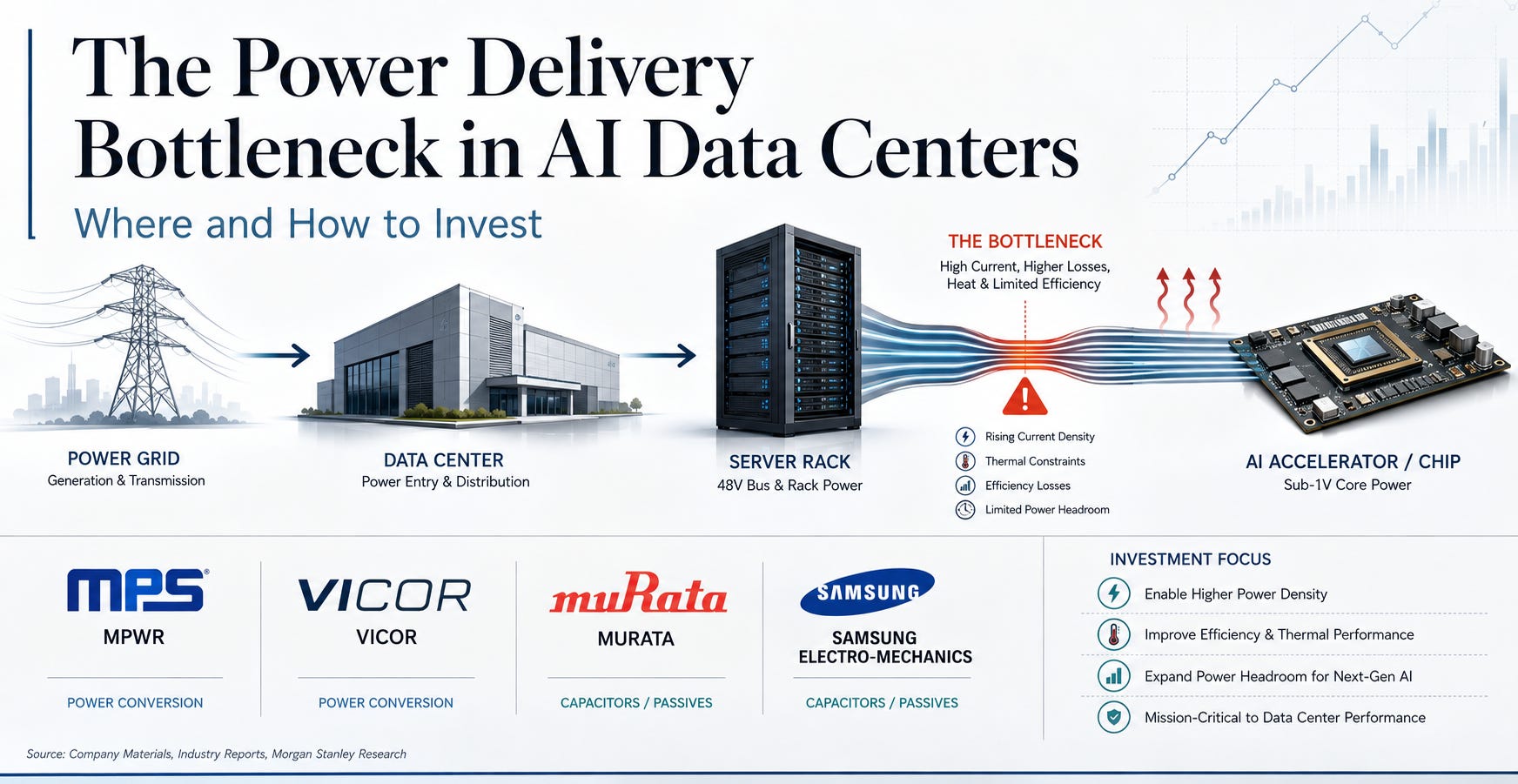
Power comes up in every conversation about AI infrastructure bottlenecks.
The problem is that it usually takes some engineering background to follow. I’ve written about power investing before, and the main thing I took away was that readers wanted the technical side explained much more simply.
So this piece does that.
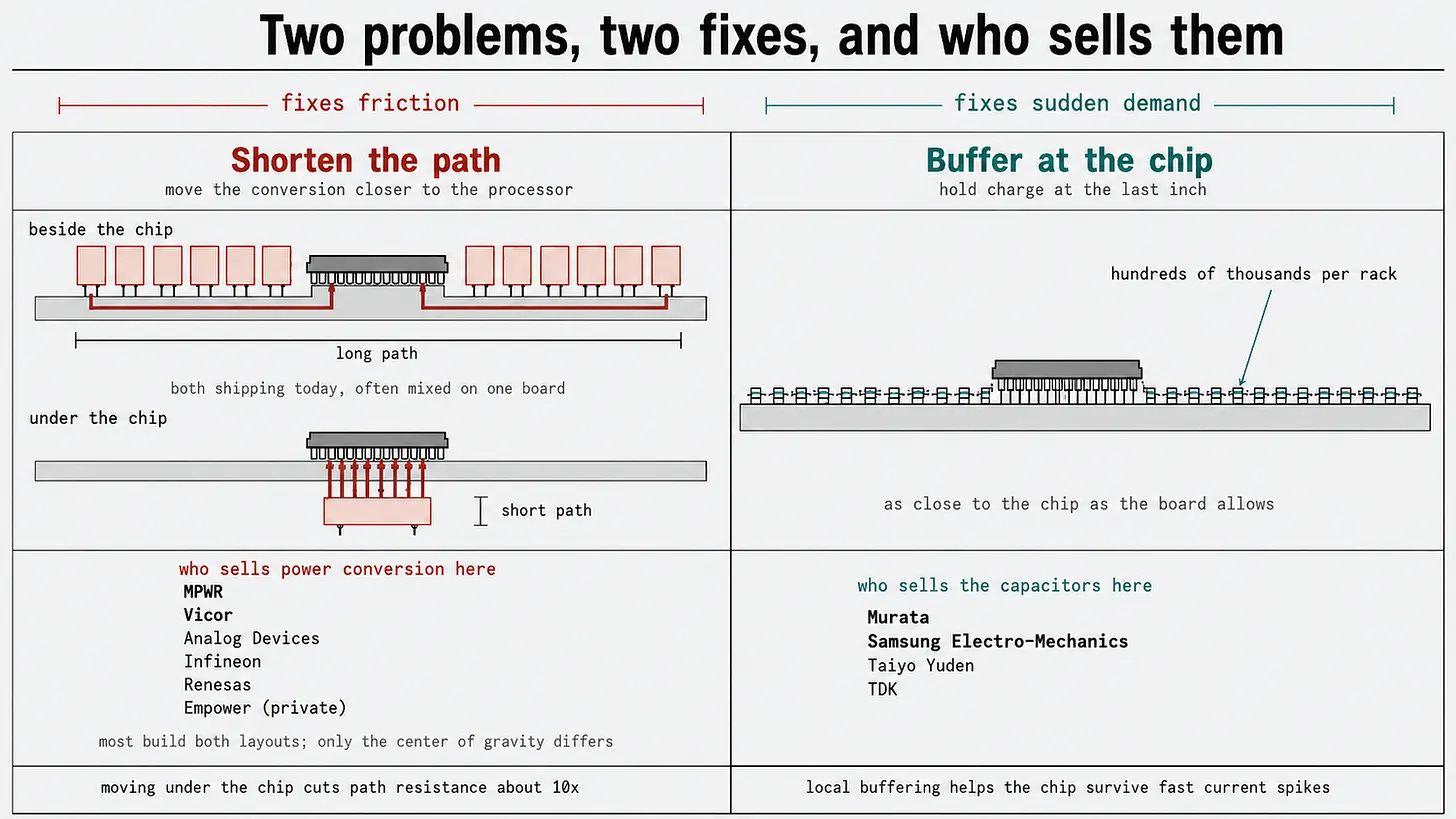
It walks through why the power delivery bottleneck exists, in the plainest terms I can manage, and then lays out how to think about the four companies closest to it: MPWR, Vicor, Murata and Samsung Electro-Mechanics. If you’ve been investing here without a clear picture of the mechanics, this should help.
Note: There’s a whole other part of the delivery bottleneck around 800VDC distribution, where 800 volts of direct current runs all the way to the rack. That’s big enough to need its own article, so I’ve left it out. I’ll cover it next time.
Disclaimer
This article is for information only. It does not recommend buying or selling any security. Investment decisions and their outcomes are the reader’s own responsibility. Figures cited are based on public sources and may have changed since publication.
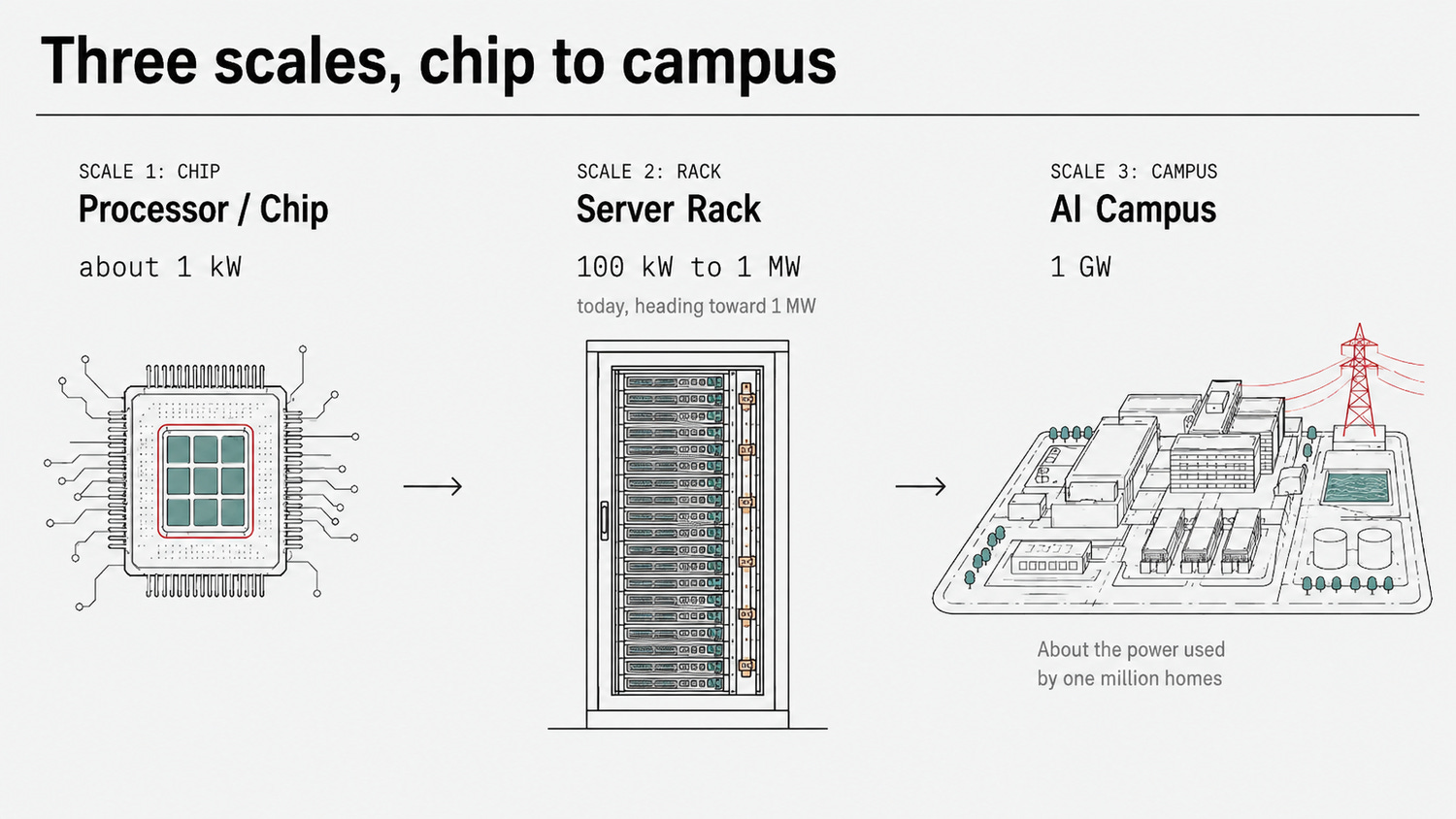
Power is measured in watts, written W. A kilowatt is a thousand watts, a megawatt is a thousand kilowatts, and a gigawatt is a thousand megawatts. For scale, the microwave in your kitchen pulls about a kilowatt.
AI infrastructure power is easiest to picture at three levels. A GPU accelerator, the part doing the computing, sits at roughly a kilowatt. A rack, the cabinet servers get stacked into, runs in the hundreds of kilowatts today and is heading toward a megawatt. A campus is measured in gigawatts. That’s what people mean when they say hyperscalers are building gigawatt data centers. A gigawatt is roughly what a million American homes use, and several AI campuses are due to hit that scale in 2026.
And the buildout keeps accelerating. When OpenAI announced Stargate, it committed to ten gigawatts of AI infrastructure by 2029. By April 2026 the company said it had already passed that, having added more than three gigawatts in the previous ninety days alone. Meta has said it will build tens of gigawatts this decade. AI data centers are about to consume a staggering amount of electricity.
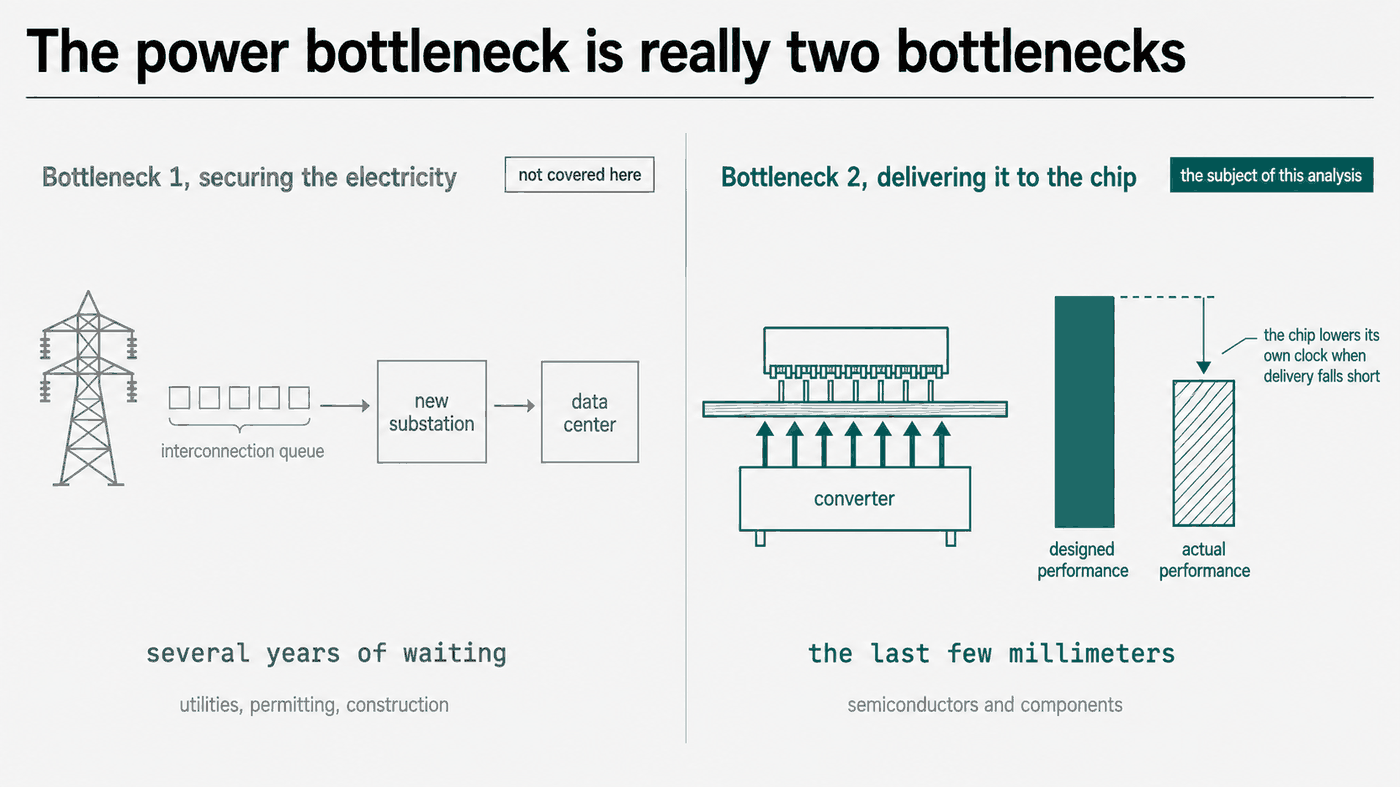
So why has power become the next bottleneck? Two very different problems get bundled under that one word.
The first is getting the electricity in the first place.
Moving power from a plant to a data center means new transmission lines and new substations, and in the US the wait just to get an interconnection approved can run for years. That’s a grid and permitting problem, and it belongs to utilities and power equipment makers.
The second is getting that electricity to the chip without losing it on the way.
A GPU can be as fast as you like on paper, but it won’t hit those numbers if the power can’t reach it cleanly. That second problem, the power delivery bottleneck inside the data center, is what this article is about.
So what does delivering power well actually mean?
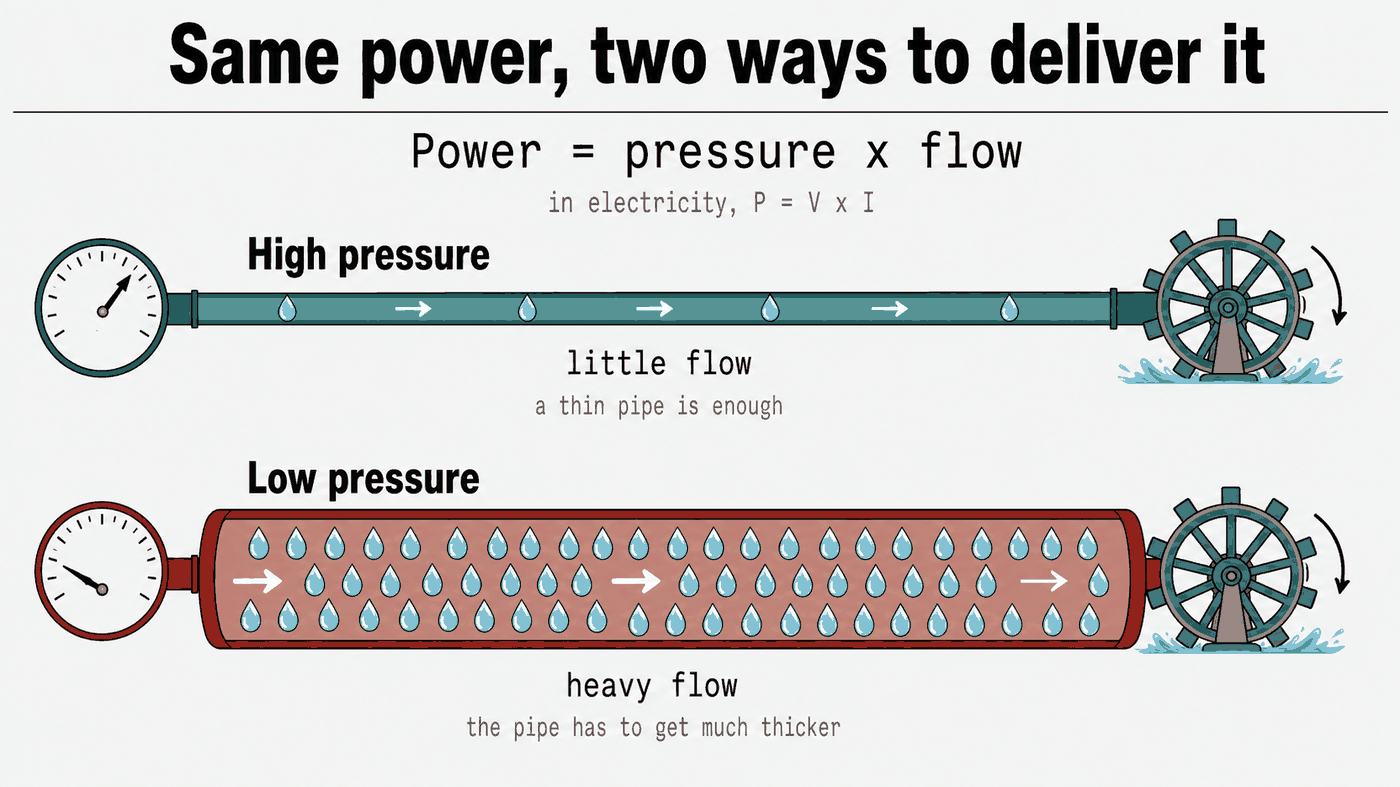
The easiest way to picture electricity, as you probably learned in school, is water moving through a pipe.
(If that’s gone fuzzy, no problem, here it is again)
Voltage is pressure.
Current is how much water is flowing.
Power is the two multiplied together, P (power) = V (voltage) × I (current).
Which means that for a fixed amount of power, higher pressure lets you move less water, and lower pressure forces you to move more.
Think about a water pipe.
To do the same job, high pressure gets by with a narrow pipe. Low pressure means pushing far more water through, and the pipe has to get much fatter to handle it.
Here’s the problem with a chip: it needs a lot of power but runs at almost no voltage.
A modern data center GPU pulls more than a thousand watts, while the voltage it actually accepts is under one volt. Pushing all that power through at rock bottom pressure sends the current into the thousands of amps. A typical home, for comparison, is served by around 200.
So what goes wrong once the current gets that high?
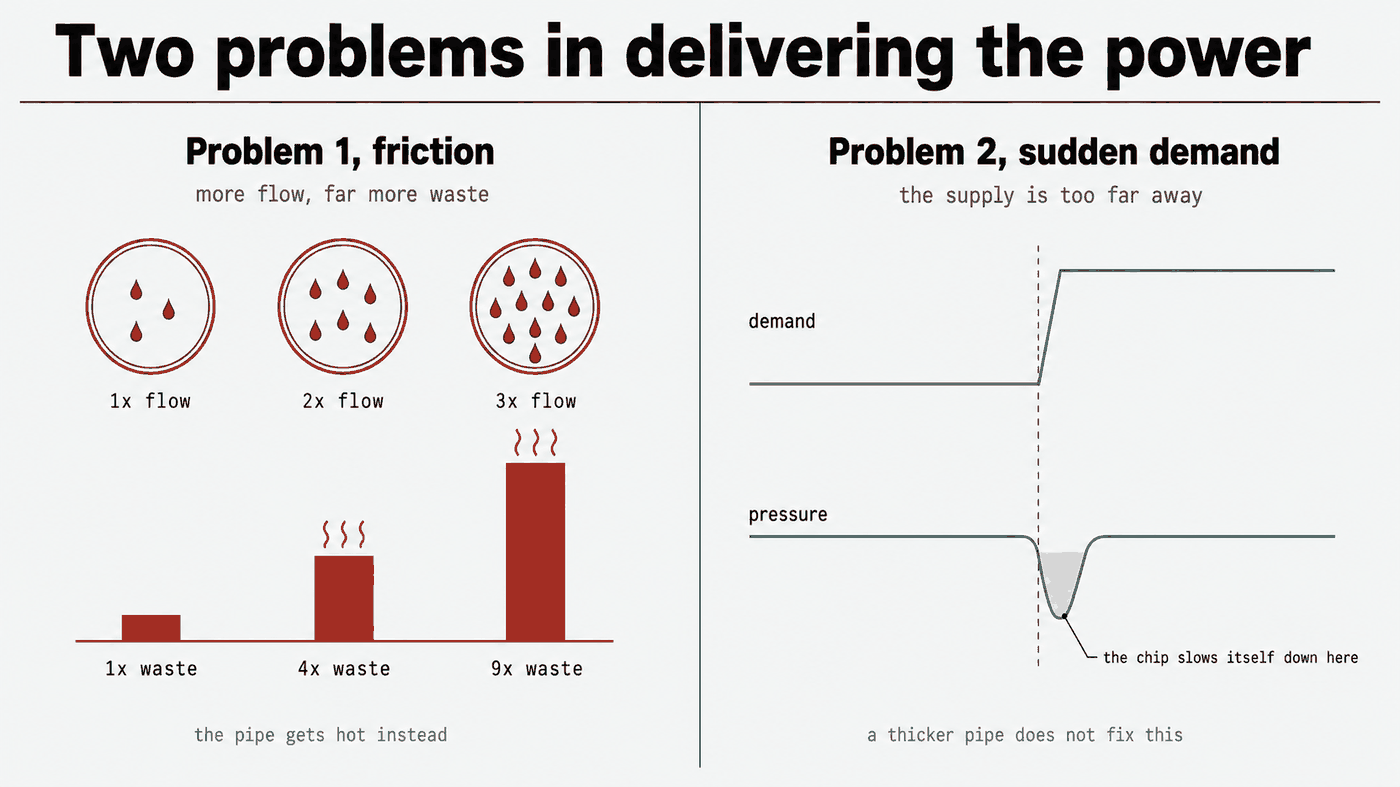
Back to the water. As it travels down a pipe it rubs against the walls, and in electricity we call that friction resistance. Pushing power through resistance costs you some of it, and the loss scales with the square of the current. Double the flow and the loss is four times. Triple it and it’s nine. Since the voltage can’t be raised at the chip, the only lever left is to make the path shorter and thicker.
Then there’s a second problem. So far we’ve assumed the water flows at a steady rate, but it doesn’t. Say you’re in the shower and the washing machine starts up while someone flushes the toilet. The amount of water being drawn jumps several times over in an instant. The water is coming from a main some distance away, so it can’t meet that demand right away, and your shower goes weak for a moment.
The same thing happens at the chip. When the compute load spikes, the current it needs jumps instantly, and a power source sitting some distance away can’t respond fast enough. The voltage sags briefly, and the chip throttles itself to avoid glitching.
Leave either problem unsolved and a good share of the power you brought onto the campus turns into heat before it ever reaches the chip. Buy all the high end GPUs you want; you won’t get the performance they were built for. That’s the power delivery bottleneck.
Comments
Nothing yet. Say the first thing.
Sign in to join the conversation.