
The biggest confusion in discussions of CPO is that scale-out and scale-up are used without distinction. With NPO added to the picture, the market’s misreadings have grown further.
I have written several articles on CPO so far. In this one I want to start by resolving this structural confusion. From there I will use my own model to examine how much room the scale-up CPO market has to be repriced, and analyze the laser names that would be repriced along with it.
Let us begin.
Contents
Pluggable, CPO, and NPO
How Long Will NPO Last
Three Misconceptions About CPO
The Real Variable Is Scale-Up
Which Laser Companies Get Repriced
Disclaimer
This material is written for informational purposes and does not recommend the purchase or sale of any security. The author may hold positions in the names mentioned, and scenario results depend on assumptions and may differ from actual outcomes.
Responsibility for investment decisions and their outcomes rests with the investor. Conduct your own research and invest on that basis.
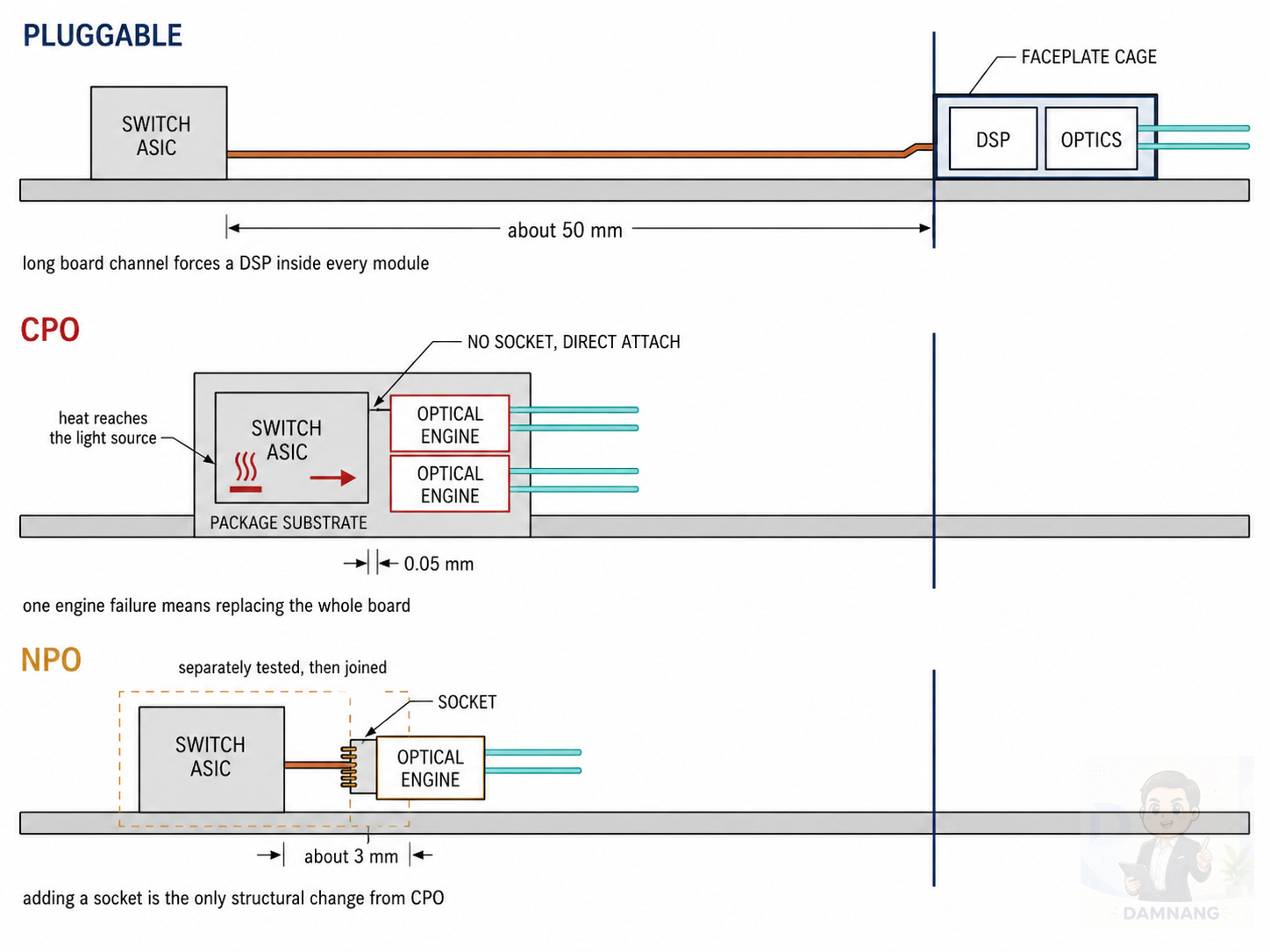
The method mainly used in optical communications today is pluggable.
Because the structure plugs an optical module into a cage on the front of the switch chassis, a failed module can be pulled and replaced in place, and the same form factor can be purchased from multiple suppliers.
The problem with pluggable, as shown in the figure, is the distance from the switch chip to the faceplate. Electrical signals become harder to maintain in waveform as they travel further, and this can lead to signal loss.
So at this stage a DSP (digital signal processor) that restores the signal is essential. Of the 15.5 watts a typical 800G module uses, 6 to 7 watts are consumed by this DSP chip, and adding the share used by the transmit circuitry on the switch chip side to drive the long board section brings the power on a single port to around 30 watts.
What is being developed to solve this power consumption is CPO (co-packaged optics),
which puts the optical components in the same package as the switch chip.
As the electrical path shortens to microns, the DSP can be removed. Power per port falls more than 70 percent versus pluggable, from 30 watts to 9 watts, and emptying the front cages also removes the limit on how many ports a single chassis can hold.
However, the disadvantages of CPO are also clear.
Because the optical engine must be attached in the same package as the switch chip, manufacturing difficulty rises sharply, and the more tightly the optical engine is integrated into the package, the larger the replacement unit becomes on failure.
To reduce this manufacturing, yield, and service burden of CPO,
the compromise that took shape alongside CPO is NPO (Near-packaged optics).
NPO places the packaged switch ASIC and the optical engine close together on a common high-performance substrate, with the optical engine configured as a separate part or a socketed module.
This allows the ASIC and the optical engine to be tested separately and then joined, and depending on the implementation, rework or replacement at the optical engine level is also possible.
The electrical path is longer than CPO but far shorter than conventional front-panel pluggable, so a significant portion of the power benefit can be secured.
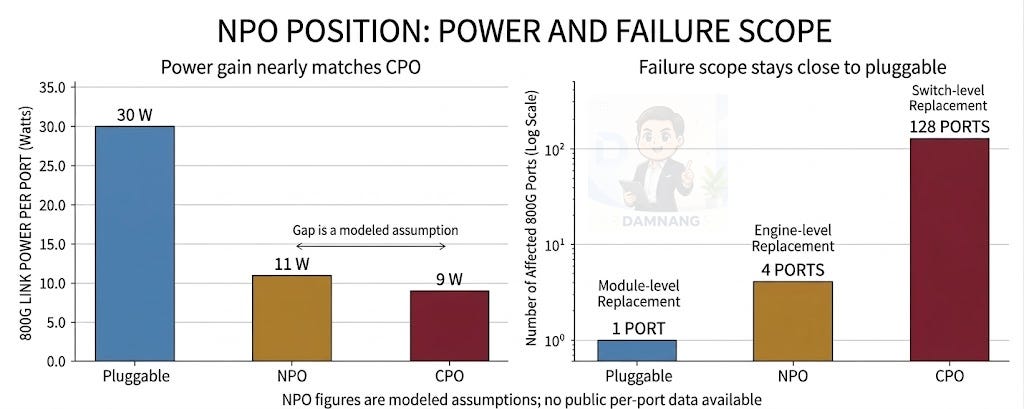
From the explanation so far, NPO looks technically better than CPO. It secures a significant portion of the power saving versus pluggable while allowing the switch chip and optical engine to be tested separately and then joined, and depending on the design, replacement at the optical engine level is also possible. It is easy to keep away from the heat source, and once a standard is established, optical engines can be chosen from multiple suppliers. So why not have every company go with NPO instead of CPO?
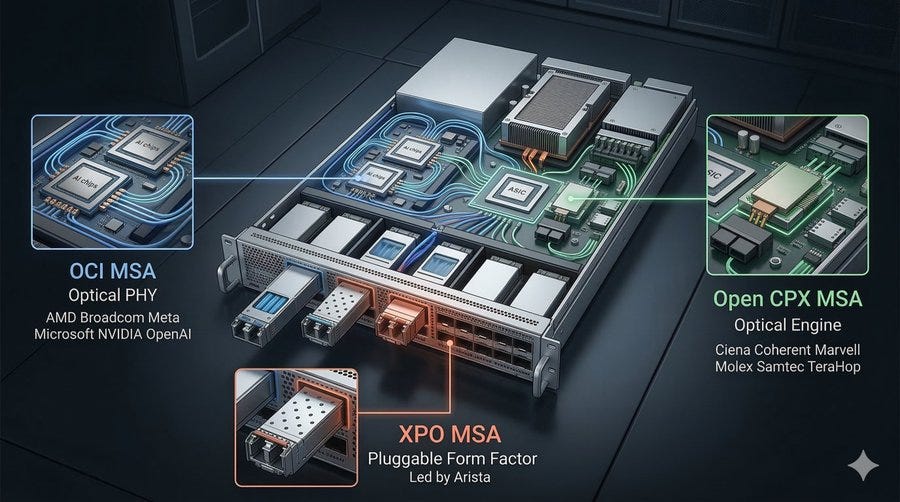
The obstacle lay in the fact that the socket itself is a part that had to be newly created. A high-density connector of the NPO type that sends 200G on a single lane while holding loss to a minimum did not exist before, and putting optical engines from different companies into the same socket requires agreeing on a specification first. For this, a number of suppliers launched the Open CPX MSA in 2026 to develop a common specification. Participating companies include Ciena, Coherent, Marvell, Molex, Samtec, and TeraHop.
Optics
The War of Light Has Begun
·
Mar 17
On March 12, 2026, three separate optical-related MSAs dropped on the same day. That does not happen by coincidence. It means the entire industry has converged on the same conclusion: the physical layer of AI infrastructure needs to change, and it needs to change now. Call it the opening shot of the Optical War.
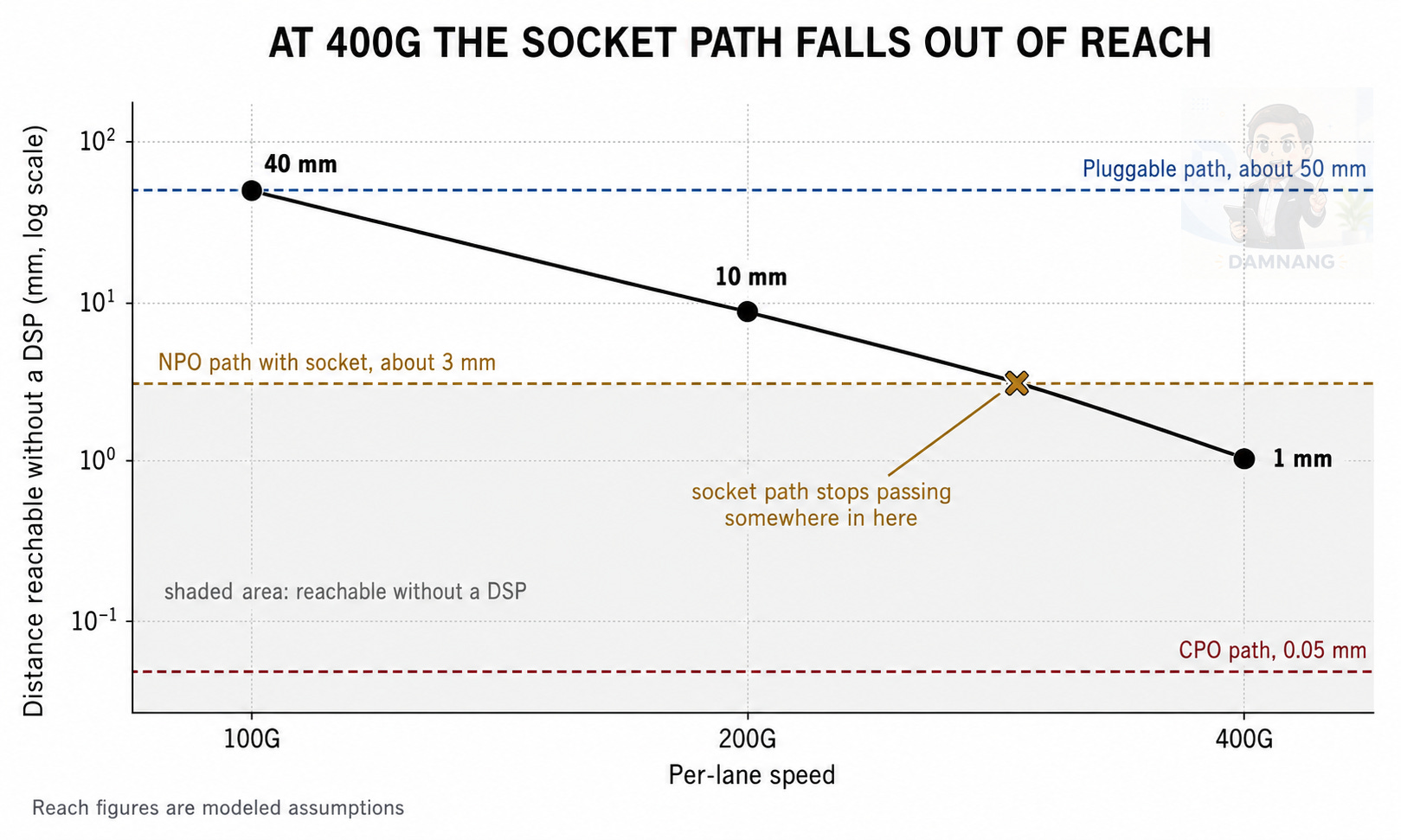
The larger constraint is the speed the socket can withstand. When the rate carried on a single lane doubles from 200G to 400G, more signal is stripped over the same trace, and the amount reflected back at surfaces where parts meet also increases. It means a point arrives where inserting a single socket is enough for the signal to fail. The OIF (Optical Internetworking Forum) and the Open CPX MSA have this on their roadmap.
If it is solved, NPO carries into the next generation.
If not, CPO without the socket has to be used.
To summarize, once manufacturing difficulty, reliability, and serviceability are solved, performance itself favors CPO.
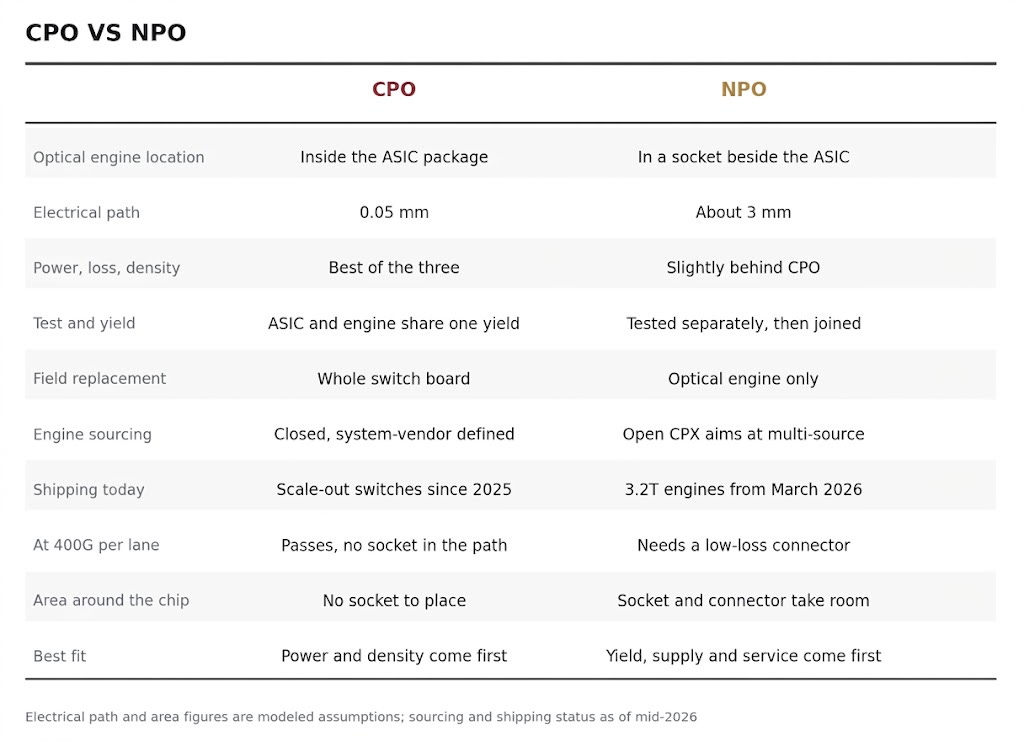
But in the current generation the gap NPO concedes is small, so a trade holds in which it is exchanged for assembly yield, supply chain flexibility, and serviceability. In systems where power and bandwidth density must be pushed to the limit, CPO leads; in systems where part separation, test yield, supply chain, and serviceability matter more, NPO is retained.
NPO is commonly thought of as an interim step before CPO.
But given that the two methods have different optimal points and that this optimum is divided by the character of the system, I view it as closer to a parallel structure than an interim step. For reference, the industry movement I hear from optical specialists in the field points in the same direction. The model calculated later is also set on this view, with both methods in use through 2030.
Comments
Nothing yet. Say the first thing.
Sign in to join the conversation.