
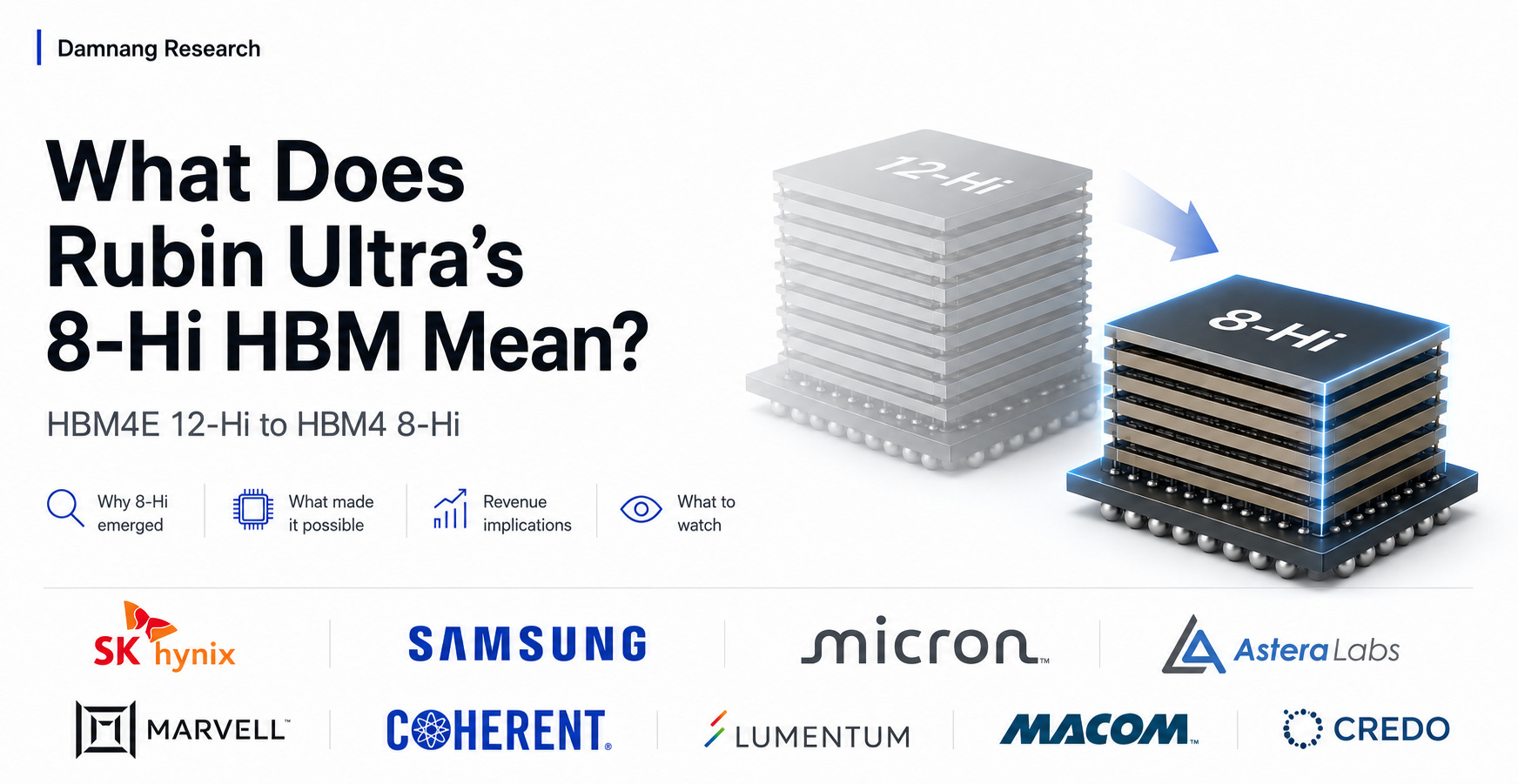
Since SemiAnalysis published its institutional report on the HBM4 8-Hi despec, a wide range of interpretations and speculation surrounding it has spread quickly through the market.
As someone who covered the HBM4 8-Hi story in an article about a week ahead of SemiAnalysis, I will also admit that every time I saw misunderstandings and conjecture get amplified and reproduced from fragmentary numbers and information, without a sufficient understanding of the technical context of the matter, it genuinely saddened me.
This article was written conclusion first, and that part will be open to both free and paid subscribers. There is a lot of market misunderstanding around this HBM4 8-Hi move, and I judged that making my analytical view on it public would be meaningful in its own right.
In the paid section that follows, I will walk through, in order, why HBM4 8-Hi emerged, how it became possible, whether memory makers’ revenue will actually head lower, and what to watch going forward for each memory maker. I am confident that this article will be the deepest analysis yet of the technical background and meaning of HBM4 8-Hi, which the market has not properly covered so far.
I hope this piece clears up at least some of the market’s unnecessary misunderstandings around HBM4 8-Hi, and helps investors view this change on a more accurate technical footing.
This article is written for informational purposes and does not recommend buying or selling any particular stock. Responsibility for investment decisions and their outcomes rests with the investor. The Rubin Ultra specifications in this article are reported configurations under review, not confirmed facts, and the final specifications may change. The figures are based on public reporting, standard specifications, and my own calculations and illustrative assumptions. Anything attributed to industry chatter is hearsay that has not been publicly confirmed.
To sum up this article, I do not see this 8-Hi transition as a bad signal for memory. This is a market where HBM cannot be sold for lack of it, and I see the HBM4 8-Hi despec as a special measure by NVIDIA to build more GPUs out of that scarce HBM. As discussed in the body, this despec is a move that would be hard for anyone but NVIDIA, which has built technical vertical integration spanning chip design, optics, and software.
Also, despite this despec, my calculations suggest the ratio of output gains to HBM price decline can come out higher, so total HBM revenue holds at 81.5% to 98% of planned 4E revenue. This means that if 12-Hi HBM4E could not actually meet more than 81.5% of the required volume, this despec can actually result in higher revenue.
Of course, what this NVIDIA request means for the memory makers is also significant. As I said in a previous article, NVIDIA has shown through this despec card that it has the influence to actually steer memory price negotiations.
Conversely, I think this may be a case that illustrates the view of SK hynix Chairman Choi Tae-won, that current memory prices are too high and that suppliers should move forward together with customers by coordinating them well.
In the end, I think it would be hasty to read this despec as a signal that the memory cycle has broken, and the right way to read it is as a signal that suppliers and customers have entered a phase of moving together, coordinating price, volume, and even design approaches.
Why 8-Hi HBM4 Instead of 12-Hi HBM4E
Is the Performance Possible with 8-Hi 192GB
Does Memory Supplier Revenue Shrink
What It Means for Each Memory Supplier and the Optical Names
Comments
Nothing yet. Say the first thing.
Sign in to join the conversation.