
Few psychological ideas are as misunderstood as will.
In everyday language, will is often reduced to discipline, determination, grit or forcing ourselves to do difficult things. Someone wakes at 5am to run in the rain and we call them “strong willed”. Someone procrastinates or struggles to change and we assume they “lack willpower”.
Yet this framing misses something essential.
Many people who appear highly disciplined are eventually exhausted, emotionally disconnected or driven by fear and compensation. Others who seem unmotivated may possess profound will that is trapped beneath trauma, fragmentation, chronic stress, grief or conflicting inner loyalties.
Will is not simply force.
Nor is it identical to motivation.
And it is certainly not reducible to productivity.
The deeper traditions of psychology, philosophy and contemplative practice have long recognised that will is a far more subtle and important human capacity. Roberto Assagioli, founder of and the creator of Psychosynthesis, viewed the will as central to psychological health and spiritual development. Not domination. Not suppression. A living organising principle within the psyche.
Modern neuroscience, trauma research and systems thinking increasingly point in a similar direction. Human beings are not machines directed by rational thought alone. We are complex adaptive systems shaped by physiology, emotion, attachment, meaning, memory, environment and relationship.
What we call “will” emerges from the quality of relationship between these layers.
This changes how we understand procrastination, addiction, collapse, burnout, avoidance, creativity and transformation itself.
It also changes how we help people change.
Motivation Is Not Will
One of the great confusions in psychology and self-development is the tendency to equate motivation with will.
Motivation fluctuates.
It is heavily influenced by sleep, blood sugar, stress, hormones, novelty, emotional state, social reinforcement, nervous system activation and perceived reward. Motivation rises and falls throughout the day. It can disappear under grief, inflammation, heartbreak, trauma or uncertainty.
Many people spend years waiting to “feel motivated” before acting.
But motivation is often a consequence of movement rather than its cause.
Will operates differently.
Will allows movement even when motivation is absent.
Not through harsh self coercion, but through alignment.
A parent caring for a sick child at 3am may feel no motivation whatsoever, yet love and responsibility organise behaviour into action. A person in recovery attends a meeting despite exhaustion. Someone grieving still gets out of bed and walks the dog because part of them remains connected to life.
These are not simply acts of motivation.
They are expressions of will.
The distinction matters clinically.
If we mistake low motivation for weakness or laziness, we shame people whose systems may already be overwhelmed. If we understand will more deeply, we begin asking different questions:
What inner conflicts are present?
What fears emerge when movement begins?
Is the nervous system depleted?
Does the person actually value the thing they are pursuing?
Is there grief, fragmentation or collapse beneath the procrastination?
Is action being organised through fear rather than coherence?
Often the issue is not absence of will.
It is competing wills within the self.
The Fragmented Self
Most people do not possess a single unified will.
They contain multiple impulses, identities, fears, needs and protective structures.
Part of someone may long for intimacy while another part fears engulfment. One aspect seeks health while another seeks comfort, sedation or escape. A person may consciously desire change while unconsciously remaining loyal to old identities, family systems or survival strategies.
This is why insight alone rarely creates transformation.
People frequently know what they “should” do.
Knowledge is not the problem.
Coherence is.
In therapeutic work this becomes obvious very quickly. The individual who procrastinates is often not resisting action itself. They may be resisting shame, exposure, failure, success, visibility, loss of belonging or nervous system overload.
Underneath many behavioural struggles lies an internal field that has lost coherence.
Will weakens when the system fragments.
This has profound implications for therapy, coaching and leadership development.
Attempts to strengthen will through pressure alone often intensify fragmentation. Endless optimisation strategies can create temporary compliance while increasing exhaustion and inner division.
People can force behaviour for surprisingly long periods.
But force is metabolically expensive.
Eventually the system compensates.
Burnout, collapse, addiction, depression, chronic avoidance and emotional numbing often emerge from prolonged incoherence between inner reality and outer performance.
Will as an Emergent Capacity
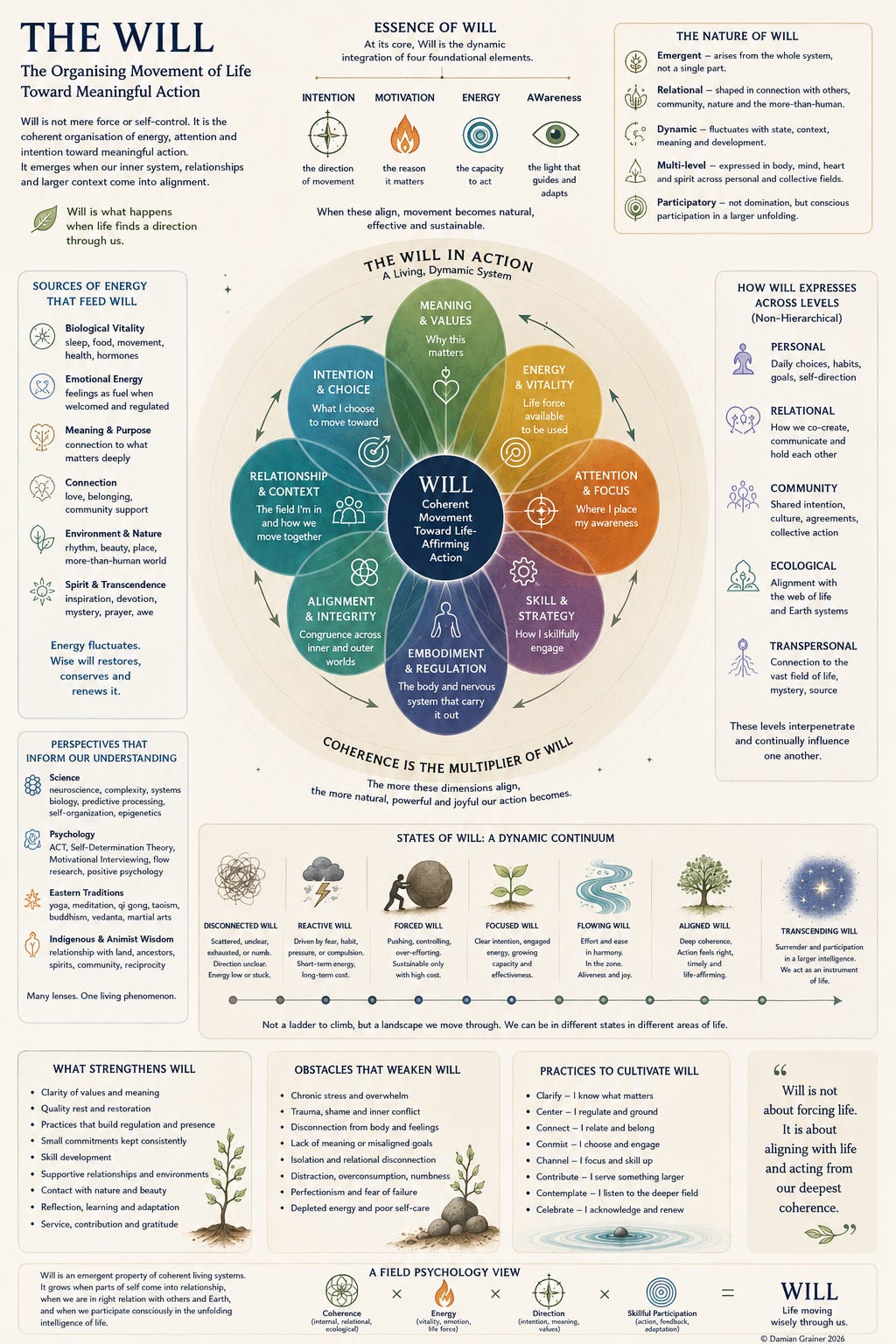
From a Field Psychology perspective, will is best understood as an emergent property of coherence.
Not a moral virtue.
Not a personality trait.
Not simply cognitive control.
When thoughts, emotions, body states, values and relational reality become more aligned, energy becomes available for directed action.
This is why clarity can feel energising.
Why unresolved conflict drains vitality.
Why grief can either immobilise or deepen purpose.
Why meaningful ritual, contemplative practice, embodiment and relational honesty often strengthen will more effectively than productivity systems alone.
Human beings function more like ecosystems than machines.
When an ecosystem becomes excessively fragmented, energy is consumed maintaining instability. When conditions support integration, adaptive movement becomes possible again.
This understanding aligns with several traditions simultaneously:
Psychosynthesis viewed the will as a central organising function of the personality.
Acceptance and Commitment Therapy emphasises values based action even in the presence of discomfort.
Trauma research shows that chronic threat states impair executive functioning, impulse regulation and long term orientation.
Contemplative traditions recognise that scattered attention weakens intentionality.
Complex systems theory suggests coherence allows greater adaptive capacity and energy efficiency.
Will, then, is not merely pushing harder.
It is the capacity to sustain meaningful direction through increasing levels of inner integration.
Energy and the Myth of Laziness
Many people are accused of laziness when they are actually exhausted, dysregulated or existentially disconnected.
Modern culture often treats human energy as infinite and interchangeable. If someone cannot perform consistently, the assumption is moral failure or insufficient ambition.
Yet energy is deeply relational.
It is affected by meaning, attachment, physiology, environment, grief, diet, nervous system state, loneliness, purpose and hope.
A person trapped in chronic hypervigilance may expend enormous amounts of energy simply remaining functional. Someone carrying unresolved grief may struggle to mobilise action because part of the psyche is still orientated toward loss. Another person may appear highly productive while operating entirely through anxiety and self rejection.
Again, motivation and will become confused.
The person running on adrenaline may appear “strong willed” while slowly approaching collapse.
Meanwhile someone healing from trauma may be engaged in immense acts of will that remain invisible externally.
A deeper understanding of will requires us to move beyond simplistic behavioural judgments.
Developing Will
If will emerges from coherence, then developing will involves cultivating the conditions that support coherence.
This changes the conversation considerably.
Many traditional approaches to self discipline focus primarily on suppression and behavioural control. Sometimes this is necessary. Structure matters. Repetition matters. Commitment matters.
But sustainable will develops through relationship with the self rather than war against the self.
Several practices appear consistently across therapeutic traditions, contemplative disciplines and high performance psychology.
1. Clarifying Values
Will strengthens when action connects to meaning.
People can endure extraordinary difficulty when movement aligns with deeply held values. Without meaning, discipline deteriorates into mechanical effort.
This is one reason why externally imposed goals often fail.
The psyche resists what it does not truly serve.
Values work helps distinguish authentic direction from internalised expectation.
2. Developing Nervous System Capacity
A dysregulated nervous system weakens intentionality.
When individuals remain chronically overwhelmed, exhausted or threat activated, survival responses dominate awareness. Long term thinking narrows. Avoidance increases. Impulse control deteriorates.
Breathwork, embodiment practices, sleep, movement, relational safety, grief work and trauma informed therapy all influence the system’s capacity to sustain directed attention and action.
This is not separate from will development.
It is foundational to it.
3. Strengthening Attention
Attention directs energy.
Many contemplative traditions understood this long before neuroscience began mapping attentional networks.
Scattered attention fragments behaviour.
Practices such as meditation, mindfulness, contemplative walking, journalling and reflective silence strengthen the capacity to remain present with discomfort without immediately collapsing into distraction or avoidance.
This increases behavioural freedom.
4. Working With Inner Conflict
People often attempt behavioural change without addressing the parts of themselves resisting that change.
The individual who procrastinates may contain frightened, perfectionistic or protective aspects that fear movement. Suppressing these parts frequently intensifies resistance.
Curiosity tends to work better than domination.
When conflicting needs become conscious and relationally integrated, more energy becomes available for action.
5. Embodied Repetition
Will develops through enacted experience.
Not abstract intention alone.
Small repeated actions matter because they gradually reorganise identity and expectation. The nervous system begins learning: I am someone capable of movement even when discomfort is present.
This is one reason behavioural activation works.
Action alters perception.
6. Relationship and Field Effects
Human beings do not develop will in isolation.
Coherent relationships strengthen coherence within individuals.
Therapists, coaches, mentors, communities and groups often function as stabilising fields in which fragmented parts of the self can reorganise. In many healing traditions this relational dimension has always been central.
We borrow regulation from one another.
We borrow courage from one another.
Over time, these experiences become internalised.
The Spiritual Dimension of Will
Most spiritual traditions contain teachings on will, though they describe it differently.
In some traditions it appears as devotion. In others as right action, disciplined awareness, surrender, service or alignment with a deeper order of reality.
What unites many of them is the recognition that mature will is not fundamentally egocentric.
It involves increasing alignment between personal action and something larger than immediate impulse gratification.
This does not necessarily require religious belief.
But it does involve depth.
People often discover that genuine will emerges most powerfully when life becomes organised around meaning, relationship, contribution, beauty, truth or love rather than endless self optimisation.
At deeper levels of development, will becomes less about forcing life and more about participating consciously within it.
A Different Conversation About Change
Perhaps one of the most important implications of this understanding is compassion.
Not indulgence.
Not avoidance.
Compassion rooted in complexity.
Human beings are extraordinarily adaptive systems shaped by experience, relationship and physiology. Behaviour always makes sense within some context, even when it becomes destructive.
When we understand will more deeply, we stop reducing people to lazy or disciplined, weak or strong.
Instead we begin asking:
What conditions support coherence here?
What fragments the system?
What restores connection to meaning?
What increases aliveness, integration and relational honesty?
And perhaps most importantly:
How do we help people develop forms of will that do not require self abandonment?
Because sustainable transformation rarely emerges through violence against the self.
More often it emerges through increasing coherence between body, mind, feeling, relationship and purpose.
From there, movement becomes possible again.
Not perfectly. Not permanently.
But genuinely enough to begin walking.
No posts
Comments
Nothing yet. Say the first thing.
Sign in to join the conversation.