
There are moments when something breaks through the surface of culture and refuses to be explained away.
A news story about thousands of videos of women being assaulted while unconscious. The slow drip of the Epstein files, revealing networks of power, complicity, and silence. The steady, almost numbing statistics of male violence against women across the world.
We have learned, collectively, to metabolise these as separate events. Isolated horrors. Deviations from the norm.
They are not.
They are expressions of a pattern that is both ancient and current. A pattern that exists in its most extreme form as violence, but also in subtler, more socially acceptable, even spiritualised forms that are far harder to see and therefore harder to interrupt.
I write as a single parent father of three daughters and a younger son, and as a clinician who has spent many hours sitting with people, both women and men, in the aftermath of what this pattern produces. Much of what follows is drawn from those two vantage points at once.
If we are willing to look carefully, we can trace a continuum.
At one end: coercion, assault, femicide. At the other: objectification, extraction, pseudo-intimacy, the use of another’s emotional or erotic openness without the capacity to meet or hold it.
Different in degree. Not entirely different in kind.
The difficulty is this. The further we move away from overt violence, the more language becomes unstable. The more we rely on felt sense, intuition, and relational awareness rather than legal definitions.
But the field knows.
Many women know — and many of the women I work with have described — the experience of being looked at in a way that does not meet them, but takes from them. Of being entered psychologically, emotionally, or energetically without invitation. Of feeling, afterwards, a subtle depletion that is difficult to name and easy to dismiss.
In some contemporary spaces, this has been described as “energetic violation” or even “energetic rape.” The language is provocative, and it needs to be handled with care. It is not a legal category, nor should it blur the profound difference between physical sexual violence and subtler forms of boundary violation.
And yet, as a phenomenological description, it points to something real.
A pattern of uninvited entry, extraction, and lack of responsibility.
In Field Psychology terms, we might say this:
a failure to hold one’s own field, leading to the colonisation of another’s.
The Scale of It
Before moving further into the relational and symbolic registers, it is worth naming the social fact on which everything else rests.
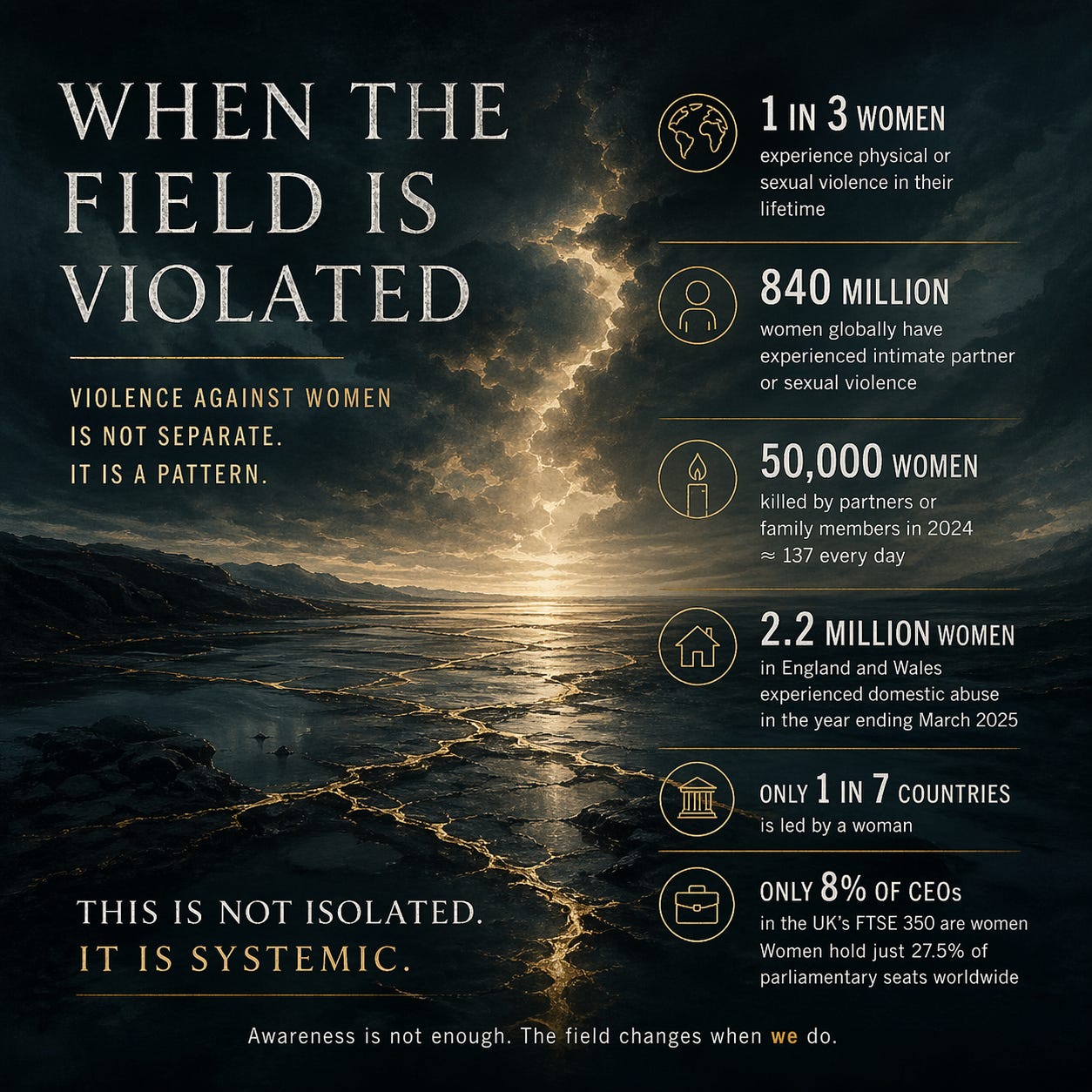
In November 2025, the World Health Organization estimated that approximately 840 million women, nearly one in three globally, have experienced intimate partner or sexual violence in their lifetime. A further 316 million women experienced physical or sexual violence at the hands of an intimate partner in the previous twelve months alone.
The UN Office on Drugs and Crime and UN Women reported that around 50,000 women and girls were killed by intimate partners or family members in 2024 — roughly 137 deaths a day. In March 2026, European Union data confirmed that nearly one in three women in the EU have experienced physical or sexual violence in their lifetime. In the year ending March 2025, an estimated 2.2 million women in England and Wales experienced domestic abuse (roughly 9.1% of the female population)
These figures sit alongside another pattern. As of January 2026, UN Women and the Inter-Parliamentary Union reported that only one in seven countries is led by a woman, that women hold only 27.5 per cent of parliamentary seats worldwide, and 22.4 per cent of cabinet posts.
This economic exclusion is further mirrored in the architecture of global wealth and corporate leadership. As of April 2026, while women have reached a record 43% of board positions in the UK’s FTSE 350, they remain starkly absent from the roles of ultimate authority; only 8% of CEOs in these companies are women. This “authority gap” is even more pronounced in the world of extreme wealth. According to the 2026 Forbes World’s Billionaires list, women account for just 14% of the world’s wealthiest individuals, with the vast majority of the top ten inheriting their fortunes rather than building them through the same executive pathways as their male counterparts.
In the UK, this systemic imbalance manifests in a 6.9% gender pay gap and a staggering 48% gender pensions gap, reflecting a lifetime of cumulative economic marginalisation. These are not merely financial discrepancies; they are the structural evidence of a “field” that continues to gatekeep the highest forms of symbolic and material power.
Violence against women and women’s exclusion from power are not two separate stories. They are expressions of the same underlying dynamic. A dynamic in which women’s bodies and women’s authority are both, in different ways, denied full recognition.
What follows is an attempt to understand that dynamic, not only at the level of individual behaviour, but at the level of field.
The Persistence of Predation in “Conscious” Spaces
There is a persistent myth that if we leave behind mainstream culture and enter therapeutic, spiritual, or “conscious” environments, we also leave behind the dynamics of domination and exploitation.
My experience suggests otherwise.
What often happens is not the disappearance of predatory dynamics, but their refinement.
The language changes. The aesthetics change. The explicitness softens.
But the underlying pattern can remain intact.
The man who once pursued through intoxication may now pursue through presence. The one who once objectified through crude language may now do so through spiritualised intimacy. The one who once avoided responsibility may now frame that avoidance as freedom, sovereignty, or non-attachment.
This is not a condemnation of conscious communities. It is a recognition that psychological and moral development do not automatically follow spiritual language or practice.
Research into coercive control and sexual objectification supports this. Harm is not limited to discrete acts of violence. It is often patterned, relational, and normalised within specific environments. It can be subtle, cumulative, and difficult to challenge precisely because it does not always cross clear external thresholds.
In such contexts, harm becomes harder to name.
And what cannot be named cannot be interrupted.
What Drives the Pattern?
It is tempting to search for a single cause.
Pornography. Patriarchy. Trauma. Capitalism. Evolution. Social media.
Each of these plays a role. None of them are sufficient on their own.
What we are looking at is a multi-layered system.
At the personal level, we see trauma, shame, dissociation, unmet dependency needs, and emotional illiteracy.
At the relational level, we see objectification, entitlement, avoidance of vulnerability, and the use of others for regulation.
At the cultural level, we see norms that reward dominance, performance, conquest, and the commodification of intimacy.
At the structural level, we see uneven accountability, persistent power asymmetries, and institutions that have historically been shaped by male dominance.
The figures above make the stakes plain. This is not marginal. It is systemic.
But even this multi-level analysis does not fully explain the quality of the pattern. The particular flavour of extraction, avoidance, and control.
For that, we need to move into a deeper register.
Fear of the Feminine
In earlier work, I used the phrase fear of the feminine.
This is easily misunderstood if taken literally or ideologically. It is not a claim about women. Nor is it a fixed biological statement.
It is a depth-psychological observation.
Across many men, what is avoided, defended against, or controlled includes vulnerability, dependence, receptivity, emotional exposure, embodiment, grief, relational accountability, and the limits of control.
These qualities are often symbolically associated with the feminine, not because they belong to women, but because they have historically been disowned within dominant forms of masculinity.
To fear the feminine, in this sense, is to fear those aspects of life that undo defended identity.
If these dimensions cannot be met internally, they tend to be managed externally.
Through control. Through idealisation. Through avoidance. Through domination. Through extraction.
The same man may long for intimacy and simultaneously undermine it. Seek connection and resist being known. Open another’s heart and withdraw when responsibility is required.
Not because he is calculating in a simple sense, but because he cannot remain coherent in the presence of what is being evoked.
From a Field Psychology perspective, this is a problem of coherence.
The system destabilises under certain relational conditions. Instead of increasing capacity, it moves to regain stability through strategies that externalise the disturbance.
Sometimes those strategies are subtle. Sometimes they are devastating.
Trauma, Masculinity, and Responsibility
There is strong evidence linking childhood adversity, trauma symptoms, and rigid adherence to traditional masculinity norms with increased risk of violence against women.
But we need to be precise.
Trauma does not cause violence in a simple, linear way. Most people who experience trauma do not become perpetrators.
What trauma can do is reduce capacity.
Capacity to feel without dissociating. Capacity to tolerate shame without collapsing or attacking. Capacity to regulate without externalising. Capacity to remain present under emotional intensity.
When this reduced capacity is combined with entitlement, social reinforcement, and lack of accountability, the risk increases.
This is where the conversation must shift.
Understanding is necessary. It is not sufficient.
At a certain point, awareness of pattern brings responsibility.
When a man can feel the effect he is having, recognise the dynamic he is repeating, and still continue, the explanation moves from unconscious repetition to choice within constraint.
The work then is not only therapeutic. It is ethical.
Death Denial and Hardening Masculinity
There is another layer that becomes visible when we widen the frame.
We are living in a time of ecological strain, economic instability, and increasing social fragmentation. A time in which many of the structures that have provided meaning and identity are weakening.
Under such conditions, systems tend to polarise.
Some soften. Others harden.
For some men, the response to uncertainty is not greater openness, but increased rigidity.
Control instead of surrender. Certainty instead of inquiry. Dominance instead of reciprocity. Identity instead of relationship.
This can be understood, in part, through the lens of death denial. Not as a singular cause, but as a contributing dynamic. When mortality, limitation, and vulnerability cannot be faced, they are often defended against through expansion, control, or transcendence.
At the cultural level, this can manifest as extractive economics, authoritarian politics, and the devaluation of care.
At the interpersonal level, it can manifest as refusal of vulnerability, commodification of intimacy, and domination of the relational field.
The pattern repeats across scale.
Not identical. But resonant.
Two Worlds: What I See in My Own Home
I have three adult daughters and a younger son. I love all four fiercely, but I am under no illusion that they inhabit the same world.
My daughters have had to manage, from an early age, a background field of risk my son has never had to consider. Unwanted attention on the street, in clubs, online, in public places, sometimes from men they had reason to trust. The normalised calculations, which route home, which drink, which friend’s lift, which message to leave unanswered, that shape a woman’s freedom of movement in ways most men simply never register.
What my son is growing into is a different territory, but one that connects directly to theirs.
Although the values modelled at home are the opposite, I watch him encounter a peer culture in which approval and belonging are increasingly earned through derogation of women. The influencers he and his friends follow, men with enormous reach, stage masculinity as contempt. Women are framed as hierarchies to be climbed, bodies to be rated, tests of status to be passed. What was once muttered in locker rooms is now produced with high production values and recommended at scale, by algorithm, to boys whose sense of what it is to be a man is still forming.
Inside this frame, a girl’s choice, most of all her choice not to engage, not to respond, not to enter a relationship. is experienced as intolerable. It is often met with anger, ridicule, or online abuse. Beneath that aggression, what is being defended against is rejection, inadequacy, and an entitlement that has never had to meet the reality of another person’s autonomy.
This is not a lament that “the kids” are worse. They are being shaped, as every generation is, by the material available to them. The material currently on offer is unusually bad.
And the two things I see are related. My daughters move through a world in which large numbers of young men are being actively coached into contempt. My son is being formed inside a field in which the simplest, cheapest route to peer belonging is to participate in that coaching.
Something in a father sees both at once, and refuses to be neutral.
Bringing up a son against this current is itself a form of the work this essay is about. Not lecturing. Not moralising from above. Allowing him to feel, in the fabric of daily life, what it is to live in a home where his sisters are not commodities, where emotional life is not weakness, where men can disagree with each other without violence, and where the quick hit of peer approval through contempt is named, gently but firmly, for what it is.
What Men Must Do With Men
If the problem includes men, the solution must include men.
Not as saviours. Not as exceptions. But as participants in change.
This cannot be reduced to better behaviour in public spaces. It requires developmental work.
Men need contexts where they can face shame without deflection; contact grief without converting it into anger; develop embodied self-regulation; recognise and interrupt entitlement; be challenged by other men without collapse or retaliation; and learn to remain present in the face of relational intensity.
Most importantly, men need to become accountable to each other.
Not in the performative sense of calling out, but in the deeper sense of refusing to collude with predation, even in its subtle forms.
This may be as simple, and as difficult, as not laughing when a woman is reduced to a story or a body, and instead letting the moment land differently. Or asking, quietly but directly, when another man speaks about blurred boundaries or multiple partners, “are they aware of that?, bringing reality back into a space that was allowing it to drift.
In other contexts, it may be noticing when a woman is being talked over, interrupted, or subtly diminished, and restoring her place without drama. Or, in more intimate or “conscious” spaces, slowing something down when the language of connection is being used to override hesitation, making consent explicit where it has been assumed.
These are not grand gestures and they rarely win approval.
This is where much current culture fails.
Because the cost of interruption is often social exclusion, a subtle but powerful loss of belonging within the male group.
And so silence persists. Not always from agreement, but from the internal calculation that it is easier not to disrupt the field.
From a Field Psychology perspective, this is a failure of the collective field. A system in which coherence is not yet strong enough to withstand the tension of truth, and so defaults, again and again, to complicity.
Space for Women’s Truth
There is another side to this work that is equally important.
Women need spaces where their experience can be expressed without being minimised, corrected, or redirected toward male comfort.
Fear. Rage. Disgust. Grief.
These are not pathologies. They are responses.
When these responses are suppressed, they do not disappear. They move underground and shape relationships, sexuality, and culture in indirect ways.
The aim of such spaces is not to fix men, nor to entrench division.
It is to allow truth to emerge in a form that can be metabolised rather than carried in isolation.
For this to be effective, the space must be well held. Safety without collapse. Expression without re-traumatisation. Witnessing without analysis. Intensity without fragmentation.
Only then can the movement occur from raw affect to discernment, boundary, and choice.
The Witch Wound: Ancestral Redemption of Female Power
In my clinical work with women, one theme surfaces with a frequency I cannot ignore.
It rarely arrives named. It emerges through dreams, through bodily symptoms, through recurrent relational patterns, through an obscure inhibition around being seen. A woman who is perceptive, capable, and effective finds that something in her contracts whenever her authority is about to be recognised in public. Another feels an unspecified danger around speaking what she actually knows. Another carries, without autobiographical cause, a deep-seated fear of being punished for her gifts.
Over time, what often becomes clear is that the wound is not only personal. It is ancestral.
The phrase some clinicians use for this - the witch wound -is imperfect, but it points to something real. Over centuries, in Europe and elsewhere, women who held knowledge of the body, of plants, of birth, of the dying, women who were independent, perceptive, and unavailable for containment, were persecuted, exiled, killed. The cultural memory of this has not been metabolised. It has been inherited.
What I see in practice is slow, careful work of redemption. Women recognising in themselves a reluctance to step fully into their own authority, and tracing it, through the body, through lineage, through grief, back to a collective field of interrupted female power. The healing is not metaphorical. When this wound is met, something in the present changes. Voice returns. Visibility becomes tolerable. The body stops bracing for a blow that, in this life, has not yet come.
This matters to the wider conversation because it tells us that what we are dealing with is not only a present crisis. It is a long inheritance, held in the bodies of women who are alive now.
It also tells us what kind of healing is required. Not only better rules, safer spaces, and clearer accountability, important as those are. Also a cultural act of recognition: that a great deal was done, over a long period, to break female authority; that this has left a mark; and that its unmaking is part of the work of our time.
Toward Coherence
What we are facing is not a single issue.
It is a pattern that spans violence, culture, psychology, and spirituality.
The temptation is to simplify. To locate a single cause. To assign blame in a way that resolves the discomfort.
But if we do that, we miss the deeper opportunity.
Because what is being revealed is not only what is broken, but what is required.
A maturation.
In men. In women. In culture.
For men, this means learning to hold their own field. To remain present in the face of vulnerability. To move from extraction to reciprocity, from avoidance to responsibility.
For women, it means reclaiming value from within, often with the slow, ancestral work described above, expressing truth without self-abandonment, and refusing to participate in dynamics that diminish them.
For all of us, it means recognising that coherence is not the absence of disturbance, but the capacity to remain present within it.
To meet what arises without collapsing into old patterns.
To take responsibility for the effects we have on others.
To become, gradually, capable of relationship that is not organised around control or need, but around presence and mutual recognition.
This is not abstract.
It is lived.
In how we look. In how we listen. In how we touch. In how we stay. In how we leave.
In how I raise a son. In how I stand beside my daughters. In how, as a clinician, I honour the inheritance carried by the women who walk into my consulting room.
And in whether we are willing to face, without turning away, what has been done, what continues to be done, and what it will take to change it.
No posts
Comments
Nothing yet. Say the first thing.
Sign in to join the conversation.