
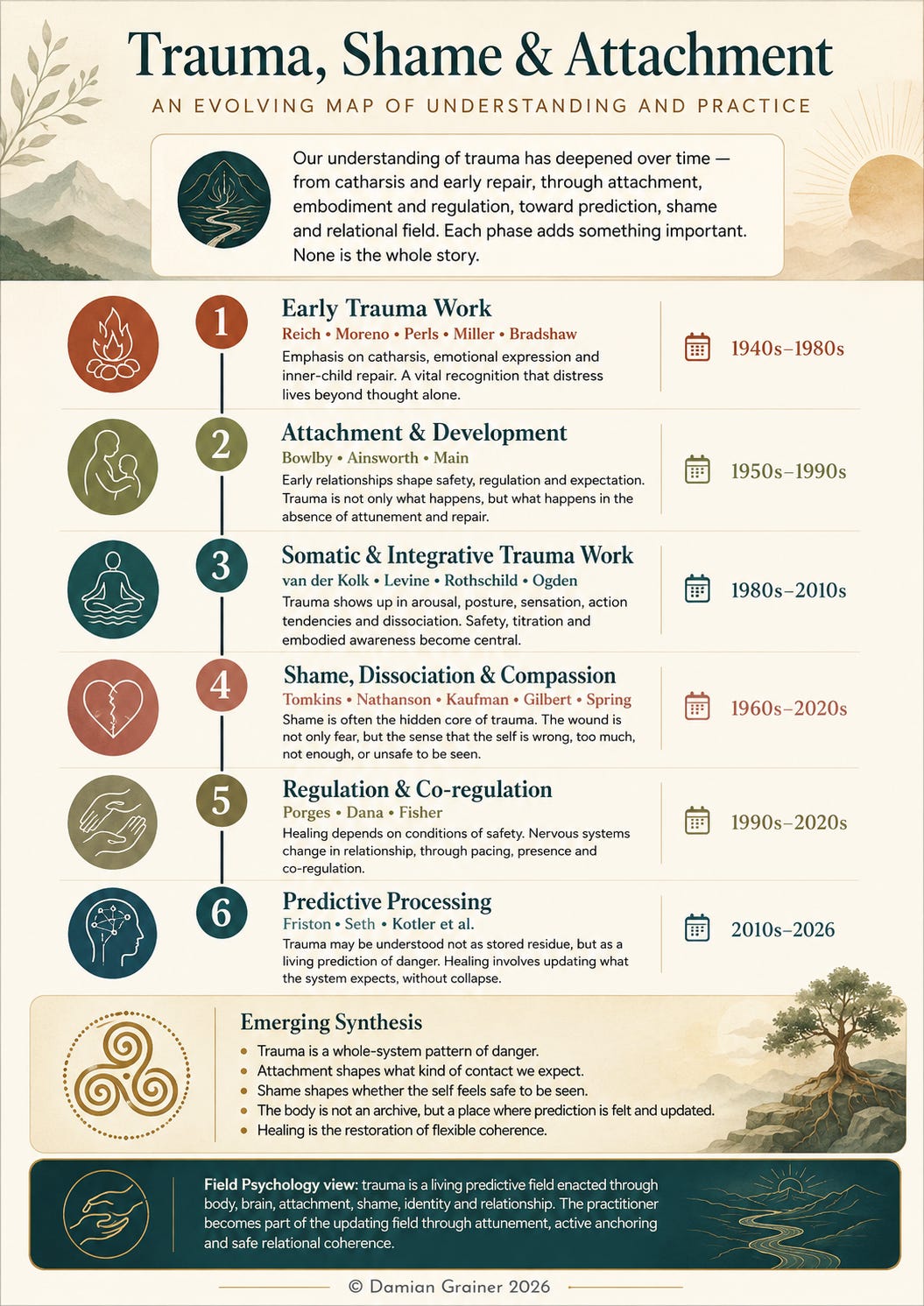
A new debate is opening in trauma work. For years, many of us have used the phrase “the body keeps the score” to honour the fact that trauma is not merely a story in the mind. It lives in breath, posture, sleep, startle, shutdown, pain, impulse and relationship. Now predictive neuroscience is asking us to refine that language. The body may not store trauma like an archive. What we call trauma may be better understood as an active prediction of danger, continually enacted in the present. This is an important correction. But it would be a mistake to turn it into another reductionism. The body is still central. Attachment is still central. Shame is still central. Relationship is still central. The question is not whether trauma is in the body or in the brain, but how the whole person-field has learned to organise around danger, and what conditions allow that organisation to change.
I come to this question as a psychosynthesis practitioner, so I have never been wholly comfortable with models that divide the person too neatly into separate parts. Psychosynthesis has always held a wider view of the human being: body, feeling, mind, imagination, will, soul and Self. In that sense, it already resists any purely cognitive account of trauma. It also resists a purely biological one. Human beings are not mechanisms to be repaired, but living systems seeking coherence, meaning and reconnection.
At the same time, my own practice has been changed by developments beyond classical psychosynthesis. Compassion-based approaches gave me a far deeper understanding of shame, self-attack and the suffering that comes when a person experiences themselves as fundamentally wrong. Work with nervous system regulation brought greater precision to what safety actually means in the body: the difference between activation and overwhelm, mobilisation and panic, stillness and collapse, contact and compliance. Somatic awareness brought more of the body into the room, not as an object to be worked on, but as a living source of information, protection and possibility.
So when I hear the claim that “the body does not keep the score”, I do not hear a dismissal of the body. I hear an invitation to become more precise.
The recent paper by Kotler, Mannino, Fox and Friston argues that trauma is better understood through predictive coding and active inference than through a literal storage model. Its central claim is that the body does not hold trauma as a kind of residue in tissue. Rather, the brain and body participate in the present-moment re-enactment of learned predictions. The system has learned danger, weighted that danger heavily, and continues to organise perception, sensation and action around it. The paper frames trauma in terms of maladaptive inference, threat prediction and reduced metastability, meaning a loss of flexible movement between states.
This is a significant development, but it needs careful handling.
For many clients, the phrase “the body keeps the score” has been a relief. It has helped them understand why trauma cannot simply be reasoned away. It has helped explain why the body flinches before the mind understands, why sleep is disturbed, why touch can feel unsafe, why the voice disappears, why shame floods the face, why the stomach tightens, why a person can know they are safe and still feel endangered. At its best, the phrase returned dignity to experiences that had been dismissed as irrational, dramatic or “all in the mind.”
The problem begins when the metaphor becomes literal. If we imagine trauma as a thing stored in the body, we can begin to look for it as though it were hidden material: a residue to be discharged, an energy to be released, a wound to be extracted, a frozen fragment to be completed. There are moments in therapy that can feel exactly like release. Tears come. Trembling moves through the body. Breath deepens. Heat rises. A long-held contraction softens. Something that seemed fixed begins to move.
Yet perhaps what is happening is not that trauma is leaving the body. Perhaps the system is updating.
This does not make somatic work less important. It may make it more intelligible. The body is where predictions become available to experience. It is where danger is felt as bracing, shame as collapse, grief as heaviness, anger as heat, longing as ache, safety as breath. If trauma is a prediction, the body is one of the primary places where that prediction is enacted and one of the primary places where it can change.
This is why the new neuroscience should not be used to dismiss the somatic pioneers. Peter Levine’s attention to titration and pendulation, Babette Rothschild’s emphasis on safety and brakes, Pat Ogden’s work with posture, movement and action tendencies, and Bessel van der Kolk’s insistence that trauma is embodied all remain clinically important. Their language may need refinement, but their observations should not be casually discarded. Much of what they noticed in the room is still true: trauma is lived through the body, even if it is not stored there as an archive.
The same applies to nervous system models. Deb Dana’s clinical translation of Polyvagal Theory has helped many practitioners attend more carefully to states of safety, mobilisation, shutdown and connection. There are legitimate debates about the anatomical claims of Polyvagal Theory, but its wider clinical contribution remains significant: trauma work depends on conditions of safety, pacing and co-regulation. A system organised around danger does not update simply because we explain something to it. It updates when the body begins to experience that another response is possible.
The evidence base also invites humility. NICE guidance continues to recommend trauma-focused psychological therapies, particularly trauma-focused CBT and EMDR, for PTSD. These approaches can help many people. They should not be set against somatic, relational or compassion-based work as though the field must choose one truth. The more useful question is: what is changing when these approaches work? From a predictive perspective, they may help the system revise what it expects. From a Field Psychology perspective, they may support a movement from rigid survival coherence toward more flexible, living coherence.
Shame is especially important here. Many trauma discussions focus on fear, but shame often sits closer to the centre of developmental trauma. If fear says, “danger is coming”, shame says, “I am the danger.” It is the felt conviction that the self is wrong, too much, not enough, disgusting, weak, needy or unsafe to reveal. Shame is not only a thought. It is posture, gaze, breath, heat, collapse, silence and hiding. It is relational prediction in the body.
Attachment disruption deepens this. A child does not merely learn what happened. The child learns what kind of world this is, what kind of contact can be expected, whether need brings care or humiliation, whether anger destroys connection, whether delight is welcomed, whether repair follows rupture. These are not abstract beliefs. They become organising predictions. They shape the developing self.
This is why trauma work must be more than memory work. It must also be attachment work, shame work, body work, nervous system work, and meaning work. At depth, it is also soul work, because trauma does not only disturb symptoms. It can disturb a person’s contact with their own aliveness.
In Field Psychology, I would describe trauma as a living predictive field. It is not a fixed wound stored somewhere inside the person, nor is it merely a brain-generated error. It is a whole-system organisation of danger, enacted through body, brain, attachment, shame, identity, relationship and meaning. Symptoms persist because the system has found a form of coherence around threat. Painful though it may be, that coherence is protective. It has helped the person survive.
Healing, then, is not the extraction of stored pain. It is the restoration of flexible coherence.
This is where the practitioner matters. The therapist is not simply applying a technique to a nervous system. They are part of the field in which the client’s predictions are either confirmed or revised. A shaming therapist confirms shame. A rushed therapist confirms danger. An overly interpretive therapist may confirm intrusion. A collapsed therapist may confirm abandonment. A coherent, attuned and ethically grounded practitioner becomes part of the updating environment.
This is what I mean by active anchoring. There are moments when receptive presence is enough. There are other moments, especially with shame, dissociation or developmental trauma, when the practitioner must actively help hold orientation, pacing, dignity and connection. Not by controlling the client’s process, but by lending enough coherence for the system to risk something new.
The body may not keep the score in the way we once imagined. But the body still matters because it is where the person discovers whether the world has changed. The brain still matters because prediction shapes perception. Attachment still matters because relationship teaches the nervous system what to expect. Shame still matters because it can organise identity around hiding. Meaning still matters because human beings are not only trying to regulate. We are trying to live.
The next phase of trauma work does not need another split. It needs a wider synthesis. We can refine the storage metaphor without humiliating the people it helped. We can welcome predictive neuroscience without reducing trauma to computation. We can honour the body without treating it as a vault. We can honour the brain without making it sovereign. We can honour evidence-based practice while remembering that healing also depends on presence, compassion, grief, relationship and the slow return of trust.
Perhaps the better question is not, “where is trauma stored?”
Perhaps it is:
What has this person’s whole system learned to expect?
What field conditions keep that expectation in place?
And what kind of relationship, practice and embodied experience would allow a different future to become believable?
No posts
Comments
Nothing yet. Say the first thing.
Sign in to join the conversation.