
Welcome to SEE YOU—a companion for artists, thinkers, and analog lovers with ideas, inspiration, and reflections on living an intentional creative life.
Today I’m revisiting a newsletter post I shared three years ago on the myth of artists always enjoying the process of making art, especially as a beginner. Join to follow along!
One of the many benefits of writing a blog or newsletter is seeing the trails of your beliefs and patterns change over time.
This week, as I was talking to a friend who’s been having difficulty trying to write more, I thought about a Substack post I wrote back in 2023. I wrote this two years into my art practice, when I was often beating myself up for not measuring up to my own standards. Before I talk about what’s changed since three years ago, I first invite you to read the piece in full:
What fantasy do you believe about your practice? Do you have a vision for how it should go and get frustrated or become mean to yourself when this vision doesn’t match reality?
The #1 myth I have around my creative practice is that I should always be enjoying myself when I make art. I should be in flow, in “the zone” like in the movie Soul—immersed in my work, bursting with energy, and free of anxious thought.
Flow state is definitely possible, and I have greatly appreciated the times I have been immersed in it! But it’s unrealistic to expect that we can enter this flow state every day at a moment’s notice when we are managing so many different emotions and life complexities, not only about our art but outside of it as well.
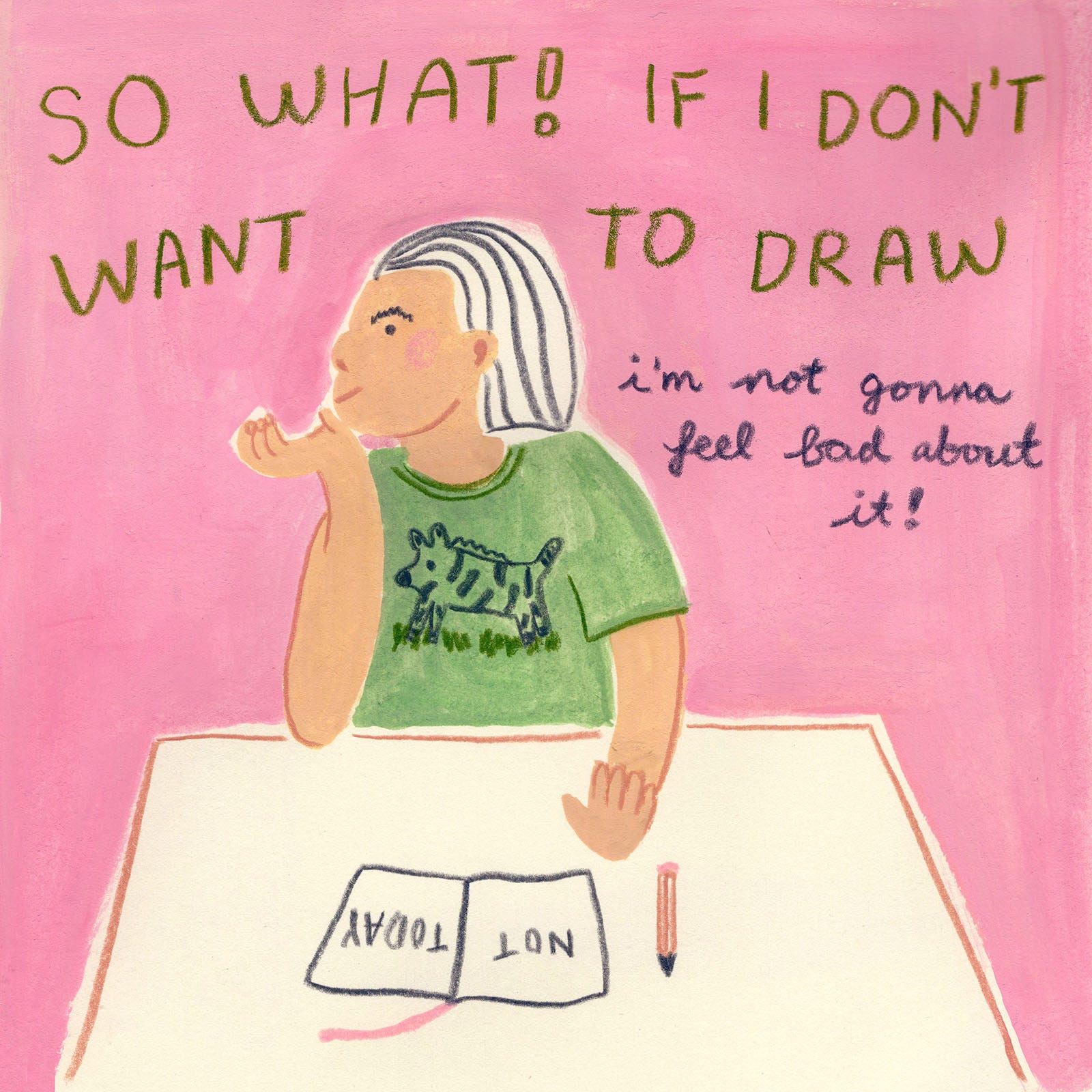
The funny thing is, an artist making their work will often look like they’re in flow to the outside eye. This is especially true when you see the process of an artwork through beautifully condensed videos and reels. Everything about the practice looks beautiful, without struggle or doubt. Often this curation makes us feel worse about our own messy mistakes, our bodies contorted into balls of stress while trying to work through a problem or salvage a piece.
What’s helped me break the myth of needing to always enjoy my practice is the reminder that creation is labor. You are making something from what was previously nothing! You are bringing your work into existence. No one would fault a mother birthing a child for experiencing messy feelings and all sorts of pain during labor (I hope). Flow state and joy may be an ideal state, but should it be the metric we measure our creation upon?
What matters is that you showed up, despite the chaos of your feelings and thoughts, and created something. Some of those days felt great, others not so much. Maybe all of it felt terrible. But you did it—you made the thing. And you will make more.
In Buddhism there is a parable of the second arrow. This is the suffering brought on by judgment or anxiety that follows the initial pain. Pain is guaranteed to randomly happen throughout life, but our own mental weather responding to the pain is at the root of our greatest suffering.
When I wrote the above post in 2023, I wrote it to make my own medicine, wanting to convince myself out of my internal judgment. I kept repeating negative self-talk that I wasn’t meant to be an artist or make art if I wasn’t excited to take out my sketchbook or work for hours on a painting. The drab or stressful emotions that came up while making art was the initial pain; the subsequent narrative spins about my worthiness was the second arrow suffering.
I still stand by every word I wrote in my first post. It’s given me great comfort over the years, as I continue practicing art through emotional ups and downs. With the years of distance, I can parse out some threads that I think adds more nuance to this binary of “enjoying” or “not enjoying” making art.
1. You can trust your desires, even if your actions don’t match it yet.
One of the toxic narratives that popped up when I would struggle to make art was questioning whether I was really an artist, when I wasn’t enjoying the process. Everyone says the whole point of making art is to enjoy the process (and it’s true!)
What people don’t repeat as often is that there is a large period after a beginner’s initial development when improving on a skill is a major slog. The dopamine rewards are few and far between compared to the early days. It can be really hard to continue during this period, and it’s when many people give up.
I think it’s always okay to give up, let go, or pivot, but I would first recommend checking whether there is still pain or longing attached to not making art. Maybe the pain of not making art is greater than the pain of making art.
“Artists are people who are profoundly compelled to make their creative work, and when they are distanced from their practice, their life quality suffers.”
- Beth Pickens
If you’re living in the in-between, caught between wanting to make art but also suffering while making it, keep trusting in your desires. Tend to that future identity. At some point, your actions will follow.
2. Some kinds of art will feel better to make than others.
It takes time to find out what kind of creative activity you enjoy most. There’s no need to force a medium or style you don’t enjoy, even if it seems more popular or impressive.
You don’t need to try every single medium out there—that’d get really overwhelming!—but it is worth experimenting with your process. After years of making art, I know that I like to jump back and forth between analog and digital for my illustrations, and that I prefer working with brush more than pen or marker.
There are a lot of decisions that go into how you might want to make art. If you’re exploring this for yourself, try removing the variable of deciding what to create by going to drawing sessions (Helen Stark, Beth Spencer, and Sara Boccacini Meadows are a few folks that run sessions on Substack!) I enjoy experimenting with materials at figure drawing sessions, and seeing how people illustrate the same thing in such different ways.
3. Hone in on what you care about. Let the rest go.
A major component of not enjoying making art is not enjoying what we’ve made. It is such default programming in our brains to get upset and disappointed by this, especially in the beginning!
Rather than tell you to just make stuff and not care about the result, I want you to give your brain one specific thing to focus on. Maybe it’s your details, your composition, or your lettering. Let your perfectionist tendencies go wild on that one aspect, and let go of the rest. Once you get bored by that challenge, you can pick another aspect to improve.
Personally, I care a lot about colors so I devote most of my efforts to getting that right. My compositions are relatively simple, and my linework could be improved—but those are future problems that I can tackle over time.
4. Enjoyment is joy, but it’s also satisfaction.
I’m happy to report that nowadays, I feel the joy of making art more than I did in 2023. Most of that change is from time and practice. I have a better idea of the kinds of things I like to make, and I can more easily let go of styles or ideas that look nice but don’t personally resonate with me. The biggest difference is that making ugly art bothers me way less than it did before.
Of course, I still have moments of stress and pressure! I feel this most when I’m working on projects bred from my imagination, when I don’t have as many references to consult or when I’m telling a personal story close to my heart.
It’s not fun to keep working on a project that has lost its pleasure and joy, but thankfully there’s another faraway, glimmering mountain to sustain our efforts—satisfaction. It represents pride in our work, a long-lasting reflection of what we most value. Envision future satisfaction to keep you going when enjoyment has gone out the window, and fully savor it when it comes.
SEE YOU Reader Site Feature: Rachel Ropeik
What’s your favorite page? I love my About Page! It’s got so many little corners of my nerdery on display: a choose-your-own-adventure bio menu, my pirate articles aka sources of inspiration to think differently, imaginary job titles, and shareable adventure maps.
How has creating your web world been fruitful for your creative practice? Having the freedom to create and curate my own online world has let me indulge in creativity. It's been increasingly liberating over the last 4 years of solopreneurship to lean into making an online presence that fits me. I love crafting pages (like my 404 page) that embody the playful pirate leader I aim to be.Why is being quietly public important to you? My inner critic, named Should-erella, can be a very loud voice. Being quietly public is a way I have worked on befriending Should-erella: thanking her for motivating me to keep doing good work, while bringing a gentle quality to my striving and turning down the volume on the pressure she can add. I see [being quietly public] as a way to work while also living my values. It's saying no to the things—like social media—that add comparison, stress, and big tech panoptica to my life, and saying yes to the things—like a gracefully rogueish, playful web world—that let me practice what I preach.

🍁 Want to see the final art made from the works in progress shown in today’s post? Preorder Autumn Practice—now extended through the weekend!
🍁 Have you purchased a seasonal zine from me this year? I’m seeking your input to shape my mail offering for 2027!
Comments
Nothing yet. Say the first thing.
Sign in to join the conversation.