
Welcome to SEE YOU—a companion for artists, thinkers, and analog lovers with ideas, inspiration, and reflections on living an intentional creative life.
Today I am interviewing web designer and artist Núria Gispert for Quietly Public, a series about sharing without performing one’s self on the internet. Join to follow along!
When I came across designer Núria Gispert’s website garden filled with reflections and ideas on building homegrown sites, I knew I had to share her work with you all. Núria embodies the Quietly Public ethos, inhabiting her world with all of its tangents and processes without worrying about it being impressive or making sense.
Please enjoy this interview with Núria, and stay til the end for more website inspiration from SEE YOU readers!
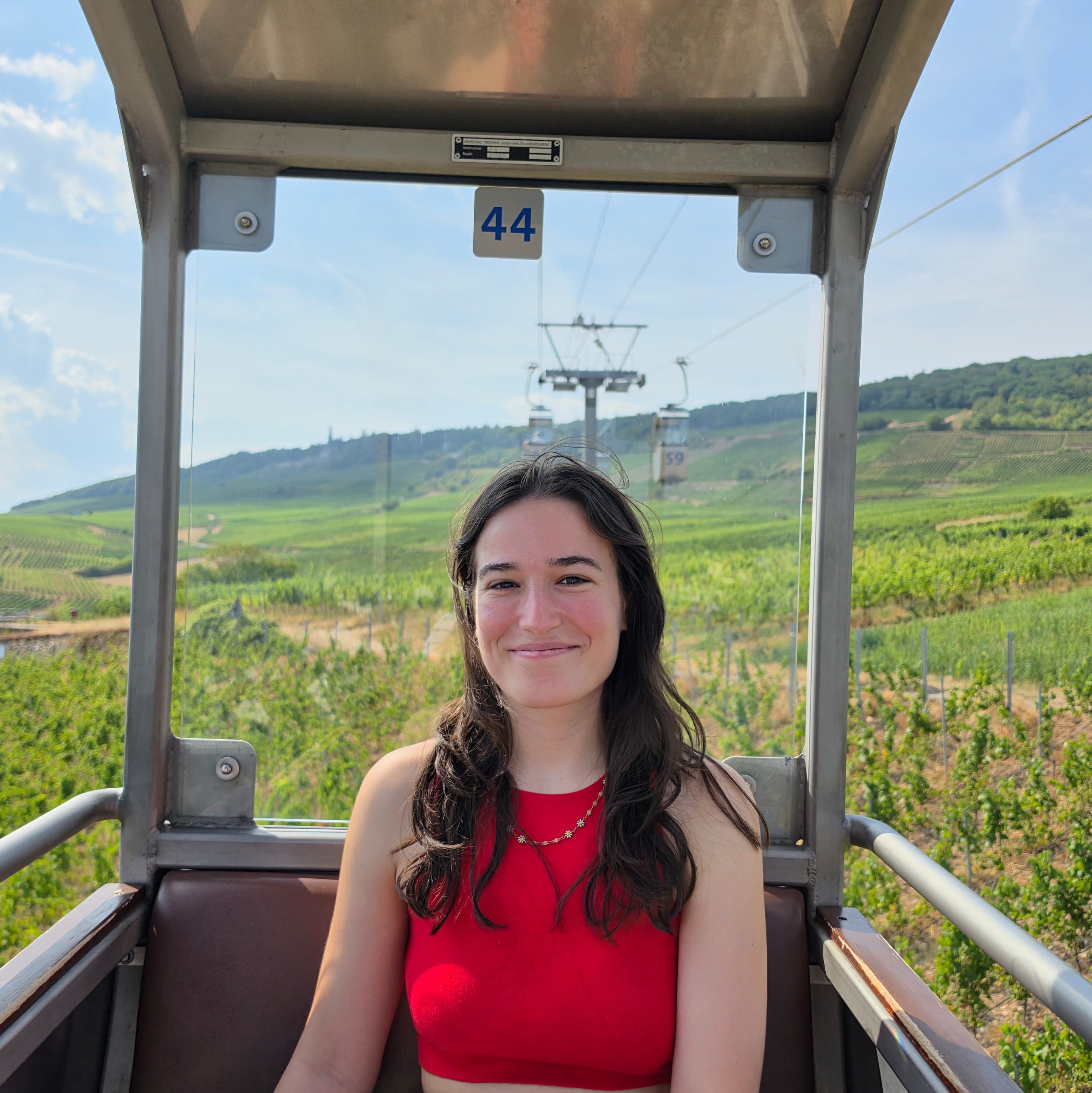
Hi Núria! Please introduce yourself and the various aspects of your creative work.
I’m a designer and artist, a Catalan living in Germany, born too late to know the world without the internet, too early to make viral reels like it’s second nature. I was the kid who always offered to design the Powerpoint presentations in group projects. My favorite thing in school was making notes understandable, visual, and pretty.
Now I design websites, draw, make zines, design posters, express myself with different media, and share all about it.
You’re a big believer in creating digital homes, which can be seen in your interactive digital zine inviting others to create their own spaces on the internet. What first got you interested in digital homes, and why do you think they’re so important to create?
Like all web designers, I love browsing websites for fun and for inspiration. In January 2025, I found myself browsing “personal website” channels in Are.na and exploring internet corners that felt secret and cozy. I wanted such an internet space for myself and deleted Instagram off my phone around that time.
Like so many creatives, I’m someone who can’t just do one thing, so I loved the idea of a place that could combine all interests and projects. Right around then I had to pick a topic for my bachelor degree’s final project, so I decided to combine the world of digital homes with scrollytelling and zine-like websites which is how the Digital Home zine came to life.
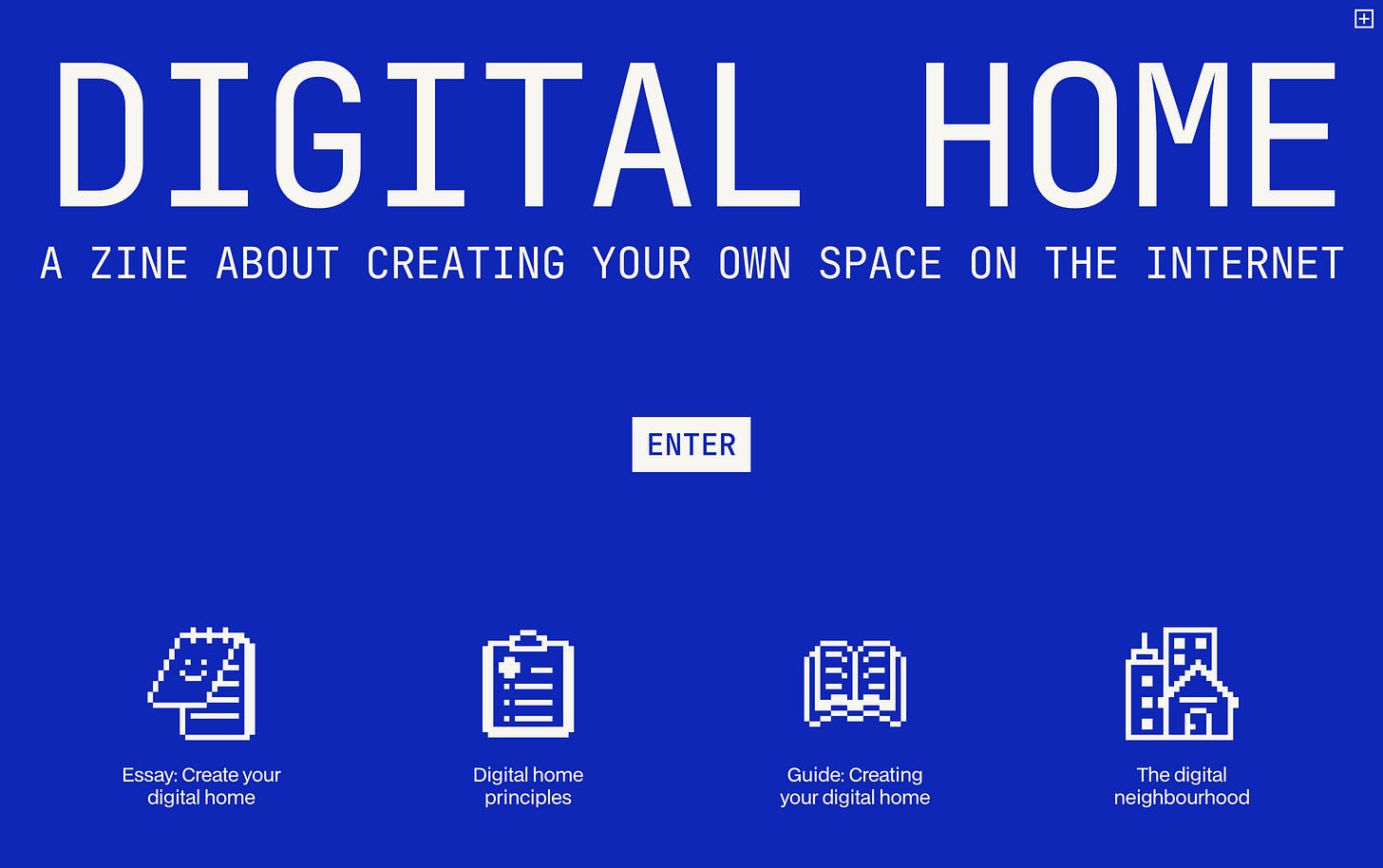
This zine was about encouraging other people to create a space to hold their creative endeavors, but it ended up turning into advice for myself too. While I was writing the essay and making a digital home just for fun, my actual main website was collecting dust. People like Kening Zhu, Laurel Schwulst, and Seth Werkheiser made me rethink and redesign my website after finishing the project and degree, to make it more digital-home-like, more alive, more lived in!
I think it’s important to create digital homes because it’s the only place on the internet where you fully get to decide what goes in it, how you present things, and how you design the experience. Creating and inhabiting a digital home is an exercise of shaping who you are and what you do while sharing it on the internet, which is something that accumulates so much value for others and yourself.
How often do you interact or update your own home, aka your “lived-in website”? Where in your home are you most often found?
I interact with my website at least once a week, even if I don’t post something. I try to prioritize doing and sharing more while avoiding perfectionism, so most updates end up being minor changes or fixes.
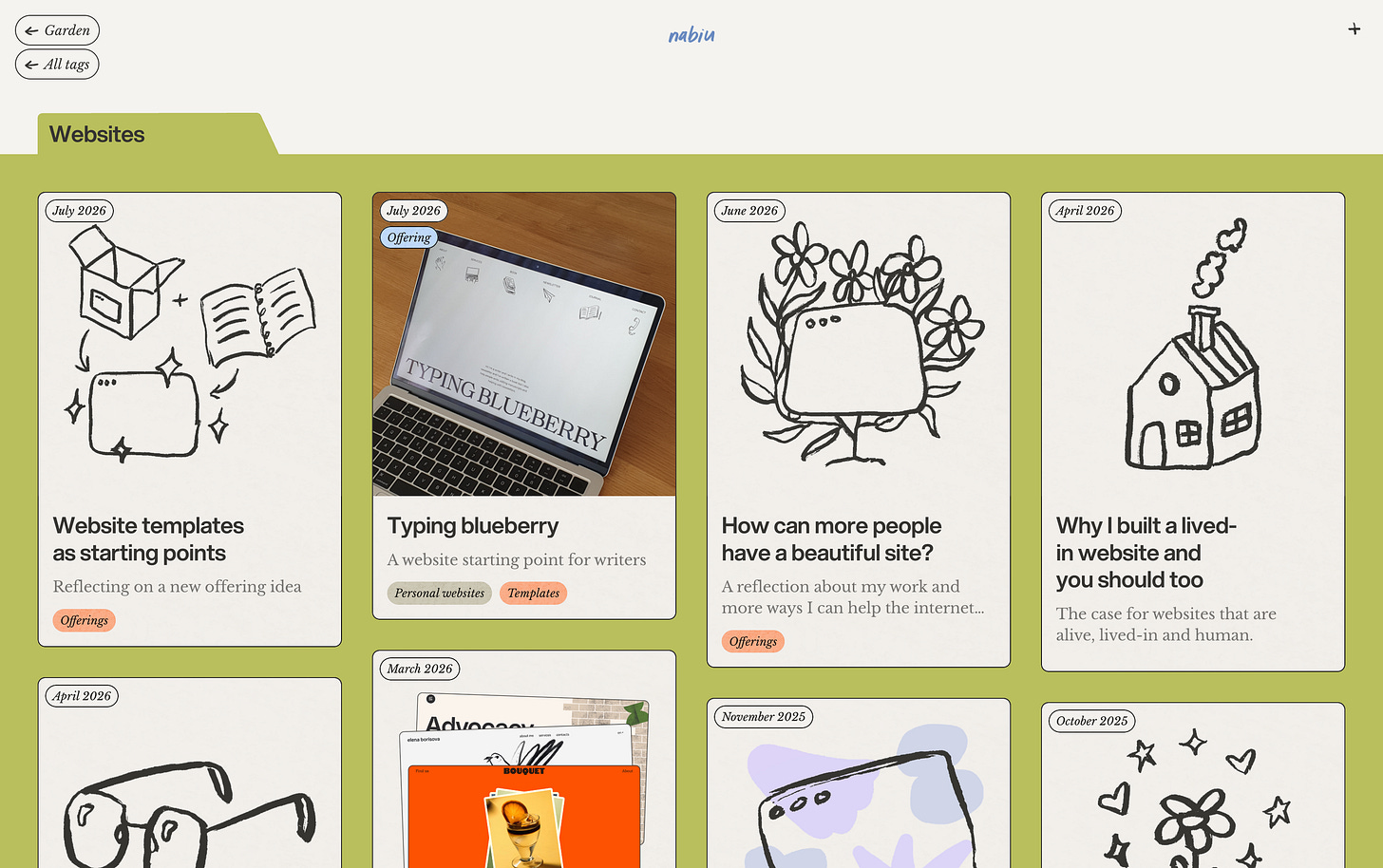
I also try to post in the garden (aka blog) a few times a month. The garden is the most alive part of the site—it’s where I share things I’m working on, things that I keep coming back to, or things I designed, drew or made.
My website is often my grounding compass or anchor. I visit it when I’m uninspired or have been away for some time, and being on my site reminds me of what I’m doing and why. It brings the creative vision back and puts me in the right state of mind.
What tools do you recommend for people as they inhabit their own digital homes? How did you land on using Framer to build yours?
I think the technical aspect of building a digital home can be one of the biggest roadblocks, because it typically requires learning a new skill or choosing the “right” website builder. And there is no right one. Everyone has their own preferences and needs.
As for me, I brought my website to Framer in 2023 and started using it for client websites too. I had tried almost every website builder, and once I learned Framer I found it to be the perfect balance of ease and creative freedom. You can do almost anything. It has a steeper learning curve than Squarespace or Wix, but it isn’t coding, and it gets close to the things you can do with code.
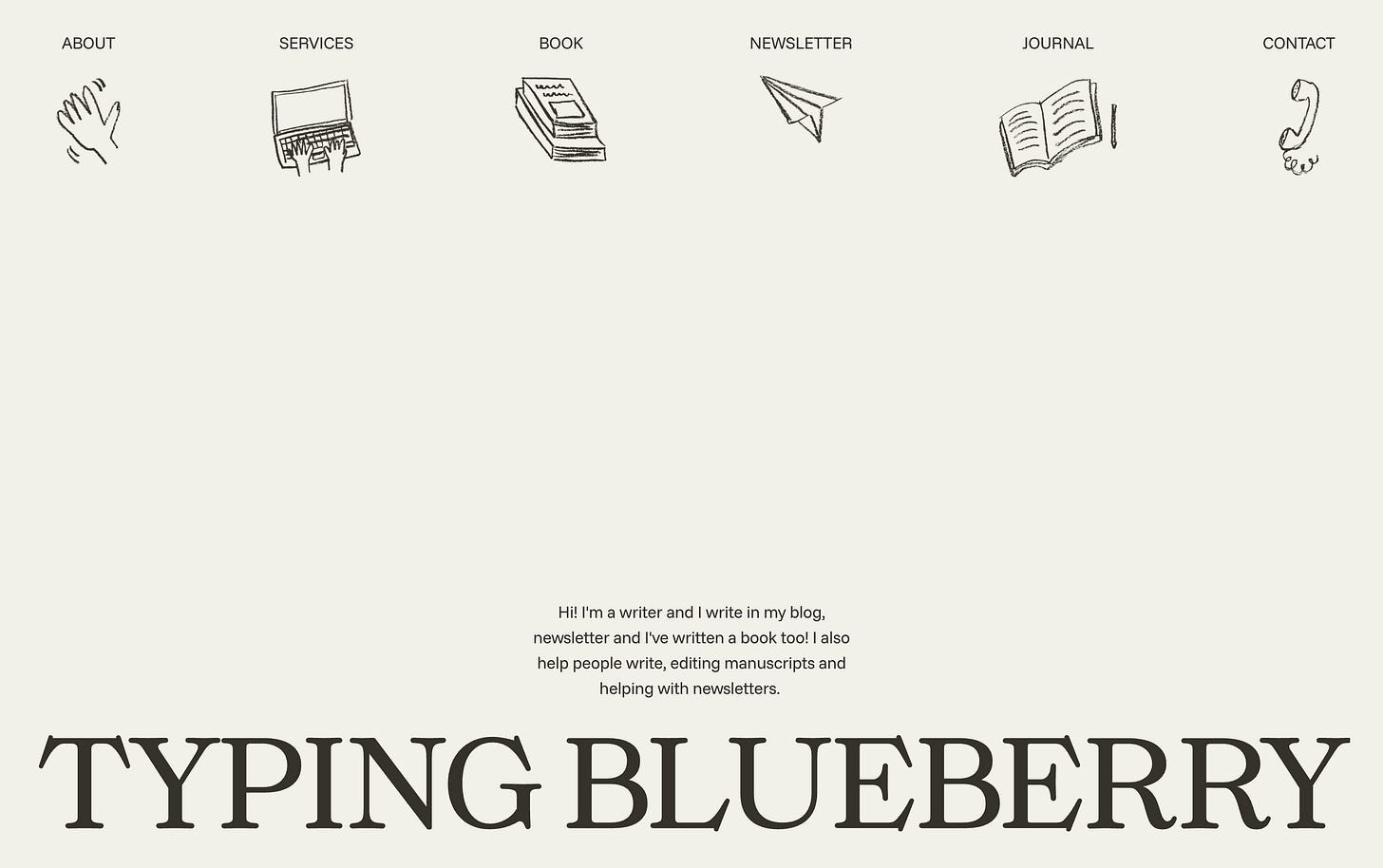
Choosing and learning a new tool can become a project of its own and keep us from actually publishing, stuck in the preparation phase. Preparing feels productive, but it isn't quite the same as just starting. I recently felt inspired to design website starting points—or templates—for those who need help making that start. The goal is to make it less intimidating and more exciting to build their own website. The first template I designed, Typing Blueberry, is built with writers in mind, but it can be for anyone, of course!
Another tool I really recommend is Obsidian. I have a private digital garden/second brain in Obsidian, where ideas, offerings and posts are often born. It’s such a great tool to collect, connect and organize ideas , and it feels like I can generate ideas more organically.
Also, some months ago I got a block of A2 papers and that’s been incredibly great for thinking and idea dumping. Having a giant piece of paper makes me feel like I can tackle anything and often multiplies my ideas. It’s almost like it induces the flow state!
What do you think people find most overwhelming about the process of creating a digital home? Any advice on moving past those blocks?
When I asked this question on Notes, the common thread was that building a website feels like a big, time-consuming project, and we often want it to be “perfect” right away. So we feel paralyzed and overwhelmed and don’t know where to start. I know that feeling all too well.
What changed for me was that I took the pressure off by thinking about what the website could become over time, not what it had to be right then and there. I simplified the design and focused on keeping the website alive—writing on it regularly and updating it with more pages as time went by. It isn’t until now, a whole year later, that I’m updating the design to something that feels more like me.
For those who feel overwhelmed and blocked, my advice is don’t try to figure it all out right away. You don’t need to collect and package all of your creative projects now and make them make sense before building a website. You also don’t need the most impressive website visually. If code is overwhelming, don’t force it—use a no-code tool. Make it easy for yourself to update your website.
Do the minimum to publish it and get excited about updating it and making it grow. Start with what you already have and what you have some clarity on. Get pen and paper and map a minimal website structure. Think of your digital home as a home for you first, and your work and projects as byproducts of you. As you share, you’ll start to see patterns that start to make sense. Then you can start to structure them.
Unlike an actual home, the structure of a website is moldable—the walls aren’t permanent. So you don’t need your dream home right away. You can mold it while inhabiting it.
This interview is part of “Quietly Public”, a series about sharing without performing one’s self on the internet. What does being quietly public mean to you?
To me, being quietly public is about sharing authentically and imperfectly. Performing feels difficult and daunting, full of expectations and perfectionism. It’s much easier, natural and regenerative to show up authentically, even with imperfections and contradictions. Being perfect is boring anyway.
It’s also knowing that people on the other side of the screen are human, just like me, so there’s no need to perform anything. We all have flaws, insecurities, and struggles that we’re figuring out. That takes the pressure off and helps me turn inwards to focus on what it is that I want to say and share with others.
Performing is forcing a narrative before you have clarity on something. Sharing authentically is sharing before you know where something is going, and trusting that it is going somewhere. Even if it ends up going nowhere, it still builds the way forward.
Thank you Núria! You can dive deeper into Núria’s body of work through her website or newsletter. Check out her Typing Blueberry template for an easy way to get started creating your own website. Use code QUIETLYPUBLIC for 15% off!

Over the next few months, I’ll be featuring SEE YOU readers’ websites in my newsletter! Have a website of your own? Click here to submit.
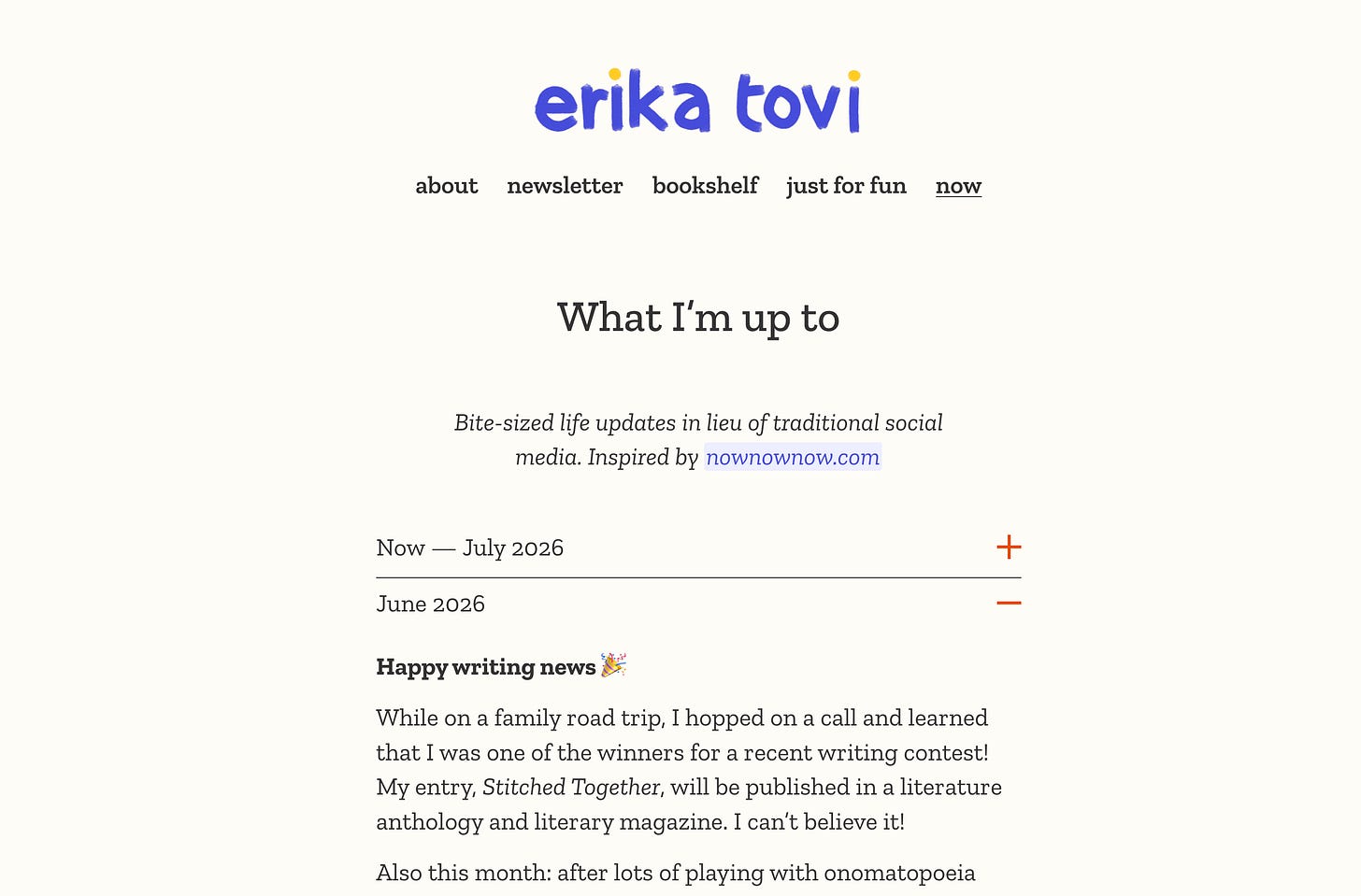
This week’s website feature is from writer and artist Erika Tovi!
What’s your favorite page? Every month, I update my "now page" on my website. It's an unassuming page with an evolving list of what I'm currently up to. I keep my previous entries there so I (and anyone interested) can spot themes in what I've been exploring/working on! I like having this spot to share my projects and interests without getting tangled up in social media.
How has creating your web world been fruitful for your creative practice? I want my website to reflect my personality and creative work without being overly fussy. While it's quite simple by design, I've enjoyed adding nods to my work as a writer for kids and grown-ups. For example: I created a hand-drawn wordmark with a hidden hiragana character (I'm Japanese American!). I also made a fake ISBN barcode for the footer and designed the virtual bookshelf to look like rows of date due slips from the library. These small choices might not be noticeable to most, but they bring me joy and remind me to approach the rest of my creative work with thoughtfulness, sincerity, and PLAY!

Comments
Nothing yet. Say the first thing.
Sign in to join the conversation.