
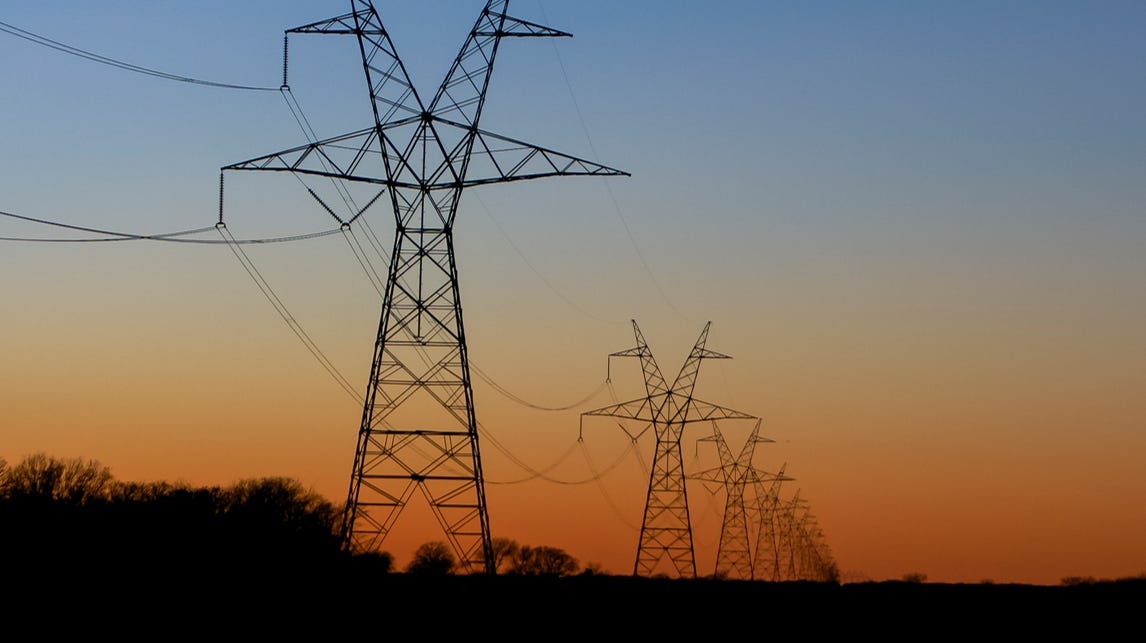
Christopher Cox |The New York Times
Electricity is the modern convenience we most often take for granted. When we flip a wall switch, we expect the light to come on.
However, the electrical grid is the largest, most complex machine ever built, and this machine that forms the foundation of our modern economy is aging, increasingly strained, and surprisingly difficult to repair when something goes wrong.
A new investigation by The New York Times revisits a 2013 rifle attack on PG&E’s Metcalf substation in California and asks a disturbing question: What happens if a localized attack becomes a nationwide grid failure?
The answer is not simply darkness. Water systems, telecommunications, hospitals, transportation, food distribution, financial transactions and fuel supplies all depend on electricity. A prolonged outage could therefore become a cascading crisis affecting almost every part of society.
The recent push to build and equip data centers means that wait times for new electrical equipment is long and were a relatively few key electrical substations to be damaged, it might take months to restart electrical service.
Thanks for reading Climate Tech Venture Review! This post is public so feel free to share it.
A small number of nodes carry enormous consequences. A Federal Energy Regulatory Commission (FERC) analysis found that taking nine strategically important substations offline could potentially trigger cascading failures across America’s three major grid interconnections. The Metcalf attack in California—in what seems like a carefully planned and organized attack—demonstrated that even a relatively small facility could be deliberately hobbled in a matter of minutes.
The replacement problem is becoming a crisis of its own — Large power transformers now have average wait times of 128 weeks, up from less than a year in 2021, with some orders taking as long as five years. Meanwhile, demand for transformers in 2027 is expected to be more than double 2020 levels, driven by electrification, manufacturing and AI data centers.
The grid is entering an unprecedented demand-and-investment cycle — Aging infrastructure needs replacement just as data centers and other electricity-intensive industries are pushing demand higher. The U.S. could spend as much on the grid over the next 15 years as it has over the previous 150.
To put in context, the Metcalf substation repairs took 27 days, despite the wider power system remaining operational and with an unconstrained market for replacement equipment. Experts worry that a nationwide event involving simultaneously targeted, key facilities would create a vastly more difficult recovery challenge.
Thanks for reading Climate Tech Venture Review! This post is public so feel free to share it.
The United States has roughly 55,000 substations and more than 200,000 miles of high-voltage transmission lines. Protecting every component equally is effectively impossible, making resilience increasingly important alongside physical security.
The transformer itself is a remarkable industrial bottleneck. Some large units are individually engineered, can weigh up to 800,000 pounds, and require highly specialized materials, manufacturing skills, transportation and installation equipment.
The article estimates that a severe nationwide event could involve roughly 180 large transformers. At up to $14 million each, replacing them could represent around $2.5 billion in transformer equipment alone, before transportation, installation and wider recovery costs.
You may dismiss the possibility of a mass coordinated attack on key substations, but the underlying and arguably more serious issue is an economic one: a severe mismatch between supply and demand.
The United States is rushing into an electricity-intensive period just as much of its grid infrastructure is reaching the end of its useful life. Data centers, artificial intelligence and the electrification of transportation systems all compete for electrical supply with companies looking to electrify factories and consumers looking to electrify their homes.
Grid operators are simultaneously trying to order replacement equipment for its aging stock while also buying new equipment to fortify its transmission and distribution system to meet increased demand. The uncomfortable truth is that industrial electrical equipment is not an ordinary, fungible commodity product.
Large transformers are highly specialized products, each of which is essentially custom designed and built to meet the specifications of a particular substation. Manufacturing can take months, transportation is complicated by their extraordinary weight, and the supply chain depends on specialized steel, copper, skilled workers and manufacturing capacity.
That creates a dangerous mismatch: Electricity demand is accelerating faster than the infrastructure needed to deliver it.
The technology that could change the equation: One of the most interesting parts of the story is the emergence of solid-state transformers, a topic that we covered in our articles regarding the Iberian blackout of 2025 (see link at end of article).
Unlike conventional transformers, solid-state transformers use power electronics and semiconductor technology rather than relying entirely on the massive steel, copper and oil-based architecture that has dominated the industry for more than a century.
Companies including Ampersand, Heron Power and DG Matrix are developing the technology, while the rapidly expanding data-center industry is creating a powerful early market.
Solid-state transformers could eventually offer more flexible voltage control, modularity and faster response to rapidly changing electricity loads. That matters because AI data centers can create enormous and highly variable electricity demand.
One quote from the article particularly struck me:
When a large language model like Google’s Gemini or Anthropic’s Opus is in training mode, it uses huge amounts of electricity, 500 megawatts or more. When the model switches out of training mode, Dow said, “it’s like the city of Cincinnati turning off every single light instantaneously.”
Conventional transformers cannot handle such a rapid change in demand but solid-state transformers can. We will need many more of these devices the more our economy relies on AI.
Resilience may come from thousands of smaller solutions: The most compelling idea in the article is that the answer may not be one enormous replacement project.
Batteries, distributed generation, storage, microgrids, smarter power electronics and other decentralized technologies could make the grid less dependent on any single vulnerable component.
Energy storage is particularly important because it can provide electricity during periods of peak demand and help smooth sudden changes in load.
The article notes that battery storage is expected to double between 2025 and 2027. That points toward a different model of grid resilience: instead of building one enormous system and hoping nothing breaks, build enough distributed capacity that individual failures do not become systemic failures.
Thanks for reading Climate Tech Venture Review! This post is public so feel free to share it.
The most important lesson here is not that America could experience a catastrophic blackout. It is that resilience is becoming an economic necessity, not merely a national-security concern.
For decades, efficiency shaped how infrastructure was built. Just-in-time supply chains, centralized generation and highly optimized networks reduced costs. But efficiency without redundancy can create fragility.
Climate change adds another layer to the problem. Heat waves increase electricity demand precisely when power infrastructure is under stress, while wildfires, floods, storms and extreme temperatures can damage the systems people increasingly depend on for cooling, water, communications and transport.
The opportunity is to rethink resilience before a crisis forces the investment.
Distributed solar, battery storage, microgrids and modern power electronics are often discussed as clean-energy technologies. They should also be understood as resilience technologies. They can reduce dependence on vulnerable infrastructure and keep critical services running when larger systems fail.
That perspective is especially relevant across one of our author’s home continent of Africa, where unreliable electricity remains a major constraint on economic development. As countries expand their power systems, they do not necessarily have to reproduce the highly centralized model built elsewhere. Distributed energy systems can bring power closer to where it is needed while building resilience into the network from the start.
There is also a striking paradox in the story: AI is putting enormous new pressure on electricity systems, but that same demand could accelerate technologies that make those systems more flexible, distributed and resilient.
The future of electricity may depend less on building one bigger grid and more on building a smarter, more resilient one.
No posts
Comments
Nothing yet. Say the first thing.
Sign in to join the conversation.