
Our changing climate is testing infrastructure, markets, ecosystems and institutions at the same time, while adaptation is becoming less about reacting to individual disasters and more about preparing for a fundamentally different baseline.
The question is no longer simply how much the climate will change. It is whether the systems we depend on can change fast enough with it.
One article to especially highlight this week is the New York Times’s feature entitled 3 Charts That Explain El Niño, in the Climate Science section.
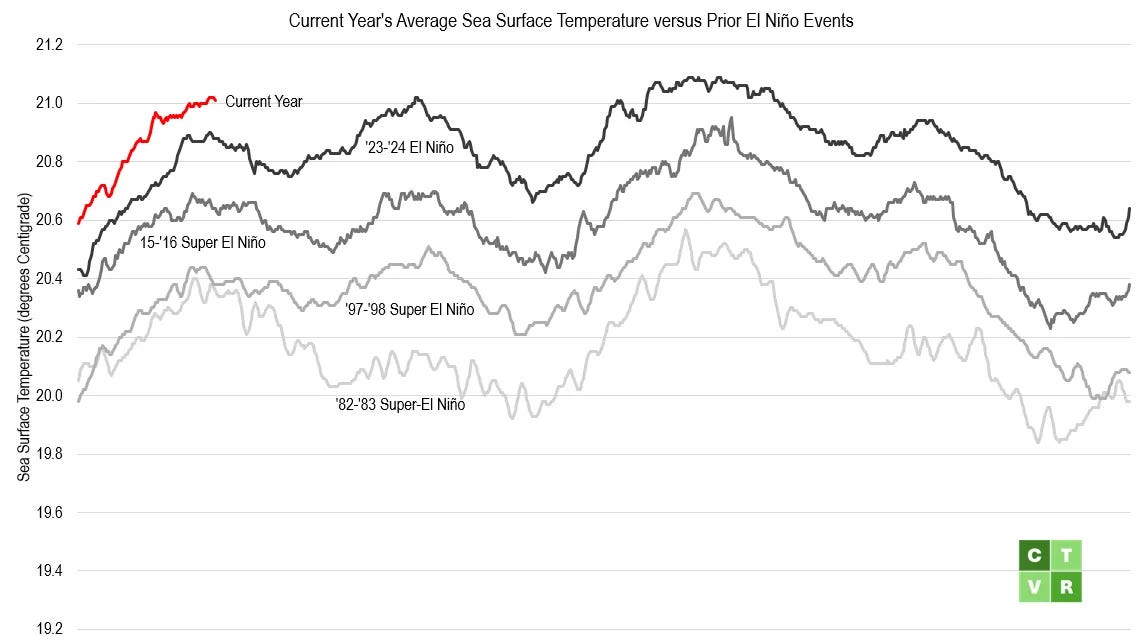
We wrote about the emerging Super El Niño and published the chart above in early July—it provides another sobering look at sea temperature data not captured in the Times’s feature. Please read the accompanying CTVR article as well: The World is in Hot Water!
Thanks for reading Climate Tech Venture Review! This post is public so feel free to share it.
“Power systems face growing risks from climate change and future extreme weather, yet existing resilience frameworks remain event-based and must be rethought for long horizons. Long-horizon resilience reframes resilience from an event-specific outcome into an integrated cross-system property, describing how a power system will perform across evolving climate conditions and uncertain extreme weather events rather than under any single event.” (Nature)
See also our Newsfeed from last weekend: America’s Power Grid Is Running Out of Slack
A new system to convert urine into fertiliser has been trialled at festivals in the UK over the last couple of years by sustainable waste management company NPK Recovery, including at Boomtown and All Points East. Elsewhere, water treatment organisations such as MTD and Azuvia (FR) provide grey water processing and recycling units that can make grey water safe to use for irrigation – and dust suppression. These technologies are increasingly necessary as water shortages and dust become frequent issues for events. (Festival Insights)
“This year’s El Niño is already intense, and it’s not done growing. Scientists expect that by December, when El Niño events typically reach their peak, this one will wind up as the strongest in at least 80 years of precise record keeping. And perhaps as the most powerful in centuries.” (The New York Times)
“The world’s oceans are hotter than ever recorded, new data suggests, as they suffer from human-caused climate change and the growing El Niño weather phenomenon. The average surface temperature of the planet’s seas outside the polar regions hit 21.1C (70F) on Saturday, according to figures from the European Copernicus climate change service. That edges past the 21.09C recorded on three separate days in March 2024, and is far above average for the time of year.” (BBC News)
“Our findings confirm how important pollinators are for agriculture—and how closely biodiversity and climate adaptation are linked,” says Paula Prucker, a doctoral student at TUM and first author of the study. “Strategies for adapting to climate change should therefore not only take into account the climatic requirements of various crops but also specifically and sustainably support pollinators.” (Phys.org)
“One of the study’s key findings is that wheat stands out from other crops. The relationship between water scarcity and price proved far stronger for wheat than for maize, while researchers found no comparable relationship for rice.” (Phys.org)
“Scientists from Spain and Germany investigated how higher water temperatures affect the dissolved organic carbon released by seagrasses and marine algae. The results show that as temperatures rise, the proportion of dissolved organic carbon that persists in the ocean over long periods and therefore contributes to long-term carbon storage declines significantly.” (Phys.org)
“Savannas cover around one-fifth of Earth’s land surface and contribute to around 30% of global plant productivity. While increased grass growth may sound positive, researchers warn it could have complex, wide-ranging consequences: Fire risk: More grass can increase the fuel available for savanna fires. Wildlife: Increased vegetation can provide more forage for animals, altering wildlife distribution. Carbon storage: Extra grass does not automatically mean more long-term carbon storage.” (Phys.org)
“Katja Matthes, director of the GEOMAR Helmholtz Centre for Ocean Research Kiel in Germany, believes…her fellow scientists need to communicate that climate change is not only a threat, but an opportunity to find solutions. “We need to change our narrative and expand our strategic alliances with those who are willing,” she says, “and luckily there are a lot of willing people and countries.” (Science Business)
“Nevada sued the federal government on Monday to block officials from cutting its share of the Colorado River, launching the first major legal fight over the Southwest’s dwindling water supply. The state asked the U.S. District Court in Nevada to order the Bureau of Reclamation to rescind plans that would cut water allocations significantly for Nevada, California and Arizona over the next decade if the river basin continues to dry up.” (The New York Times)
“Between 2021 and 2025, climate coverage in media decreased by 38%. In June this year, the UK recorded its then-hottest month on record, but more than 70% of the coverage didn’t mention climate change at all. The net-zero policies designed to address the challenge were hardly mentioned, except by outlets frantically peddling misinformation.” (Reuters)
“But our climate is changing. This summer’s heat is a harbinger of the new normal. Green fields are yellow and parched. Plants in the UK flower around a month earlier than they did hundreds of years ago, because of global heating. Those singing cuckoos are now on the red conservation list. We’re facing future ecosystem collapse – and it’s already happening now. If the future of England’s green and pleasant land is precarious, then so might be the stories we tell about ourselves.” (The Conversation)
“Angola’s peatlands, which regulate water flow in southern Africa’s biggest river systems and store climate-warming carbon, are at least four times larger than initially thought, a new study showed.” (Bloomberg)
“Climate change is driving up fire activity across Europe as hot, dry and windy conditions become more severe,” said Maik Billing, researcher at PIK and lead author of the study published today in Global Change Biology. “Our results indicate there could be widespread increases in burned area even under comparatively low warming of around 1.8°C. But if we emit more, and global temperatures rise by roughly 3.6°C, we see fires become much more prevalent, especially around the Mediterranean and across much of Western and Central Europe, including areas that have not experienced many fires to date,” Billing added.” (Phys.org)
“The Danube River, spanning 10 European countries, has seen record-low water levels this summer, causing power plants to shut down due to a lack of water. A recent United Nations report has warned that the world is in a state of “water bankruptcy,” as more than half of the planet’s large lakes have declined in storage size since the 1990s.” (The Conversation)
See also: AI’s Hidden Water Footprint
“This year has proven difficult for the normally lush canopy, though, as five successive heat waves and a serious lack of rain have strained plants and wildlife. And it’s projected to get much worse for the city’s eight million trees. By the end of the century, according to a recent report from Royal Botanic Gardens Kew forecasting the vulnerability of London’s urban forest, some 73 per cent of the city’s trees could be at risk of dying due to climate change.” (CBC News)
See also: Forests Still Look Alive. Something Beneath Them Isn’t and The Forests Are Burning—and so is Our Climate Buffer
Thanks for reading Climate Tech Venture Review! This post is public so feel free to share it.
No posts
Comments
Nothing yet. Say the first thing.
Sign in to join the conversation.