
I’m the kind of person who thinks about Three Mile Island at odd hours. Not because of what it changed, but because of how it happened.
It starts in the part of the plant that isn’t nuclear at all. Feedwater pumps trip, the turbine trips, and the steam generators stop pulling heat off the reactor. Auxiliary feedwater starts automatically, exactly as designed, and moves nothing—because two block valves in its lines had been incorrectly left closed after maintenance two days earlier. By many accounts, the indicator light that would have said so was sitting behind a maintenance tag hung on the panel. Regardless, eight minutes pass before anyone notices the valves are shut.
Pressure climbs and the relief valve opens on cue, and then fails to close when pressure falls back. An indicator light reports it shut, because the light was wired to the signal sent to the valve rather than to the valve itself. That one’s an engineering mistake.
The pressurizer gauge is worse: it was accurate. Level really was rising, because coolant escaping through the open valve left steam voids that pushed water upward—so the one instrument telling the truth told operators the system was about to go solid and lose pressure control. They throttled back the emergency injection that was the only thing replacing what they were losing.
What follows is a chain of reasonable decisions. Coolant kept leaving for two hours and twenty-two minutes before anyone thought to close the block valve upstream of it. The reactor coolant pumps began shaking hard as they tried to move a mixture of steam and water, so the operators shut them down, which ended circulation. What was left boiled off. The top of the core uncovered, the fuel cladding reacted with steam and made hydrogen, and something close to half the core melted into the bottom of the vessel, which held. The operators did exactly what their instruments told them to do. That’s how you get twenty tons of fuel on the floor.
You can imagine that a CRS nuclear energy compendium was always going to hold my attention longer than strictly necessary. It is a reference document about a technology whose entire regulatory apparatus exists because small things compound, and because nobody inside the system can see it happening. This concept applies across all three August 5 CRS products below.
Which is as good an excuse/transition as I’m going to get to point you toward Interwoven Chaos, whose author appears to think about all of this the way I do, only more rigorously. Recent posts: what chaos theory can teach risk managers, what the wreck of the Exxon Valdez can teach AI risk management, path dependence as organizational vestigial organs, and why the rise of the hallucination excuse is an existential risk. Full disclosure, I’m cited a time or two. If any of these things sound like your kind of problems, go give her a follow. You may tire of seeing me daily, but you’ll be eager when one of her posts shows up each Thursday. I know I am!
I’m off to find my paperback copy of Jurassic Park.1
Title: Freight Rail Automation: Driverless Trains, Automated Inspections, and Other Technologies
Report No. IF13282 | Type: In Focus | Date: August 5, 2026, version 1
CRS Author(s): Ben Goldman, Analyst in Transportation Policy | Official Congress.gov copy
I’m excited to see this product. WCSBR covered Freight Rail Safety Issues in the 119th Congress on July 25th and I’ve been thinking about one part of it since. That report described the crew-size fight as a labor-versus-automation argument being litigated inside a surface transportation bill. This product covers that automation half.
Two bills pending in the 119th Congress would push freight rail automation in opposite directions at the same time. The Remote Control Locomotives Safety Improvement Act of 2026 (H.R. 9409) would ban remote control locomotives from main lines and require a human engineer physically inside the control cab of any train operating outside a rail yard—language broad enough to block the autonomous railcars two U.S. companies are currently developing. The BUILD America 250 Act (H.R. 8870), the surface transportation reauthorization ordered reported to the House, would direct the Secretary of Transportation to consider rules specifying performance objectives rather than a required manner of compliance, which would tend to make automated inspection easier to adopt.
Underneath both bills is a regulatory action that already happened. In December 2025, the Federal Railroad Administration (FRA) approved a waiver letting railroads reduce how often they visually inspect track in areas where automated track inspection is in use, for up to five years and subject to performance and reporting conditions. Railroads never needed permission to deploy the technology. They needed permission to do less of the thing it supplements. Supporters call automated inspection a complement to human inspectors. Opponents point out that most defects human inspectors find are not the kind current automated equipment detects. The Secure Tracks Act (H.R. 7784, S. 3987) would codify minimum inspection frequencies and restrict FRA’s ability to waive them.
The report’s one hard dataset concerns remote control locomotives, which FRA has regulated since 2012 and capped at 15 miles per hour. In 2025, roughly 25% of accidents in rail yards involved an RCL, compared with 13% of accidents overall and under 1% on main line track. A 2006 FRA study found RCL operations produced more accidents than conventional operations industry-wide, but roughly equivalent safety performance on the major railroads that used the technology most.
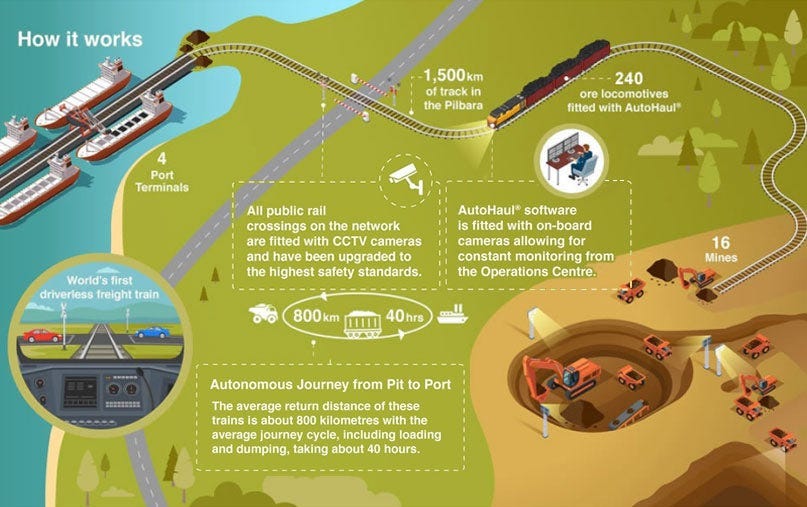
The affirmative case for driverless long-haul freight relies on one example: Rio Tinto’s AutoHaul, running a roughly 1,200-mile private network connecting 18 iron ore mines to 2 seaports in Western Australia, monitored from Perth nearly 1,000 miles away.
One paragraph builds the Rio Tinto example and the next paragraph takes it back apart. The system is privately owned, has few branches or interchanges, sits in sparsely populated country with few grade crossings, carries one commodity, and hosts no passenger traffic, making it resemble a transit line more than a freight network. The U.S. system has nothing comparable on long-haul routes.
Congress is now setting national automation policy for freight rail through a reauthorization bill, a waiver nobody voted on, and a ban that would incidentally kill a technology still in testing. Also, still no pictures of trains provided, so instead please enjoy this promotional sales infographic from Hitachi Rail STS demonstrating the Rio Tinto AutoHaul system.
Title: Nuclear Energy: Overview of Congressional Issues
Report No. R42853 | Type: Report | Date: August 5, 2026, version 43
CRS Author(s): Mark Holt, Specialist in Energy Policy | Official Congress.gov copy
Three weeks before this version published, the Nuclear Regulatory Commission proposed removing the requirement that licensed nuclear facilities keep radiation doses as low as reasonably achievable. ALARA has organized U.S. radiation protection for decades: it obligates operators to push exposure below the legal ceiling wherever doing so is practical. The July 15, 2026 proposal would replace it with fixed dose limits and an exemption process. NRC’s draft regulatory analysis frames the change as cost savings that keep exposure within safe limits. The Union of Concerned Scientists characterizes it as permitting higher exposure for workers and the public in order to reduce industry costs.
That proposal is one entry in a deregulatory sequence this report documents inside a single year. NRC finalized its new advanced reactor licensing framework at 10 CFR Part 53 on March 25, 2026. It launched a faster environmental review process on March 23 that it expects will cut agency review time by half. On March 3 it proposed compressing adjudicatory hearings toward an 18-month licensing clock. On June 26 it proposed loosening drug and alcohol testing, spent fuel storage security, and clearance requirements. On July 7 it proposed narrowing the scope of NEPA review. On July 14 the House Energy and Commerce energy subcommittee approved five more bills in the same direction.
The through-line is the ADVANCE Act of 2024 and the four executive orders President Trump signed on May 23, 2025. The orders set goals of starting construction on 10 large reactors by 2030 and quadrupling U.S. nuclear capacity to 400 gigawatts by 2050, against roughly 97 gigawatts operating today. One order directed DOE to approve at least three test reactors under its own Atomic Energy Act authority, bypassing NRC licensing entirely, targeting criticality by July 4, 2026. Four reactors met the deadline.
Elsewhere in the fuel cycle and waste sections: DOE awarded $2.7 billion to three uranium enrichment companies on January 5, 2026. The United States signed a 123 Agreement with Saudi Arabia on July 22, 2026—an agreement Congress has conditioned Export-Import Bank financing on since FY2020, contingent on Saudi renunciation of enrichment and reprocessing. On waste, DOE invited states on January 28 to host Nuclear Lifecycle Innovation Campuses; twenty-six applied, and Idaho, Louisiana, Oklahoma, Tennessee, and Utah were named finalists on July 28. Yucca Mountain remains the only site authorized for permanent disposal and has received no appropriation since FY2010.
Underneath everything above sits about 99,000 metric tons of spent nuclear fuel, growing by roughly 2,200 metric tons a year, sitting at the reactor sites that produced it. That was never the plan. When these plants were built, the fuel was supposed to leave—either for reprocessing into new fuel or for permanent burial. Neither arrived. Reprocessing never became commercial in the United States, for cost and weapons-proliferation reasons both, and no disposal site has ever been successfully sited.
So the buildout described above is going up on top of a waste system that is, functionally, the parking lot. Yucca Mountain is still the only site Congress has authorized and still has no money. DOE’s workaround—asking states to volunteer to host Nuclear Lifecycle Innovation Campuses—drew twenty-six applications and five finalists inside six months, which is more movement than the previous three decades produced. It is also five states that have not yet been asked to accept anything specific.
One caution on using this report: it contradicts itself in at least four places, including the year the South Carolina reactors were canceled (2017 vs 2019), the year of a DOE fact sheet (2025 vs 2026), the public law number of the FY2026 appropriations act (P.L. 118-74 vs 119-74), and the chamber status of H.R. 3978. None of it changes a conclusion. Check any specific date, law number, or bill status before you quote it.
Title: Taiwan: Background and U.S. Relations
Report No. IF10275 | Type: In Focus | Date: August 5, 2026, version 90
CRS Author(s): Susan V. Lawrence, Specialist in Asian Affairs | Official Congress.gov copy
WCSBR has covered related products—IF12481 on June 5 and again on June 23, and IF11665 yesterday—but never the foundational primer itself, now at version 90.
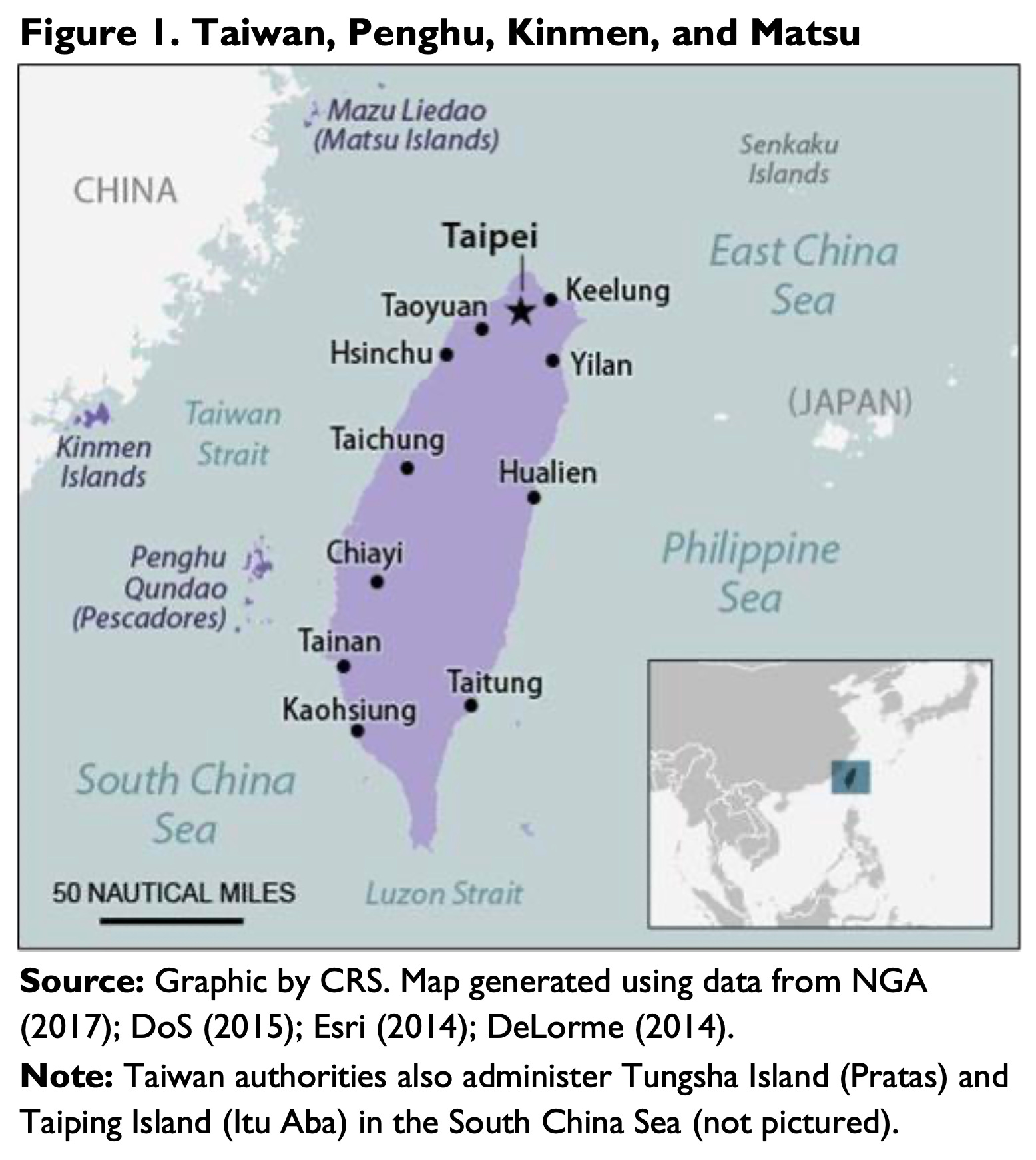
In December 2025 the second Trump Administration announced an $11 billion arms sales package for Taiwan, the largest by value in the history of the relationship. A $14 billion follow-on package has not been approved. Speaking to Fox News from Beijing during a May 2026 summit with PRC leader Xi Jinping, President Trump said he was holding the second package in abeyance and called it a very good negotiating chip with the PRC. In the same interview he alleged that Taiwan President Lai Ching-te wants to go independent, said he was not looking to travel 9,500 miles to fight a war, and said he wanted both Taipei and Beijing to cool down. Returning from Beijing, he told reporters he and Xi had discussed Taiwan arms sales in great detail.
Under questioning at June 2026 budget hearings, Secretary of State and National Security Advisor Marco Rubio told Members the $14 billion package remains under review, that the United States does not consult the PRC on these sales, and that U.S. policy on Taiwan did not change on the trip.
The report also records the January 2026 trade and investment deals setting a 15% U.S. tariff on Taiwanese goods with exceptions, against Taiwanese pledges to invest $500 billion in the United States, and the Legislative Yuan’s May 2026 approval of $25 billion of the $40 billion special defense budget Lai’s administration proposed in November 2025. Taiwan holds local elections on November 28.
Holding an arms package “in abeyance” means Taiwan does not receive the weapons and nobody has said no. Nothing is canceled, so there is nothing to protest and no decision to appeal. The President has said publicly what the package is doing instead: serving as leverage in negotiations with Beijing over other matters. The weapons were sold to deter an invasion. At the moment they are working as a bargaining position.
The 1979 law that governs this relationship is why that matters. The Taiwan Relations Act commits the United States to making available whatever defense equipment Taiwan needs to defend itself. The quantity was meant to be set by what Taiwan requires. It was not meant to be set by what Beijing will trade to keep Taiwan from having it.
Taiwan is meanwhile trying to spend its own money on the same problem and struggling to. President Lai’s party does not control the legislature—the two opposition parties do, together—and they approved $25 billion of the $40 billion he asked for after months of delay. Voters go to the polls in November. Every side of that fight has been budgeting against an American supply line whose terms the President of the United States has now publicly described as negotiable.
Share this with anyone who assumed spent fuel went somewhere.
Share What Congress Should Be Reading
AI Disclosure: Claude Opus 5 (Anthropic) handled the WCSBR archives, proposed triage and tier assignments, drafted all Synopsis and Commentary text, built the metadata blocks, wrote figure alt text and captions, and ran final fact-checking against the source materials. Charlie Amiot supplied the source materials, directed coverage and sequence, wrote the opener and the footnote, and recursively edited throughout. Charlie Amiot holds final responsibility for all accuracy and editorial judgment. AI use is disclosed in every post.
I may or may not own more than five copies of Michael Crichton’s world-influencing novel, Jurassic Park. Spielberg’s adaptation of it into a movie was, make no mistake, outstanding. There are few movies that have stood the test of time, particularly in special effects, better than that. It is a reliable crowd pleaser, inescapable in modern life. But the book? Hammond gets what he always should have gotten, and you get to experience the river and find out what made the Triceratops sick. What, you never wanted to know?
Comments
Nothing yet. Say the first thing.
Sign in to join the conversation.