
At roughly 2am I got a very small local LLM installed and running on my own machine, watched it produce actual sentences, and then made myself log off and go to bed.
I am extremely thankful for a very light CRS publishing schedule this week, especially coming off last week—WCSBR covered 46 products published last week by CRS. To everyone who has stayed current reading these emails: I appreciate you.
I’ll see y’all sometime tomorrow. How far into tomorrow depends entirely on how far into the LLM hole I go. The weather here is nasty and getting nastier, so I have my fingers crossed that BGE keeps the power on long enough for me to do both things.
Title: Trump Administration’s Proposed Changes to Remote Firearm Purchases and Transfers
Report No. IN12725 | Type: Insight | Date: August 6, 2026, version 1
CRS Author(s): Jordan B. Cohen, Analyst in Firearms Policy | Official Congress.gov copy
Two proposed rules are moving in parallel, and CRS treats them as one story because they land in the same place. The first, published by USPS on April 2, 2026 at 91 Federal Register 16601, would rewrite Publication 52 to declare that lawful firearms—pistols, revolvers, shotguns, and rifles—are mailable in- and out-of-state. The governing statute, 18 U.S.C. §1715, says the opposite: firearms capable of being concealed on the person are non-mailable and may not be carried by the mails at all. USPS does not dispute this. It cites a Department of Justice Office of Legal Counsel memorandum opinion on the Second Amendment as its reason for issuing a regulation inconsistent with the statute.
Because non-licensee owners are not required to run background checks before selling a firearm, the practical effect is that a handgun could be delivered to a residence with no check performed by anyone. FedEx and UPS accept firearm shipments only from federally licensed dealers, and DHL refuses them entirely, so USPS would become the only carrier in the country that will mail a handgun. Advocacy groups have raised both the background-check gap and the risk of weapons being misdelivered, stolen, or lost in transit.
The second rule, an ATF notice of proposed rulemaking at 91 Federal Register 25216,1 revises Non-Over-The-Counter transaction requirements. It would eliminate the NICS-exempt transfer condition, permit background checks to occur somewhere other than a licensee’s place of business, and let licensees verify a buyer’s identity and eligibility remotely. Licensees would still have to run the check. ATF estimates the change could benefit 3.28 million purchasers, save 3,988,620 hours of travel and time on licensee premises, and cut $103.7 million per year in costs.
USPS is not arguing that §1715 permits this. It is arguing that an executive branch legal opinion about the Second Amendment justifies a regulation the agency concedes is inconsistent with the statute, and the rule does not ask Congress to amend anything. That is the structural fact here, and it will outlast whatever happens to handgun shipping.
The two rules do not do the same work, though they are presented as one package. ATF’s rule keeps the background check and moves where it happens. The USPS rule opens a channel with no dealer in it at all, which is where the no-check outcome actually originates.
Congress’s near-term options are the ones it always has with a proposed rule—comment, oversight, the Congressional Review Act after finalization—plus one it does not usually need: §1715 is its own statute, and it is still on the books saying what it says.
On a personal note: I find it infuriating that we may be heading to a future where the Postal Service is cleared to deliver a handgun to someone nobody ran a check on, while the right to vote by mail is under attack.
Title: China-Sub-Saharan Africa Ties and U.S. Policy
Report No. R49080 | Type: Report | Date: August 6, 2026, version 2 (New)
CRS Author(s): Nicolas Cook, Specialist in African Affairs; Lauren Ploch Blanchard, Specialist in African Affairs; Michael D. Sutherland, Analyst in International Trade and Finance | Official Congress.gov copy
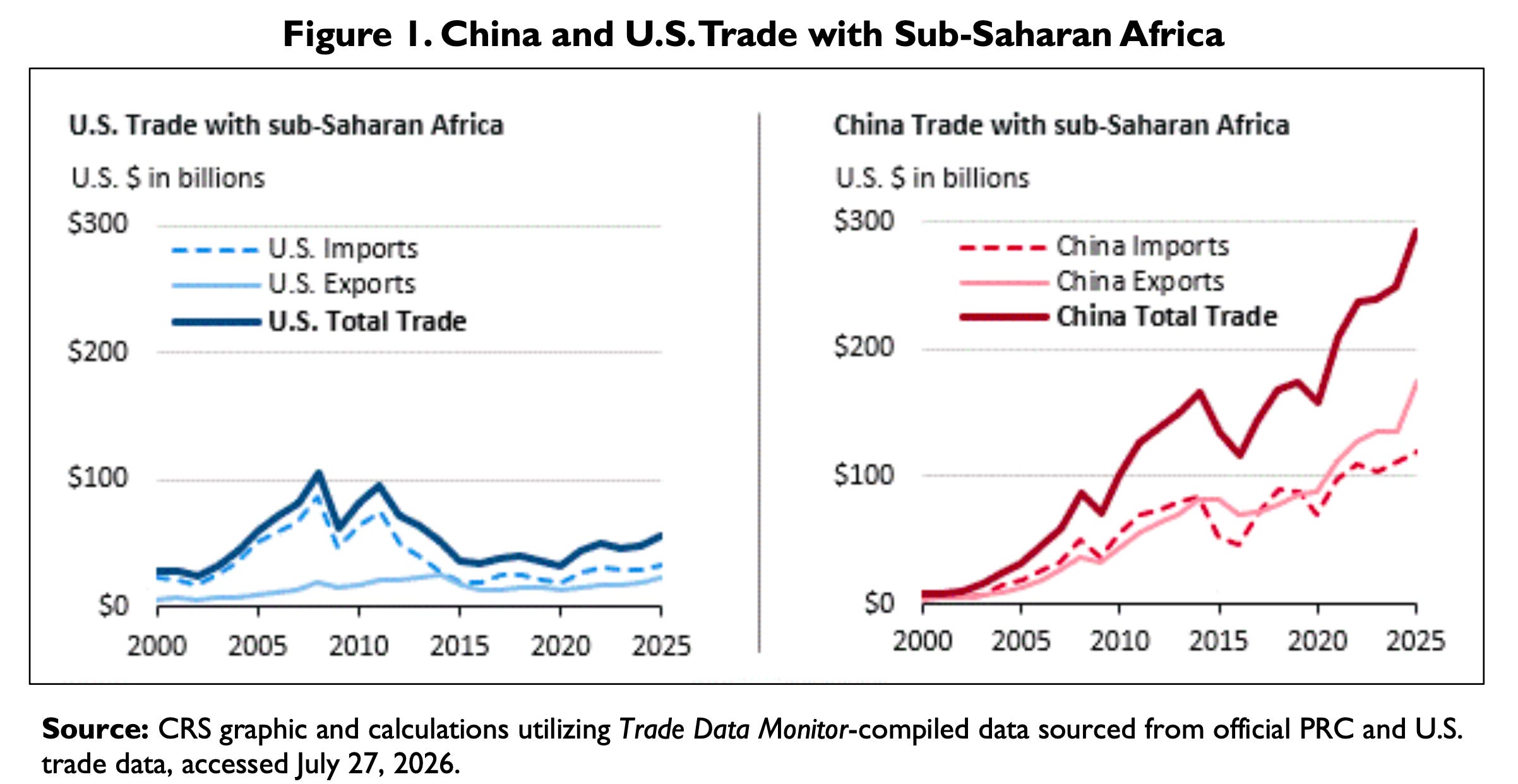
CRS has published a full accounting of the China-Africa relationship in the same year that Congress extended the African Growth and Opportunity Act for twelve months and China extended tariff-free access, effective May 1, 2026, to every African country except Eswatini. Total China-Africa goods trade first passed U.S.-Africa trade in 2009. In 2025 it was four times larger. South Africa, Nigeria, and the Democratic Republic of the Congo are China’s biggest trading partners on the continent; the United States trades with the first two as well, at a fraction of the volume.
The investment and lending picture is more complicated than the trade lines suggest. China holds more direct investment in Africa than the United States does, but the position is a rounding error inside China’s own global portfolio—1.4% of its worldwide investment stock. Lending has fallen off a cliff. It peaked a decade ago, collapsed by 2021, and since 2020 China has been a net debt collector in the region rather than a net lender. It remains the largest bilateral creditor to the region, and African governments owe it close to a tenth of their total external debt.
Minerals are where the dependency runs the other direction. In 2025 Africa supplied 99.9% of China’s cobalt ore imports, 91% of its chromium, and 86% of its natural graphite. Chinese firms control several of the DRC’s largest copper-cobalt mines; CMOC’s production surge drove global cobalt prices down far enough that Kinshasa imposed export controls in 2025. On security, China opened its first overseas base in Djibouti in 2017, next door to the only permanent U.S. base on the continent, and the Defense Department reported last year that Beijing has discussed a second one in Gabon and has looked at eight other countries besides. Roughly a third of the Chinese-linked seaport projects tracked worldwide are in Africa, and most of those were judged to have dual-use potential. AFRICOM’s 2026 posture statement calls a PLA base on Africa’s west coast a direct threat to the U.S. homeland.
African publics are, on the whole, not alarmed. A 2026 Afrobarometer analysis of surveys in 38 countries found more respondents saw China as a positive economic and political influence than said the same of the United States—62% versus 52%.
The most useful number in the report is the smallest one. Chinese FDI stock in Africa is 1.4% of China’s global FDI stock. Whatever Beijing is doing on the continent, it is not primarily a balance-sheet exercise, and the influence is wildly out of proportion to the money committed.
The debt-trap frame is also close to backwards now. Lending collapsed years ago and China spends its time collecting. The live leverage question is not what new loans buy, it is what the confidentiality clauses, revenue escrows, and repayment priorities on the existing $77.6 billion allow—which is the part nobody outside the contracts can see.
This report catalogs the dismantling of USAID, the shuttering of Voice of America’s Africa services, the absence of country-specific aid requests for most of the region, tariff surcharges, and entry restrictions. It catalogs Chinese positioning in adjacent paragraphs. It’s not hard to connect this information. Congress renewed, for twelve months, the deal that lets goods from qualifying African countries in duty-free. The other offer on the table didn’t need a vote.
Title: The Universal Service Fund’s Lifeline Program and High Cost Program: Current Regulatory Activity
Report No. IF13283 | Type: In Focus | Date: August 6, 2026, version 1
CRS Author(s): Patricia Moloney Figliola, Specialist in Internet and Telecommunications Policy; Colby Leigh Pechtol, Specialist in Telecommunications Policy | Official Congress.gov copy
WCSBR covered the revenue side of the Universal Service Fund on July 31, when CRS published on the shrinking contribution base that funds it. This is the spending side, and two of the four programs are in active rulemaking right now. Comments on the High Cost proceeding closed on August 4.
The Lifeline proceeding, adopted February 18, 2026, is under FCC consideration with the comment record closed since June 2. Its stated motivation is a January 2026 Inspector General finding that between 2020 and 2025, providers in states running their own eligibility databases received about $5 million disbursed on behalf of deceased individuals and $5.5 million for duplicate enrollments. The proposals go well past that. The FCC would limit benefits to U.S. citizens and immigrants holding “qualified alien” status under the 1996 welfare law, with a five-year waiting period for the latter; eliminate the remaining state opt-out arrangements, which would force Oregon and Texas onto the National Verifier; add address-level controls to catch duplicate households; and it asks whether to keep supporting voice-only service at all. Consumer advocates warn the address controls will hit group homes, assisted living facilities, domestic violence shelters, and multifamily housing, where legally separate households share one mailing address. Immigration advocates have noted that undocumented individuals are already ineligible for Lifeline under current rules.
The utilization figures come from the Universal Service Administrative Company, which runs the fund day to day: roughly 37.6 million households were eligible on 2024 data, and about 8.2 million were enrolled as of March 2026, a participation rate near 22%. The monthly benefit of $9.25 has not changed since 2016, and no comparable federal broadband affordability program has existed since the Affordable Connectivity Program ended in June 2024. Two bills are live in the 119th Congress pointing opposite directions: the No Lifeline for Dead People Act (H.R. 7963/S. 3954) would mandate the National Verifier and reverify current enrollees, while the Promoting Access to Broadband Act of 2026 (H.R. 8576/S. 4438) would fund state efforts to raise enrollment.
The High Cost proceeding, adopted May 20, 2026, asks a more existential question. Legacy funding mechanisms begin sunsetting this year, the $42.45 billion BEAD program is deploying, and per the FCC’s own notice, nearly every location on the National Broadband Map counted as served by a low Earth orbit satellite provider as of June 30, 2025. SpaceX has argued those areas are therefore served and need no further support. Separately, the Rural Broadband Protection Act of 2025 (P.L. 119-89), signed May 11, 2026, requires the FCC to vet applicants before committing High Cost awards and to open an implementing rulemaking by November 2026.
Ten and a half million dollars in improper payments over five years is the stated reason for the Lifeline proceeding. Citizenship restrictions with a five-year wait, the elimination of two states’ verification systems, address-level household controls, and the possible end of voice-only support are the proposals. Those are not the same size.
22%. Four out of five eligible households are not enrolled in a program whose benefit has been frozen at $9.25 for a decade, and nearly everything in the notice makes enrollment harder to complete or easier to lose. Congress has a bill to raise participation and the FCC has a proceeding likely to lower it.
High Cost asks something different: whether the program still has a job, now that a satellite constellation can claim to serve almost everywhere the map looks. Both proceedings sit on top of a contribution base that is shrinking underneath them, which is the part the July 31 report already established and neither of these notices has to solve.
Title: Mental States in Criminal Law
Report No. IG10099 | Type: Infographics | Date: August 6, 2026, version 1
CRS Author(s): Dave S. Sidhu, Legislative Attorney; Mari Lee, Visual Information Specialist | Official Congress.gov copy ←Graphics inside!
This applies to anyone who has wondered why two people who cause the identical injury can face very different charges. The answer is mens rea, and the Supreme Court’s formulation from Morissette in 1952 still governs: a crime is the concurrence of an evil-meaning mind with an evil-doing hand. The complication is that federal criminal law contains no uniform mens rea standards and no generally applicable definitions of the terms, so federal courts have sometimes borrowed the Model Penal Code’s hierarchy instead—which is what this infographic uses. Purposefully means a conscious objective to cause the result. Knowingly means awareness of a practical certainty it will happen. Recklessly means awareness of a substantial and unjustifiable risk and proceeding anyway. Negligently means no awareness at all, where a reasonable person would have had some. These are well-demonstrated through a unified example. The infographic closes on strict liability offenses, the narrow category—explosives, toxic substances—where the actor’s mental state is simply irrelevant, on the theory that the danger of the thing itself puts you on notice.
WCSBR covered the In Focus companion on standards of proof on July 22. That one maps how sure the government has to be. This one maps what the defendant had to be thinking. Read together they cover both axes. Great for criminal law students! Use the two to craft an outline of your own understanding.
If you have thoughts, I truly want to hear them. Constructiveness is preferred!
Share What Congress Should Be Reading
AI Disclosure: This post was drafted with Anthropic’s Claude Opus 5. Claude ran prior-coverage checks against the WCSBR archive, proposed triage and tiers, drafted all Synopsis, Commentary, and dispatch text, built the metadata blocks, and wrote the figure alt text and caption. Under close observation, Claude also performed fact checking against the source documents. That is how it caught an internal date contradiction in IN12725 and traced it to the correct Federal Register document, which is the substance of the footnote below. Charlie Amiot supplied all source materials, set publishing order and coverage, wrote the opener, cut heavily, and rewrote throughout. As human author, Charlie Amiot holds final responsibility for all accuracy and editorial judgment in this post. AI use is disclosed in every post.
The Insight gives March 8, 2026 as the publication date for the ATF notice at 91 Federal Register 25216, but also dates page 16601 of the same volume to April 2, 2026—a later date at an earlier page. The Federal Register document linked is dated May 8, 2026, which is consistent with the page number. Read May 8.
Comments
Nothing yet. Say the first thing.
Sign in to join the conversation.