
Eight products from August 4, and one of them has a deadline: the Senate Agriculture Committee marks up its farm bill tomorrow morning; the SNAP cost-sharing provision the Chairman added on July 31 wasn't in earlier drafts. That one goes first. After it: the Fed’s new account for crypto firms, two firearms import rules, a nationwide freeze on new hospices, the Fifth Amendment in a committee room, $750,000 per Senator for security, three non-matching texts of the same Taiwan promise, and a 1940 registration law that now has a form.
Title: Senate Committee Chairman’s New Farm Bill Draft Would Change the Upcoming State Sharing of SNAP Benefit Costs
Report No. IN12723 | Type: Insight | Date: August 4, 2026, version 2 (New)
CRS Author(s): Gene Falk, Specialist in Social Policy | Official Congress.gov copy
The Senate Agriculture Committee takes up its farm bill tomorrow. The draft Chairman John Boozman released on July 31 contains a provision that was not in his earlier drafts, and it changes both when states start paying for SNAP benefits and how much the worst performers pay.
Under the FY2025 reconciliation law, states with payment error rates of 6% or higher must begin covering a share of SNAP benefit costs in October 2027. The share rises with the error rate and tops out at 15%. Benefits have been fully federally financed for the program’s history; states have only ever split administrative costs. That law was the first departure from the arrangement.
Boozman’s draft pushes the start date back a year, to October 2028, and recalculates the shares on more recent error data. It also raises the top share from 15% to 20% beginning in FY2031. The House-passed farm bill has no comparable provision.
The payment error rate measures overpayments and underpayments together, drawn from a sample of household cases in each state. E.g., the FY2024 national rate of 10.93% broke down to 9.26% overpayment and 1.67% underpayment. It is a measure of administrative accuracy.
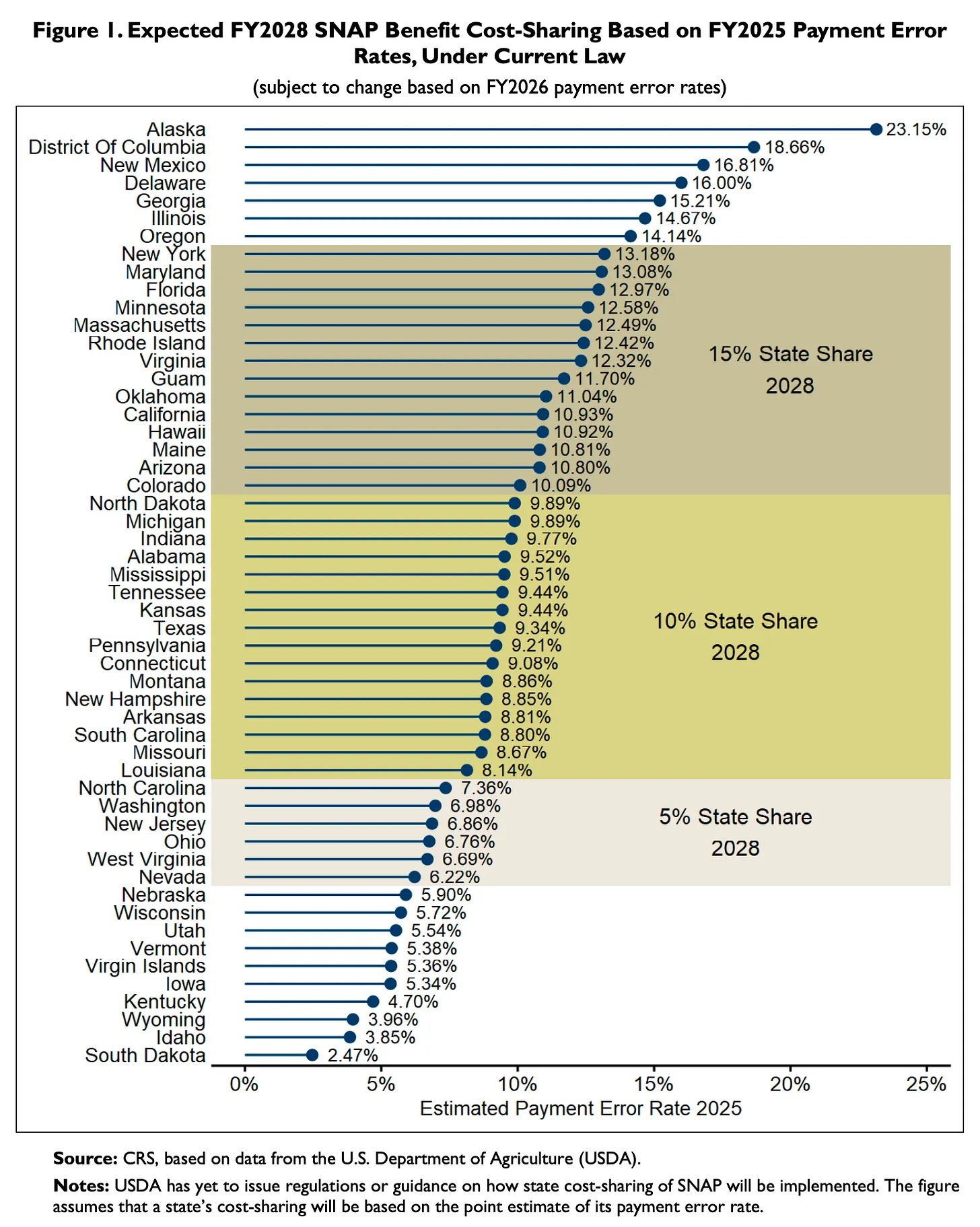
The delay and the increase are not offsetting concessions. They trade timing for severity: states get another year to bring error rates down, and the ones that fail pay more when the bill finally arrives.
Whether the year is usable is the open question. The Agriculture Department has not issued regulations or guidance explaining how cost-sharing will work at all, and the first calculation under the draft would rest on FY2026 error rates—from a fiscal year that ends September 30. Ten months of that sampling year are already behind the states. What the delay mostly buys is time to budget for the result, not time to change it.
The House bill’s silence makes this a conference item rather than settled policy, and the two halves of the provision have different shelf lives. The delay expires on its own. The 20% ceiling does not. Also worth noting for anyone modeling the politics: the first payments would come due weeks before the 2028 general election.
Title: Federal Reserve: “Skinny” Master Account Proposal
Report No. IN12722 | Type: Insight | Date: August 4, 2026, version 1
CRS Author(s): Marc Labonte, Specialist in Macroeconomic Policy | Official Congress.gov copy
Banks settle payments directly through master accounts at the Federal Reserve. Everyone else rents that access from a bank. As crypto and fintech firms have obtained charters from the Office of the Comptroller of the Currency and from states, they have applied for master accounts of their own, and their applications have sat for years or failed.
In May the Fed proposed a stripped-down version, which Fed Governor Christopher Waller has called a skinny account. Approval would typically come within 90 days rather than indefinitely. The account would carry a balance cap, pay no interest, and provide no access to the Fed’s cash, check, or automated clearinghouse services, and no discount window or intraday overdraft credit. Legal eligibility would not change—an applicant still needs a charter.
The proposal adds no anti-money-laundering requirements beyond what already applies. The Fed would keep discretion to periodically ask a holder to confirm its anti-money-laundering compliance. Fed Governor Michael Barr dissented on exactly that point, arguing the safeguards against laundering and terrorist financing were insufficient.
Two months before the proposal was published, the Fed granted Kraken, a Wyoming-chartered crypto firm, a twelve-month pilot limited master account.
What the Fed is giving up is leverage. It does not supervise these firms—running the payment rails confers no regulatory authority over who uses them—so access has been the only lever it holds, and slowness has been how it used that lever. Making access fast and cheap surrenders it in exchange for visibility into firms it still cannot examine.
The stripped features—no interest, no automated clearinghouse access, no discount window, a balance cap—each limit the Fed’s own financial exposure. None of them limits what moves through the account.
Title: ATF’s Proposed Rules for Firearms Imports
Report No. IN12724 | Type: Insight | Date: August 4, 2026, version 1
CRS Author(s): Jordan B. Cohen, Analyst in Firearms Policy | Official Congress.gov copy
Federal law restricts firearm imports by requiring that an imported firearm be generally recognized as particularly suitable for sporting purposes. The law applies to parts too: a frame, receiver, or barrel cannot be imported if the firearm it would build could not be imported assembled. Folding stocks, protruding pistol grips, suppressors, threaded barrels, and high-capacity magazines are among the features ATF treats as marking a firearm non-sporting.
ATF proposed two rules on May 8 that change how that evaluation operates.
The first concerns dual-use parts—frames, receivers, and barrels that fit both sporting and non-sporting firearms. Today they may be imported only for assembly into sporting firearms, and the importer remains restricted afterward. Under the proposal, a dual-use part could be imported so long as an identified sporting configuration for it exists at the time of import. Once here, it could be built into a sporting firearm, a non-sporting one, or one regulated under the National Firearms Act, subject only to the laws governing any firearm already in the country.
The second redefines import to include temporary imports, allowing a firearm already in the United States on a temporary license to be converted to a permanent one. Traceability markings would be required within fifteen days of approval.
The sporting-purposes restriction would become a description of what a part could be at the moment it crosses the border, rather than a limit on what it becomes. A barrel that fits both a hunting rifle and a rifle barred from import enters on the strength of the first fit. The second fit is what it may lawfully be used for the following day, and nothing federal tracks which one happens.
Non-sporting firearms are lawful to build and own in the United States. The sporting-purposes standard has never said otherwise—it governs what comes in, not what gets made here. That is why the standard reaches parts at all: without it, an importer could bring in frames, receivers, and barrels and assemble domestically what could not have been imported whole. Extending the standard to components is what makes the import restriction hold. The proposal releases it at the border, and the assembly channel the parts rule was written to close reopens.
The conversion rule has a smaller and more concrete edge: a firearm brought in temporarily can sit in the country, and be made permanent, before it carries the markings that make it traceable.
Title: Program Integrity in the Medicare Hospice Benefit
Report No. R49060 | Type: Report | Date: August 4, 2026, version 1
CRS Author(s): Jenny M. Markell, Analyst in Health Policy | Official Congress.gov copy
In May, the Centers for Medicare & Medicaid Services (CMS) stopped accepting new hospices into Medicare. The moratorium is nationwide, runs six months, and arrived alongside suspended payments to roughly 800 hospice and home health agencies in Los Angeles.
The enforcement record behind it is narrower than the moratorium is. Since 2023, CMS has concentrated on a handful of states—Arizona, California, Nevada, and Texas, adding Georgia and Ohio last year—where certified hospices multiplied faster than any patient population explained and where agencies turned out to share addresses. New hospices in those states have had every claim reviewed before payment. More than 200 have been revoked in the original four alone.
Three structural features separate hospice from most of Medicare. Care is delivered at home, where it is difficult to observe. Eligibility rests on a physician’s judgment that a patient has six months or less to live, which is a prognosis rather than a test result. And Medicare pays a daily rate for every enrolled patient, so an agency is paid whether or not anyone visits.
Focus has shifted from what a provider billed to whether it should have been admitted at all. In 2025, CMS revoked 149 hospices and gave most of them the maximum ten-year bar on returning—a penalty that did not exist before 2019. Roughly a quarter of those revocations were not for anything the hospice billed, but for whom it was affiliated with.
Screening at the door is cheaper than auditing claims, and blunter. A hospice can be revoked for its ownership ties to a provider with unpaid Medicare debt, a prior suspension, or a prior revocation—regardless of how it billed. That works against shell networks, where one operator opens many agencies. It also leaves a clean agency with nothing to contest, because the disqualifying fact belongs to somebody else.
The nationwide moratorium extends that logic to states with no identified problem. State hospice associations asked CMS to keep restrictions targeted at the hotspots; CMS’s answer is that fraudulent operators relocate to wherever the restrictions are not. Both claims are plausible, which is why the useful oversight question is empirical rather than philosophical: has any legitimate agency been shut out, and has any patient lost access to care?
Title: The Fifth Amendment Privilege Against Self-Incrimination: Background and Selected Topics for Congress
Report No. LSB11466 | Type: Legal Sidebar | Date: August 4, 2026, version 1
CRS Author(s): Clay Wild, Legislative Attorney | Official Congress.gov copy
Witnesses invoke the Fifth Amendment before congressional committees regularly enough that the gesture is familiar. The rules governing what a committee must do next are less so.
No particular words are required. If an invocation is made in language a committee could reasonably understand as one, it must be respected, and the committee must either accept the claim or ask the witness directly whether he is asserting it. In Quinn v. United States, the Supreme Court reversed a contempt conviction because the witness could not tell whether the committee had accepted his claim or was demanding an answer over it. Refusing to answer is a crime under federal law only if the witness was clearly told the committee demanded the answer anyway.
The limits are genuine but narrow. Blanket refusals to answer anything at all are generally rejected in favor of question-by-question inquiry. A pardon removes the privilege for the pardoned offense, but not for unrelated federal crimes and not where state prosecution remains possible. And a witness who has testified to something incriminating cannot then stop when asked for the details of it.
Immunity is the only reliable way through, and it is expensive. A committee can compel testimony by court order after a floor majority or a two-thirds committee vote, and the court must grant the petition. What that buys is testimony the government cannot use against the witness in any respect—short of a prosecution for perjury or false statements—along with anything derived from it. A later prosecution has to be built from provably independent evidence, which is a difficult thing to demonstrate and a difficult thing to have.
So the trade is a public record now against a conviction later—and the body making the trade is not the one that bears the cost. A committee gets its hearing; the Justice Department inherits the problem.
That structure, more than the doctrine, is what makes the privilege a real constraint on congressional investigations rather than a formality to be worked around.
Title: Senators’ Official Personnel and Office Expense Account (SOPOEA): History and Usage
Report No. R44399 | Type: Report | Date: August 4, 2026, version 7
CRS Author(s): Ida A. Brudnick, Specialist on the Congress | Official Congress.gov copy
Every Senate office runs on a single consolidated account covering staff, travel, mail, equipment, and everything else the office does. Senators have wide discretion over how to divide it, and in practice they divide it the same way: more than 90% goes to payroll, year after year, across offices of every size.
The account now also buys personal protection. Following a Senate resolution agreed to in September 2025, each Senator’s account received an additional $750,000 for security enhancements and services—covering the Senator and the Senator’s residence, wherever the Senator happens to be. Senators select their own providers and define the scope of what those providers do. The Sergeant at Arms offers coordination and procurement support, and a Senator may accept its recommendations or decline them.
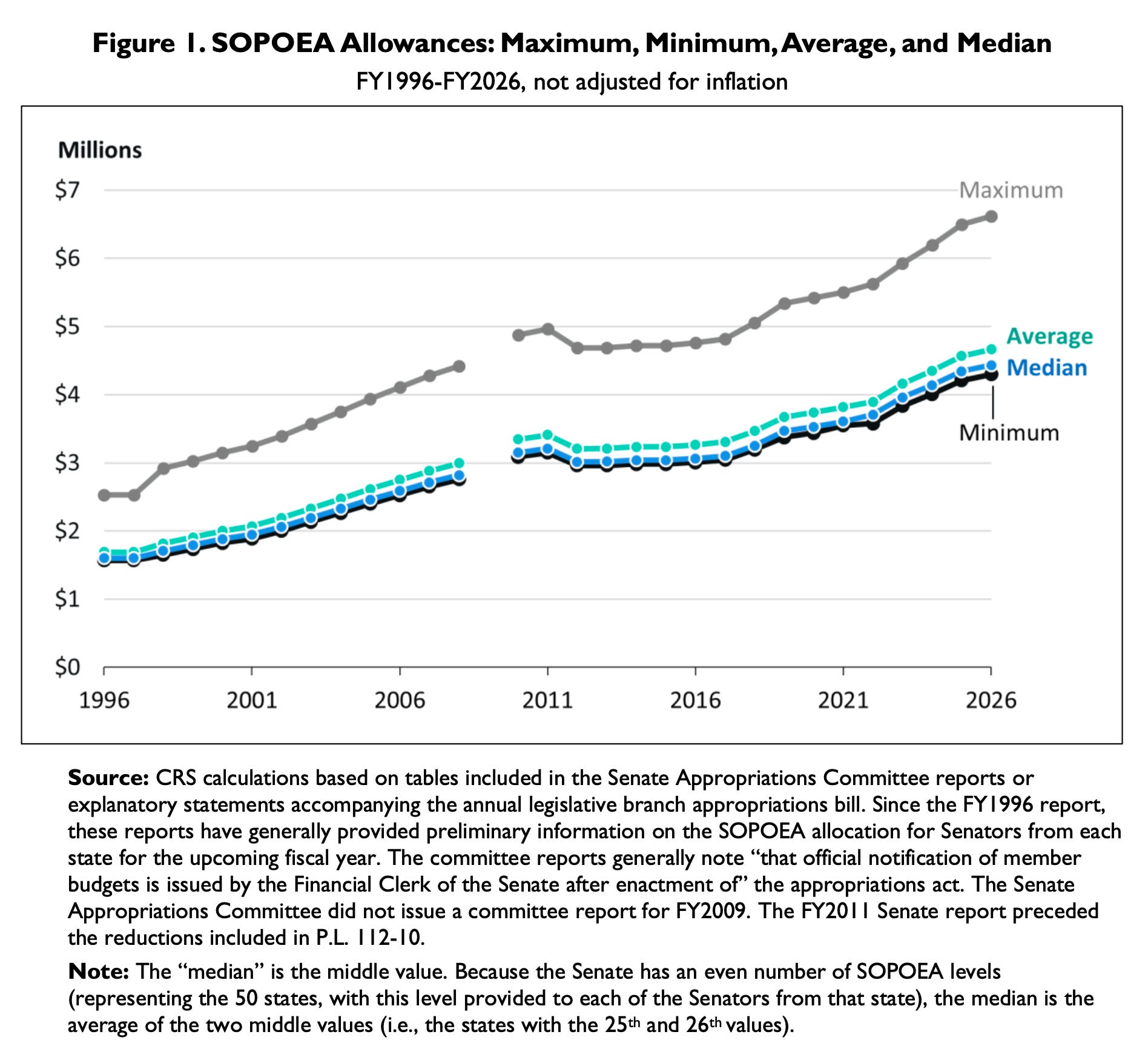
Routing this money through each Senator’s own account rather than through the Sergeant at Arms is a substantive choice, not a bookkeeping one. It treats protection the way the account treats everything else: as something each office specifies for itself.
The cost is consistency. A hundred offices contracting separately will not converge on a hundred equivalent security arrangements, and the entity with the fullest view of the threat picture advises rather than decides. That is a defensible allocation of authority—Senators are not interchangeable and neither are their circumstances—but it is an allocation, and it was made deliberately.
It is also hard to audit. Senate expenses are published by broad category, so protective services appear folded in with other contracted services rather than as a line of their own. What was purchased, from whom, and whether it worked are not questions the public record is built to answer.
As a personal aside, by all rights this could be an incredibly boring report, and don’t get me wrong, it’s not a thriller, but it held my attention the entire read, which is no small feat most days. The information is understandable, multimodal, approachable, and highly usable. Did you see the tables?
Title: President Reagan’s Six Assurances to Taiwan
Report No. IF11665 | Type: In Focus | Date: August 4, 2026, version 13
CRS Author(s): Susan V. Lawrence, Specialist in Asian Affairs | Official Congress.gov copy
A two-page document for anyone who needs to show students a) that language and interpretation matter, b) what an effective comparison chart does, c) that CRS exists, d) how to write a lot with a little, e) what government document research actually looks like (which they could then practice), and/or f) a little civics.
In July 1982, while negotiating a communiqué that committed the United States to gradually reducing arms sales to Taiwan, the Reagan Administration sent Taiwan’s president a private list of things it had not agreed to. Those six statements are now cited in U.S. law as a foundation of the relationship.
There are three official American texts of them, and they do not match. This product has an excellent table for reader comparison. There is the original cable delivered in Taipei, a reworded version cleared for public release a month later on the condition that it not be linked to Reagan, and a version an Assistant Secretary of State folded into congressional testimony without labeling it as anything. Only the testimony was public until 2020, when the first Trump Administration declassified the cables.
The differences matter. On sovereignty, the original says the United States has not agreed to take any position on Taiwan’s status. The public version says only that it has not altered its position, without stating what the position is. The verb tenses diverge as well: some assurances are framed as things not conceded in 1982, others as things the United States will not do.
For decades the most widely repeated version of one assurance appears in none of the three texts—that the United States would not formally recognize Chinese sovereignty over Taiwan. House concurrent resolutions in seven separate Congresses repeated it. The actual assurance is that the United States has not taken a position, which forecloses nothing and commits to nothing.
The tense problem is the substantive one. An assurance in the past tense records what was not given away during a single negotiation. An assurance in the future tense binds. Congress has written the Six Assurances into eleven laws since 2017 without ever resolving which kind they are.
Pending legislation would settle both problems at once, merging the three texts and requiring congressional review before the executive branch pauses arms sales, negotiates with Beijing over them, or shifts the sovereignty position. That turns a diplomatic assurance into a procedural check—much harder to quietly let lapse.
Title: Alien Registration Requirements
Report No. IF13003 | Type: In Focus | Date: August 4, 2026, version 3
CRS Author(s): Holly Straut-Eppsteiner, Analyst in Immigration Policy; Alejandra Aramayo, Legislative Attorney | Official Congress.gov copy
This applies to anyone who advises noncitizens, and to any noncitizen present in the United States for more than thirty days without a green card, a visa, an I-94, or a work permit. Federal law has required noncitizens aged 14 and older to register and be fingerprinted since 1940, to carry proof of registration, and to report address changes within ten days. For most of that history the obligation was satisfied automatically by the paperwork of obtaining a status, and for people without a status there was no form to file at all. Prosecutions were rare.
That changed in 2025. After a January executive order directing agencies to treat registration as a civil and criminal enforcement priority, the Department of Homeland Security created a general registration form, G-325R, filed through a U.S. Citizenship and Immigration Services online account, with fingerprinting scheduled afterward and a downloadable notice serving as proof. A final rule making technical changes followed in June 2026. DHS estimated that between 2.2 and 3.2 million people fall into the newly covered groups: those who entered without inspection, Canadian visitors who crossed at land ports without an I-94, and children who turn 14 while here.
The litigation is unresolved. Advocacy organizations argued the rule imposed substantive burdens and should have gone through notice and comment; a district court declined to block it, first for lack of standing and then for lack of irreparable injury, and the appeal is now before the D.C. Circuit. The practical situation for anyone covered is that the requirement is enforceable today—with misdemeanor penalties and removal consequences attached—while the question of whether it was lawfully imposed remains open.
Share with someone who needs to catch up before the next Senate hearing.
Share What Congress Should Be Reading
AI Disclosure: Claude Opus 5 (Anthropic) ran prior-coverage checks against the WCSBR archives, proposed triage and tier assignments, drafted all Synopsis and Commentary text, built the metadata blocks, wrote the figure alt text and captions, and ran a fact-checking pass against the source PDFs. Charlie Amiot supplied the source documents, closely directed coverage, wrote the opener and framing, and cut, edited, and rewrote across the draft, recursively. Charlie Amiot holds final responsibility for all accuracy and editorial judgment. Claude was particularly effective tonight in comparison to the last few weeks, but changes were also made to archival storage, source material uploading, and prompting. And of course none were done in isolation, that would be too logical! AI use is disclosed in every post.
Comments
Nothing yet. Say the first thing.
Sign in to join the conversation.