
Four products from August 7.
There are two ways to read today’s batch. One is a conflict story: Iran is charging tolls at the mouth of the Persian Gulf, the war in Ukraine has entered its fifth year with the talks stalled, and the Senate spent yesterday passing a Russia sanctions bill by a margin of 86 to 11. The other is an energy story: a quarter of the world’s seaborne oil, a Qatari force majeure, an Arctic lease sale, and a duty exemption that no longer exists.
Or perhaps it’s the same story.
I’ve ordered them as conflict. What all four are really about is what things cost once someone decides to make them cost something.
Title: The Strait of Hormuz: Security Developments and Impacts on Oil, Gas, and Other Commodities
Report No. R45281 | Type: Report | Date: August 7, 2026, version 8
CRS Author(s): Michael Ratner, Specialist in Energy Policy; Liana W. Rosen, Specialist in International Sanctions and Financial Crimes; Clayton Thomas, Specialist in Middle Eastern Affairs | Official Congress.gov copy
WCSBR covered a companion product, R48903 on the Strait’s non-oil shipments, back on April 12, when the question was still what a temporary disruption would do to American shippers. This is the first time the full security-and-markets report has appeared here, at version 8.1
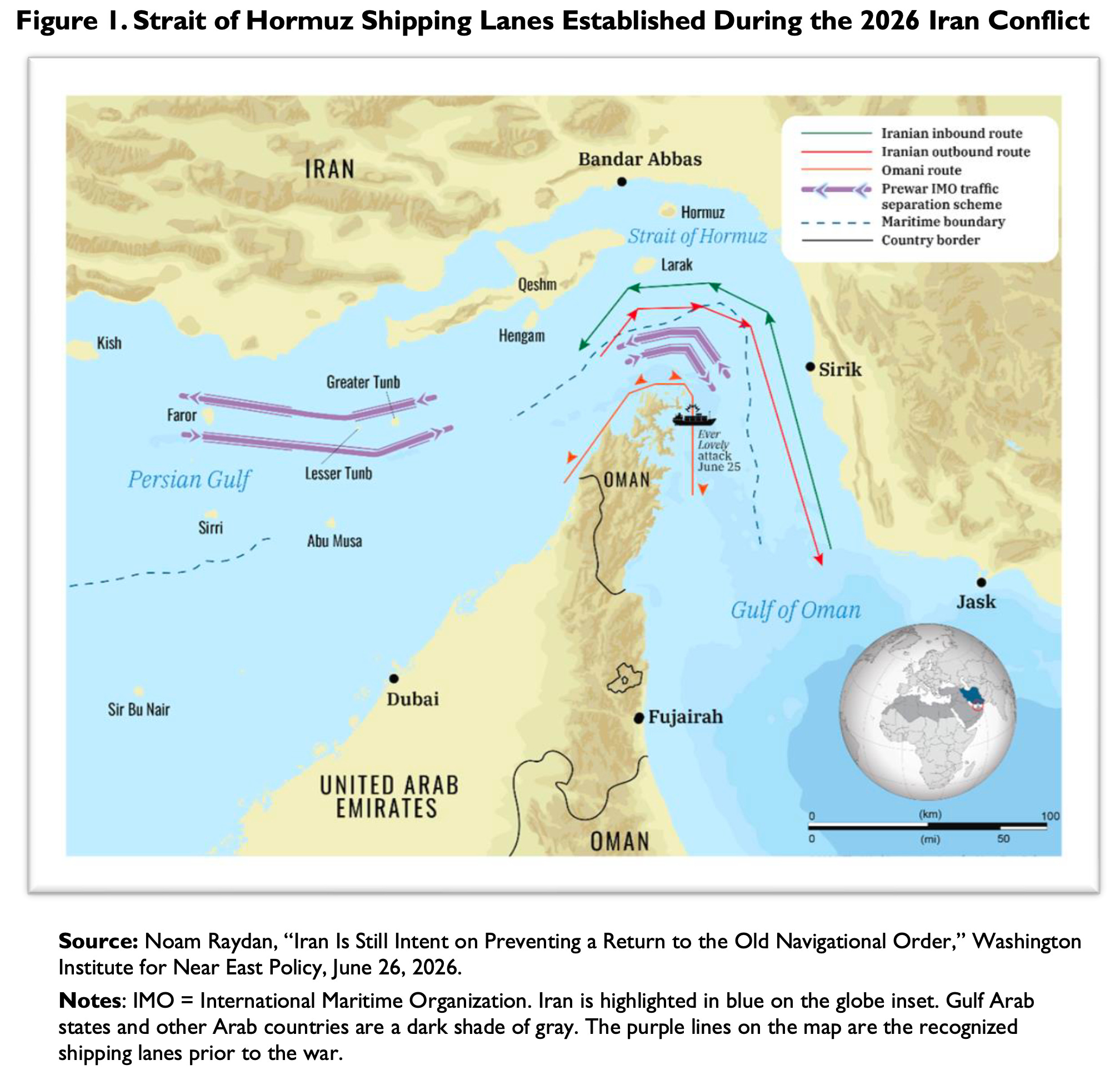
As of early August 2026, the United States has reimposed a naval blockade of Iranian ports, and the memorandum of understanding (MOU) that President Trump and Iranian President Masoud Pezeshkian signed on June 17 is, by the President’s own statement, no longer in force. Iran established a Persian Gulf Strait Authority in May and has claimed that no vessel may transit the Strait of Hormuz without a permit the PGSA issues. Iranian officials point to the MOU—in which Iran committed to make arrangements for the safe passage of commercial vessels, with no charge, for sixty days only—as the document that granted Iran the right to administer the waterway. Speaker of Parliament Mohammad Baqer Qalibaf reportedly said in June that management of the Strait will never return to what it was before the war. The Strait comprises Iranian and Omani territorial waters. Oman has not endorsed the Iranian position.
What transits it: in 2025, roughly 25% of the world’s maritime trade in crude oil and petroleum products, about 20 million barrels a day, plus roughly 19% of global liquefied natural gas. The emergency machinery has already been used. The International Energy Agency initiated a coordinated release of 400 million barrels from 32 member countries in March and April, the largest in its history; the United States committed 172 million barrels over 120 days, and by early July member releases had reached 276 million. IEA analysis puts the maximum achievable drawdown rate at 25 million barrels a day for two months, with emergency stocks exhausted in roughly six.
Natural gas has no equivalent. Most major consuming countries hold no strategic gas reserve, and LNG terminals outside the Gulf already run near capacity. QatarEnergy has declared force majeure; if the outage at Ras Laffan continues, approximately 19% of global LNG stays off the market. Between February and May 2026, European gas prices rose 44% and Asian prices 66% while U.S. prices fell 6%. Oil rose 50% over the same window. Further down the supply chain sit the things nobody thinks about until they are gone: Qatar holds about 30% of world helium production capacity, used among other things in semiconductor manufacturing; Iran, Saudi Arabia, Qatar, the UAE, and Bahrain together account for over a third of global urea fertilizer supply; five Gulf producers account for nearly a quarter of the world’s sulfur.
The report catalogs what the Second Trump Administration has tried. Airstrikes on Iranian mine-laying vessels and missile sites. A blockade, lifted in June and reimposed in July. “Project Freedom,” a May attempt to route ships south of Iranian waters, paused within two days after Iranian attacks on the UAE and Oman. And a failed insurance program: on March 3, President Trump directed the U.S. International Development Finance Corporation to provide political risk insurance for maritime trade through the Gulf, a reinsurance facility that reached $40 billion with private partners and named Chubb as lead underwriter. By news accounts, it has written no coverage. Chubb indicated in April that the naval escorts meant to complement the facility never materialized. One analysis found the facility sat idle because insurance had not become unavailable; it had become expensive.
Six forward scenarios are laid out: U.S. military operations to control Iranian coastal areas, naval escorts as in the 1980s, a formal U.S. administration of the Strait, a cooperative administration modeled on the Straits of Malacca, indefinite instability, or American withdrawal from the effort. President Trump has floated a toll “for services rendered as the Guardian Angel to the countries of the Middle East,” then said in mid-July that Gulf countries would instead make massive investments in the United States.
Read the six scenarios as a set. Four of them end with somebody administering the Strait and collecting something for it. Free and unfettered passage, the arrangement that held for four decades, survives in this report mainly as the baseline every option is measured against.
The insurance facility is the tell. Forty billion dollars of capacity produced no transits, because the problem was never that coverage vanished. It was repriced, and no amount of reinsurance persuades a captain to sail his crew past a missile battery. Money was aimed at a problem money does not solve.
What is actually being decided is whether transit through Hormuz becomes a service that someone sells and who that someone is. Iran already sells it, with a permit office and a fee schedule. The United States has now floated selling it twice, in two different currencies.
Title: Russia’s War Against Ukraine: Diplomatic Talks and U.S. Policy
Report No. IN12534 | Type: Insight | Date: August 7, 2026, version 8
CRS Author(s): Andrew S. Bowen, Analyst in Russian and European Affairs; Cory Welt, Specialist in Russian and European Affairs | Official Congress.gov copy
WCSBR covered version 7 on May 24. That post carried the CRS casualty estimate as 1.3 million to 1.8 million killed or wounded. Version 8 puts it at up to 2 million or more. Enough has changed that this entry treats the product as new rather than solely as a list of changes: the section describing what a peace settlement might actually contain has been cut, the security assistance posture reverses from no new announcements to new announcements at reduced levels, and the sanctions discussion has been compressed from two paragraphs of general license mechanics to one sentence ending in expiration.
On August 7, 2026, the Senate passed the Lindsey O. Graham Sanctioning Russia and Iran Act of 2026 by a vote of 86-11, as an amendment (S.Amdt. 6711) to H.R. 5334. The bill would reinforce existing sanctions authorities, authorize tariffs against Russia and against third countries that import certain Russian products, and expand congressional oversight of most Russia sanctions imposed since 2022. It began life as a bill introduced in 2025.
Formal negotiations were last held in February 2026. Trilateral talks among Russian, Ukrainian, and U.S. officials opened in Abu Dhabi in January and two rounds of U.S.-mediated talks followed, but nothing formal has convened since U.S.-Israeli military operations against Iran began in late February. In May, Secretary of State Marco Rubio said the talks had not been fruitful and that the Administration was not interested in an endless cycle of meetings that lead to nothing; in July he referred to the failed efforts that began in Anchorage, while allowing that the United States was prepared to offer new ideas in the right setting. In June, President Zelensky proposed meeting President Putin in a neutral country and called for a full ceasefire for the duration of negotiations. Putin reportedly rejected it and indicated Russia would fight until it achieved its stated goals.
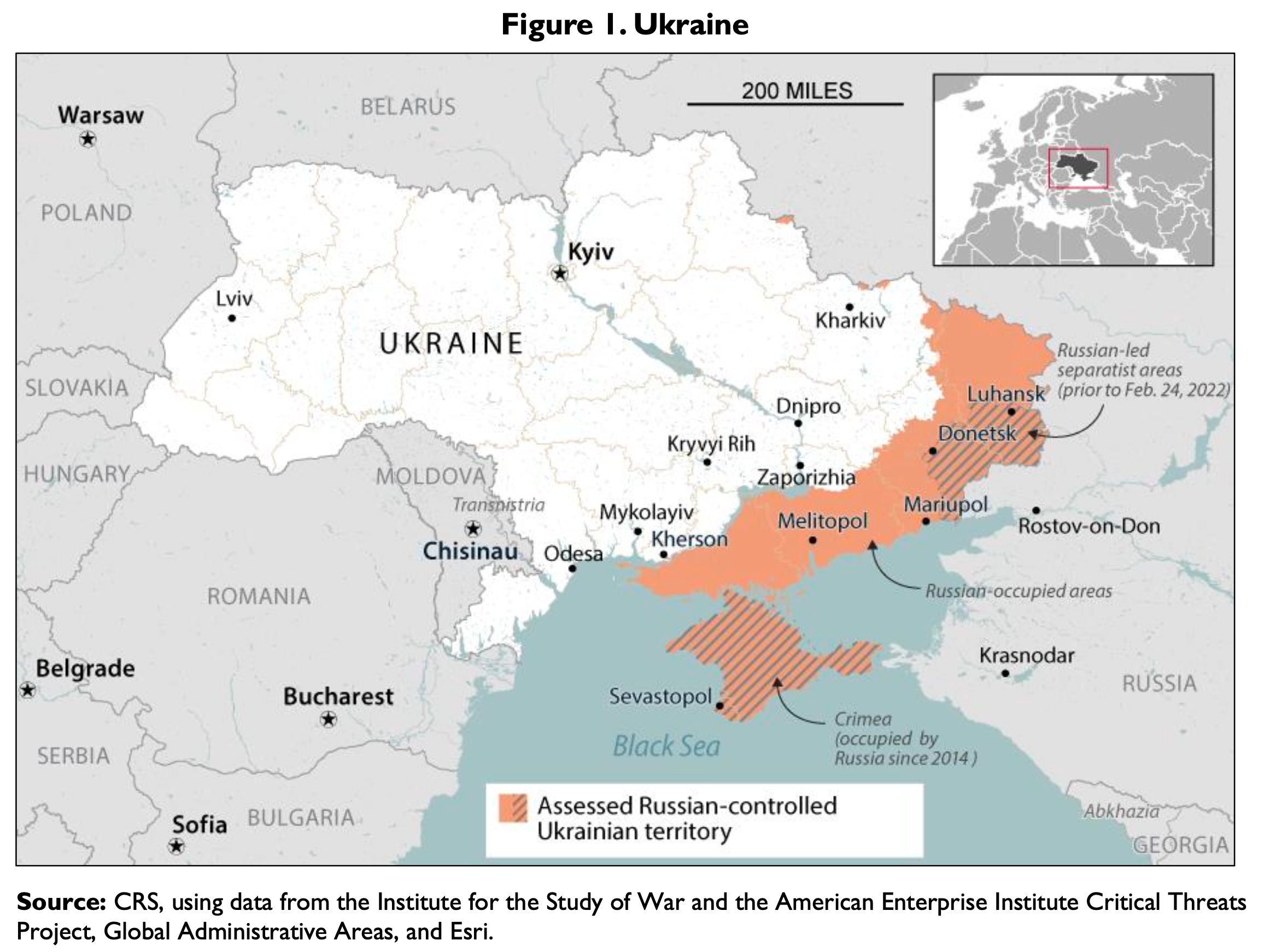
The war has not paused for the diplomacy. Russia holds about 20% of Ukraine’s territory. In 2026, Ukrainian forces have limited and in places reversed Russian gains, and have substantially expanded long-range strikes on Russian oil facilities and logistics infrastructure. Ukrainian officials state they are running low on air defense munitions to intercept Russian ballistic and hypersonic missiles.
On the American side, the burden has shifted. NATO allies and partners have contributed more than $6 billion under the Prioritized Ukraine Requirements List, the arrangement by which allies fund procurement of U.S. defense articles for Ukraine. In July, President Trump said the United States was considering letting Ukraine coproduce Patriot missiles, then noted it would be a big step requiring care. Treasury has maintained existing sanctions and added Rosneft and Lukoil; the general licenses issued after operations against Iran began, which temporarily relaxed sanctions on certain Russian oil exports to steady the market, expired June 17 and were not renewed.
Congress has moved on its own. It authorized $400 million annually in security assistance for FY2026 and FY2027 and appropriated $400 million for European capacity building. The House passed the Ukraine Support Act 226-195 on June 4, after a discharge process on the special rule that allowed the bill to be considered at all.
The Iran war is the hinge in this document and it swings both ways. It stopped the Ukraine negotiations in February, and it is the reason the Treasury Department spent part of the spring quietly making it easier to sell Russian oil.
Set the two American branches side by side. The executive branch’s own Secretary of State has described the mediation effort as failed. The legislative branch spent the same period producing a 226-195 House vote that required a discharge process to reach the floor, and an 86-11 Senate vote. Those are not the numbers of a body that is uncertain what it thinks.
And in eleven weeks the estimate went from a range topping out at 1.8 million to 2 million or more. It is the only number in the document that is not a policy variable.
Title: China’s E-Commerce Exports and U.S. De Minimis Policies
Report No. IF12891 | Type: In Focus | Date: August 7, 2026, version 5
CRS Author(s): Karen M. Sutter, Specialist in Asian Trade and Finance; Michael D. Sutherland, Analyst in International Trade and Finance | Official Congress.gov copy
For years, anything worth $800 or less could be shipped to you from abroad without a cent of tariff attached. That is what ended. Section 321 of the Tariff Act of 1930 let low-value shipments enter the United States free of tariffs, fees, and taxes. President Trump withdrew that treatment for Chinese imports in February 2025, the Administration suspended it for everyone else by that August, and the FY2025 reconciliation law repealed Section 321 outright, effective July 1, 2027.
The volume responded, and so did the firms. Chinese e-commerce exports to the United States fell by roughly a third in a year; global Chinese e-commerce exports barely moved, and exports to Russia nearly quadrupled. Temu’s parent moved its legal domicile to Ireland and now ships from American warehouses. Shein’s parent sits in Singapore, tied to a holding company in the British Virgin Islands, and is buying the American clothing brand Everlane.
Two countries had a duty-free threshold for small parcels. One ran it as a customs convenience; the other ran it as an industrial policy instrument, confined to pilot zones, limited to a catalogue of goods last updated in 2018, capped per importer and exporter, taxed, and closed to foreign firms that would not operate as joint ventures. Chinese e-commerce imports fell by more than half between 2018 and 2025 while its exports grew more than twenty-one-fold. Congress’s answer was to repeal the threshold rather than manage it, which is a defensible choice and also a permanent one.
Title: Arctic National Wildlife Refuge: Status of Oil and Gas Program
Report No. IF12006 | Type: In Focus | Date: August 7, 2026, version 30
CRS Author(s): Laura B. Comay, Specialist in Natural Resources Policy | Official Congress.gov copy
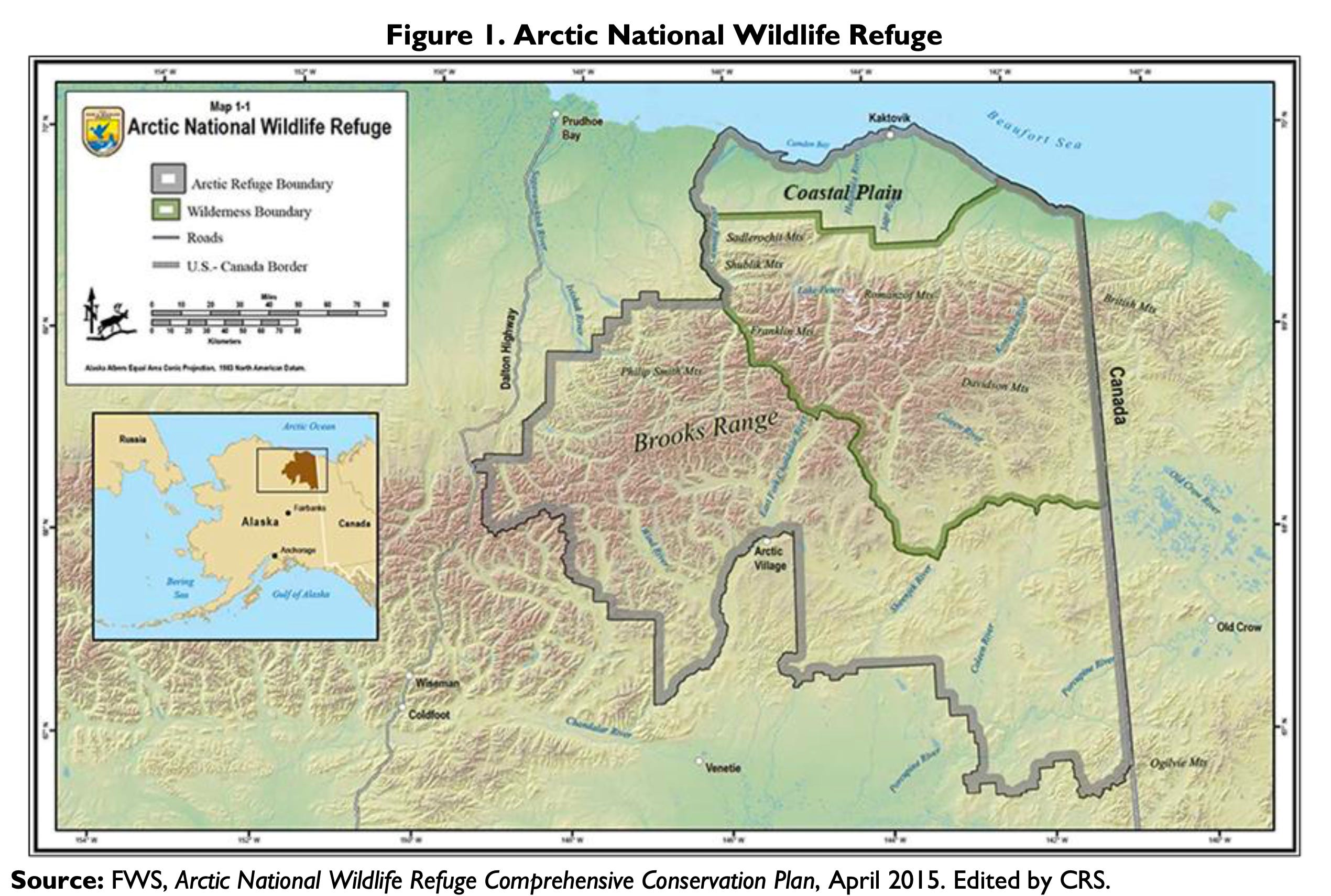
Section 50104 of the July 2025 budget reconciliation act requires at least four new lease sales in the Coastal Plain of the Arctic National Wildlife Refuge. The Bureau of Land Management held the first on June 5, 2026, offering 58 tracts. Five sold, for $3.7 million in high bids—three to the Alaska Industrial Development and Export Authority, a state-established public corporation, and two to Hex Energy LLC.
For scale: the first sale under the program, held in January 2021 during the First Trump Administration, yielded $14.4 million. The second, in January 2025, drew no bids at all. Observers cited BLM’s strict terms, the distance from existing infrastructure, the cost of Arctic development, outdated resource data, and the likelihood of litigation. The 2021 leases were canceled in 2023, restored by executive order in January 2025, and the cancellations vacated by a federal court that March.
The prize, per the U.S. Geological Survey’s mean estimate, is 7.7 billion barrels of technically recoverable oil on federal lands. Total U.S. petroleum consumption in 2025 was about 7.5 billion barrels. Two bills in the 119th Congress, H.R. 3067 and S. 1519, would repeal the leasing program and designate the Coastal Plain as wilderness.
Share What Congress Should Be Reading
The U.S. government stood up a $40 billion insurance program for Gulf shipping and reportedly got zero customers. WCSBR is roughly the same age and has more subscribers than that program has policyholders. Admittedly this newsletter is free, making it an unfair fight. It also came in $40 billion under budget. Give or take a few hundred dollars. Share.
Share What Congress Should Be Reading
AI Disclosure: Claude Opus 5 (Anthropic) ran prior-coverage checks against the WCSBR archives, proposed triage and tier assignments, drafted all Synopsis and Commentary text, built the metadata blocks, wrote the figure alt text and captions, and performed all final fact checking against source documents under close supervision. Charlie Amiot supplied the source documents and version diffs, directed order and coverage, wrote the opener and the footnote, cut what needed cutting, and edited recursively throughout. Charlie Amiot holds final responsibility for all accuracy and editorial judgment. AI use is disclosed in every post.
Technically v.7, but it was a same-day update, so I’m only focusing on v.8.
Comments
Nothing yet. Say the first thing.
Sign in to join the conversation.