
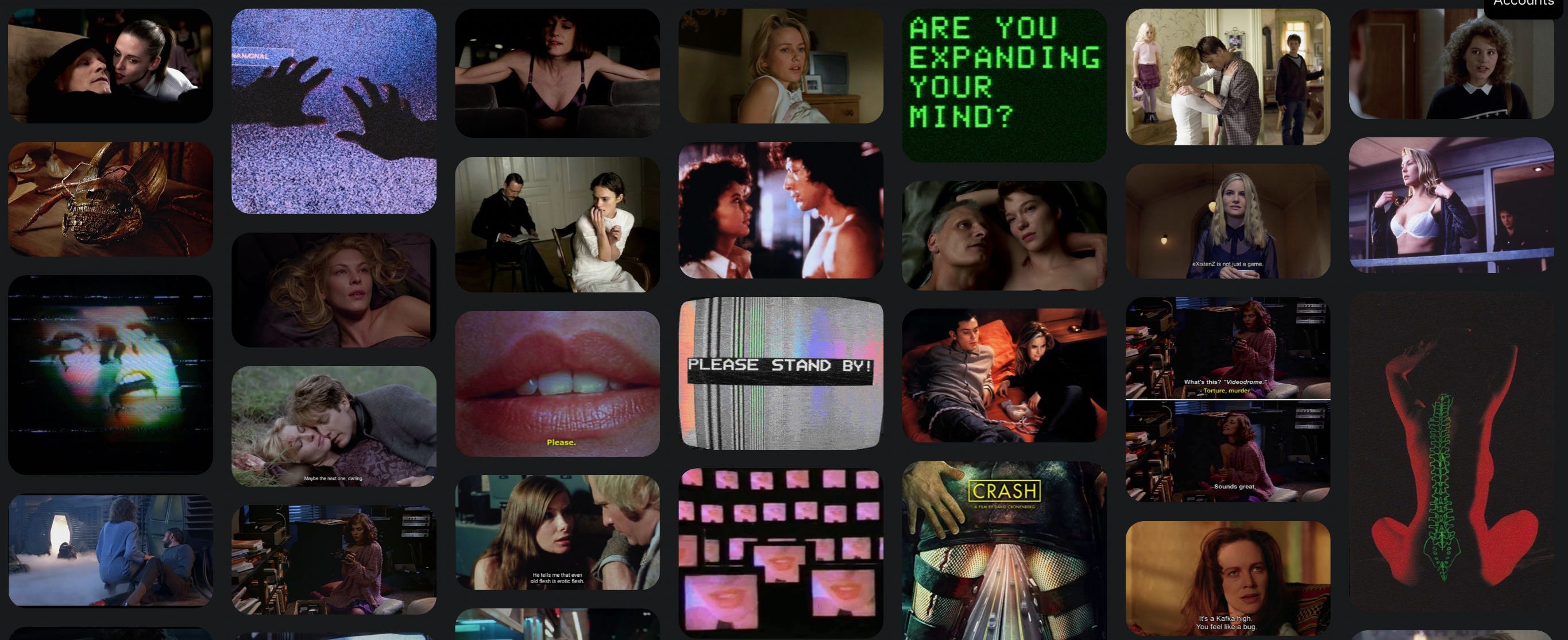
Any woman you pass on the street could be a Cronenbabe. Your neighbour. Your coworker. Your dentist. Anyone. They walk among us. The woman reading this right now might even be a Cronenbabe. The one writing this definitely is.
But what exactly is a Cronenbabe?
The term “Cronenbabe” wasn’t coined simply because some women enjoy David Cronenberg’s films. It’s primarily used to refer to the collective group of female characters and actresses featured within Cronenberg’s body of work spanning from the 1970s through to present day. It emerged through his films as he offers a vocabulary that many women already understand. The body is unstable. Desire is messy. And our flesh is an ever changing thing.
(Cronenberg Girls fancam video: @thatlacavagirl on X.)
WHO ARE THE CRONENBABES?
Think Marilyn Chambers in Rabid, Samantha Eggar in The Brood, Debbie Harry in Videodrome, Geena Davis in The Fly, Genevieve Bujold in Dead Ringers, Holly Hunter in Crash, Jennifer Jason Leigh in eXistenZ, Maria Bello in A History of Violence, Naomi Watts in Eastern Promises, Keira Knightley in A Dangerous Method, Julianne Moore and Mia Wasikowska in Maps to the Stars, Kristen Stewart and Léa Seydoux in Crimes of the Future.
They’re transgressive women. Monstrous women. Deeply flawed and lustful. Psychologically complex. Women unbound by what society deems as morally correct.
You can think of the Cronenbabe as the antithesis of the “Bond Girl”. Bond Girls exist to affirm Bond, to be charmed by him or simply seduce him. They reinforce his masculinity and reward his heroism. Cronenbabes instead destabilise the men around them. They’re not rewards. They’re mirrors and infections.
In Videodrome, Nicki Brand (Debbie Harry) isn’t just the love interest. She draws Max Renn (James Woods) deeper into conspiracy. She already craves pain and self-modification. She wants more than what he can offer her. She’s pursuing desires he’s still trying to comprehend.
In Crash, Helen Remington (Holly Hunter) isn’t just there to heal James Ballard (James Spader). She’s already accepted a way of living that he hasn’t. She’s his gateway into a new erotic world.
In The Fly, Veronica Quaife (Geena Davis) isn’t the passive girlfriend watching Seth Brundle’s horrific transformation. She’s an investigative journalist. She’s intellectually engaged with his work. And by the end she’s forced to become the moral centre of the film.
In Crimes of the Future, Caprice (Lea Seydoux) isn’t horrified by Saul Tenser’s (Viggo Mortensen) surgical innovations. She’s fascinated by them. She performs them, and facilitates surgery as “the new sex”.
However, none of these examples are to say that Cronenberg has always written women perfectly. Far from it. His depictions of women have been criticised since his earliest films like The Brood and Rabid. In the longform interview book Cronenberg on Cronenberg, the director gives his reaction to how feminist groups were critical of his early films:
(On Rabid) “I remember being totally bemused by the complaint that I was portraying female sexuality as predatory. With Shivers I had been attacked for showing women as sexually passive. So I was beginning to realize that this was a no-win situation. Unless all the women in your movie are absolutely done by the feminist book— and, of course, it depends which feminist book — you are not going to escape. Someone who writes an anti-sexist tract is not going to write a great anything. […] I thought I was suitably nasty to everybody at one point or another in Rabid: male, female, homosexual, child, everybody gets it. If you’re going to accuse me of something, you might as well accuse me of being misanthropic. I don’t feel I’m that either.”
Editor Chris Rodley notes the following concerning reception to Videodrome upon its release in 1983 and it’s depiction of Nicki Brand, the female lead:
“Cronenberg’s transgressions in the sexual-political arena have continued to antagonize certain audiences and critics. Nicki Brand, so named—presumably—because of her taste for burning her breast with lighted cigarettes, was merely the latest in a line of predominantly rapacious female creations. As with Cronenberg’s obsession with male/female opposition – in which female ‘difference’ can slip imperceptibly into ‘the other’ (and, in Naked Lunch, into the ‘non-human’) – his determination and desire to be free of politicized constraints and considerations in imagining his women, and their sexuality, will continue to offend.”
Whether or not you agree with Cronenberg's defence here or not, it raises a more interesting question than whether his women are "good representations", but instead leaves us to wonder why so many women continue to see themselves in his films?
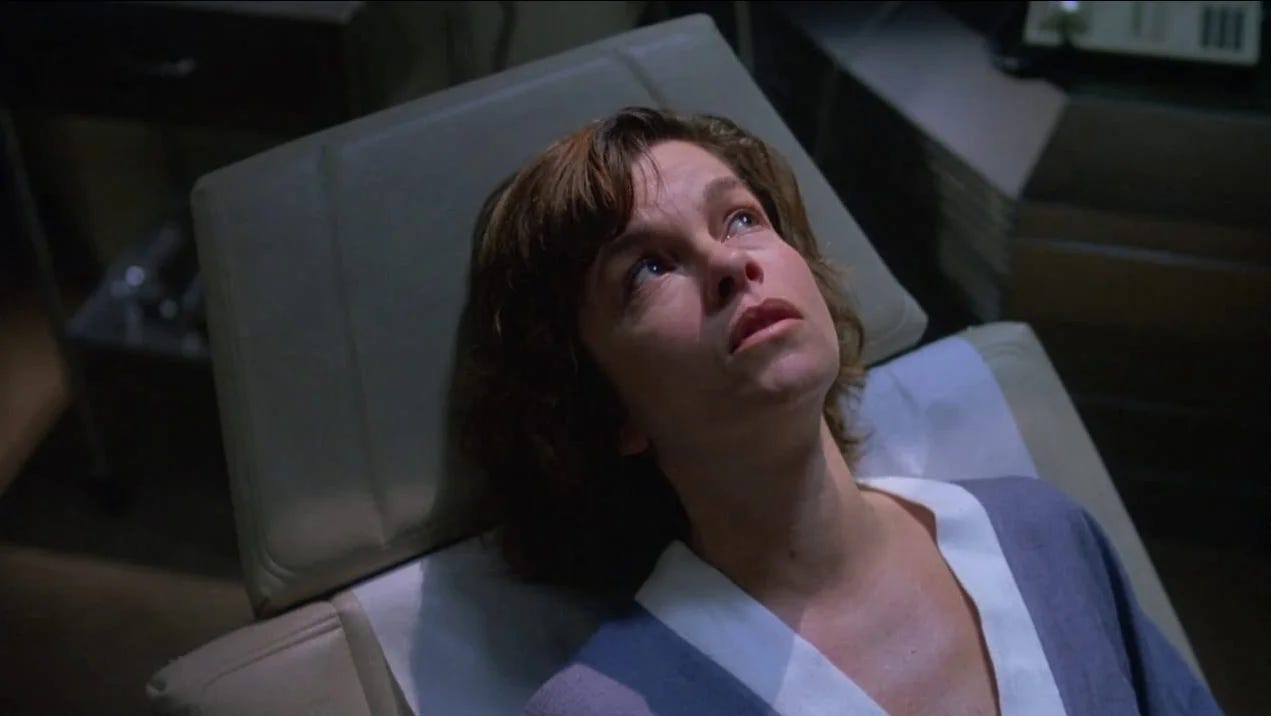
LIVED BODY HORROR
The female experience is inherently full of body horror, and as a result we’re more desensitised to it. Many of us experience gore on a monthly basis. Our bodies can literally grow, shed and expel flesh. If you’ve ever passed your entire decidual cast (do not google the term if you’re squeamish), you’ll be more than familiar with the pain and terror our own flesh can bring upon us. But more than just menstruation, we have the capacity to grow organs and life and our bodies mutate in strange and visceral ways in different stages in our lives. All things that would qualify as body horror in any other context. Very Cronenbergian, if you ask me.
On this topic, in Cronenberg on Cronenberg the director uses an example from the shooting of Dead Ringers to drive this point home:
“You get heated reactions from women about Dead Ringers, but one thing they aren’t is squeamish about it. It’s their bodies; they do it all the time. The men were squeamish. […] A lot of people say, ‘I suppose women find this movie much harder to take.’ The answer is, ‘Not really.’ For a lot of women, the opening scene of gynaecological examination is no big deal. Later on it gets weird, of course it’s uncomfortable. But, for a lot of men, that very first scene is the worst. They’ve never been there; they’ve never seen it; they don’t want to think about it.”
THIS CRONENBABE’S ORIGINS
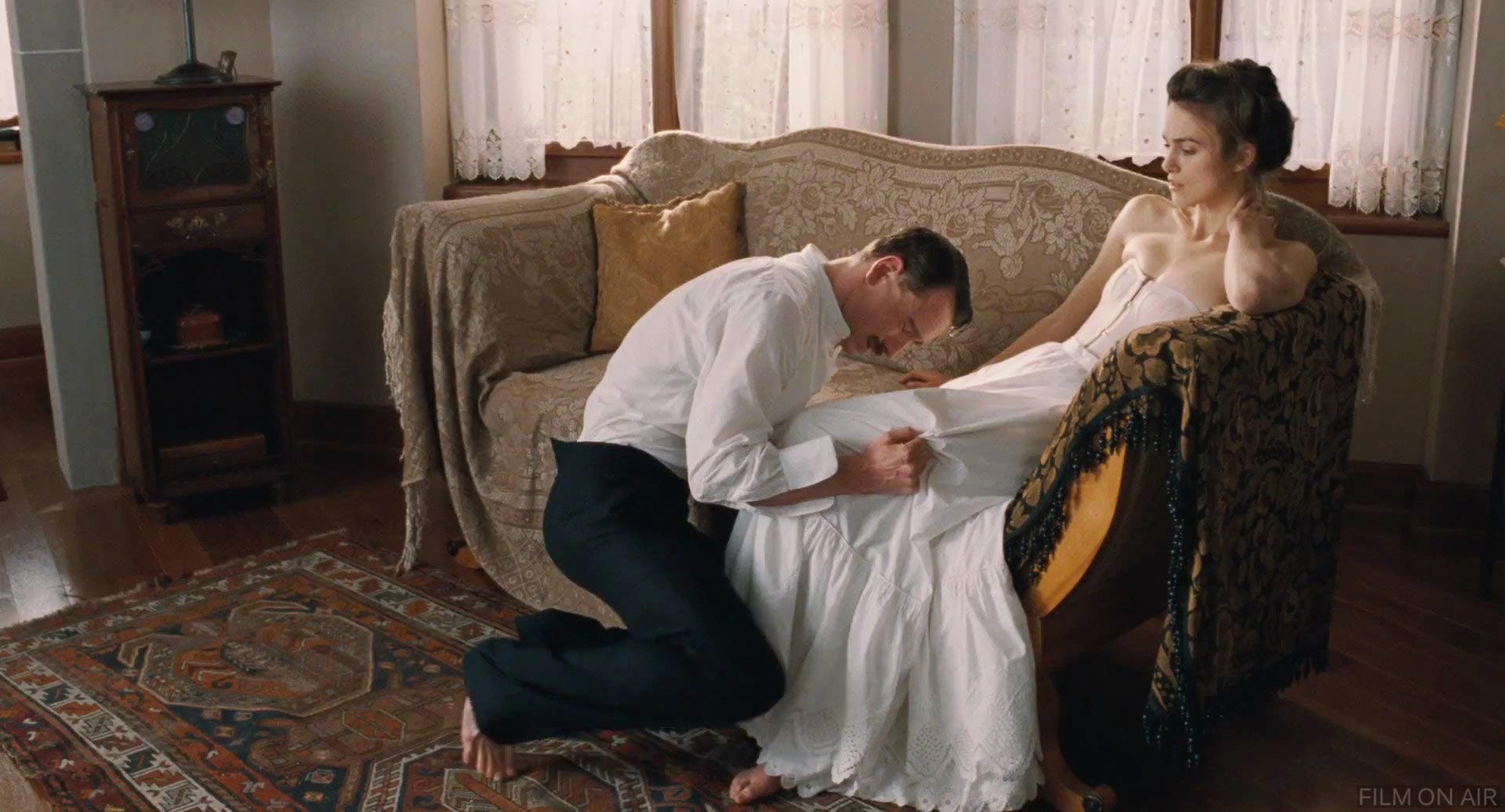
My own mutation into a Cronenbabe began at seventeen, and it didn’t start with exploding heads or car crashes. But instead with one of his most stripped-back stories: A Dangerous Method. A story about the origins of psychotherapy and one of history’s most overlooked women, Sabina Spielrein (Keira Knightley). It’s a film that sits apart in his filmography. There’s no gore or fleshy technology, but rather it focuses on the interior life of a woman in the depths of hysteria, her sense of self and identity as unstable as the horrors contained within so many of his other films. Ultimately it didn’t end up becoming one of my favourites of his, but it was my first entry into a filmography that presents female desire as something to be dissected and analysed rather than sanitised… and, crucially, it led to me tearing through the rest of his filmography and discovering so many of my favourite films. (It’s also the first ever film I logged on Letterboxd in 2012.) (The review has since become lost media, AKA deleted.)
Soon after, I somehow convinced my A-level Media Studies teacher to let me base my coursework on Videodrome. I had to make alternate posters for the film, and so I set up an old CRT TV glowing with static, and had my friend pose in front of it, her hands tied with SCART and AV cables, and edited some badly rendered bruises on her face. My accompanying essay was less of an explanation of my creative choices, and more just an excuse to talk about my new favourite director (I haven’t changed) … resulting in a B overall. Respectable, but clearly they weren’t vibing with the new flesh. (The posters are also lost media, AKA on a USB drive in a drawer somewhere, never to see the light of day.)
I was a mere Cronenbaby at the time, but the signs were all there. The flesh had already begun to mutate. Once it starts, there’s no stopping it.

Holly-Beth@cronenbabe


Holly-Beth @cronenbabe
once you accept that all forms of sex are cronenbergian you are truly free
11:15 AM · Mar 28, 2026 · 133K Views
919 Reposts · 7.47K Likes
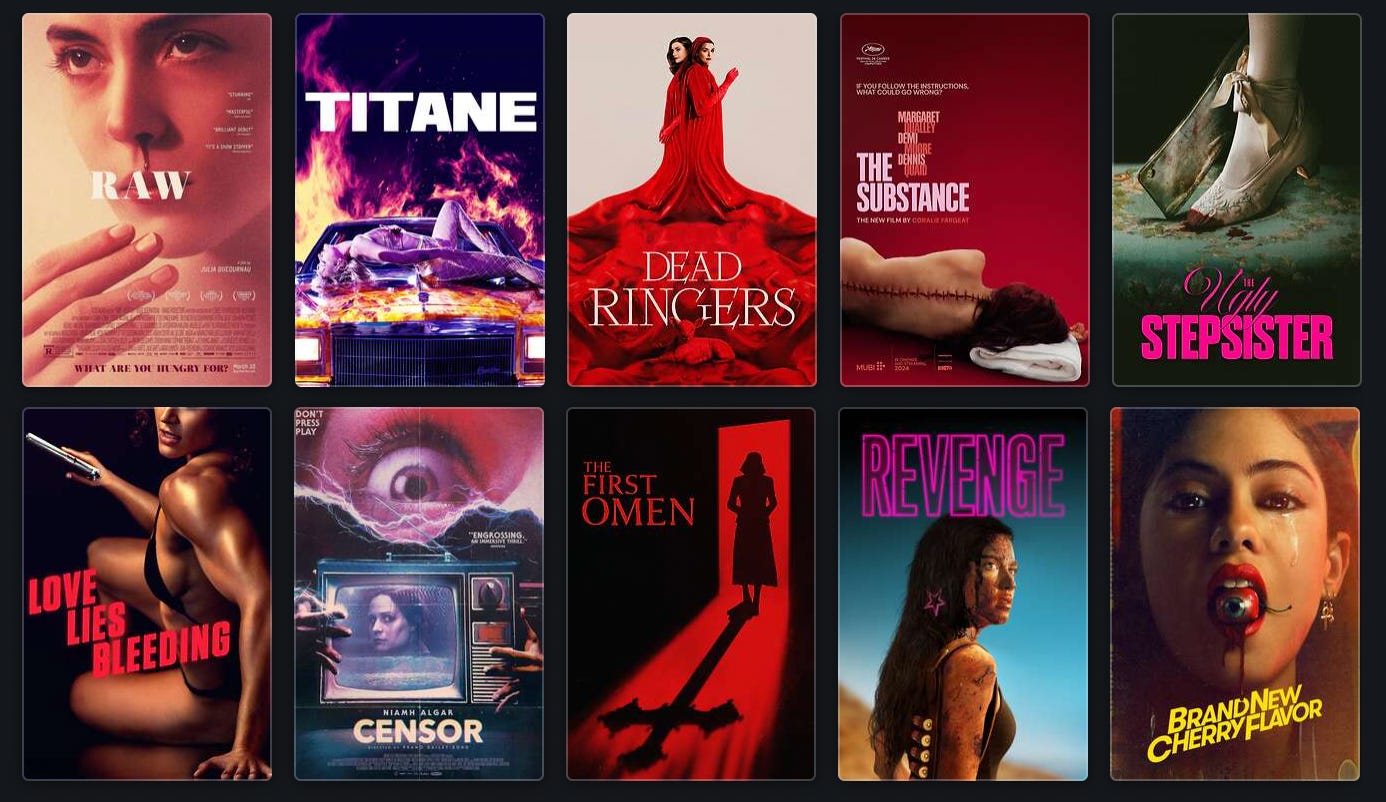
NEW WAVE BODY HORROR
Over a career spanning fifty years, Cronenberg has established a clear cinematic language for bodily transformation, and in recent years, a new wave of female-directed body horror has emerged. The most notable of these filmmakers are Julia Ducournau (Raw, Titane) and Coralie Fargeat (The Substance). It’s no surprise that women have continued to build upon the foundations Cronenberg laid out. Where Cronenberg explored transformation via technology, desire and disease, directors like Ducournau and Fargeat have redirected these same thematic anxieties towards the female experience. Focusing on stories about beauty, bodily autonomy, ageing, and motherhood. As a result their films are reaching new heights and acclaim, with Ducournau becoming only the second woman to win the Palme d’Or for Titane and Fargeat earning three Oscar nominations for The Substance. Cronenberg may have pioneered modern body horror as we know it, but some of its most exciting new flesh is being grown by women.
CRONENBERGIAN AESTHETIC
Cronenberg’s influence doesn’t just end at the cinema. It’s now an aesthetic in its own right. This even extends to pop stars like Charli xcx, whose latest album (released on the same day that I’m sat in a cafe writing this essay) features Cronenberg on the final track in a song called ‘No One Lasts Forever’. At first glance, this collab seems unexpected, but anyone following Charli on Letterboxd will know that she’s a certified Cronenbabe through and through, regularly citing Maps to the Stars and Crash among her favourite films. Her new album, Music Fashion Film, is similarly interested in the instability of identity and performance of desire, and constant reinvention. These themes feel more than a little Cronenbergian, and are part of the reason why Cronenberg has become such a recognisable cultural figure online recently.
In an age of influencer perfectionism and the tyranny of “the clean girl”, Cronenberg’s women offer something else entirely. They’re contradictory, erotic, messy, angry. They refuse to become palatable. After all, our fruitless obsession with perfection is far stranger than anything you’ll find in a Cronenberg film.
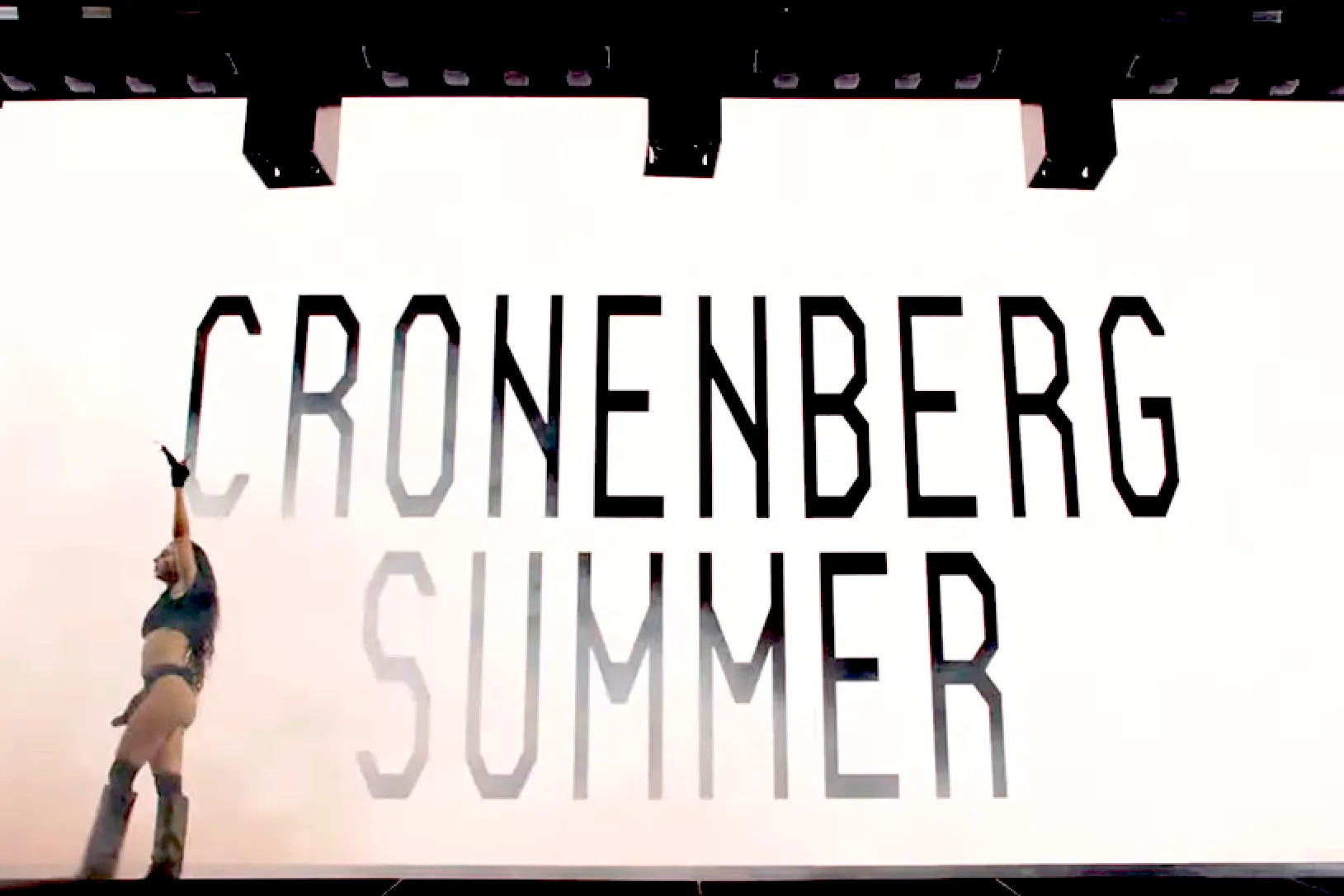
To be a Cronenbabe isn’t simply to love Cronenberg. It’s to recognise that our bodies, identities and desires are always in the process of becoming something else.
So, perhaps the woman sat opposite you on the train is a Cronenbabe. Perhaps it’s Charli xcx. Or perhaps it’s the teenager convincing her Media Studies teacher to let her make Videodrome posters.
We walk among you.
Long live the new flesh. Long live the Cronenbabes.
Sources:
Cronenberg Girls fancam video: @thatlacavagirl on twitter.
Cronenberg on Cronenberg Rabid/Shivers excerpt: https://archive.org/details/cronenbergoncron0000cron_o3z5/page/56/mode/1up?q=female+sexuality
Cronenberg on Cronenberg Videodrome excerpt: https://archive.org/details/cronenbergoncron0000cron_o3z5/page/98/mode/2up?q=female+sexuality
Cronenberg on Cronenberg Dead Ringers excerpt: https://archive.org/details/cronenbergoncron0000cron_o3z5/page/146/mode/1up?q=women
No posts
Comments
Nothing yet. Say the first thing.
Sign in to join the conversation.