
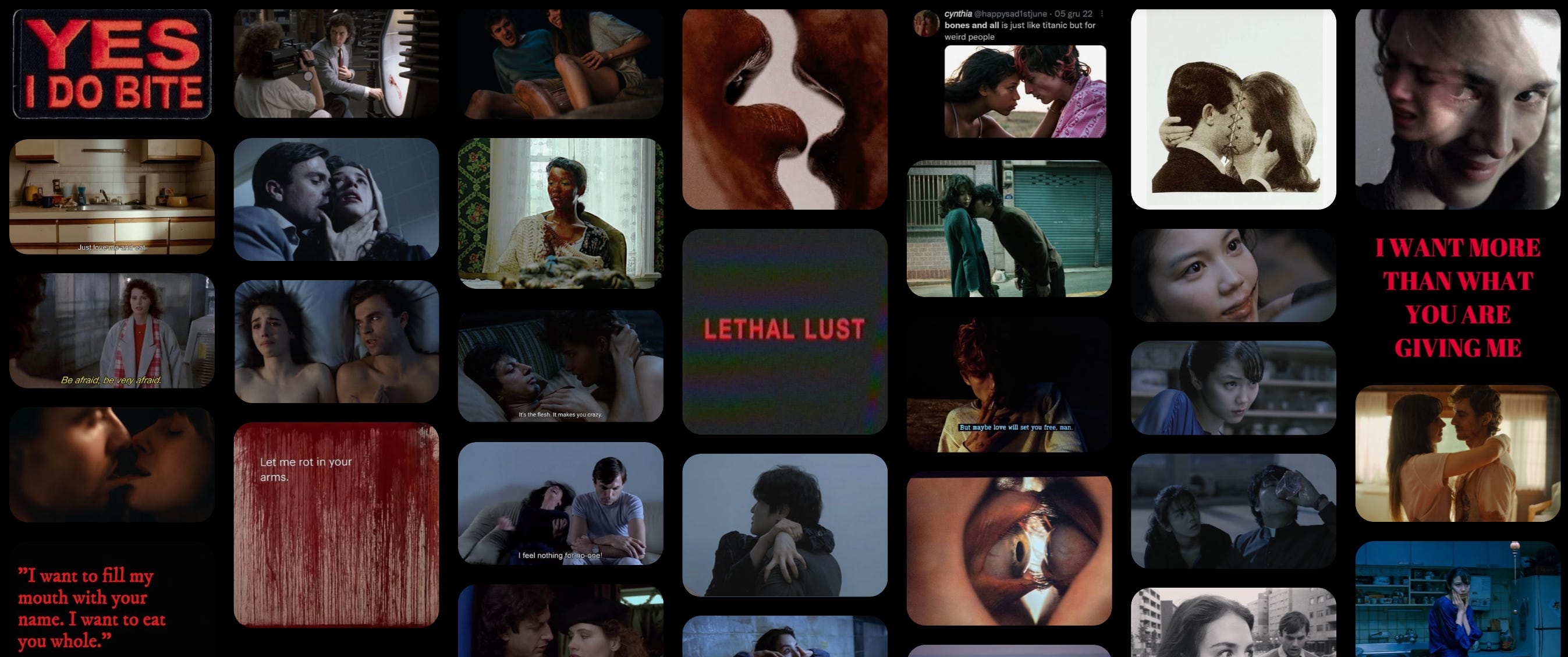
Romance is often sold to us as something finite. Finding your other half. Becoming one. Loving someone with every fibre of your being. But when does devotion become obsession? When does intimacy mean disappearing inside someone?
What does it feel like to be in love? Is it wholesome? Pure?
In my experience, it almost never is. Love at it’s messiest can feel like a vicious cycle: the creeping desire of an all-consuming crush, the building heat of potential in the first few dates and months, the settled resentment of codependency, and the blistering anger when it all falls apart. This timeline can unfold in a week, a few months, or insidiously slowly over decades.
Why are we drawn to stories where the beauty of love is explored through a grotesque lens?
Body horror understands the heights and depths of romance more than most romantic comedies. Love explored through a grotesque and tragic lens often has an opportunity to explore the more transgressive side to relationships, where happily-ever-afters are seldom found.
The language we use to describe desire is already laced with bodily imagery. Ordinary phrases like: “I want you.” “I could eat you up.” “You’re my other half.” “You’re under my skin.” “I’d do anything for you.”
The way we lust is inherently of the flesh, it’s an ache, a hunger. It burns and possesses us.
Romance has always spoken the language of flesh. Body horror simply has the audacity to take that language and hold it up like a mirror back to us.
“I LOVE YOU NO MATTER WHAT”
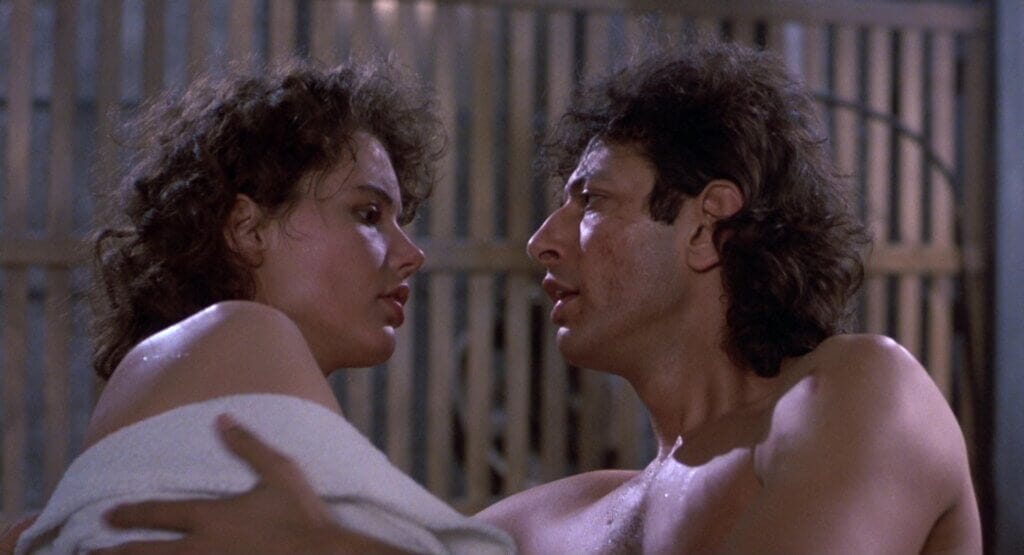
Well, that’s a nice sentiment. But what does “no matter what” really mean? “No matter what” is all well and good until your partner has accidentally spliced his DNA with that of a fly and is genetically mutating into a horror beyond all comprehension before your very eyes.
Whenever I’m talking to someone about David Cronenberg’s The Fly (1986), which happens more often than you’d think, I always try and sneak in that I think it’s one of the most romantic movies ever made… And I usually get some sort of confused reaction.
Veronica (Geena Davis) would do anything for Seth (Jeff Goldblum), and the film makes her prove it. Though initially their relationship builds very sweetly, it quickly turns after Seth’s fateful experiment goes awry. She stays with him when he’s cruel. She stays when his body is falling apart. She stays when the person she knew is becoming increasingly difficult to distinguish from the monster he's becoming. And it falls to her to put him out of his misery at the end of the film, in one last act of kindness. “No matter what” means accepting that loving someone might not mean keeping him alive.
The Fly is often interpreted as a metaphor for the HIV/AIDS epidemic of the 1980s, and it’s easy to see how the case can be made. Seth’s physical decay, social isolation and paranoia all evoke the fears surrounding the epidemic at the time. Cronenberg himself has acknowledged the AIDS reading, but has noted that it wasn’t his intention. For him, Seth’s transformation was something more fundamental: an artificially accelerated version of ageing, the horror of becoming acutely aware that your body is mortal and that, eventually, all flesh will betray us.1
Which makes The Fly's romance even more tragic. Loving someone means loving a body that will inevitably change, decay and eventually fail. The vulnerability of that is terrifying. We just usually get the luxury of growing old together slowly enough that we can pretend otherwise.
“I CAN’T GET ENOUGH OF YOU”
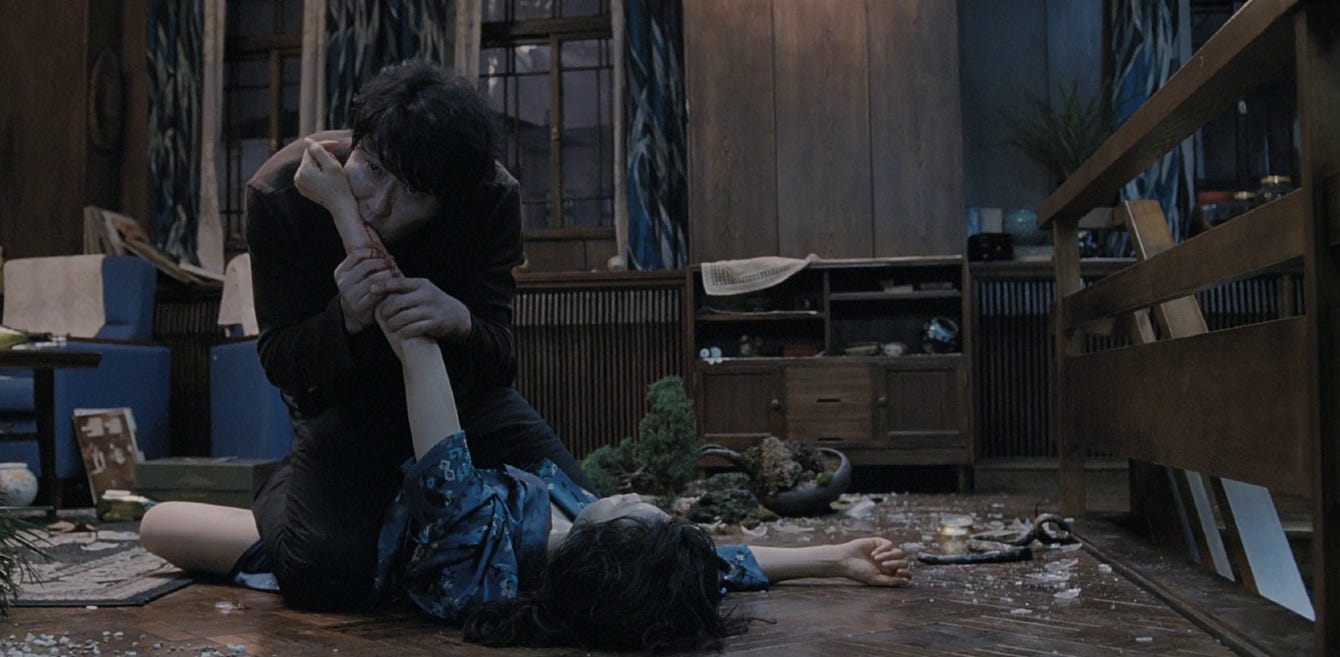
Desire is a wound. It opens up a space between what we have and what we want, and the more we want, the more difficult that absence becomes to ignore. In Park Chan-wook’s Thirst (2009) desire mutates into addiction until the two become indistinguishable.
Sang-hyeon (Song Kang-ho), a Catholic priest turned vampire after a mysterious illness, battles with his faith, his newfound compulsion for blood and for all of the earthly pleasures he’s spent his life denying himself of. He doesn’t just want Tae-ju (Kim Ok-vin) romantically, he needs her. Her blood. Her body. His lust for her is all-consuming and insatiable.
A priest in crisis, conflicted over the depths of human depravity that he’s powerless to resist, is the perfect vessel to explore how festering guilt warps the way that we desire.
I may not be a priest or a vampire (at the time of writing this), but I know how it feels to want someone that I shouldn’t. I’m sure you do too. The thrill when that forbidden desire is reciprocated is extremely addictive. It makes us do things we ordinarily wouldn’t, things that are even against our own beliefs and morals. It can change the way we see ourselves, and how others see us. And for Sang-hyeon, unleashing a lifetime’s worth of stoicism and piety results in absolute carnage. It’s a kind of desire that’s satisfying to act on in the moment, but ultimately leaves you hollow, with a bottomless vat of guilt left in its wake.
Tae-ju is both the subject of Sang-hyeon’s hunger, and after becoming infected with the same affliction, she matches his thirst. Their relationship becomes a stuck in a loop where each person’s appetite for desire simultaneously fuels and drains the other’s. What’s left if all you’re consuming is each other?
The blood of it all is ripe for comparison too. We associate blood with life, sacrifice, violence, bodily fluids. Vampire stories have always made the consumption of blood intensely erotic. In Thirst, the act of feeding is both intimate and predatory. It asks us at what point does intimacy become consumption? And, at what point is desire just a vicious cycle, tearing open the same wounds again and again until they can no longer heal, and what’s left can only bleed and scar?
“I COULD EAT YOU UP”
What does it mean to consume someone you love?
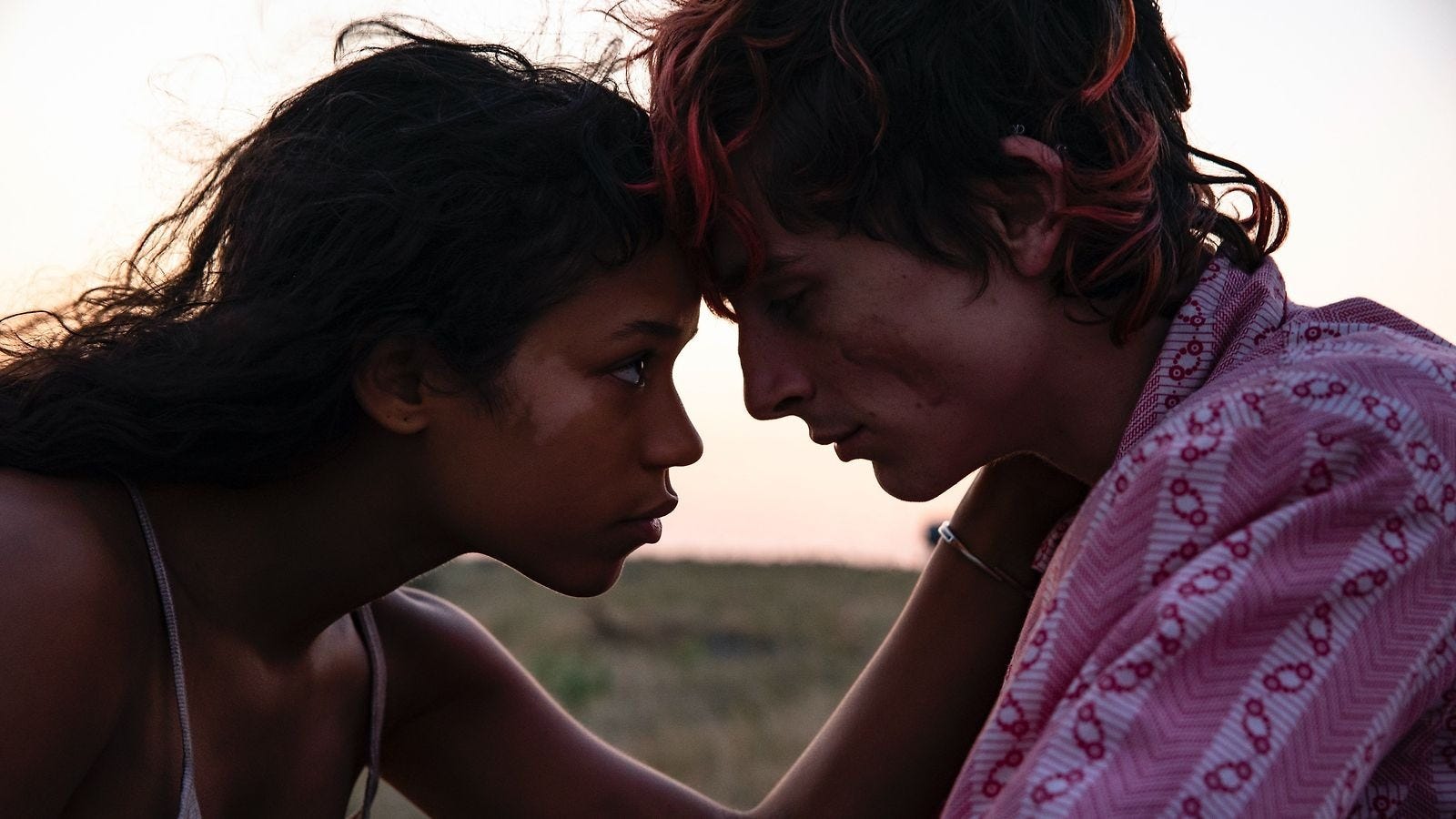
In Luca Guadagnino’s Bones and All (2022), Maren (Taylor Russell) and Lee (Timothée Chalamet) are consumed by a different kind of bloodlust. They’re not vampires, but instead cannibals, referred to in the film as “Eaters”. And the film has a decidedly more romantic viewpoint on consumption and the radical self-acceptance that can come from embracing it.
Maren and Lee have been raised in a society that sees them as vultures. Outcasts living in the shadows, surviving on scraps, hiding their appetites… Until they can no longer conceal their carnal cravings and are forced to go on the run together.
Maren finds solace and family in her connection with Lee. They know exactly how monstrous the other is, and love each other despite this. Lee doesn’t ask Maren to become less of an Eater, or love her on the condition that she suppresses what’s natural to her.
In the film’s final scene, Lee lays dying and gives Maren permission to consume him. It’s an extreme act of love from Lee, and an extreme moment of catharsis for Maren and extremely painful for them both. Maren is able to accept herself by fully giving in to her Eater impulses, which she’s spent her entire life being ashamed of. And she’s able to do it because Lee has given her permission to embrace who she is without shame. The horror of their flaws is also the basis for their intimacy. It’s incredibly romantic… and tragic…
Need me a “Real Eater” like that.
“I’M NOT ME WITHOUT YOU”
Have you ever lost someone you loved? Maybe you were the one who broke up with them. And yet you can’t seem to move on. Or you might not want the other person to move on. You might hate them and still feel tied to them. You might even still see them in everyday places.
I had only seen Andrej Zulawski’s Possession once, and I didn’t think much of it at the time. I couldn’t pin down why I hadn’t liked it. If you’d have asked me then I might’ve given you some cynical and dismissive take. I’m rewatching the film right now as I’m writing this, and having the opposite experience. It no longer feels inaccessible. I think it felt too close to home during my first watch, and I was in denial about it.
At the time, I was mid-break up, and still living with my ex. In a limbo-state between the past six years we’d spent together, and whatever the future had in store for me. There was nothing particularly dramatic about the breakup, but this rewatch has made me think about how interesting, but crucially ordinary, emotional contradiction is. It’s an odd thing to break up with someone and still want them in some way. At once feeling smothered by them and drawn to them.
What does it actually feel like when a relationship ends but your sense of self hasn't caught up yet?
In Possession, Zulawski takes this contradiction and turns it monstrous. And it feels like that when you’re in the midst of it. Turmoil. Sleepless nights. The terror of losing the version of yourself that existed in the relationship is pure horror.
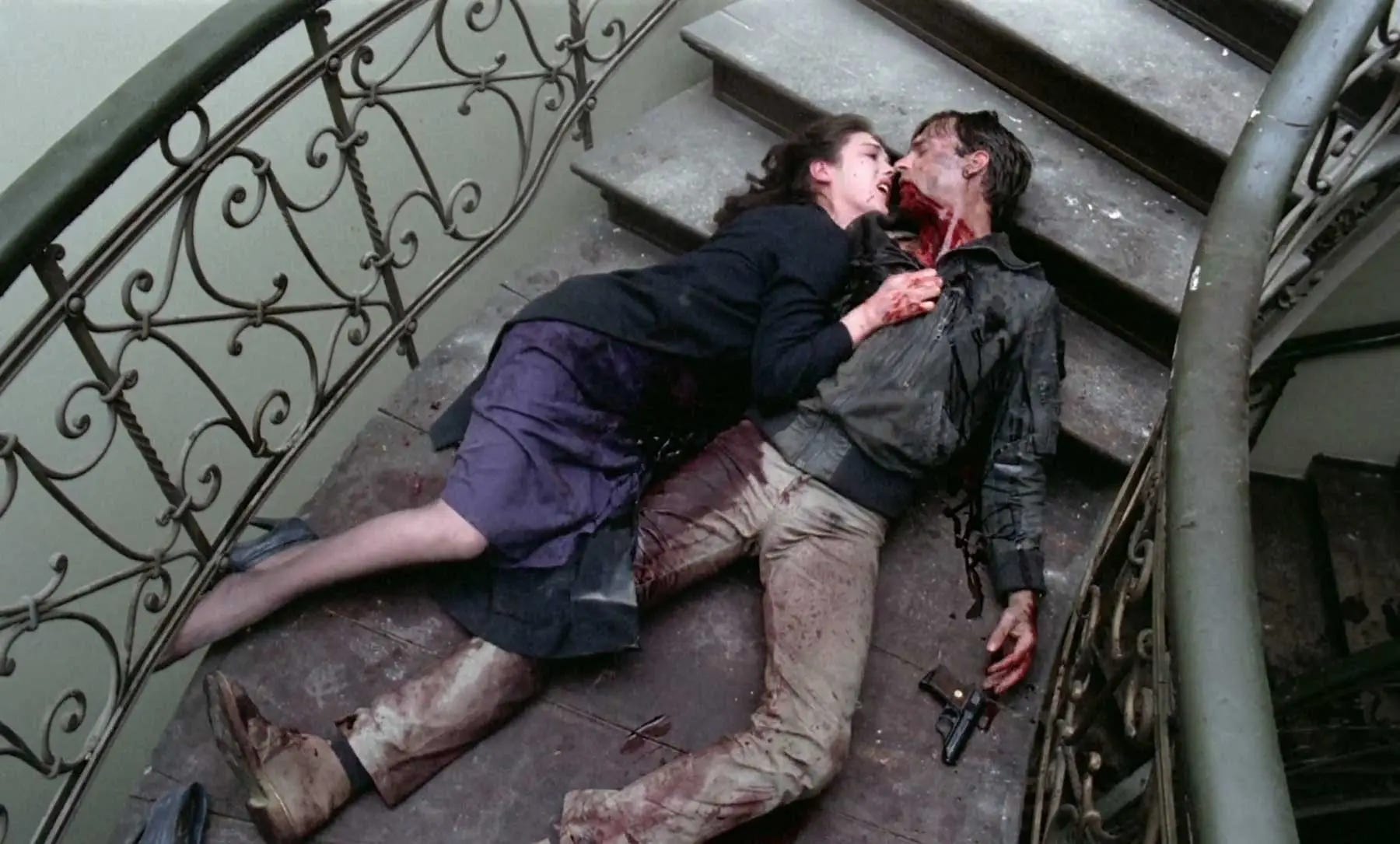
Anna (Isabelle Adjani) and Mark’s (Sam Neill) relationship is rotting from the inside out. Words are meaningless between them, and physical violence is the only thing that registers. They're divorcing, but they're still completely entangled in one another. Resentment doesn’t free them. Love doesn't free them. Even violence doesn't free them. They’re possessed by the relationship itself.
Anna undergoes a powerful full body evisceration at the prospect of parting from Mark. It’s an exorcism of fluids and raw emotion at the prospect of starting again without him. Who is she without him? It’s a question she can’t answer.
In the film’s penultimate scene, the “ideal” doubles of themselves that have been haunting them throughout the film, torture them as they lie bleeding. Look at how perfect they could’ve been together if they had only been slightly different. But they weren’t.
Mark bleeds out and Anna lies by his side and as he slips away she puts a gun to her head. Their exchange is tender. They love each other, they hate each other. They can’t live together, they can’t exist apart. Maybe that's what makes Possession so horrifying: not that love can become some monstrous thing, but that sometimes the monstrous thing is how difficult it is to stop loving someone.
“YOU COMPLETE ME”
Maybe then, it’s better to embrace losing yourself in a relationship. To become completely codependent and almost indecipherable from your partner. Both of you with your eyes wide shut and all in. Is that what “real love” is? That’s the argument that Michael Shanks makes in Together (2025).
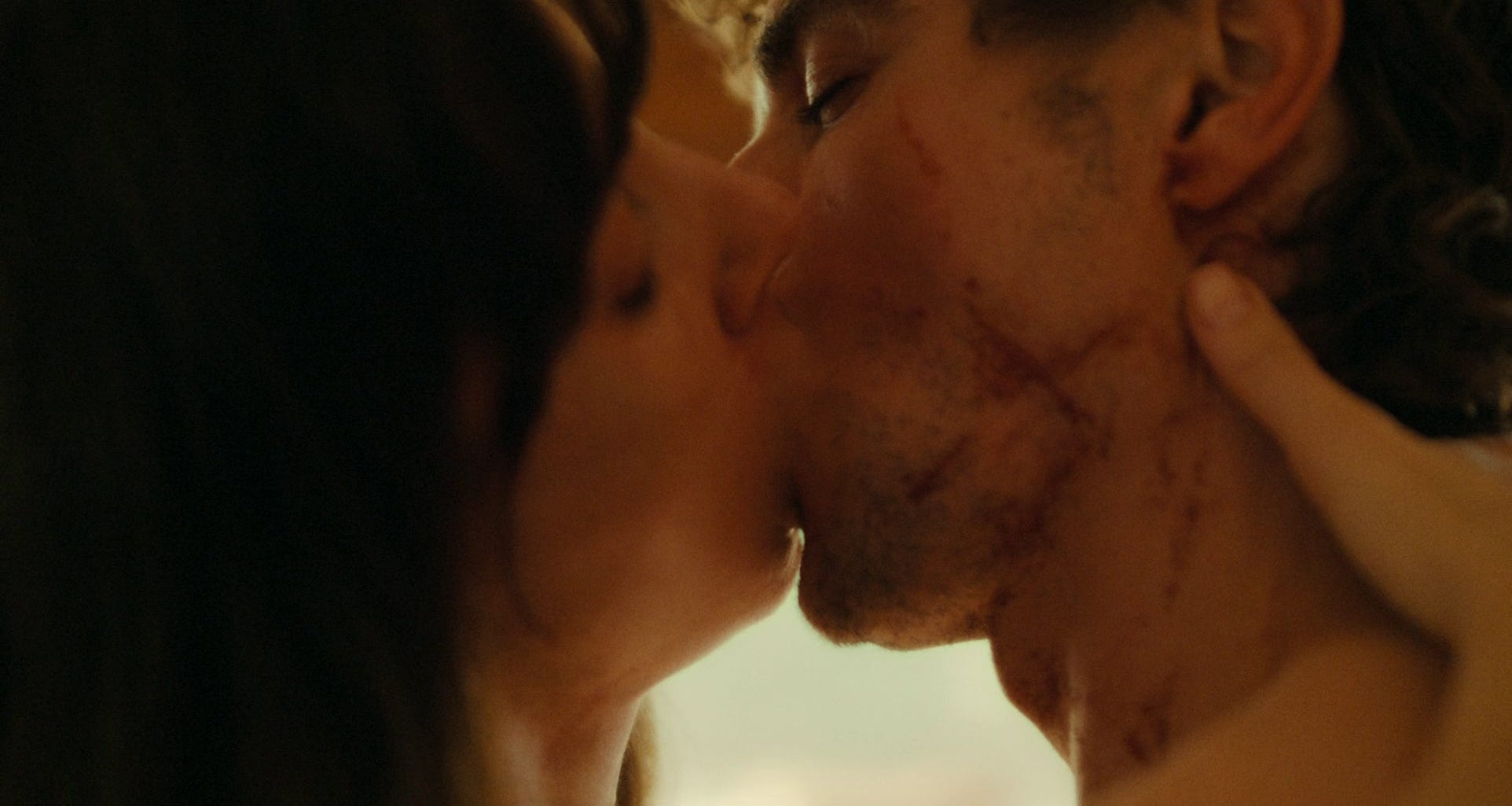
Together sees Millie (Alison Brie) and Tim (Dave Franco) transform codependency into visual horror. Their bodies and flesh are drawn to each other. It’s a magnetic pull. No matter how hard they try, they can’t resist it and eventually they give in.
The Spice Girls “2 Become 1” plays out as they lock into a fleshy embrace, and they become fused together until neither person exists anymore, and instead a humanoid meld of the two lives in their place.
Millie and Tim simply cannot be apart and so, for better or for worse, they’ll be Together forever.
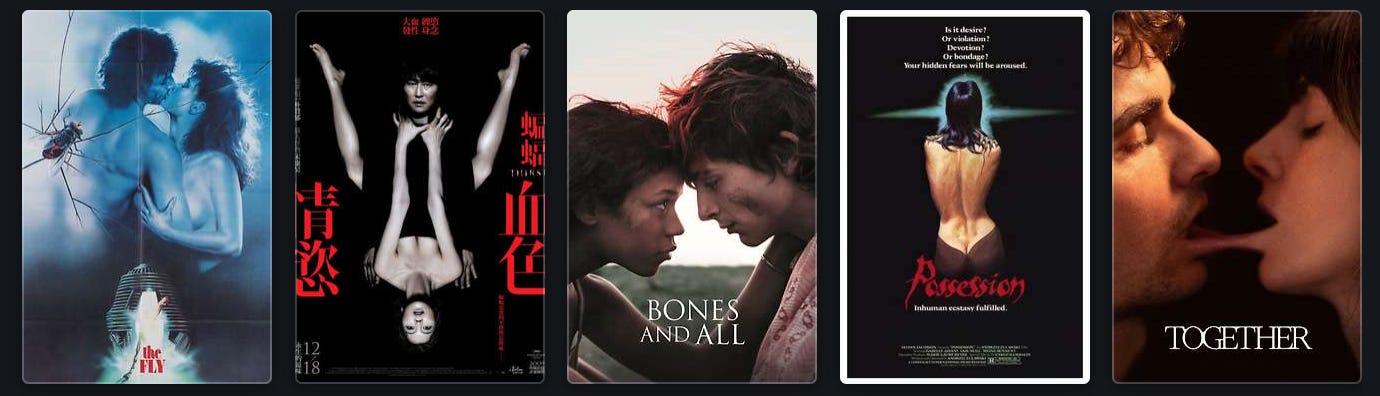
Body horror wastes no time trying to pretend that love is always wholesome. There’s a vulnerability to the way it forces us to face what we risk when we open ourselves up to another person. It’s exposing, but it embraces the messiness the everyday of romance. There’s tragedy in the casual cruelty we inflict on the people we love, and intimacy in the way our bodies both enable and betray us in relationships.
Despite all of their tragic endings, these films are still deeply romantic and they all arrive at different answers to the same questions about love and desire. Ultimately, there’s beauty in the inevitable carnage.
We use carnal language to describe love because love itself can feel physically overwhelming.
Body horror simply has the audacity to confront us with it.
David Cronenberg for The Paris Review, 2014: https://www.theparisreview.org/blog/2014/01/17/the-beetle-and-the-fly/
No posts
Comments
Nothing yet. Say the first thing.
Sign in to join the conversation.