
We’re going to end our AI blog series with the ins and outs of using AI without falling into the uncanny valley, and take advantage of the full potential of this technology like the smartest brands are doing now. Instead of chasing speed and efficiency at all costs, the most AI-savvy brands are using AI to enhance creativity and deepen customer understanding to deliver more relevant, personalized and human experiences at scale. They already understood that AI isn’t a replacement for strategy or storytelling; it’s a tool that, when used thoughtfully, makes both stronger.
In this blog, we’ll explore how some companies are getting AI right: where it actually adds value, where it falls short, and how to strike the balance between automation and authenticity in modern marketing.
The difference between using AI for marketing and using it right lies in intent. Many brands have adopted AI to produce faster, cut costs or substitute human labour, but speed and savings without a plan with human supervision lead to content that feels hollow, generic, disconnected, or fake, triggering the uncanny valley’s rejection and the consumer’s alienation that follows. On the other side of the fence,using AI right means starting with the strategy and using the technology to support it, not replace it.
AI works best as an amplifier of human efforts. It can take a strong idea, a clear brand positioning, and a well-segmented audience, and help you scale them across channels and formats. But if the foundation is weak, like a prompt as a bare-minimum instruction, AI will simply produce weak content. That’s why the most effective teams treat AI as a tool within their marketing system, not the system itself.
Strategic AI use in marketing means equipping teams with tools that take care of the repetitive, time-consuming tasks, freeing manpower to focus on planning, leadership and creativity, hence allowing them to do better work: faster research, more variations, more detailed insights, and more time spent refining ideas that truly connect.
However, the efficiency AI brings can’t sacrifice authenticity, or brand competence and warmth. Brands that struggle to take full advantage of AI are the ones that don’t understand the distinction between enhancement and replacement: The ones that use AI as a shortcut or a substitute for human thinking, creativity, and judgment with automation get content that checks all the technical boxes but lacks depth, originality, or emotional resonance.
On the other hand, brands that use AI as an augmenting force empower their teams to deliver campaigns that bridge the gap between the data that supports the creativity and authenticity that drives better results, at scale.
The brands getting real value from AI aren’t the ones using it the most; they’re the ones using it where they need it. Instead of chasing automation for its own sake, they’re designing workflows where AI strengthens what humans already do best.
This is how it translates into marketing:
AI can be an assistant to help teams handle the heavy lifting of the most time-consuming aspects of the creative process, removing the friction around creative thinking. In marketing, this friction usually shows up in several ways:
The Blank Page Problem: One of the most relevant hurdles in creativity is figuring out where to start forming an idea, as even the most experienced creatives can get stuck or feel pressure to come up with something original from scratch.
Text GenAI can act as an initial draft writer, using past successful campaigns and raw data as fuel to generate a brief, including key elements like audience segments, predicted KPIs, and suggested messaging angles; while AI image models can help designers generate visual concepts from text, enabling teams to align on “vibes” before the final concept is polished.
Setup Work: Marketing creativity needs some time-consuming, foundation work: from topic research, past campaigns analysis, to organizing assignment notes. AI compresses hours of preliminary work into minutes by summarizing and breaking down information, analyzing past campaigns, highlighting key trends and statistics, and presenting its findings in ready-to-use insights to start forming ideas faster.
Essential, But Repetitive Tasks: Modern marketing thrives on personalization, A/B testing and multi-channel campaigns, and all these variables feed on multiple variations of the same assets. Instead of manually rewriting the same idea over and over, AI can generate multiple versions in seconds, improving the team’s work in all aspects of personalization:
Faster Ideation Through Volume: AI can instantly generate dozens of variations that go beyond extra tweaks of headlines, taglines, ad copy, email subject lines and call to actions, with adaptations for several channels and different audiences. This volume of meaningful variations allows teams to gain a broader perspective on the campaign by seeing multiple angles of the same ideas side by side, helping them spot stronger concepts, unexpected directions, or phrasing they wouldn’t have thought of on their own.
Better A/B Testing: The volume of variations AI generates also allows testing on a granular level we couldn’t fathom doing manually. Instead of finding one winner, AI-powered A/B testing delivers customized results by selecting winning variations for different audiences, improving the overall performance of campaigns. Another perk is that, unlike traditional testing, AI-powered tools can constantly learn and improve their decision-making criteria if teams regularly feed them with feedback and campaign performance data.
Breaking Creative Ruts: Sometimes teams get stuck repeating the same style or messaging and struggle brainstorming new alternatives. With the right prompts, AI can introduce new phrasing, different structures or alternative angles that, even if they aren’t perfect, can act as a creative push that can send thinking in new directions.
By removing these repetitive tasks from the creative process, marketers can spend more time creating: refining ideas, developing stronger narratives, and ensuring the final product actually resonates with the target audience. The output will still feel human because the human input is concentrated where it has the most impact: Direction, storytelling, and emotional impact.
Branding and AI can co-exist perfectly, with the proper training. Instead of relying on generic, inconsistent outputs, smart brands train AI on how to sound like them by feeding AI with:
Brand voice guidelines (tone, style, personality)
Keywords, phrases and taglines
Messaging frameworks and positioning
Examples of high-performing, on-brand past content
This turns AI from a generic-purpose tool into a brand-aligned assistant. The result is content that scales without losing identity, something many brands struggle to maintain as production increases.
As powerful as AI can be, it still lacks the context, emotional intelligence, nuance and lived experience humans have. Smart brands acknowledge this and treat AI tools as a starting point, not the finished product.
As MIT Sloan professor, Thomas W. Malone said, “Combinations of humans and AI work best when each party can do the thing they do better than the other.” With this quote in mind, when AI takes care of structure and speed, and humans handle customer insights and feedback, cultural and market context, and strategic nuance and editorial judgment can lead to better campaigns that are both efficient and impactful.
As you can probably tell, using AI differently implies thinking about it outside of the box and shifting the way we question AI’s role in marketing. Instead of asking, “How much can we produce?” we should ask, “What’s actually worth producing?” And after seeing the staggering amount of AI slop flooding the Internet and enraging the public, this is the most important question brands should ask themselves, and it’s the one the smarter ones answer before creating AI campaigns.
Smart brands resist the temptation to pump out AI-slop content and instead focus on:
Fewer, more meaningful pieces
Messaging tailored to their real audience needs
Content that feels intentional and is brand-centric, not automated and generic
As people become more aware of AI-generated content, trust becomes a competitive advantage. Brands using AI while maintaining their authenticity, clarity, and originality stand out; not because they use less AI, but because they use it more responsibly.
In 2022, Heinz proved that the best way to know if your brand is deeply ingrained in people’s minds in the current 21st century is to ask AI. They asked the AI image generator DALL·E 2 to produce images of how it thought a ketchup would look, using prompts like “ketchup”, “ketchup scuba diving,” or “ketchup in outer space”, and most of the images had ketchup bottles that looked a lot like the Heinz ones.
With those results in mind, the creatives behind the campaign decided to make AI the center of the campaign, instead of just a tool. The message of the campaign was simple, but impactful: Heinz is the global standard for ketchup, and even an unbiased source like an AI knows it.
The campaign worked because it transformed an emergent technological trend at the time into a brand and pop culture event. Rather than using AI as a production shortcut, Heinz used it to strengthen its brand equity in a way audiences immediately understood. The campaign blended humour, internet culture, and technology into something that felt timely and self-aware.
Among the several concerns surrounding AI use in activities known for their artistry and need for human creativity, the ethical, long-term use of models and actors’ likenesses is at the center of discussion. Fast fashion brand H&M brought a new edge to this dilemma with its transparent approach to AI use by announcing the use of “digital twins” made of real models for use in marketing campaigns and social media content.
Instead of generating 100% digital models, H&M worked with 30 real models to create digital replicas that could be used in future photoshoots and promotional materials. The concept was as simple as it was innovative: instead of flying models to multiple locations and organizing extensive photo shoots, H&M could use AI-generated “twin” versions of those models to create marketing imagery more efficiently. The models retained ownership rights over their digital counterparts and would be compensated whenever their twins were used.
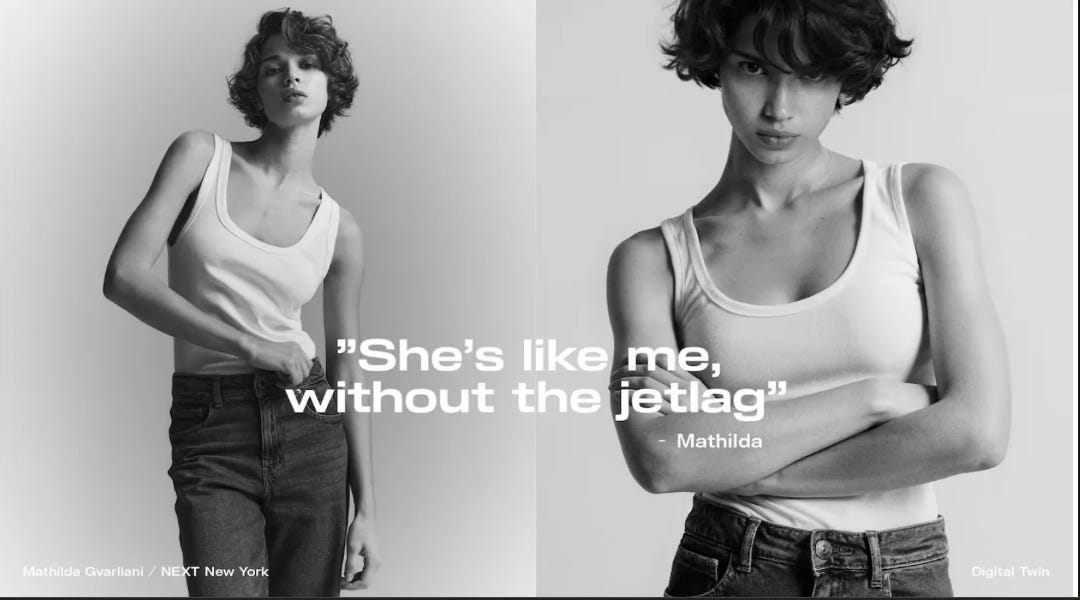
H&M gained both praise and criticism for this way of using AI. While it was received as an original, forward-thinking way of using AI ethically while solving the uncanny valley problem and scaling content production with a compensation model that could be a potential solution to the Name, Image, and Likeness (NIL) use debate surrounding AI; it also got words of concern by people worried about the long-time effect on fashion photographers, makeup artists, stylists and production crews work if H&M’s model becomes the norm across the industry.
Coca-Cola’s marketing has had its ups and downs with AI marketing. We discussed one of the flops here, but now we’re going to explore one of its success cases. In 2023, Coca-Cola partnered with OpenAI and Bain & Company to make the beverage giant’s brand assets available on an online platform for artists and consumers to create original AI-generated artwork remixing iconic brand elements like the Holiday classics Coke’s Santa Claus and the polar bears, as well as the contour bottle, the script logo and the complementary flowing white ribbon to create new artwork pieces that could’ve chosen to be exhibited in billboards in London or New York.
The initiative set Coca-Cola at the forefront of AI-powered artistic expression while strengthening its brand identity by making its brand elements’ library the raw material for consumers and artists’ self-expression. Rather than replacing creativity with AI, the campaign positioned it as a tool for enhancing human imagination, as participants still had to produce their ideas, write prompts, refine outputs and mix-and-match different concepts.
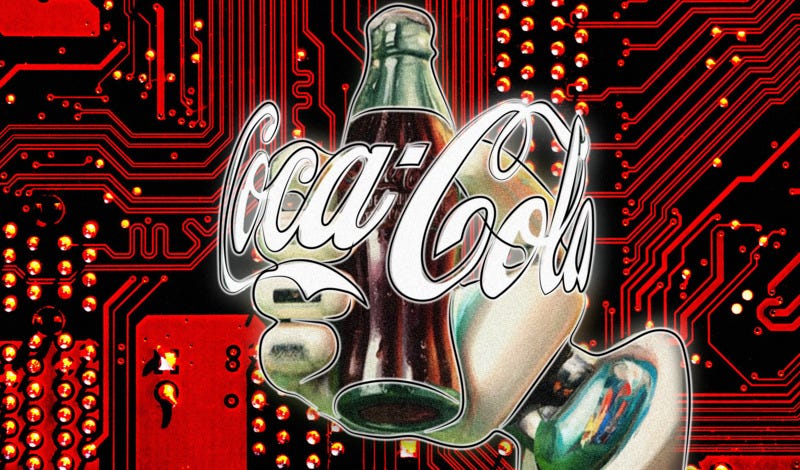
“Create Real Magic” was a success that put Coca-Cola on the positive side of the AI conversation and caught the attention of key demographics like Gen Z consumers. Coca-Cola also launched the Real Magic Creative Academy, selecting digital artists from around the world to collaborate with experienced designers and creative leaders, helping position the brand as a supporter of emerging digital artists rather than merely a user of AI technology.
AI tools are now a standard in the marketing toolkit, but simply using them isn’t enough in a scenario dominated by the “AI replacing humans” ethical debate. The brands seeing success aren’t those pumping out the most AI-generated content; they’re the ones using AI with purpose. They understand that technology is most valuable when it supports a clear strategy, strengthens creativity, and doesn’t leave human values behind.
The examples we’ve discussed show that AI works best when it’s used to improve human creativity and intervention instead of replacing it. Whether it’s creating more engaging brand experiences, optimizing creative workflows, or inviting customers to be part of the brand’s creative process, the common thread is the intention: These brands aren’t asking AI to think for them; they’re using it to think bigger and at scale.
The controversy surrounding AI marketing is far from over, though. H&M’s digital twins may solve the problem of model logistics, but it creates work uncertainty in other professionals who are essential for photoshoots to happen. While historical shifts have a profound impact that reshape societies, we can improve ours with AI, but only when it’s guided by the one thing it can’t replace: human insight.
No posts
Comments
Nothing yet. Say the first thing.
Sign in to join the conversation.