
I’m a venture capitalist. My job is to find new, undersaturated talent markets and to invest in those before they even know they are venture-scalable. Content and Creators are what I’m betting on. They are my two loves.
Over the last five years, I’ve been watching billions of dollars being thrown to what can only be described as the “creator economy” and it’s clear that most of those bills were set on fire. I don’t want to blame anyone for that - since “Creator” is something so misunderstood that we can’t even decide on its definition or who is/isn’t one.
Creator is a $200B industry. Creators are rich. Creators need this product.
All assumptions. I’ve invested 1) with, 2) for, and 3) in Creators, professionally. I guarantee that there are maybe four or five investors on the planet that can say that. My biggest takeaway is this: The Creator ecosystem is an underdeveloped ecosystem. It’s been entirely misunderstood and hasn’t matured.
I started this newsletter to continue to find out why.
Early in my venture career, I was given what sounded like a straightforward assignment: map an entire catalogue of niche Creators.
At first, the work felt almost mechanical. Find the Creators, organize them by niche, compare their channels, and determine which ones were most relevant to include. But the longer I spent looking, the stranger the exercise became. Over the weeks, it all started to blur together. Finding the niches was genuinely fascinating: a real window into what people actually want to consume. But the Creators within those niches? Remarkably alike. Similar formats. Similar upload schedules. Similar audiences. Even their performance on a given day frequently looked almost indistinguishable, which is a very annoying thing to discover when your whole job is finding the difference.
The expectation, I assumed, was that I would develop conviction. Look at each creator's channel on a particular day, decide who mattered, who was emerging, who wasn't, write it up, done.
I finished the project. I presented it.
My conclusion was, I'm told, not what anyone wanted to hear: I suggested we wait.
And so we did.
Several months later, we went back to the same group of Creators, and that's when the differences finally showed up. Some had quietly built catalogs that kept pulling in attention long after publication. Others were living entirely off their most recent upload, with everything older basically going silent the second it stopped being new.
Over time, I noticed, of course, the rankings changed. In my opinion, Creators or their niches had not fundamentally changed, but because we had finally observed enough of their content to see how it behaved through time.
The original snapshot had concealed the only variable that ultimately separated them: time.
It’s a very obvious understatement that a single screenshot of their analytics never told the whole story. What mattered wasn't where they were or are today. These founders are alive and their portfolios (channels) are ever living, shockingly, no matter how frequently they post. Content is a moving vessel.
Now, as mentioned in the previous article, most content markets are built off of measurements. Very obviously, views, impressions, reach, watch time, engagement, downloads, and click-through rates have become the accounting systems of the content economy. But, to me, they mean too much when you stare at them at face value. They currently determine advertising payouts, influence recommendation systems, guide creator strategy, and increasingly shape how investors evaluate content businesses. And this standardization has been super helpful…
Why Metrics Matter: A platform must be able to aggregate billions of interactions into a common set of units. A Creator must be able to compare one upload against another. An advertiser must be able to compare one campaign against the next. Measurement requires a shared language.
This though, is limiting. The idea of a unit of attention (metric) treated as equivalent to another unit of attention (another metric) is too simple to be treated as the determinant of a successful comparison.
Still a view is treated as a view, an impression is treated as an impression, a minute watched is treated as a minute watched.
This standardization assumes:
Assumption
1 Unit of attention = 1 unit of attention
Meaning, the entire content and creator ecosystem, not just platforms, to aggregate attention into common units.
And, by the way, this assumption isn’t entirely irrational. Without it, measurement would basically be impossible. Platforms wouldn’t be able to report performance and the general markets would struggle to compare across units of content, or even assets. So the issue isn’t that the assumption exists. The issue is when we forget this is an assumption, or a snapshot, at all.
Summary: Platform metrics provide a snapshot of attention at a particular moment in time. They describe what has already happened. They do not necessarily describe what will continue happening, nor do they fully capture the economic state of the underlying content asset.
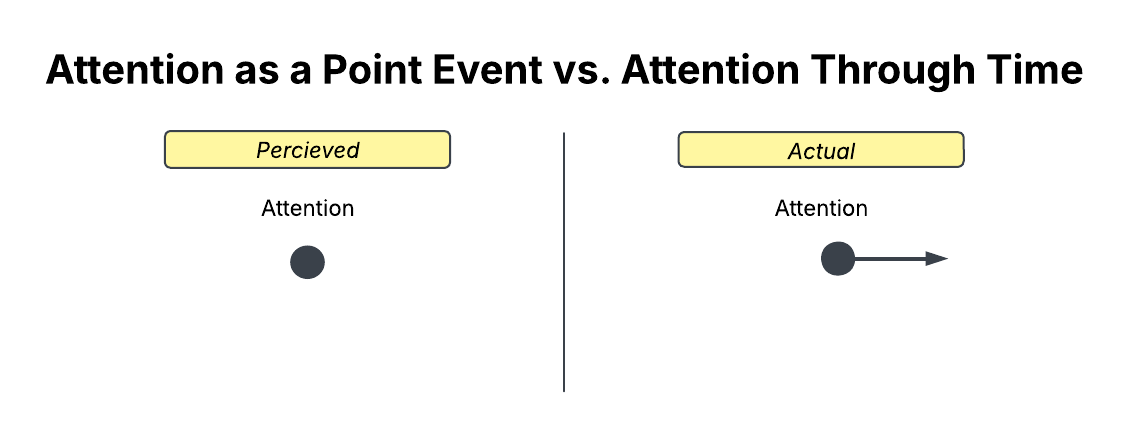
From the perspective of the metric, both events appear identical - even when the economic value is different.
The truth is content is a moving target. Creator as an industry is an ocean to navigate. It’s very difficult to grab within one short sitting.
So what do we do if attention has to be understood through time?
Most content metrics measure attention at the moment it is allocated. For the sake of this piece, let’s allow for economic value to emerge through what happens after allocation.
Platform metrics observe attention at the moment it is allocated. A view is recorded when it occurs. Watch time is accumulated while content is consumed. Granted, we don’t have assurance that an “impression” is measured the instant it is served across all platforms.
Regardless, these metrics provide an accurate record of allocation, but they do not fully describe the economic value of a content asset.
Consider two pieces of content that each receive 100,000 views:
The view is recorded immediately
The watch time is recorded immediately
Yet the economic state of that content asset continues to evolve days, months, or even years after the original allocation of attention
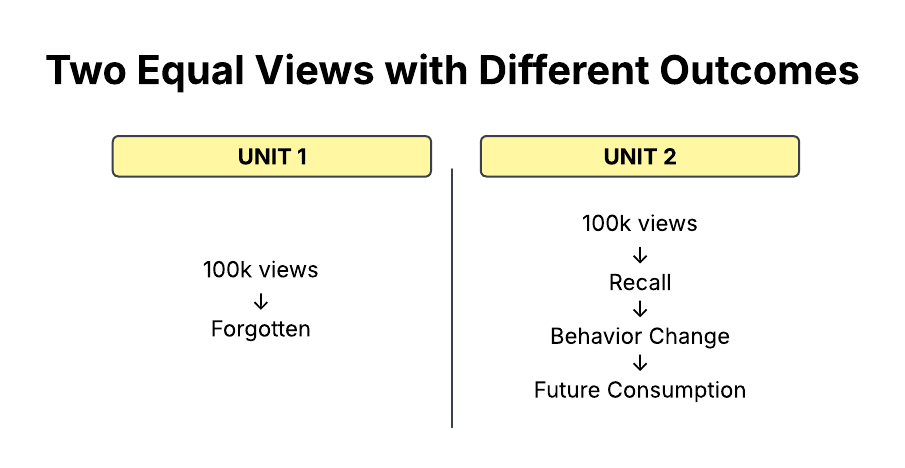
OUTCOME — from here, either unit of content can go on to:
Continue receiving new attention
Retain previously allocated attention through recall.
The value is in the evolution through time.
These possibilities reveal a limitation of treating attention as a completed event. At the moment of allocation, both content units appear to be identical in value. But, as time passes, their value states begin to diverge. One unit can continue generating attention and future consumption, while another gradually loses relevance.
The initial allocation remains unchanged, but the economic significance of that allocation evolves through time.
Very simply: The thing that changes is the economic state of the asset.
This distinction suggests that attention should be modeled as something that unfolds across time. Looking like:
\(A(t)\)
Definition
Let A(t) represent the economically meaningful attention associated with a unit of content at time t. Unlike a static metric, A(t) recognizes that attention is capable of persistence, accumulation, decline, and renewal following its initial allocation as a state.
Economically Meaningful Attention. Attention that retains the capacity to generate future economic consequences for a content unit, including continued consumption, recall, recommendation, redistribution, behavioral change, or future monetization.
If attention is a temporal economic state rather than a completed event, the next question is straightforward: How does that state evolve?
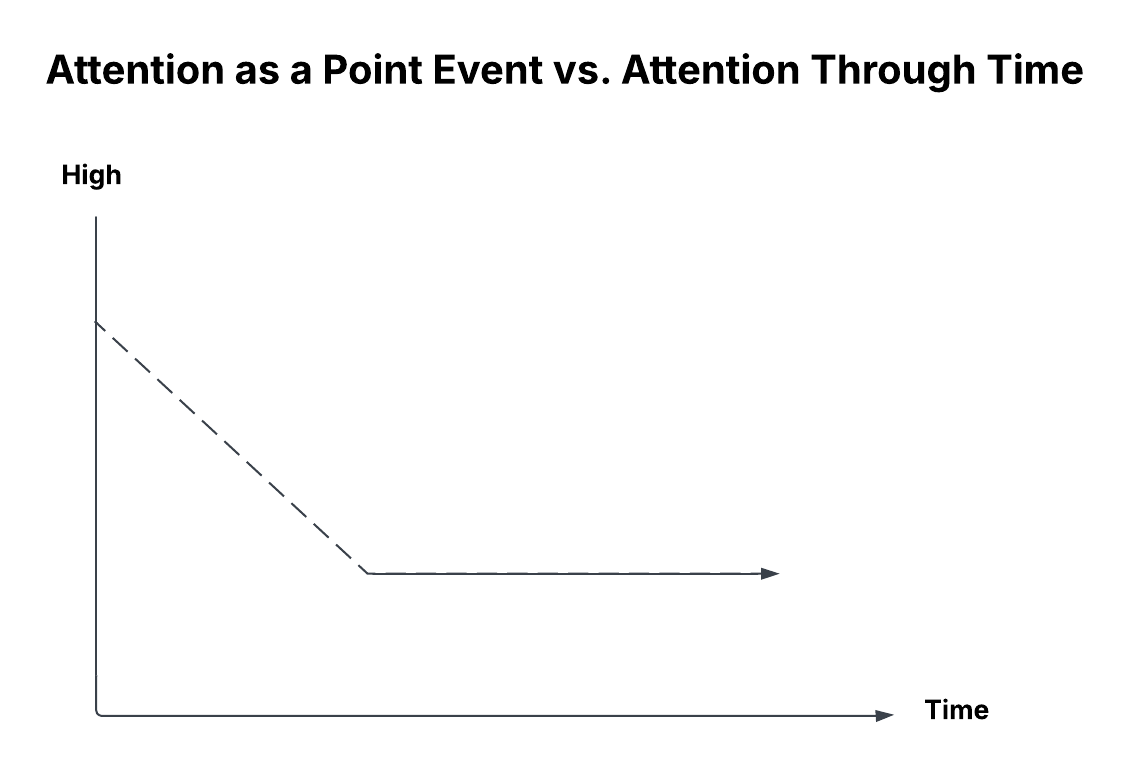
Most attention dissipates after allocation. The rate at which attention decays attributes to its overall economic significance.
Most content receives its greatest concentration of attention shortly after publication, followed by progressively lower levels of consumption as time passes. This decline is observable across nearly every content market, regardless of platform, format, or creator. While the rate of decline varies considerably, the tendency itself is sufficiently widespread to be considered a core characteristic of attention markets.
Most Creators would interpret decay as failure. But in economic terms, decay is the expected consequence of scarcity. It’s only natural for consumers to continuously reallocate their finite attention toward newly available alternatives, causing previously consumed content to lose relative prominence over time.
In the absence of forces that sustain or regenerate attention, the economically meaningful attention associated with a unit of content approaches zero over time.
The core question is then: why some content declines more slowly than others?
The presence of decay does not imply that all content behaves identically. Some units lose attention within hours, while others continue attracting attention for months or years. The distinguishing characteristic is therefore its rate of decay.
This relationship can be represented by modeling attention as an exponentially decaying function:
\(A(t)=A_{0}e^{-\delta t}\)
Definition
Attention Decay Rate (δ)=The rate at which the economically meaningful attention associated with a content asset dissipates over time.
Where:
A(t) = economically meaningful attention associated with a content asset at time t
A0= initial attention immediately following allocation
t = elapsed time since allocation
δ = attention decay rate
The attention decay rate (δ) measures the speed at which economically meaningful attention dissipates following allocation to a unit of content.
Higher values of δ indicate more rapid declines in attention, while lower values indicate greater persistence.
Content assets may therefore receive identical initial attention yet produce substantially different attention trajectories solely because they exhibit different rates of decay.
Although the attention decay rate provides a useful mathematical description of temporal attention, it is often difficult to interpret directly. The value of δ indicates how rapidly attention dissipates, but offers little intuitive sense of the duration over which a content asset remains economically relevant. For this reason, it is often more useful to express persistence in terms of an attention half-life.
\(t_{1/2}=\frac{ln(2)}{\delta}\)
Content Half-Life: the amount of time required for a content asset to lose one-half of its economically meaningful attention.
Expressing persistence as a half-life allows content units with different attention trajectories to be compared using a common temporal measure. Rather than describing content as "long-lasting" or "short-lived," half-life provides a standardized metric for evaluating how long attention remains economically meaningful. Two content assets may receive identical initial attention yet differ substantially in half-life, indicating that one retains economically valuable attention considerably longer than the other.
The distinction between exposure and persistence becomes clearer when content assets are compared directly.
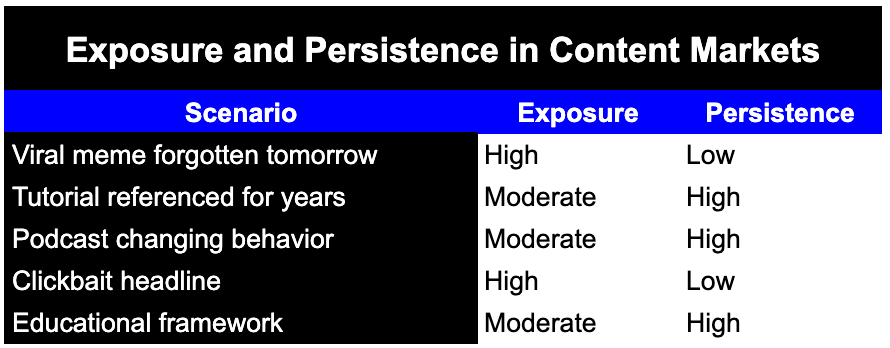
In simple terms, a half-life shifts the economic unit of analysis from the magnitude of attention to its direct persistence.
Although, yes, the long-run tendency is toward declining attention, content assets do not actually decay uniformly.
I started writing this to argue the value of understanding time, the vast space of content markets and how that impacts value not only of the Creator, their portfolio, and (as a precursor to) the formula to which they are both valued on: the sum of the value of individual units (with sprinkles).
One hope, is to start feeling these depths and take them further into account when deciding which contents to work with, for, or allocate resources towards.
Traditionally, there has been a silent debate on the ever-seeing hand of the platform’s corporate team can “industry plug” an individual as successful vs. the people supporting the person, or content, to significance.
Here though, the aim is to question not only the value, but by what metric specifically we can begin to understand success. Whether it’s the value of brand, execution of production, strategy, community reign, or management of the content portfolio to at least maintain the optics of the perceived success.
Applied to the real world: platform metrics measure attention at allocation. This paper argues that attention should instead be modeled as a temporal economic state. Once attention is viewed through time rather than as a completed event, persistence becomes an observable and measurable characteristic of content performance.
This changes the unit of analysis. Content assets can no longer be compared solely according to the amount of attention they receive at publication. They must also be evaluated according to the duration over which that attention remains economically meaningful. Time therefore becomes an economic dimension of content performance rather than merely a chronological one.
Persistence alone, however, does not determine economic value. It is one input into valuation. The next question is therefore not how attention behaves through time, but how the economic output generated by that attention should be measured.
This is one of four essays I wrote coming back from Thea & Jimmy Donaldson’s wedding. Hope you enjoyed!
No posts
Comments
Nothing yet. Say the first thing.
Sign in to join the conversation.