
I’m a venture capitalist. My job is to find new, undersaturated talent markets and to invest in those before they even know they are venture-scalable. Content and Creators are what I’m betting on. They are my two loves.
Over the last five years, I’ve been watching billions of dollars being thrown to what can only be described as the “creator economy” and it’s clear that most of those bills were set on fire. I don’t want to blame anyone for that - since “Creator” is something so misunderstood that we can’t even decide on its definition or who is/isn’t one.
Creator is a $200B industry. Creators are rich. Creators need this product.
All assumptions. I’ve invested 1) with, 2) for, and 3) in Creators, professionally. I guarantee that there are maybe four or five investors on the planet that can say that. My biggest takeaway is this: The Creator ecosystem is an underdeveloped ecosystem. It’s been entirely misunderstood and hasn’t matured.
I started this newsletter to continue to find out why.
I started the Center for Creator Policy and Research as a youthful attempt to grasp which pieces legislation, people or efforts can care to nurture the progress of creators.
There are, by my count, thirteen valuable elements to Creator Policy. Most of them more focused on platforms, IP, or some other mythical, magical artist focus, but very few focus on the Creators themselves.
One of the most consequential elements hasn’t been settled at all: how a Creator gets classified, and how that classification gets taxed.
My personal frustration: you can’t underwrite an asset class the law hasn’t decided how to define yet.
In my everyday life, most people identify this topic as just “semantics” or “endless details” - which is the story of my life. But these details are always exactly what determine whether a business survives its own success. This particular detail plays out every day, in real balance sheets and real take-home pay.
We are talking about a tax code with no box for what you actually are. A classification question nobody's bothered to answer that ends up deciding (1) what you owe, (2) what you're liable for, and (3) whether the thing you built is even legally yours.
Taxation and classification, more than almost any policy proposal I've read, still can’t recognize Creators as the kind of economic actor they've actually become. This leads to, of course in my opinion, almost every “Creator business” being priced, invested in, and taxed against a category that it doesn't actually fit in.
That's a ceiling (subsequently, an investment return ceiling) problem before it's anything else. And my most surprising takeaway: the thing making it worse isn't even the platforms or directly the lawmakers (bless their hearts: they mostly haven't been asking the right question yet.) It's the prevailing description (and lack of agreement) of what a Creator even is.
And we know this through the countless, overthought-piece’d out desire to ask: What is the Creator Economy? What is a Creator?
You'll hear it constantly: Creators are the last artists. The reinvention of Hollywood. The heartbeat of human creative existence, standing against the algorithmic tide. While I do love a nice sentence, and I do understand its appeal [and applied optimism], it's too vague, boxing and borderline political to further the understanding of the hardworking people who contribute to an ecosystem I love so much.
Clinically, we can all be on the same page, but we don’t yet really know what we’re looking at. Humorously, I’ve waited years for someone far more academic or qualified to find a definition. I haven’t gotten one yet.
So instead, I’ll ask the question the “last artist” framing never gets around to: before classification, taxation, preservation, or anything else gets fixed…what is a Creator's labor and its value, actually, in the plain economic sense?
To be honest, content creator labor hasn’t gone completely unstudied as a broad subject. Media scholars have spent over a decade describing the conditions of this work. Conditions like:
precarity, unpaid speculative effort undertaken in anticipation of a payoff rather than in exchange for one,¹
the invisible labor of staying visible to a system a Creator doesn't control and can't fully observe,²
the emotional toll of an audience relationship that behaves like intimacy and functions like infrastructure.
What that scholarship hasn't answered is a narrower, more structural question: What is economically distinctive about content creator labor?
Not what it feels like, or what it costs emotionally, or how unevenly it pays. The question this piece is asking is more mechanical: what is the actual economic relationship between the labor a Creator supplies and the output that labor produces?
Before making the economic argument, it’s worth stating the legal one plainly, because it’s more embarrassing than most people realize.
The United States has no distinct worker classification category called Creator. Legally, a Creator defaults to one of the oldest boxes in labor law:
DEFINITION
Independent Contractor. A worker who operates an independent business rather than working as an employee of the party receiving the worker's services. The applicable legal test varies by statute and context.
Several areas of U.S. law approach Creator work through existing legal categories rather than a Creator-specific classification::
Tax treatment (IRS). A Creator earning revenue independently through an ongoing business activity will generally be treated as self-employed for federal tax purposes. If operating as a sole proprietor, the Creator ordinarily reports business income and expenses on Schedule C and uses Schedule SE to calculate self-employment tax when applicable.
The scale of the activity does not, by itself, create a different worker classification. The size of the audience, the size of the Creator’s team, and the amount of income earned may change the Creator’s tax obligations, payroll responsibilities, or choice of business structure, but they don’t alone transform independent Creator activity into employment.
Worker classification (DOL or FLSA). When a Creator performs work for a brand or other business, federal labor law does not ask whether that person is a “Creator.” It asks whether the working relationship is one of employment or independent business activity. Under the Fair Labor Standards Act (FLSA), that classification highlights the reality of the relationship: whether the worker is financially dependent on the potential employer or is operating a business for themselves. Control over how the work is performed matters, but it is one part of a broader investigation into the actual economic relationship between the parties.
Copyright (work-for-hire doctrine). Copyright law adds another consequence to worker classification. It’s also the public’s favorite to debate: ownership. Copyright generally begins with the person who creates the work. When work qualifies as work made for hire, that starting point can shift to the employer or other qualifying party.
CASE STUDY: The controlling case, Community for Creative Non-Violence v. Reid, involved a sculptor commissioned to make a statue.³ The Supreme Court used the working relationship between the parties to decide whether the sculptor was an employee or an independent contractor for copyright purposes.
A Creator producing content independently will generally begin with ownership of that copyright. An employee producing qualifying work within the scope of employment may not. Classification can then affect how Creator labor is treated and who owns what that labor produces.

Content creation is first a production activity. A unit of content does not enter the market directly from an idea; productive inputs must first be transformed into an output capable of consumption.
Creator labor occurs on the production side of the market. Commonly tracked metrics arise only after the resulting unit of content becomes available for consumption. The labor and the market response to its output are therefore separate performances.
DEFINITION
Content Production. The process through which productive inputs are transformed into a unit of content.
That labor can take many forms. A Creator may research, write, perform, or direct a unit of content. In larger productions, some of these functions may be performed by other workers. For the moment, the relevant input is the labor supplied by the Creator.
DEFINITION
Content Creator Labor. The productive effort supplied by a Creator toward the production of a unit of content.
Scope Note: Content Creator Labor vs. Firm Labor. This definition is deliberately narrow. A Creator’s total labor doesn’t stop at content production since negotiating a sponsorship, managing an editor, structuring an LLC, deciding whether to spin off a second channel is labor too. None of it is what this definition describes.
Content creator labor is the labor that makes the product. It’s not the labor that runs the business the thing generates. That second category only exists once a Creator starts operating like a firm, which we will talk about another day.
Labor alone does not determine what gets produced. Two Creators can each supply one hour of labor without supplying economically equivalent labor. The time is identical, but the productive capability embodied in that time is not.
A Creator may bring technical skill, subject expertise, creative judgment, or accumulated production experience to that hour. These capabilities constitute human capital: the stock of knowledge and productive capability embodied in the worker. This follows the human-capital distinction formalized by Gary Becker in 1964.4
Production also depends on productive capital external to the worker, such as equipment, software, and production infrastructure.
Creator labor, human capital, and productive capital are therefore treated as analytically distinct inputs. A Creator’s hour and a Creator’s craft are not the same input, even though they reside in the same worker.
A simplified production relationship for unit of content (i) can therefore be written as:
THE CONTENT CREATOR PRODUCTION FUNCTION
\(Q_i = f(L_i, H_i, K_i)\)
where:
Qi = the unit of content produced;
Li = Creator labor supplied;
Hi = relevant human capital embodied in the Creator;
Ki = productive capital applied to production
Note: This is a conceptual production function used to identify the principal inputs to a unit of content. It is not an empirical model of content quality or subsequent market performance.
Creator labor is supplied during production, but most measures used to evaluate content are observed after production has ended. Views, watch time, downloads, engagement, and revenue describe the market response to a unit of content; they do not measure the labor embodied in producing it.
This creates a basic distinction:
Labor Inputs → Unit of Content
Production transforms labor and other productive inputs into content.
Unit of Content → Observed Market Performance
Once available for consumption, the unit encounters consumer choice, competition for attention, and distribution mechanisms that influence the market outcome ultimately observed.
Accordingly, greater Creator labor supplied to one unit does not imply greater realized market performance:
\(L_i > L_j ⇏ P_i > P_j\)
Additional labor, human capital, and productive resources may improve the characteristics of a unit of content and influence its expected performance. They do not uniquely determine the market outcome ultimately realized.
The weak relationship between labor input and realized market performance is not unique to content production. Workers and firms across many industries operate under uncertainty, and productive effort rarely determines market outcomes with certainty.
The economically relevant distinction is therefore not whether uncertainty exists. It is where that uncertainty is borne.
In many conventional labor arrangements, the worker supplies labor in exchange for compensation that is substantially determined before the eventual market performance of the resulting output is known. Content Creator Labor can differ because the Creator may remain economically exposed to the market realization of the unit after the labor required to produce it has already been supplied.
Labor arrangements differ in how uncertainty is allocated between the worker and the firm.
In many wage and salary arrangements, compensation is specified before the eventual market performance of the worker’s output is known. A film editor can be paid even if the film performs poorly: the worker supplies labor while the firm bears much of the downstream market risk.
Other arrangements transfer more of that risk to the worker. Piece-rate compensation links pay to measurable output; commissions link it to realized sales; entrepreneurs may bear substantially more market risk because their return depends on whether production ultimately creates economic value.
Content Creator Labor can sit unusually far toward this market-exposed end of the spectrum. A Creator may supply the labor required to produce a unit of content before knowing whether that unit will generate meaningful consumption or economic return. Where compensation depends on subsequent performance, the Creator remains economically exposed to market uncertainty after the labor has already been supplied.
DEFINITION
Market-Exposed Labor. Labor for which some or all of the worker's economic return remains contingent on the subsequent market realization of the output produced.
Brooke Erin Duffy’s concept of aspirational labor captures one manifestation of this exposure: work performed in anticipation of future economic opportunity rather than guaranteed compensation.¹ A Creator can know how much time was spent researching, filming, writing, or editing a unit of content. They can also know its production cost. They can observe the performance of similar previous work. But, what they cannot know (with the same certainty) is how the market will respond once that unit becomes available for consumption.
The economic consequence is not simply that performance is uncertain. It is that the Creator may bear that uncertainty directly. Labor can be supplied, production costs incurred, and the unit completed before the economic return associated with that labor is known.
Market exposure describes the uncertainty a Creator continues to bear after a unit of content enters the market. The magnitude and distribution of that exposure vary across creators, platforms, formats, and compensation structures. Several characteristics are especially relevant to understanding its structure.
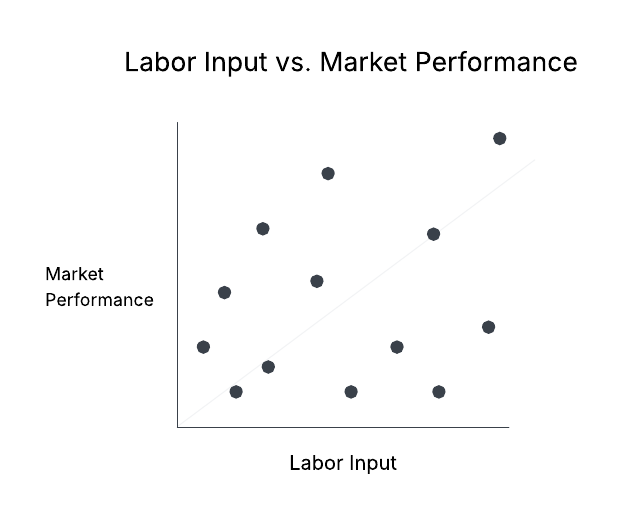
Three characteristics are particularly important:
Volatility: A given unit of content may perform exceptionally well or disappear entirely, for reasons not fully explained by observable differences in production quality. The same level of craft, applied twice, can produce two outcomes that don’t resemble each other at all.
Nonlinearity: Market returns do not always scale proportionally with either labor input or prior performance. Individual units can generate disproportionately large outcomes relative to the rest of a Creator’s output, producing a return distribution in which a small number of units account for a large share of realized value.
Algorithmic Intermediation: Much of contemporary digital content is distributed through platform ranking and recommendation systems.
Crystal Abidin’s name for this is visibility labor: the continual effort of optimizing for a system a Creator doesn’t control and can’t fully observe.² Her point was about the sustained effort of staying visible. The claim here is narrower: for platform-mediated content, the initial audience a unit reaches can be shaped by ranking and recommendation systems.
Labor arrangements differ not only in how workers are compensated, but in the relationship workers maintain with the production process and with what their labor produces.
Content Creator Labor can be compared with wage labor and task-based or gig labor along two dimensions: control over production and potential output retention.
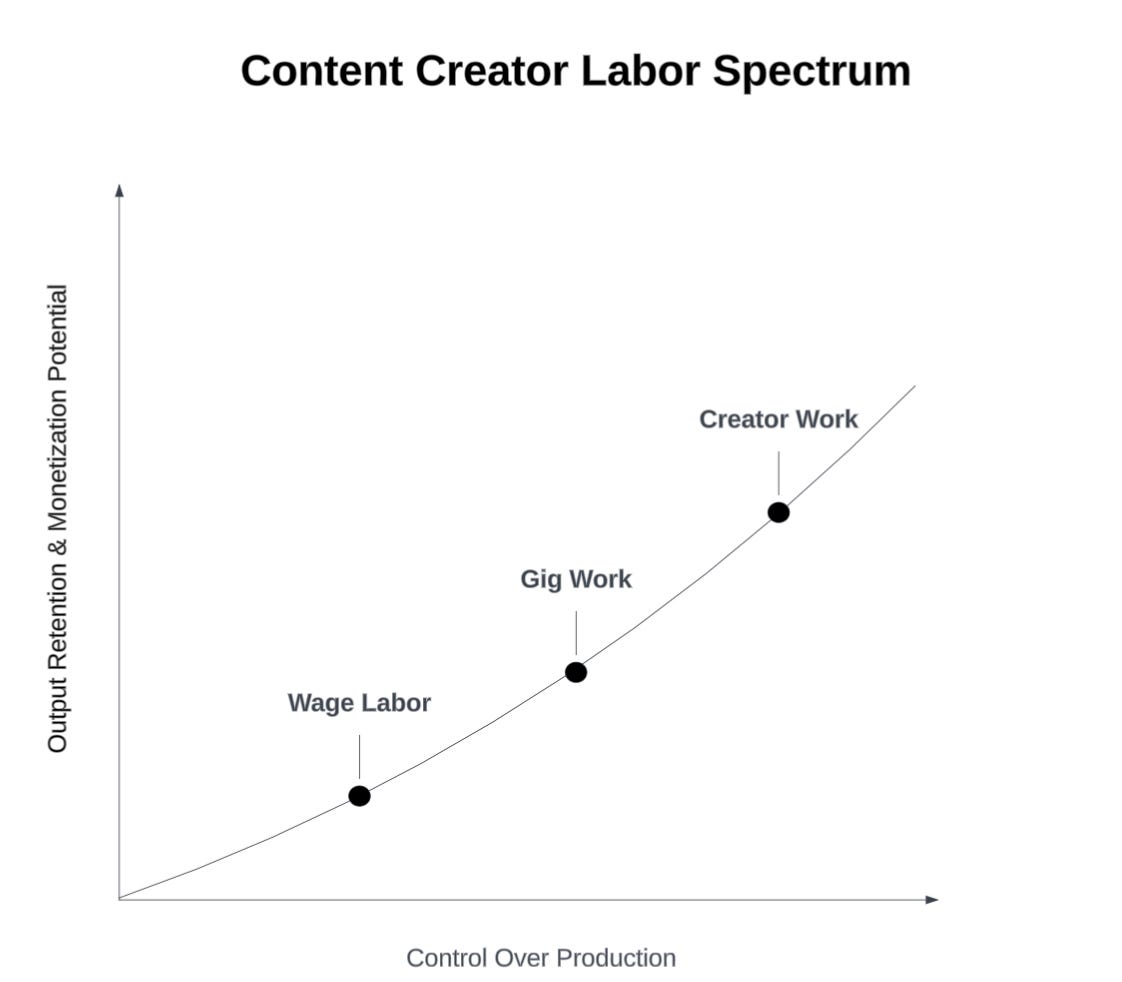
Control over production is about who decides what gets made. In wage employment, that's mostly not the worker. You show up, the firm has already decided what "the work" is, and your job is to execute inside that system.
Gig work loosens this a little. You're still producing against someone else's demand (a task, a client, a contract), but at least you're choosing how to get there.
Creator labor hands over most of that decision entirely. Subject, format, process, timing, creative direction, how often to publish. All elements where the Creator sets all of it. Nobody assigns a video.
Note: This does not mean that Creator production is unconstrained. Consumer demand, platforms, advertisers, contracts, and available capital can all influence production decisions.
The second distinction concerns what happens to the output once the labor has been supplied.
A wage worker's output isn't theirs. It never was. A gig worker gets to control how the task gets done, then hands the finished product to whoever paid for it.
Creator labor is different because the labor doesn't end the relationship.The Creator can keep the unit. They keep earning from it, keep the rights to it, keep whatever it generates even long after the actual work of making it is over.
The comparison can therefore be represented as a spectrum:

Most labor arrangements sever worker from output the moment the paycheck clears. Creator labor, when it works the way it's supposed to, doesn't sever anything.
[Worth saying plainly: this is illustrative. A Creator under a bad licensing deal can lose all of this. A contractor in a different industry can retain plenty of it. Occupational title was never the right variable: the actual economic relationship between worker, process, and output is.]
Content Creator Labor, at its best, combines both: high control over what gets made, and continued control over what it becomes.
The distribution a Creator draws from isn't fixed either. Content Creator Labor does not occur under identical economic conditions from one production cycle to the next since prior production can change the conditions facing the next.
A Creator producing their hundredth unit of content may therefore enter production with resources, information, and relationships that did not exist when they produced their first.
DEFINITION
Path Dependency. A condition in which prior production and market outcomes alter the conditions facing subsequent production.
A unit of content can leave behind effects that remain relevant to later production. Depending on the outcome, prior production may contribute to:
Audience relationships. An existing base of consumers, familiar with the Creator and their work, who may encounter future output.
Demand knowledge. Information about consumer preferences revealed through prior performance.
Production experience. Knowledge accumulated through repeated production.
Financial resources. Prior earnings that can be reinvested into subsequent production.
Financial resources provide one mechanism through which prior market outcomes can alter future production conditions. Returns from earlier units can be reinvested into labor, productive capital, or other production resources, changing the environment in which subsequent Creator labor is supplied. Financial capital therefore contributes to path dependency even though it is not itself Creator labor.
Accumulated content and IP. Prior output that can remain economically relevant alongside new production.
The production of one unit can therefore alter the starting conditions of the next.
Robert Merton coined “cumulative advantage” in a 1968 paper about, of all things, why eminent scientists get credit for work their junior collaborators actually did.6 His version was narrower than mine: recognition begets resources begets more recognition, and two researchers with comparable early ability end up with wildly different careers for reasons that have almost nothing to do with ability.
All you have to do is swap “citations” for “subscribers” and the mechanism doesn’t even need modification. It just transfers.
The one real difference is speed. Merton was describing something that unfolds over a career: decades, tenure clocks, whole academic lifetimes. A Creator's hundredth unit can show up eighteen months after their first. Same mechanism. Different clock speed entirely.
So path dependency isn't neutral. It tilts.
A Creator who already has an audience, a name people recognize, a decade of production reps, and some cash to reinvest is not standing at the same starting line as a Creator with none of that, even if you handed them identical talent and identical footage. Same input, wildly different odds.
This is the part people usually get slightly wrong in both directions. It's not "the rich get richer, full stop". An established Creator can absolutely misfire, and a nobody can absolutely break through. Cumulative advantage doesn't rig the outcome. It just loads the dice before the first one gets thrown.
Which is a less satisfying story than "the algorithm decides everything" or "quality always wins eventually," but it's the more accurate one.
DEFINITION
Audience-Trained Stochastic Output. A model of labor output in which effort is filtered through a probabilistic system trained on aggregate audience behavior, such that performance depends on audience response rather than scaling proportionally with effort.
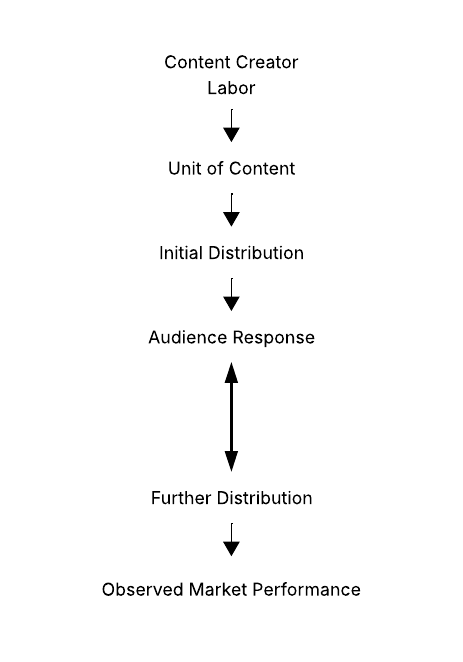
The term audience-trained is important. Uncertainty does not enter the system independently of consumer behavior. Once a unit of content is distributed, consumers begin revealing information about demand through their behavior: whether they choose the content, how long they consume it, whether they return to it, whether they share it, and whether they continue engaging with the Creator.
Platforms can use these signals, among many others, to inform subsequent distribution.
HISTORY TIME: Matthew Salganik, Peter Dodds, and Duncan Watts worked on this in 2006:
STUDY: identical songs, shown to different groups, with only one variable, whether listeners could see each other’s downloads.
OUTCOME: Quality set a floor and ceiling.
The worst songs rarely topped the charts, the best rarely bombed, but within that range, which song won came down to who liked it first, and whether that early signal got amplified.5
A song that flopped in one run became a hit in another, nothing about the song itself explaining the gap.
That’s the mechanism this section has been describing without a name for it: early audience response becomes an input into what happens next, rather than being an accurate report on quality.
I can feel it coming… before anyone gets sad: stochastic doesn’t mean arbitrary.
Skill matters. Resources matter. Timing, distribution, existing audience relationships, competitive conditions… All of it shifts the range and probability of outcomes. A highly skilled Creator can improve the expected performance of their output without determining the realized performance of any single unit.
That’s the distinction: influence. Creator labor can improve the odds, but can’t decide what happens.
Which is why both are true at once: better Creators outperform worse ones over time, and any single unit of content is still hard to call in advance.

What Is Economically Distinctive About Creator Labor?
None of these five things are, individually, interesting. That’s the annoying part.
Production control? Any freelancer has that. Output retention? So does anyone who didn’t sign away their rights. Market exposure, temporal separation, path dependency… economists had names for all of this before “Creator” was a LinkedIn job title.
What's actually new is that all five of them show up in the same worker, at the same time, in the same job. Not sequentially. Not across a career. Simultaneously.
Production control. The Creator determines what gets made and how.
Output retention. The Creator may keep an economic stake in the unit after production ends.
Market exposure. Compensation can remain contingent on how the market responds, not just on the labor supplied.
Temporal separation. Labor and its economic return often land in different periods.
Path dependency. Past outcomes reshape the conditions for future production.
Pull any one of these out and you’re describing a freelancer, a gig worker, a wage employee with an weird bonus structure. Leave all five in, at once, in one person, and you get a category the tax code has no box for and the law hasn’t bothered to finish defining, even despite millions of people currently living inside it, filing Schedule C, and hoping their accountant figures it out for them.
No single characteristic here is unique to Creator labor. Their combination is. That’s not a rhetorical flourish [I promise]; it’s the actual finding. You can’t underwrite, tax, or legislate a worker type you haven’t described correctly, and “the last artist standing against the algorithmic tide” was never going to get us there.
And that’s what Creator labor is. What happens once that labor starts running a business is a different question and a different piece.
Brooke Erin Duffy, (Not) Getting Paid to Do What You Love: Gender, Social Media, and Aspirational Work (New Haven: Yale University Press, 2017).
Crystal Abidin, “Visibility Labour: Engaging with Influencers’ Fashion Brands and #OOTD Advertorial Campaigns on Instagram,” Media International Australia 161, no. 1 (2016): 86–100.
Community for Creative Non-Violence v. Reid, 490 U.S. 730 (1989).
Gary S. Becker, Human Capital: A Theoretical and Empirical Analysis, with Special Reference to Education (New York: National Bureau of Economic Research, 1964).
Matthew J. Salganik, Peter Sheridan Dodds, and Duncan J. Watts, “Experimental Study of Inequality and Unpredictability in an Artificial Cultural Market,” Science 311, no. 5762 (2006): 854–856.
Robert K. Merton, “The Matthew Effect in Science,” Science 159, no. 3810 (1968): 56–63.
No posts
Comments
Nothing yet. Say the first thing.
Sign in to join the conversation.