
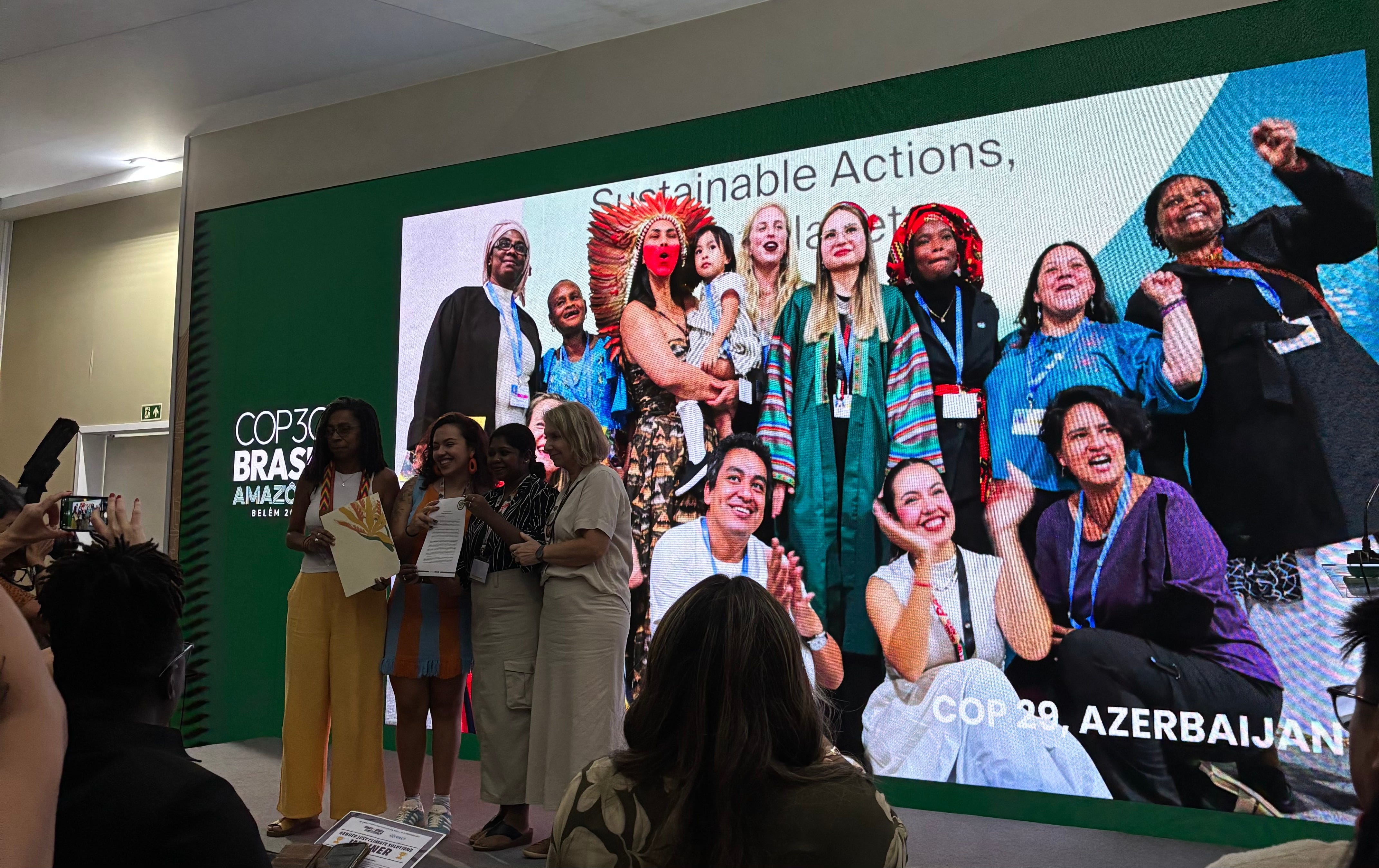
Today, I got to attend my overall favorite event that I attended at COP29, last year, again; the Gender Just Climate Solutions Awards (GJCS).
In 2015, the Paris Agreement was signed, and seen as a political breakthrough. However, for many within the feminist and climate justice movements, it served as a compromise that failed to really deliver rights based, systematic solutions that center equity and justice.
Therefore, together, the Women and Gender Constituency, Women Engaged for a Common Future (WECF), and Women Environment Development Organization (WEDO), started the Gender Just Climate Solutions as an “act of defiance against the idea that small meant insignificant,” and to recognize how true climate action is grounded in the details of justice- how food is grown, energy shared, and land is governed.
“We wanted to show policymakers what we meant when we said we wanted to integrate gender justice into climate policymaking and climate action,” said Anne Barre, Climate and Gender Senior Expert at WECF.
This award ceremony celebrated 10 years of recognizing women led, community oriented climate action that is already changing lives, restoring the environment, and building resilience in the wake of climate change.
These awards truly illuminate that progress does not begin in the negotiations or UNFCCC declarations. Rather, true progress begins and is happening in communities all over the world, from solar cooperatives to seed networks, forest restoration and water management systems. Through trust, care and persistence. Driven by those on the frontlines of climate change: women.
The climate crisis is not “gender neutral.” For more than a decade, it has been acknowledged by countries globally that women face a disproportionate burden from climate change, which amplifies existing gender inequalities and poses unique threats to their livelihoods, health, and safety.
UN Women estimates that by 2050, climate change could push 160 million women and girls into poverty and leave 240 million more facing food insecurity—far higher than the projected impacts on men and boys. These disparities stem from gendered care roles, disrupted access to reproductive services during climate disasters, and women’s disproportionate responsibility for securing food, water, and fuel.
Climate change also acts as a “threat multiplier,” worsening social and economic tensions and heightening women’s and girls’ risks of gender-based violence, including trafficking, child marriage, and conflict-related sexual violence.
It is not possible to fight climate change without confronting gender inequality, without fighting racism, hunger, and poverty, without seeking to reduce social disparities.
This is the essence of the feminist approach to climate action: there is no way to combat climate change without climate justice.
Promoting and funding gender-just, locally led climate solutions—especially those driven by women and girls—is not just about survival. Women, girls, and gender-diverse people are already leading, using their lived experience to build resilient, sustainable futures.
Valeria Pelaez Vardona, coordinator of the Gender Just Climate Solutions programme at WECF, explained how more than just an award, the GJCS is a global movement. It’s about “promoting a profound cultural transformation around female leadership in climate and environmental action.”
The GJCS demonstrates that the core goal of the UNFCCC Gender Action Plan is achievable: gender-transformative climate action is already happening—and proving highly effective in delivering just, equitable mitigation and adaptation.
Out of 2,300 registrations for the award, and 517 eligible projects, three projects were selected. One award was given for each category: technical solutions, non-technical solutions, and transformative solutions.
A gender just solution project must:
Ensure equal benefits for women, men, and youth
Strengthen women’s livelihoods and economic security
Advance women’s democratic rights and participation
Are low-resource, self-sufficient, and locally driven
Support mitigation, emissions reduction, and climate adaptation
Address cross-cutting issues (peace-building, natural resource management, food security, health, water, sanitation, etc.)
Are scalable and replicable beyond the communities where they were developed
The technical solution was awarded to the Uru Uru Team, a group of indigenous women restoring Lake Uru Uru in Bolivia. Illegal mining and plastic pollution are killing the ecosystem of Lake Uru Uru, and to restore it this team of indigenous women implemented a nature-based technological solution that combines traditional ecological knowledge with circular economy principles. They use the same plastic polluting the lake to build floating rafts, in which they plant totora reeds (aquatic plants) that purify the water by filtering out the heavy metals. This solution not only reduces contamination but also sequesters carbon into the lake and has received the lake as habitat for over 76 bird species. They recycled 1.7 tonnes of plastic to make 400 floating rafts, and now seven neighboring communities have been replicating the restoration method.
The non-technical solution award was granted to Jambo Radio, an indigenous media platform driving gender and climate justice in the Democratic Republic of the Congo. Jambo Radio amplifies voices of women and indigenous peoples through community media combining radio programs, online podcasts, listener clubs, and community debates. It works to debunk climate misinformation, facilitate dialogue, center women’s perspectives, and document community based solutions. Jambo Radio illuminates how the media can drive climate and gender justice. For example, one of their podcast series encouraged the conservation of 5,000 hectares of primary forests and 1,200 farming families to adopt sustainable agricultural practices.
The transformational solution was awarded to Fundación Sin Límites, which promotes youth and women’s leadership in contexts of climate-induced displacement in Costa Rica and Nicaragua. On Nicaragua’s Caribbean coast, people are facing displacement not only from natural disasters but also extractive violence that has destroyed ecosystems and livelihoods. This project documents the structural drivers of ecological destruction, such as illegal mining and deforestation through participatory dialogues, education, and storytelling initiatives. It gathers testimonies and community research to amplify the voices of women and young people specifically, aiming to build their capacity to respond to the impacts of climate change and strengthen their political agency.
After each award was presented and celebrated, the audience was led in a chant: “Power to the winners because the winners got the power. Tell me, can you feel it getting stronger every hour?”
I could feel that power. It got stronger every minute I heard about these solutions. It is a tangible, transformative power.
When billions continue to flow into false solutions like carbon capture—where 88% of projects fail, according to Nature—why do truly effective, community-led efforts like those of the Uru Uru Team, Jambo Radio, and Fundación Sin Límites receive only crumbs of funding in comparison?
Feminist climate approaches are routinely sidelined as “alternatives,” treated as anecdotal within the patriarchal, male-dominated structures of UNFCCC expertise.
But they are not alternatives.
They are the way forward—delivering real, justice-driven, inclusive, and powerful climate resilience and mitigation.
Can you feel that power?
No posts
Comments
Nothing yet. Say the first thing.
Sign in to join the conversation.