
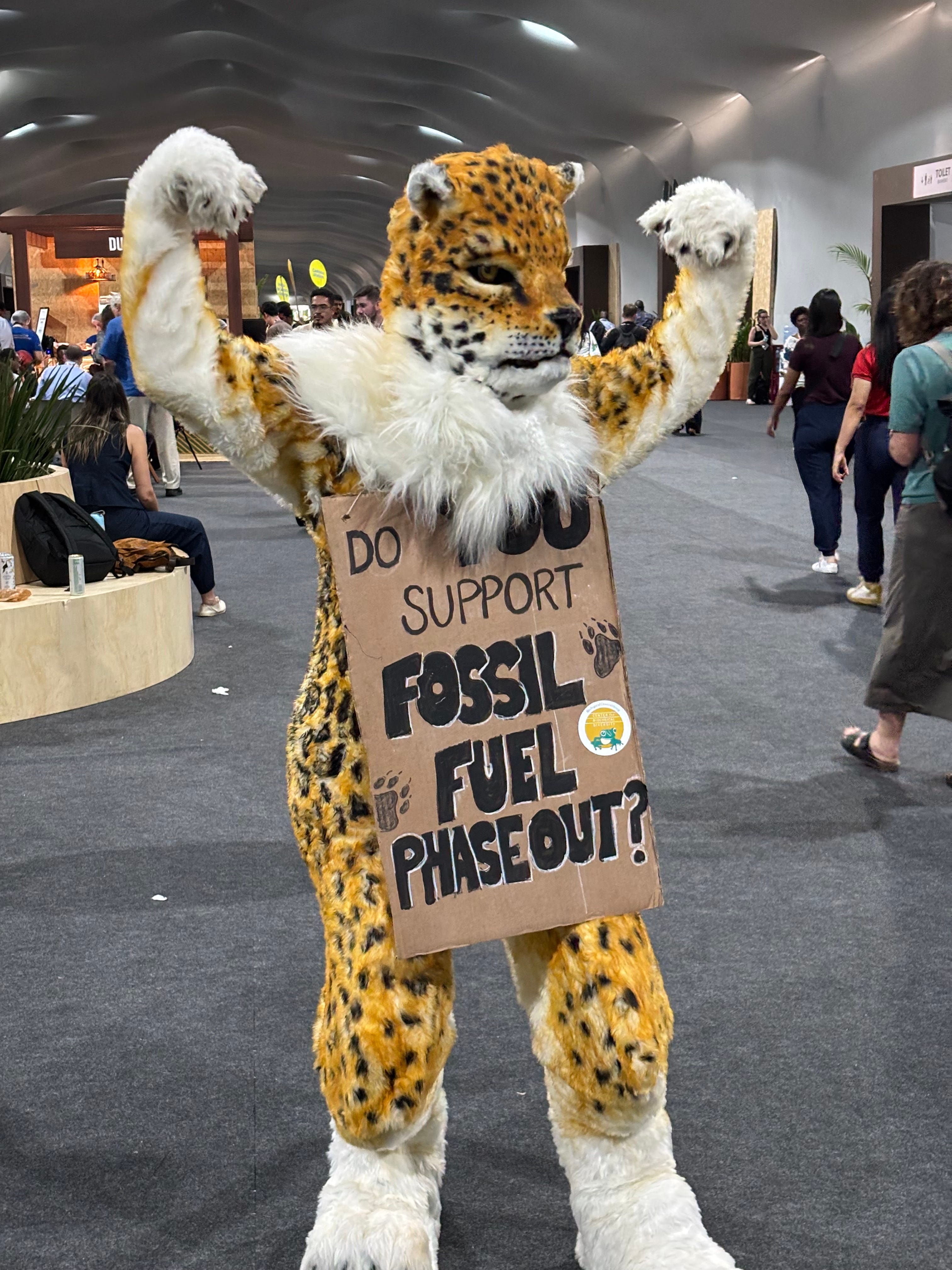
I wrote earlier this week about Senator Whitehouse’s fervent reminder that “there are villains in this story,” and the growing urgency around confronting fossil fuel lobbyists inside COP’s hallways and negotiating spaces.
That theme resurfaced at a recent town hall with the constituency groups and the UNFCCC Executive Secretary, Simon Stiell. Several speakers raised the need for a formal conflict-of-interest policy at COP, one that requires any badged participant to disclose funding or ties to fossil fuels or other destructive industries, like industrial agriculture.
Stiell responded that the UNFCCC “has not been flat-footed” on the idea of disclosure, but that any move has to be “pragmatic” and sensitive to the ever-shifting “political temperature.”
Meanwhile, the pressure on the ground is unmistakable. More and more badges now sport stickers reading “I am not a fossil fuel lobbyist,” and “Kick Big Polluters Out” protests erupt daily.
And this year, I learned about a newer face of the fossil fuel lobbyist—the one disguised as a climate solution: the Carbon Capture and Storage lobbyist. There are 531 CCS lobbyists with access to COP30.
On the surface, CCS sounds like the kind of innovation we need. Capture carbon. Store it. Reduce warming. Great, right?
But what I’ve been learning is that CCS is a pillar of fossil fuel expansion—not a safeguard against it. CCS is what keeps new fossil projects alive under the banner of a technical solution to make them “cleaner.”
CCS has decades of hype behind it, but its record is abysmal and its political function is clear: it prolongs fossil fuel dependence, provides cover for new extraction, and delays real transitions.
The Center for International Environmental Law argues that fossil fuel interests are now exploiting the energy demands of the AI boom to justify massive new gas buildout, with CCS as the magical “solution” that makes it all palatable.
The numbers back her up:
88% of CCS projects fail, according to Nature (2024).
90% of planned CSS projects in the power sector were never built, per Environmental Research (2021)
CCS would be $30 trillion more expensive than a transition led by renewables, efficiency, and electrification—roughly $1 trillion per year, the same finance gap haunting mitigation, adaptation, and loss and damage.
So, CSS lobbyists are “villains in the story.”
And we got to meet some today.
My professor, our side-event panel, and I were meeting to finalize our plan for tomorrow. Mid-sentence, mid-discussion, in fact, of the town hall debate about lobbyist disclosure we witnessed yesterday, two people walked into our side-event room. They overheard us. They inserted themselves immediately.
They introduced themselves as fossil fuel lobbyists.
I felt my eyebrows trying to leap off my face. This was the confrontation we’d been talking about, and they were volunteering for it.
The woman, from Global Carbon Capture and Storage, declared without hesitation:
“I would consider myself a fossil fuel lobbyist. But the label doesn’t describe the actual people behind it … the label makes us flat.”
She defended the “humanity” of fossil fuel lobbyists, insisting there is “richness” and “nuance” to who they are. As evidence, she offered her volunteer work with Save the Soil.
The man next to her introduced himself as part of the Clean Resource Innovation Network, “definitely on the list of fossil fuel lobbyists,” he said, even noting his group was ranked “number two.” He, too, disliked “being brushed with the label.”
When someone in my group asked them: “Where do you think the animosity is coming from?”
They admitted that it’s “because CCS is almost like a get out jail free card, you can prolong the fossil fuel industry through this technology.”
They not only admitted it, but defended it: “fossil fuel use hasn’t peaked,” she argued, so CCS must act as a bridge. “We are not mature enough yet” for a real transition.
And then, inevitably, they pulled out the classic fossil-fuel-lobbyist playbook: shift responsibility onto individuals.
“Human behavior is the biggest change we need. If society cared enough, people would change. We need to look at ourselves.”
Vote more. Consume better. Do more as individuals. The same narrative that has delayed systemic climate action for decades.
We tried to wrap up politely. They hovered outside the room. When our meeting ended, they approached us again:
“I don’t think we finished our conversation…”
At that point, my bladder and bandwidth to listen was about to burst, so I booked a move to the bathroom with Riss, us both looking back as our professor became engulfed in another round of tangent.
What struck me most was not the drama of meeting “the villains”—it was how hungry, eager they were to sermonize, to reassert the legitimacy of their role, to reframe the narrative on their terms, within their humanity. At first the encounter felt fascinating. Very quickly it became a didactic, exhausting attempt at ideological persuasion.
A live demonstration of the quiet, persistent power of fossil fuel lobbyists wields inside this process—not only in negotiations, but in conversation, proximity, and narrative capture.
They kept insisting, almost pleading, that they are more than the label “fossil fuel lobbyist.” And yes, they are more than a label, but that doesn’t change what they’re lobbying for.
They are undeniably human. earnest, emotional, even vulnerable in their own way. But their humanity doesn’t soften the reality that they are here to advance an agenda that endangers millions.
In other news…
Throughout the conference, there’s been constant hallway buzz about the race for COP31, who will win the bid to host next year’s summit? Australia or Turkey? The irony is almost cinematic: while the two countries battle it out diplomatically, and have been for 3 years, the UN’s floor planners placed their pavilions directly next to each other. It feels like a diplomatic sitcom—or a live showdown—playing out in real time on the conference floor.
Both pavilions are massive, polished, and equipped with elaborate coffee stations. Delegates and observers queue up between them, caught in the middle of this caffeinated COP31 face-off—a turf war measured in flat whites and Turkish brews.

Today it was finally announced, COP31 will be held in Turkey.
Going back to the trend of COP being held in authoritarian regimes.
If COP31 was held in Australia, it would have marked the first COP in the Pacific.
People are speculating that perhaps the challenge with travelling to Belém and conference infrastructure challenges played into the Australia ceding.
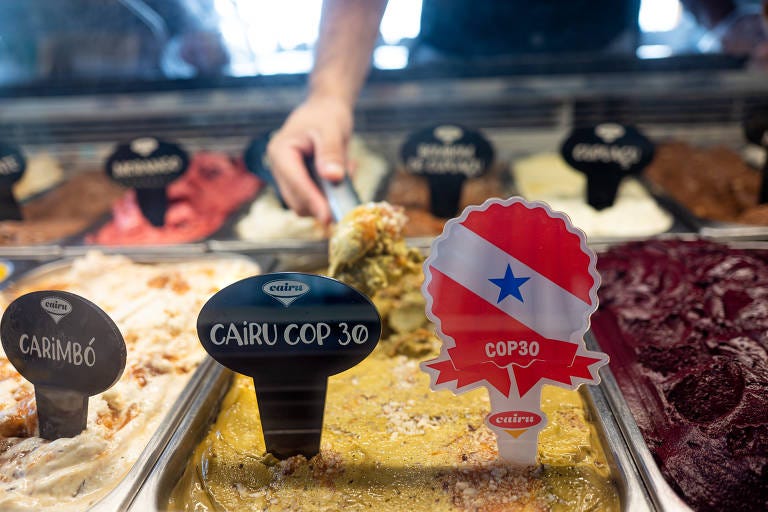
Today, for the first time, I finally braved the snaking, always impossibly long ice-cream line in the venue. Every day when I pass the booth, there are at least 30 people waiting; negotiators, observers, press, security, everyone.
The stall features Brazilian fruit flavors, açaí, of course, and a special COP30 flavor: pistachio ice cream with Brazil nuts and ribbons of Curaçao fruit jelly.
Every time I walk by, it makes me smile. There’s something about seeing negotiators and journalists and observers, licking giant cones, laughing, taking a breath, sharing a moment of sweetness. It’s contagious. And I can’t lie: it breaks through the somberness and sterility of the conference in a way almost nothing else does.
It might seem trivial to mention an ice-cream line at a COP—especially against the backdrop of the stakes, the urgency, the realities these halls hold. But I actually think this tiny detail reveals something big: the COP is a deeply human endeavor.
And sometimes, a scoop of pistachio with Brazil nuts is the pick-me-up we all need.
More to come as always. Over the past couple of days I also:
Went to a closed dialogue with the Minster of Women from Brazil and young women climate champions.
Got a one on one interview with a former US negotiator…more to come on her insights!
Have been really exploring the question of what the negotiations even are, their structure, what their outcomes mean for climate action. I wanted to give some updates on what is happening with the negotiations so far, but I first want to make sure I flush out a brief overview of what they actually entail and mean, for both myself and you! So stay tuned.
No posts
Comments
Nothing yet. Say the first thing.
Sign in to join the conversation.