
Hi! The year started fast, and startups aren’t wasting any time. In this issue: an Apple design lead jumping to a stealthy AI team, Elorian stepping into the spotlight with big early-round rumors, and a16z loading up fresh capital for 2026.
Anyway, here’s your latest tech & business recap:
🍏 What Is Worth Leaving Apple For?
🤖 Elorian Goes Big Early
🏦 a16z Reloads With $15B
📰 + Quick News That Matters
💰 + Last Week in Funding
🛠️ + New Tools to Try
📚 + Weekend Picks
Subscribe to receive new posts and support my work.

What’s Happening: Abidur Chowdhury, an Apple industrial designer who helped create (and publicly introduced) the iPhone Air, is leaving Apple to become Head of Design at a low-profile AI startup called Hark.
Hark is led by Brett Adcock (also CEO of humanoid-robotics company Figure AI) and is being funded with $100M of Adcock’s personal capital. Reports say Hark has already hired roughly 30 engineers from big tech and is aiming for ~100 people in the first half of the year, with its first AI model planned for release around mid-2026.
The Context: This is another data point in the AI talent race shifting from “who has the best lab” to “who can assemble a product team fast.” Hark’s pitch is literally hiring — pulling engineers from Google, Meta, and Amazon, then adding an Apple-caliber design lead to make the whole thing feel like a real product org, not a research project.
And it’s happening while the broader market keeps turning the comp dial up: pay packages for AI roles are still inflating, and big players keep doing headline moves to lock in people and teams. In the past week alone, the Meta/Manus deal got framed as part of a “don’t poach our AI talent” fight — a pretty blunt sign that “hiring” has become geopolitical and strategic, not just HR.
What’s Happening: The Information shared an interesting leak regarding the startup Elorian. It is a company founded by former Google and DeepMind researchers that focuses on developing native multimodal models. Elorian (unlike its competitors) builds “synesthesia” models.
This means AI that understands the logic of the world as humans do: through sight, sound, and video. In this way, the startup wants to bring humanity closer to the AGI era with the use of LLM in robots, multitasking AI agents, and everyday life in general.
The Context: Elorian has a pretty solid background. Its founders include Andrew Dai, who worked at Google DeepMind for over 14 years (he’s one of the creators of Gemini), and Yinfei Yang, former chief researcher at Apple. According to rumors, Elorian has already attracted the attention of investors and is in talks to raise $50M.
What’s Happening: Andreessen Horowitz announced it raised a little over $15B across five new funds (its biggest haul so far) headlined by a $6.75B Growth Fund V.
The rest includes $1.7B for an Apps fund, $1.7B for Infrastructure, $1.176B for American Dynamism, $700M for Bio + Health, plus $3B for “other venture strategies.” a16z says this equals 18%+ of all U.S. VC dollars allocated in 2025, in a year when overall fundraising was widely described as weak.
The Context: TechCrunch called it “the venture firm that ate Silicon Valley,” and the line lands because this is what scale looks like in modern VC: one shop fundraising like a small asset manager, then splitting it into specialized vehicles that cover the whole stack — apps, infra, biotech, growth, and a dedicated pool for “American Dynamism” themes like defense and supply chains.
A $6.75B growth fund means more late-stage rounds with fewer “pure” growth investors at the table; meanwhile the apps + infra buckets keep a16z present in earlier deals without forcing every bet to fit one mega-fund narrative. If you’re pitching, the firm’s menu makes it easier to route a deal to the right partner — and harder to “out-position” them with a generic VC value prop.
The Context Loop is a free newsletter.
If you like what I do, you can support me through a donation.
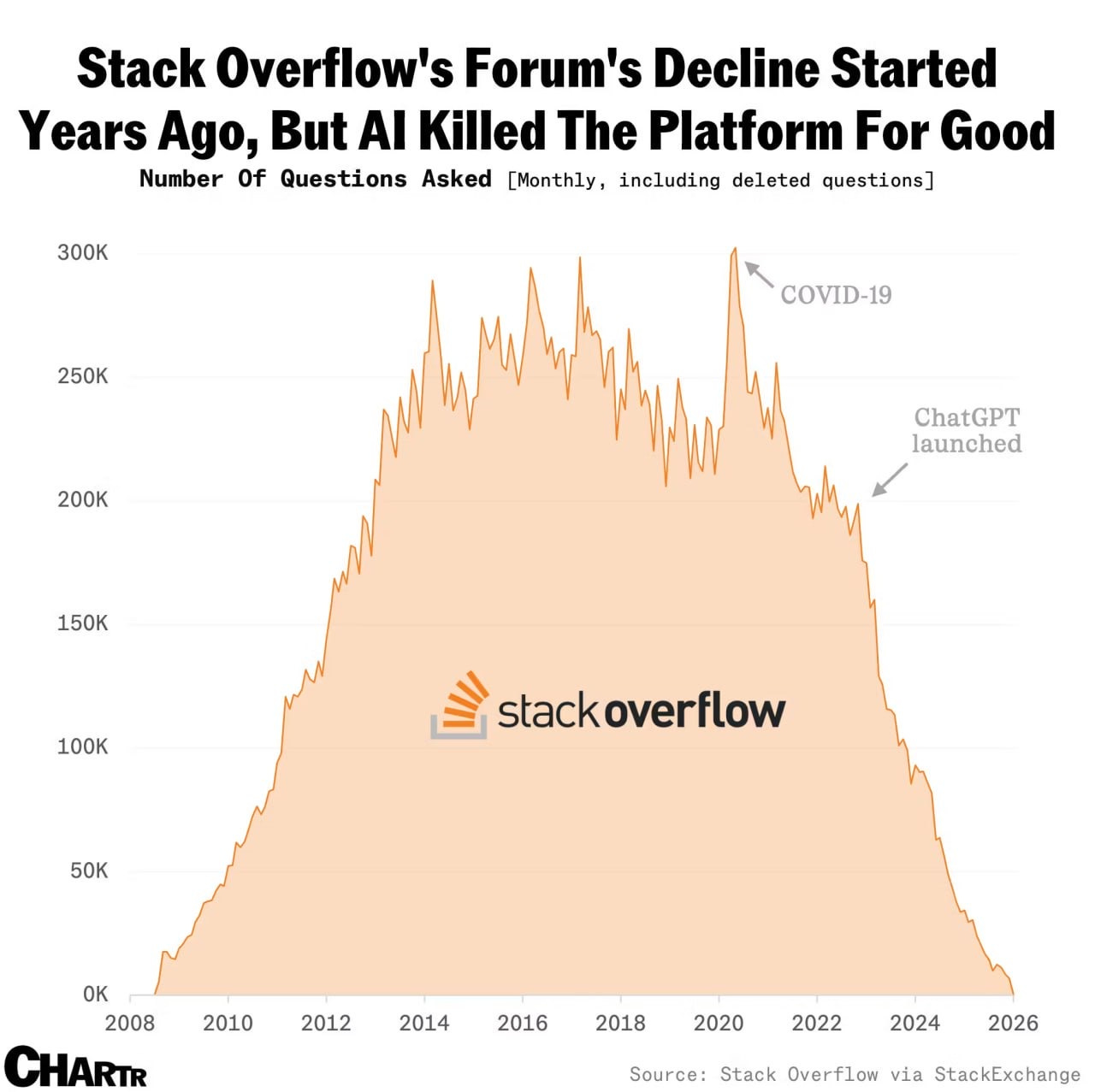
AI Is Killing Stack Overflow: One of the main resources for devs is gradually dying out because of chatbots. Last month, Stack Overflow registered fewer than 7,000 questions. That’s about the same number of questions that were asked when it launched in 2008.
The image below eloquently describes the current situation.
Elon Musk Won the Battle (But Not the War) Against OpenAI: During a hearing in Oakland, California, US District Court Judge Yvonne Gonzalez Rogers stated that she saw sufficient evidence that OpenAI’s management had previously planned to remain a non-profit organization promoting the public good.
Discord’s IPO Could Happen in March: According to Bloomberg, the company has filed a confidential IPO application with the SEC and expects to debut in March this year. The platform currently has over 200M users, and its latest valuation (for 2021) was $14.7-15M.
Anthropic Reportedly Raising $10B at $350B Valuation: Based on reports from numerous media outlets citing insiders, the startup is ready to raise another round of funding and get a new valuation. The deal is worth $10 billion, and potential investors include Singapore’s sovereign wealth fund GIC and Coatue Management.
OpenAI Intoduced ChatGPT Health: Soon, you’ll be able to talk with a chatbot about health issues with greater confidence. A new mode ChatGPT Health allows you to connect AI with apps such as Apple Health, Function, and MyFitnessPal, as well as analyze test results and prepare for doctor’s appointments.
The feature is currently in closed beta testing, but those interested can apply to join the waiting list.
A few days later, Anthropic responded to ChatGPT Health with a service called Claude for Healthcare. It is a set of tools for patients and healthcare providers. With its help, users can connect their medical records to Claude to check their medical history and interpret test results.
Claude for Healthcare includes HIPAA-compliant infrastructure with access to the CMS Coverage Database, ICD-10, National Provider Identifier Registry, and PubMed to automate authorizations, insurance appeals, and coding.
Capital piled into two buckets: AI infrastructure (compute + eval) and security platforms that are riding the “AI makes data risk worse” wave.
xAI raised $20B in an upsized Series E (valuation not disclosed). The company said the round will help scale compute infrastructure, including its “Colossus” GPU clusters, and keep pushing the Grok model line and voice agent efforts; it also named NVIDIA and Cisco Investments as strategic backers.
Cyera announced a $400M Series F at a $9B valuation. It sells data security posture management (mapping where sensitive data lives across cloud systems, tracking usage, and flagging risk) and said AI-driven data sprawl is helping pull in large enterprise customers.
Torq raised $140M at a $1.2B valuation to push adoption of its AI-driven security operations platform and expand in the U.S. The round was led by Merlin Ventures, with participation from existing investors.
LMArena raised $150M Series A at a $1.7B post-money valuation. The company (best known for crowdsourced LLM leaderboards) is turning its comparison platform into a paid evaluation service for model labs and enterprises, with Felicis and UC Investments leading the round.
Share this post if you like it!
The first week of the year was busy not only for large startups, but also for devs of productivity tools.
Here are the ones that I found most interesting:
PostSyncer — A tool that works as one place to create, schedule, and reply across multiple social platforms when you’re juggling several accounts at once.
LiveDocs — The general data agent. Drop in a CSV/spreadsheet and ask questions in plain English to get charts and answers without building dashboards.
2-b.ai — Todoist meets ChatGPT inside your browser (yeap, it sounds boring). Turn highlights into tasks and let the assistant break goals into steps, without switching tabs.
Instruct 2.5 — Connect apps, describe the job, then automate your work. Natural-language automations that can run across tools like Slack/Gmail and save repeatable workflows once they work.
SEORCE — Monitor AI visibility across ChatGPT, Claude and Perplexity. A straightforward way to see where your brand shows up in AI answers (and what’s blocking it) instead of guessing.
Inside CES 2026’s “physical AI” takeover — Equity Podcast
Google’s Koray Kavukcuoglu: Turning abstract AI thinking into user-friendly products — Financial Times
It’s a rare, fairly concrete interview with the DeepMind CTO / Google’s chief AI architect on what changed from Gemini 2.5 to Gemini 3, and why “steerability” (less sycophancy, more user-driven behavior) is becoming a core product requirement.
Global Venture Funding In 2025 Surged As Startup Deals And Valuations Set All-Time Records — Crunchbase
How to get into AI for Non-Technical Late Bloomers: A Beginner’s Guide — AI Supremacy
Elon Musk on AGI Timeline, US vs China, Job Markets, Clean Energy & Humanoid Robots | 220 — Peter H. Diamandis
Comments
Nothing yet. Say the first thing.
Sign in to join the conversation.