
For the past few weeks, I’ve been writing about practical fixes. Color contrast, headings, link text, and alt text. Last week’s post on readability made the case that the people your content is for are doing more work to engage with it than you might have realized.
We’re going to take a break from the practical tips and talk about what’s happening this month. July is Disability Pride Month.
The month isn’t arbitrary. On July 26, 1990, the Americans with Disabilities Act was signed into law. The ADA is the legislation that proclaimed that accessibility is a civil right rather than a courtesy or a nice-to-have. Public buildings, transportation, employment, and (even though the public web wouldn’t exist until 1993) the digital spaces we all work in trace back to it.
The first Disability Pride Day happened that same year, in Boston, where more than 400 people gathered to make a plain point: that disability isn’t tragic, it’s a natural part of being human. From there, the idea grew. In 2015, for the 25th anniversary of the ADA, New York City held the first Disability Pride Parade, and the city declared July Disability Pride Month. In 2019, the first Disability Pride Flag was created.
Disability Pride has a flag, and the story of that flag is itself a story about how something can become more accessible.
It was created by Ann Magill, a disabled writer. The first version had bright, zigzagging stripes across a dark background. It was striking. It was also a problem for some people. The bold colors and the sharp zigzag created a strobe-like flicker when you scrolled past it on a screen. It’s the kind of effect that can trigger migraines or seizures, or overwhelm people with sensory sensitivities. An image like this is called a “grating image” and it can cause similar effects to strobe lights, or other types of rapid flashes (we’ll talk more about these types of images as well as flashing content in a future post).
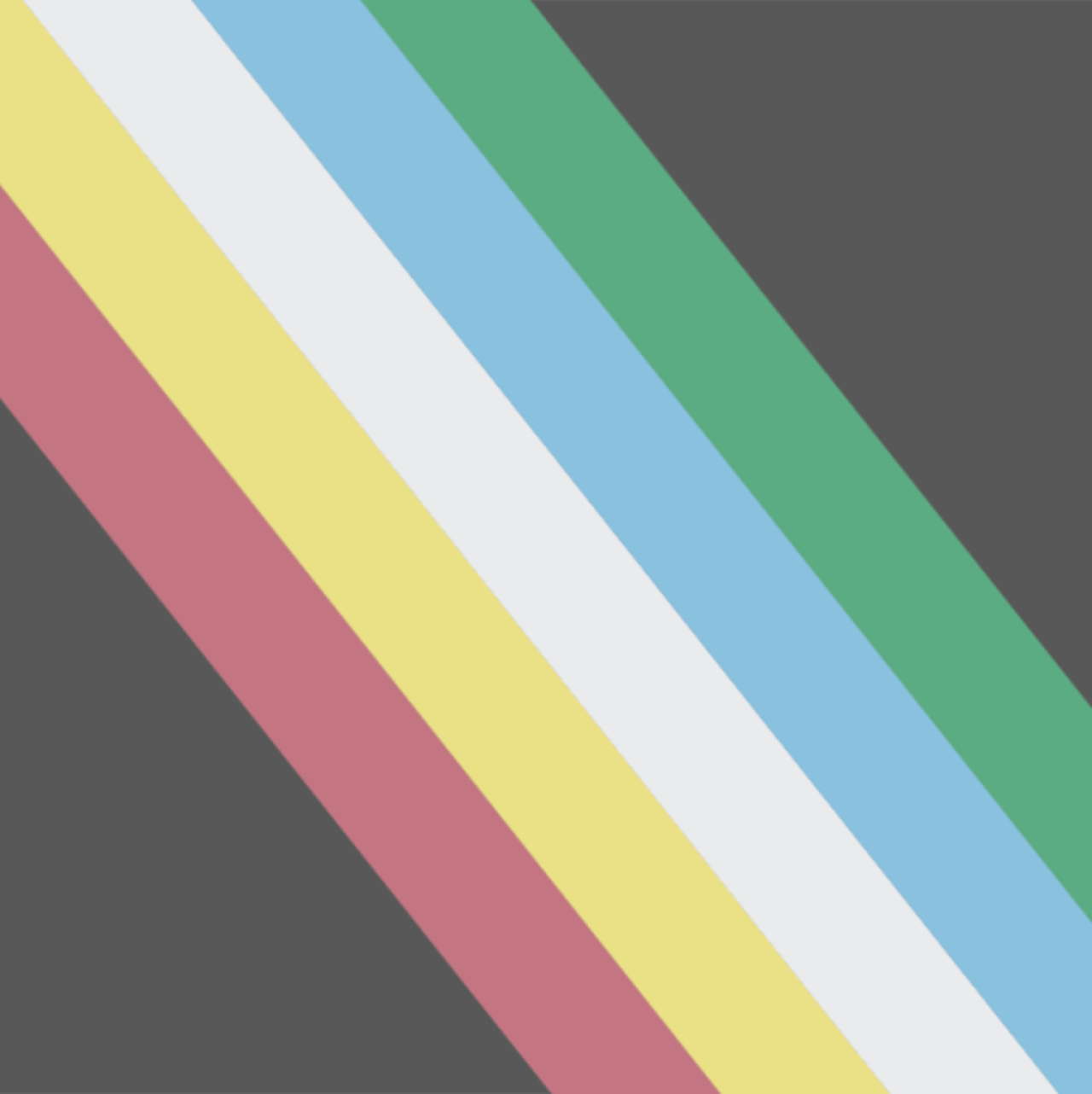
So in 2021, the flag was redesigned, with input from the people the first version was hurting. The zigzag became a smooth diagonal band. The colors were muted. The brightness was varied slightly from one stripe to the next so people with color blindness could still tell them apart. The diagonal was even chosen so the design could be felt if the flag were embossed.
The story of the flag is important because it reminds us that even with the best of intentions, it’s possible to not get accessibility right. In this case, a symbol of disability pride was made, and then made better, by listening to people about what wasn’t working for them. That is the work.
Every accessible-content choice you make is a similar version of exactly this process. You learn about what’s causing issues, learn how to fix it, and work to not create the issue again.
The flag itself is a charcoal background crossed by five diagonal stripes, and each stripe stands for part of the community:
Red for physical disabilities
Gold for neurodivergence
White for invisible and undiagnosed disabilities
Blue for psychiatric disabilities
Green for sensory disabilities
Charcoal background for disabled people who have died because the world wasn’t built with them in mind
The diagonal cuts deliberately across the societal barriers that have long kept disabled people apart from everyone else.
July is not Disability Awareness Month or Disability Acceptance Month.
It’s Pride Month.
Awareness asks people to notice. Acceptance asks them to tolerate. Pride says there was never anything to fix in the first place. It pushes back on stories our culture tells on autopilot: that disability is something to pity, something to quietly overcome, something inspiring mostly because it looks hard from the outside.
Pride says disability is an identity and a community, with its own history, its own culture, and yes, its own flag.
As Alice Wong (1974-2025), founder of the Disability Visibility Project, wrote in the introduction to Disability Visibility:
Disability is pain, struggle, brilliance, abundance, and joy. Disability is sociopolitical, cultural, and biological. Being visible and claiming a disabled identity brings risks as much as it brings pride.
Here’s where it gets practical for those of us running a one-person operation.
When you’re the team, you make every call about your content.
What goes on the homepage
How the newsletter is laid out
Whether the podcast gets a transcript or a video has captions
What images do and don’t get alt text
There’s no committee. There’s no accessibility department down the hall. It’s you.
That can feel overwhelming as you balance everything else in your creative business. I’d call it an opportunity though. You alone decide if your content is accessible to the roughly 25% of the population who are disabled.
If you read my introduction post, you know I’ve run author and podcast websites for years, along with social media channels and email newsletters. For the most part, I don’t personally know my audience, but I know some of the readers were blind and depended on their screen readers to navigate my website or read my newsletter. Some listeners were Deaf or hard of hearing and depended on whether I’d published a transcript with a podcast episode. Some were moving through my sites with a keyboard instead of a mouse.
I didn’t get all of it right, especially early on (and truthfully I’m sure there are still things I’m missing). All I can do is keep trying to do better.
Progress over perfection in action.
Disability Pride Month is a good annual nudge to ask the question outright: who’s out there in my audience, and am I doing the work so they can partake in what I’m creating?
If you want to mark the month on your platforms, wonderful. There are things to avoid though.
Here’s perhaps the most important one: inspiration porn. It describes content that frames disabled people as inspiring purely for existing and living their lives. The disabled creator praised not for the quality of their work but for having made anything at all. It feels generous. It isn’t. It quietly turns a person into a motivational prop for a non-disabled audience.
A few more things to keep in mind:
Try not to treat accessibility as charity or a kindness extended to less fortunate people. It isn’t charity. It’s design, and it’s a right.
Don’t speak for the disability community. Amplify someone inside it instead (see below for some people I recommend you check out).
Don’t let the month become the only time this crosses your mind. A burst of attention every July, then silence the rest of the year, isn’t pride. It’s a campaign.
Find one disabled creator or accessibility advocate whose work you admire, and amplify it. Share their latest post. Recommend their latest creation to your own audience. If their work has shaped how you think, tell them so.
This isn’t about a feel-good gesture, and not only because it’s July. Amplifying someone is the most direct version of what this month is for. It’s how you make sure the voices in your corner of the internet include disabled voices, and that those voices reach the people you reach.
Here are three of my recommendations.
Meryl K Evans: Meryl is a communications, accessibility, and operations expert. I’ve learned a lot from Meryl over the years. We also share a love of musicals, so I enjoy when she posts about musicals she attended or performed in. You can follow Meryl on LinkedIn and her website.
Jamie Shields: Jamie is the co-founder of Disabled by Society and author of Unlearning Ableism. He helps organizations with training, speaking, and consulting. He also calls himself a Registered Blind AuDHD Rhino. Jamie is someone else I’ve learned a lot from, and he creates amazing graphics with his posts that I always like finding in my feed. You can follow Jamie on LinkedIn.
Ryan O’Connell: Ryan created the Netflix series Special, which was a semi-autobiographical comedy/drama account of his life as a gay man in Los Angeles with cerebral palsy. The Emmy-nominated show was based on his memoir I’m Special: And Other Lies We Tell Ourselves. You can follow Ryan on Instagram.
If you’d like to share who you picked, hit reply and tell me. I’d love to hear it.
Plus I have three suggestions where you can find more about Disability Pride Month:
History of Disability Pride Month on the American Association of People with Disabilities website. (Note: This article contains an image of the original Disability Pride Flag. If you are photosensitive, you might want to skip this page.)
2022 Interview with Ann Magill on The Accessible Stall podcast.
Disability Pride Month 2026: What It Is, the 2026 Theme, and How to Celebrate on The Arc website
Next Thursday (July 9), I’ll get back to the practical side with something small and concrete: the accessibility statement. It’s a short page for your site that tells visitors you’ve thought about this, and gives them a way to reach you when something doesn’t work. I’ll have an example for you to work with.
See you next week.
— Jeff
Digital Accessibility – Content for Everyone is a free weekly post from Jeff Adams about making your digital content—your site, your podcast, your newsletter, your social media—usable by everyone who shows up to it. Built on the foundation of Content for Everyone, the book Jeff co-wrote with Michele Lucchini. Companion site: contentforeveryone.info.
No posts
Comments
Nothing yet. Say the first thing.
Sign in to join the conversation.