
Every summer vacation, my mother hauled my brother and me to Dida’s house in suburban Kolkata.
“Chhemri, look how big you are,” she would say. My maternal grandparents were the only ones who called me chhemri—a young girl, in the dialect of Dhaka and Manmoysingha districts of Bangladesh. Dida would smell of sandalwood soap and muithya—a fishball curry typical of the region she came from. She prepared it every year on the day of our arrival.
As the adults chatted, my brother and I ran through the long, red cement-floored verandah that managed to remain cool despite the heat outside. I pricked up my ears to catch the latest updates about the local gossip. With rapt attention, I tried to decipher the meaning out of Dida’s rounded syllables. Soft “sh” “ha” replaced the “chh” and “sh” of the textbook Bengali that I learned growing up in West Bengal. The differences were not limited to pronunciation and a different version of the same word. The unfamiliarity of certain words made me stare blankly at my mother, uncomprehending.
It did not sound like a mere dialect, but rather a language within a language. My grandparents’ tongue did not belong in the Bengali classics I read, the newsreaders on Bengali news channels I heard, or the educated high-brow Bengalis I was surrounded by, where I grew up 180 kilometers away from Kolkata. The only exceptions were a few fish sellers I met in the market of my town, whom my mother whispered under her breath were Bangal, like her. The term rang of a secret affiliation, of sharing roots in Bangladesh, a country neither my mother nor I had ever seen.
When I was at a loss in understanding Dida, my mother jumped in to translate. Struggling, my mother weighed every intelligible word to convey the essence. Sometimes, at my insistence, when my mother tried to speak the dialect, she sounded like a toddler trying to form new words, making everyone in earshot laugh.
There was no shame for my mother in not being able to speak the exact tongue of her parents, as she was born in India, in the suburbs of Kolkata. Long after the hammer of partition fractured the Indian subcontinent. Unlike my grandparents, who were born and raised in Bangladesh, migrating to India in the nick of time before 1947. My grandparents referred to that timeline as the time of dyash bhag—partition. From my history books, I primarily knew it as the year of Indian independence from British rule.
Sitting by the window, my grandmother would speak of those times in hushed tones. She spoke of neighbors turning into beasts overnight, of women screaming into wells so their voices wouldn’t carry. The blood-soaked communal riots that set the streets of Dhaka and many other districts in undivided Bengal ablaze before their move still haunted them. They never fully recovered from the violent death of their close relatives or everything they had had to leave behind. After fleeing to India, my grandparents worked to their bones to build a life from scratch in the new land.
Dida’s tongue came with an abundance of other treasures. On many mornings, I watched Dida toss kochur loti—chopped colocasia stems—up in the air from her wok and catch them without mixing them with a spatula. A slight variation of the recipe to preserve the smoky flavor of the dish. The greens would then be slathered in a spicy mustard paste and served with rice. On other days, it would be shutki—pungent dried fish with a smell so strong that the neighbors would run away from the door if they happened to be dropping in at the time.
Being in a Bangal Hindu household also meant fewer religious observances for women, especially the ones that involved fasting. There were fewer rules around the usage of onions and garlic at festivals and pujas. Living within the fold of the Bengali identity, the Bangal identity was distinct enough to stick out.
When I got older and gained a better grasp of the dialect, I asked Dida to narrate my grandparents’ childhood stories. She graced me with many as she stirred her ladle. How, in his boyhood, my grandfather rowed his boat across the tributaries of the Padma River to reach his high school; the lore of the local Sufi Pir Baba who blessed childless couples; Dida’s life in the dense dark jungles bordering Assam, where her father, a forest ranger, was posted. The many worlds that Dida had walked through with the resilience of a soldier danced in my mind. I associated her dialect with her food, warmth, and exuberant tenacity.
Yet, as I grew, I learned that everything was not for public life. When my grandparents went out to meet neighbors in puja pandals, other households, or traveled to visit us, they scrubbed off their lingo. They tried their best to straighten their words to the rules of written and spoken Bengali of the region, discarding the sweetness of their tongue like the bad breath of a history that had left them victims. But language, like an obstinate child, butts its head at inopportune moments.
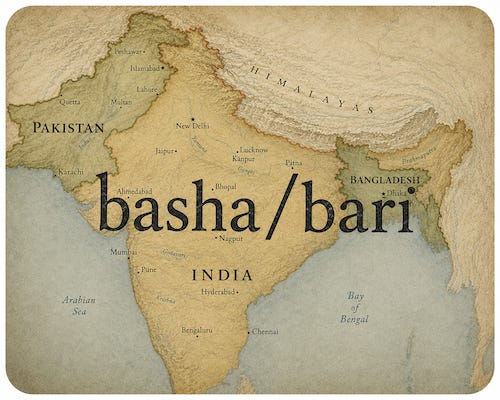
A basha, meaning nest, would sneak its way into a sentence where bari, meaning home, would be deemed more acceptable in standardized Bengali while inviting people over to their place. Any day, I would choose the intimacy of a nest over a plain home, but my grandparents shrank with every snicker and jibe that followed such slippages. Like most others who came from similar circumstances, they had borne decades of bruises from this cultural violence of language, which was passed off as a joke.
After the wave of forced migration during independence, 1971 saw another wave of people when Bangladesh was born, breaking away from Pakistan. I learned from my parents that in jobs and other opportunities, systemic discrimination against their kind wasn’t uncommon till the late seventies. Any dialect or accent from the other side of the border was synonymous with otherness, refugees an extra load on the economy. People conveniently forgot the plight of the displaced or the resilient, backbreaking labor with which millions of homeless people rebuilt their lives in this country, while contributing to the socio-economic life in every possible way.
Over time, I discovered it was not only my inexperience but also something innate in the hop from tongue to tongue and sometimes within the same tongue. It was a constant negotiation of power, identity, and essence that led to this perceived loss but also bridged ravines of incomprehension, bringing forth unheard voices. I was not a passive witness but someone to engage and distill the essence of those voices.
I thought of Ma, who once did this task for me and wondered how much had remained intelligible. I would never know. What I did know is that I witnessed their lives through their stories that tied me to my ancestors and their lives.
This was the gift of translation and continuity, I reminded myself. Because stories need to be told for the larger collective, for the personal in larger histories, so that they can help to remember, resist, and transform. It was a privilege that I was happy to be bestowed with.
Sayani De writes fiction and creative nonfiction. Her work has been longlisted for the 2025 Commonwealth Short Story Prize and Asian Prize for Short Story 2025, and shortlisted for the 2025 Rama Mehta Writing Grant. Some of her stories can be found in The Bangalore Review, Indian Literature (Ministry of Culture, India), Tamarind Literary Magazine (UK), Witcraft, Muse India, The Selkie anthology (UK), Indian Review, Kitaab, and Borderless Journal. She is working on her debut novel and lives in Kolkata, India.

Sharpen your craft, discuss project ideas, and find new communities
Comments
Nothing yet. Say the first thing.
Sign in to join the conversation.