
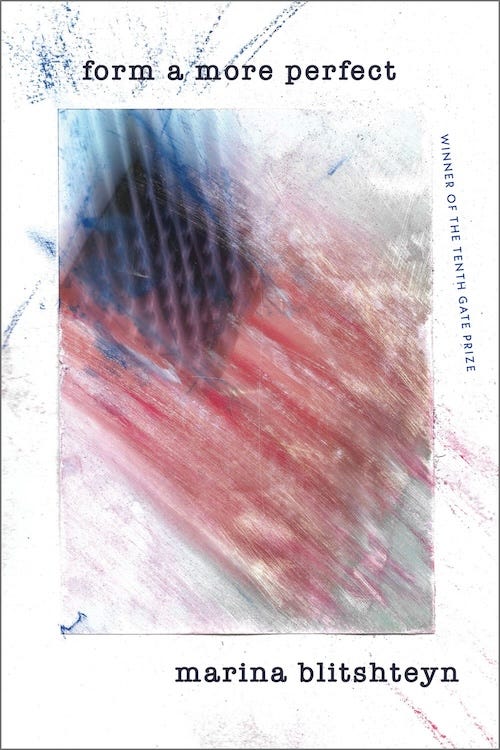
form a more perfect
Marina Blitshteyn
The Word Works, 2026. 79 pp.
Marina Blitshteyn’s poetry collection form a more perfect starts from an awkward fact: much of what we call the self has been decided before we have decided anything. A name, a language, a sex, a country, a class, a family history—these come first and speak through us. Blitshteyn was born in Soviet Moldova, into a Russian-speaking Jewish family, and came to the United States in 1991. The book treats those facts not as background but as part of the mind’s construction. Yet it does not quite say that a person is only what history has made of her. Her own hunger, grief, desire, fear, and her wish to continue remain fundamental, though these experiences too are caught in language and memory. The question running through the poems is therefore less “Who am I?” than “What in me was given, what was forced upon me, and what can I still do with it?”
The last part of that question matters most. Blitshteyn does not suppose that freedom means stepping outside language, history, class, or the body. There is no outside. Freedom lies in what one can do with the forms already there. The clearest statement comes in the poem “free”: A student suggests that one should “love the prison”—accept the limits one cannot escape and learn what can still be done within them. Another speaker in the poem calls facts “a productive limitation” and explains that “she means like a formal constraint, like verse.” The poet goes on to check her bank balance and builds “more and more cells in the room / so I can practice dancing in tight spaces.” Money, history, and poetic form all narrow her freedom; the task is to move inventively inside those limits.
form a more perfect won the 2024 Tenth Gate Prize from The Word Works. The prize is for mid-career poets writing in English who have already published at least two full-length collections. It carries publication and a cash award, and the manuscript is selected by an outside judge. The stated purpose is to honor a poet’s sustained development of a distinctive poetics. Richard Hoffman chose Blitshteyn’s manuscript, and on the prize’s own terms the choice is reasonable. As in much experimental writing, metapoetic discourse is foregrounded: several poems provide clues to the formal choices, doubts, and principles governing the rest of the book. It has a recognizable mind, a recognizable ear, and a set of formal habits that belong to one another.
Comments
Nothing yet. Say the first thing.
Sign in to join the conversation.