
In 2003, British cycling was a quiet embarrassment.
110 years of Tour de France. Zero British winners.
Then coach Dave Brailsford walked in with a simple idea: get 1% better at everything. Training. Nutrition. The pillow each rider slept on. He even painted the team truck floor white — so a single speck of dust on a bike part would be visible.
One percent. Everywhere. Every day.
Three years later, Bradley Wiggins became the first British cyclist to ever win the Tour de France. Four more victories followed in six years.
The world went wild. Books were written. Ted Talks were given. James Clear dedicated a whole chapter of Atomic Habits to it.
And the lesson everyone walked away with was:
Start small. Tweak slowly. Get 1% better every day.
Makes sense, right?
Here’s what those stories leave out.
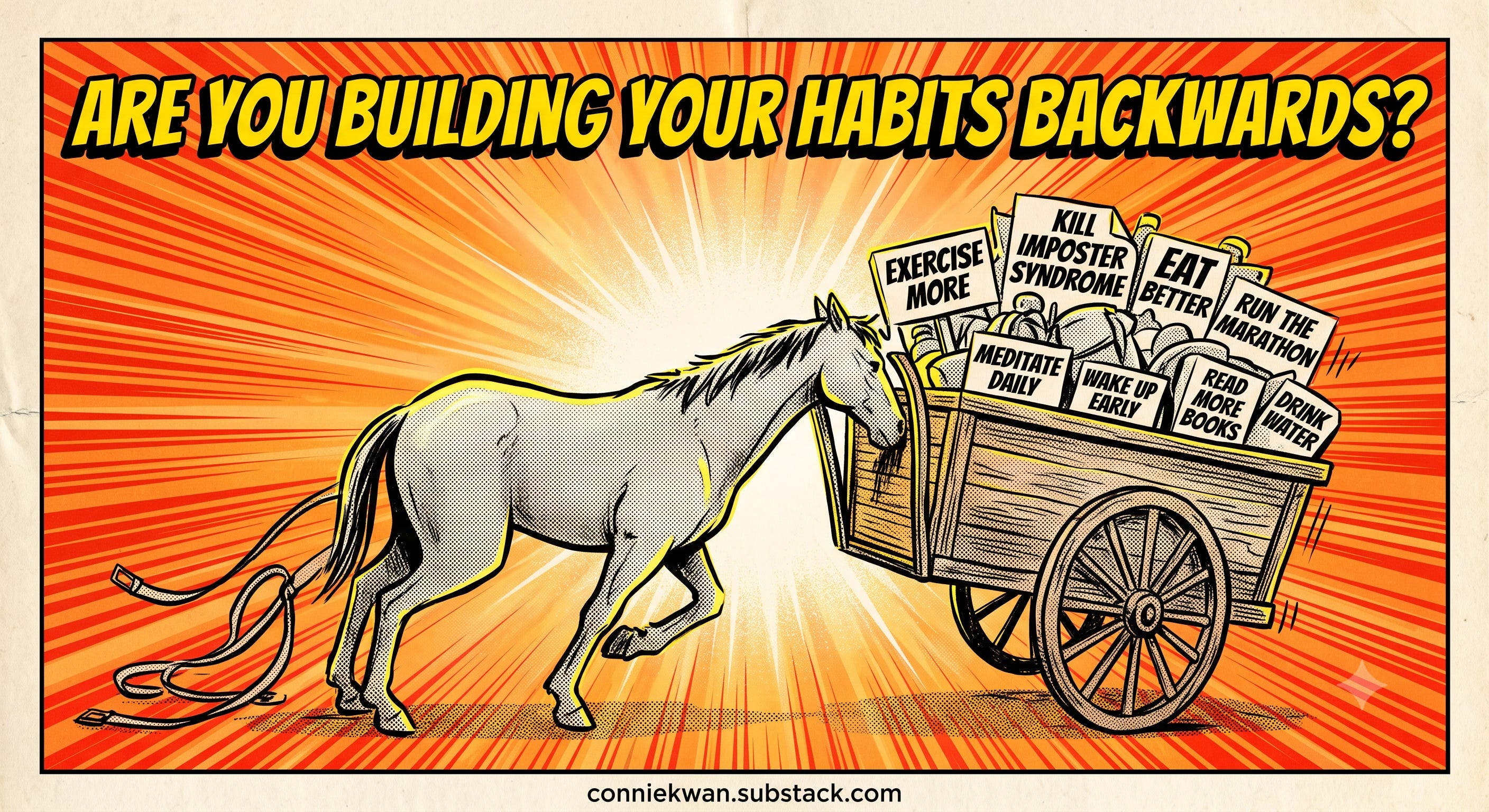
For an elite athlete, 100% commitment is a given.
You don’t make it to the Tour de France by being kind of into cycling. By the time Brailsford started optimizing pillows, those riders had already spent years choosing cycling over everything else. Their identity was locked in long before the marginal gains began.
The 1% improvements worked because the 100% mindset was already there.
But that’s not how the story gets told. The story gets told as: small steps, slow change, be patient with yourself.
And so everyday people — people trying to sleep earlier, eat better, exercise better — take that advice and apply it to their mindset.
I’ll slowly start caring more about my health. I’ll ease into believing I deserve better. I’ll get more motivated as I go.
And then the habit dies at day 4.
Because you can’t 1% your way into caring.
Your body can get 1% better every day.
Your mind needs to be 100% there on Day 1.
The behavior is gradual. The commitment is immediate.
Think about every real habit shift you’ve ever made. It’s almost never I slowly started to care. It’s almost always: something clicked.
Your boss pulls you aside. Tells you the promotion went to someone else — someone who “commanded the room better.” You’ve heard that feedback before, at age 25, then 35. Now you’re 40, and it feels like a real career blocker that needs addressing.
Or you’re at the dentist. Routine checkup. She points to an X-ray and says: this cavity’s developing. You can still stop it. But you have to floss. Every day. Not most days.
Or your doctor calls with bloodwork results. Nothing catastrophic. But your A1C is creeping. Pre-diabetic range. You’re 44. Your dad was on insulin by 55. Suddenly you’re thinking about whether you’ll be around to see your grandkids graduate.
That’s the click.
A moment where your identity shifts and the new habit is non-negotiable.
That’s 100%.
That click — that full commitment to a new identity — that’s what makes the 1% possible.
Without it, you’re just white-knuckling through day 5.
Here’s the thing though. Most people only get to 100% after bad news. After the wake-up call. After something forces their hand.
But that’s not the only way in.
What if I tell you you can get there without the bad news?
What if, you don’t need a doctor’s call, you don’t need to get passed over for a promotion. What if you don’t need a crisis before you launch into the new and improved you?
What if, you just need to find the right anchor?
Elisa had been stealing fries off her family’s plates for years. She never orders her own for health reasons, but can’t resist one, three, five, ten, or twenty fries casually taken from her husband’s plate.
As a result, her husband orders a larger plate of fries.
Elisa is a successful businses owner. She has built and sold multi-million dollar businesses. With the fries, she’d tried willpower. She’d tried rules. Nothing stuck.
So we had a conversation. Not about fries. About her.
What does she care about? What makes her angry? What has she spent her career fighting for?
Turns out — a lot. Elisa is an activist. And one of the things she fights against is the food industry’s deliberate engineering of addictive, cheap, accessible food targeted at communities with the least resources to push back.
She knew this intellectually. She’d known it for years.
We just connected it to the fries.
We renamed them. Manipulation fries.
That was it. That was the whole intervention.
Suddenly she wasn’t fighting a craving anymore. She was making a political choice. Every single time. And an activist doesn’t eat manipulation fries — that’s not even a temptation, it’s a contradiction of self.
She is 100% committed.
She stopped stealing them.
And then something unexpected happened.
Her husband started ordering a small. Sometimes none at all.
Her identity shift became contagious.
That’s the power of finding the right anchor. It doesn’t just change the habit — it changes the story you’re living in. And sometimes, the people around you start living it too.
Elisa didn’t white-knuckle her way to 100% commitment.
She didn’t give herself a pep talk. She didn’t make a vision board. She didn’t wake up one morning suddenly motivated.
She just answered one question honestly:
What do I already care about — deeply, truly, at my core — that makes this habit feel like me?
That question is the whole game.
Because here’s what’s true about every value you hold deeply: it’s already at 100%. You don’t have to build it. You don’t have to earn it. It’s been there since childhood, woven into who you are.
When you anchor a new habit to one of those values, you’re not manufacturing commitment from scratch.
You’re borrowing it from something that’s already fully charged.
That’s the STORYHabits method. And here’s exactly how it works.
Five steps. One anchor. Zero willpower.
🎯 S — SMART Goal
Comments
Nothing yet. Say the first thing.
Sign in to join the conversation.