
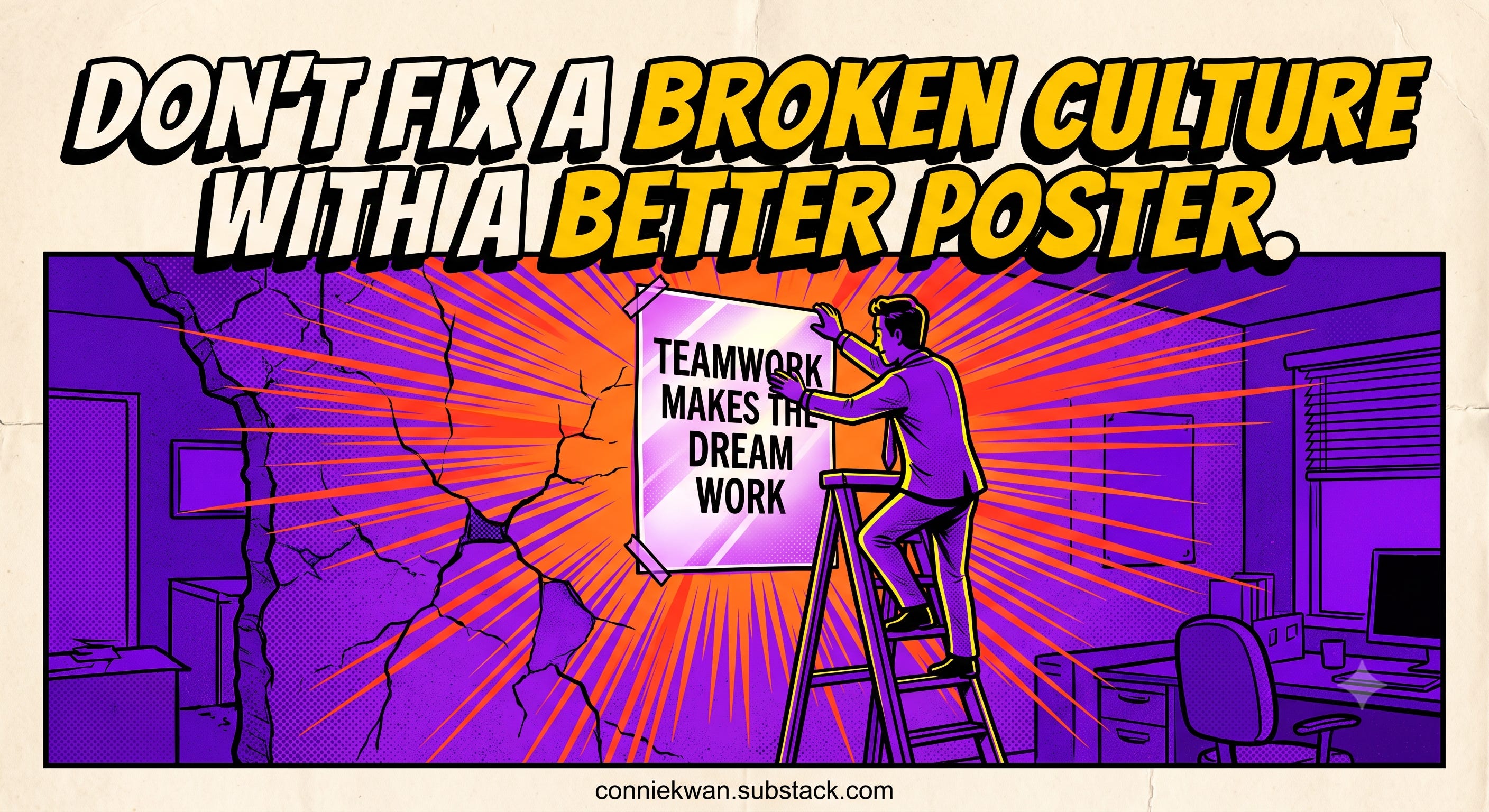
Leaders usually call me in at a very specific moment: they’ve realized they can’t hit their next phase of growth without changing a few things about how they operate.
Read: The way we work got us here, and it won’t get us there. Sometimes that means living a culture they’ve already written, but living it more deeply than they ever have. Sometimes it means building something genuinely new. Either way, it’s culture change.
People know culture change is hard. Here’s why: think about how tough it is to change one of your own habits. One person. Full control. And it still takes months of falling off and climbing back on. Now try to change everyone’s habits at once. That’s what culture change actually is — habit change, multiplied across an entire org.
But here’s the flip side, and it’s the good news. Living in an environment where everyone is already doing the habit makes it dramatically easier for any one person to pick it up. The room does half the work. You don’t white-knuckle it alone — you get carried.
So the whole game is getting started. Building enough momentum to hit critical mass — the point where the new way stops being an effort and becomes just how things are done here.
And that starts with Story. Which is why, before I try to change anything, I look at the story a team is already telling itself. And the first thing I need to know is whether that story is honest — or broken.
An engineering leader I worked with genuinely believed in experimentation. “Fail fast” was on every deck. He meant it. And when he inherited the innovation team, he was excited to really put this value to the work.
But privately, he carried a second belief he’d never said aloud: showing uncertainty means weakness. His family is half military, he worked on cybersecurity products earlier in his career with high reliability requirements. So when someone brought him a failed experiment, his face tightened. Half a second. Then back to the encouraging nod.
His team felt that half-second before he ever noticed it. They stopped bringing him the messy, half-formed ideas — the exact ones “fail fast” was supposed to protect. They brought him the safe, finished, already-de-risked stuff instead.
He couldn’t understand why his innovative team got quieter. The story was broken, and the team was reading the real one.
Another company read the book on Google’s culture and decided that psychological safety is #1. They plastered it everywhere. Leadership was proud of it.
Meanwhile, one of their most senior people held a private conviction: bad ideas need to be weeded out early before they fester into time-wasting projects. Reasonable, on its face. Except in practice it meant he’d cut people off mid-sentence, poke holes before the idea was fully out of someone’s mouth, and call it rigor.
So you had a wall that said safe and a room that felt like an exam. New hires learned within days to pre-vet everything before speaking. The quiet ones got quieter. And leadership kept pointing at the wall.
The gap between the painted value and the lived rule — that gap is where trust goes to die.
This one is the most common, and the most human.
The value was collaboration. The internal narrative of one manager was simpler and older than any value statement: I need to look good to keep this job. So in every readout, the team’s work quietly became “I.” The wins traveled up with his name on them. The credit stopped at his desk.
His team noticed immediately — people always do. They didn’t quit in a dramatic way. They just stopped going the extra mile for someone who took the mile and called it his own. The dream work slowed to exactly the work that was required, and not one drop more.
When leaders see this, the instinct is to fix the poster. New values. New offsite. New poster.
But the poster was never the problem. The problem is the distance between what a leader says and what a leader privately believes. You can’t slogan your way out of that. The team is already reading the real story, and no amount of new signage or offsite discussion overwrites it.
The work is quieter and harder. It’s helping a leader see the hidden belief they’ve been running on — uncertainty means weakness, I need to look good, bad ideas must die on contact — and deciding whether that belief still serves them. It served them in the past, it’s put them on the current trajectory. But maybe it’s costing them now. Maybe it’s costing the company now.
I’ll be honest about the catch: the person has to want to change. I can surface the broken story with surgical precision, but I can’t want it for them. If they don’t, we’re just rearranging posters.
Here’s where it gets interesting, because leadership teams contain multiple people. Company Value A might be written by leader A, but leader B is not on board. They nod in the meeting, they sign off, but they harbor a hidden value that contradicts it. What happens then?
A CEO brought me in because a value he cared about deeply — transparency — was on the wall and refused to take root. To him, transparency meant default to open. Share the mistakes. Share the messy, in-progress decisions before they’re clean, not just the polished wins. He was fully bought in. Genuinely. At every all-hands, he’s sharing the wins, failures and close calls. And he’s encouraging all leaders to do it. Some leaders are joining in, but enthusiasm is lower than he’d like.
So I did 1:1s with the leadership team. Same question, said a dozen different ways: what does transparency mean to you, and where does it snag? Six people can name a value that was friendly with the value of transparency. The Head of Marketing, Joanne, gave me a very different answer.
As a marketer, Joanne’s craft was Narrative Control: say the right thing, at the right time, in the right words. Her background is in PR. She was hired for that expertise. And transparency to her flies in the face of why she was hired. To her, “share the messy in-progress stuff” didn’t read as honesty. It read as losing control of the brand’s story before it was ready to be told. And in the all-hands situation, that brand is her.
So why did she say yes to the transparency value when it was being discussed?
Joanne says: “Because I think it’s fine for the CEO to be transparent, I don’t want to tell him how to live. But my job is to manage the brand, that’s what he hired me for.”
Two values, both defensible, pointed in opposite directions. And until those two stories were reconciled, transparency was never going to stick for her.
So I went back to the CEO and said: I found your faultline. A person whose value system quietly conflicts with the one you’re trying to install. This isn’t a performance problem. It’s a story problem. And we have two honest choices: align the stories, or decide together that they don’t align.
We chose to try. Me, the CEO, and the head of marketing, one room, one conversation. What does transparency mean to you, CEO? What does it mean to you, marketing? And then the real one: you hold Narrative Control just as deeply as he holds transparency, and right now the two are colliding — so how do these two things play together? Or do they?
That last question is the whole exercise. Not “get on board.” Not “align or leave.” Just two people putting their actual stories on the table and looking at where they collide.
Sometimes you find they fit after all, with a small adjustment neither one saw. Sometimes you find they genuinely don’t, and now everyone knows it, which is its own kind of resolution. Either way, you’ve replaced the hidden conflict with a spoken one. And a spoken conflict, unlike a broken story, is something a team can actually work with.
Don’t fix a broken culture with a better poster. Fix it by telling a Truer Story.
I help your team find the broken story, and rewrite it. Find me and my work at conniekwan.com
⚓🎈Get notified when the STORYHabits book comes out → http://storyhabitsbook.com/
No posts
Comments
Nothing yet. Say the first thing.
Sign in to join the conversation.