
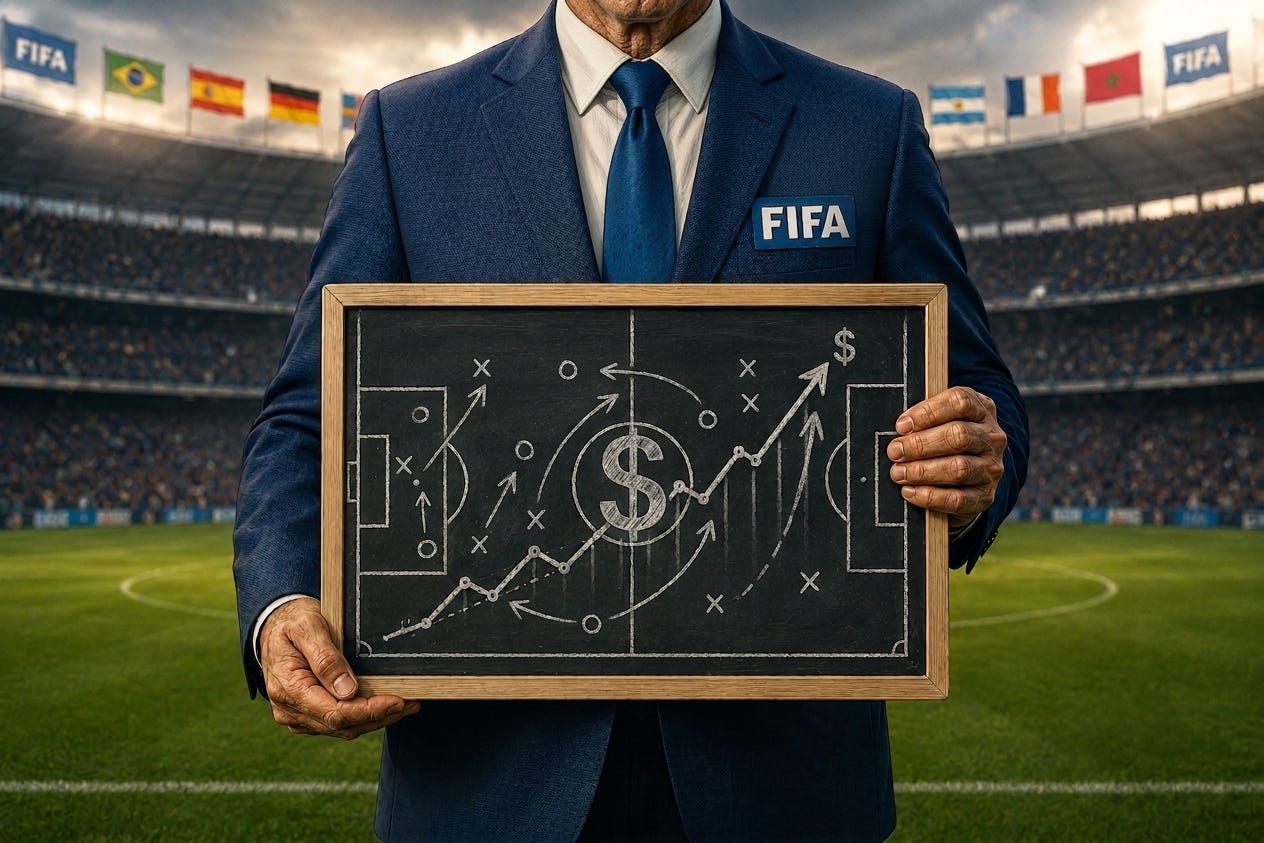
The ball stops rolling, the final whistle blows, and the stands fall quiet. Fans and casual onlookers alike return to their routines after 39 days of suspended reality, a stretch that briefly dissolved social tensions and personal troubles. Football was never just football, and the 23rd World Cup proved it once again: politics, business, and technology all shared the pitch.
Even as many are still processing the changes brought by the tournament in the United States, Mexico, and Canada, a new controversy has emerged. FIFA president Gianni Infantino has proposed expanding the tournament from 48 to 64 teams, framing it not just as growth but as a transformation of the sport itself.

ESPN@espn
Gianni Infantino confirmed that FIFA will discuss expanding the men's World Cup to 64 teams after the 2026 tournament, saying every nation should have the chance to dream of playing at football's biggest event. spr.ly/6013BET7yS
3:35 PM · Jul 13, 2026 · 6.86M Views
1.09K Replies · 463 Reposts · 4.04K Likes
“This is something that will be studied and debated in the relevant committees after this World Cup. When you organize one, you have to design it for the whole world, not just for Europe and South America. Every nation should be able to dream of taking part,” Infantino said on July 12, days before the final. But that’s not the change fans are dreaming of. Many still recall an era when the sport was less commercialized and more focused on the jogo bonito.
FIFA and its circumstantial political ally, Donald Trump, haven’t escaped the eye of the storm. Controversies ranged from fears of immigration raids and deportations targeting fans to visa denials for referees, photographers, and other accredited staff. Iran’s national team was among the hardest hit: with no guaranteed safety in U.S. territory, the squad had to base itself in Tijuana and fly in for each match.
But nothing prepared anyone for President Trump’s direct intervention. True to form, he openly admitted calling Infantino to have a red card overturned—one shown to U.S. striker Folarin Balogun in the match against Bosnia-Herzegovina—so the player could take the field in the round of 16.

The White House@WhiteHouse
USA-USA-USA 🦅


ESPN @espn
Breaking: Folarin Balogun will be available to play in USA's Round of 16 match against Belgium on Monday, FIFA announced. The FIFA Disciplinary Committee has suspended the red card issued to the USA striker during their Round of 32 win over Bosnia and Herzegovina.
5:18 PM · Jul 5, 2026 · 36.1M Views
13.3K Replies · 9.96K Reposts · 91.1K Likes
What followed veered wildly off Trump’s script and, in a way, saved the tournament. Belgium thrashed the United States 4-1, a result that read almost like poetic justice. It also kept the unprecedented decision from derailing the rest of the championship.
Mexico, another host nation, wasn’t spared its own scandal. President Claudia Sheinbaum faced criticism after revealing that FIFA paid one million pesos (more than $57,000) to rent Chapultepec Castle, a historic site, for a gala dinner ahead of the tournament. Her explanations did little to quiet the backlash.
We invite you to become a sponsor of the 2027 edition of the CONNECTAS – Martin Baron Editors’ Intensive Training Program, the most important in the Spanish-speaking world.
FIFA’s power is virtually unchecked, enough to set ticket prices that put matches out of reach for local fans and push die-hard supporters into painful sacrifices just to see their team play.
According to The New York Times, group-stage tickets in the United States started at $60, with limited availability, and climbed past $600. Official final tickets topped $10,990. The Athletic, comparing prices to the last World Cup, found that “tickets that once cost around $1,000 were reserved for the final or the best seats at the 2022 semifinals. Now, that same price gets you a decent seat for a United States–Turkey group match.”
For Nicolás Coppa, a sports journalist at Argentina’s Clarín, FIFA has taken on an outsized role compared with past tournaments. “The spirit used to be that teams arrived, competed, and you barely knew who ran FIFA, it didn’t have the outsized role Gianni Infantino has claimed for himself. These changes to the tournaments, the Club World Cup launched last year, have all been driven by business logic, by profit, by the millions generated through TV rights and sponsors. That’s landed all at once on this massive World Cup, and it’s benefited the country that is capitalism’s mecca: the United States.”
Mexico’s numbers, meanwhile, are far more modest. An official report puts the economic impact across its three host cities at roughly 50 billion pesos ($2.8 million), slightly below projections.
It’s no secret that FIFA treats the World Cup as a commercial asset, holding tight control over broadcast rights, sponsorships, product licensing, logo use, and advertising tied to the tournament. That grip maximizes revenue and lets FIFA sell sponsors’ exclusivity. Even its ban on unauthorized brands (Gillette, Levi’s, Heinz) backfired into free publicity, as those companies turned the restriction into viral marketing campaigns.
Then came the hydration breaks: three-minute pauses mid-half for players to drink water. Beyond player welfare, FIFA used the pauses to air commercials, drawing boos from stadium crowds over a measure the sport had never seen before—one that affected some teams’ rhythm on the pitch.
Diego Muñoz, a veteran journalist who has covered eight World Cups, sees FIFA as having long treated the tournament as a business first. “Some changes have helped the games, such as counting seconds for throw-ins, limiting substitution delays, stopping players from running down the clock. That’s added intensity and pace. But there’s also a bigger debate: how do you hold attention in a 45-minute half when the real competition isn’t another sport anymore, but games, social feeds, and an audience hooked on 15- or 20-second videos?”
The real money, though, is flowing elsewhere. Football has become a magnet for betting houses, and the World Cup is their golden moment worldwide. Most of that betting is illegal, moving vast sums underground. Industry estimates put global wagering during the tournament at $50 billion. As the Latam Journalism Review notes, “across Latin America, many outlets have jumped on the boom, covering sponsorship deals, odds, and predictions with the same enthusiasm usually reserved for the matches themselves.”
The World Health Organization (WHO) and the Pan American Health Organization (PAHO) warned of a surge in online betting and its toll on mental health, finances, and personal relationships. Across the Americas, roughly 2% of the population—nearly 70 million people—struggles with gambling addiction.
One detail stands out. Predictstreet, a blockchain-based sports-prediction platform, became FIFA’s first official partner in that category, going from an unknown brand to a fixture at every match. Investigative journalist Philippe Auclair notes that “this company barely existed when talks with FIFA began, and it still became a partner for a truly considerable sum—we’re talking $150 million.”

DW Español@dw_espanol
Copa del Mundo: Quién es el controvertido socio de mercados de predicciones de la FIFA Fundada apenas unos meses antes de la Copa del Mundo de la FIFA, ADI Predictstreet ya es uno de los mayores patrocinadores del torneo. Pero su vertiginoso ascenso y el escrutinio de los
8:44 PM · Jul 6, 2026 · 75.8K Views
14 Replies · 562 Reposts · 1.09K Likes
Meanwhile, corruption allegations and financial irregularities within national federations deepen the crisis of trust plaguing the sport. One recent example: Argentina’s football federation (AFA) is reportedly under scrutiny from federal prosecutors and FBI agents, according to La Nación. U.S. authorities have begun taking testimony over alleged illegal financial operations involving AFA president Claudio “Chiqui” Tapia.
Then there’s technology, with as many fans as critics. Coppa, reflecting on today’s game, recalls Diego Maradona’s 1986 “Hand of God” with nostalgia. “VAR is always controversial. I’d say it gets it right 90% of the time, but it leaves this tiny space open that kills the spirit of the game we grew up loving and playing as kids. [...] With VAR, we never would have had Maradona’s goal against England—not the first, and not the second either, since it started with a foul by an Argentine player.”
Blessed or cursed, VAR draws opinions depending on who you ask. Video assistance was meant to cut down on refereeing errors, but it hasn’t spared the sport controversial calls, some of which decided which teams advanced to the tournament’s final stages.

Mundo Deportivo@mundodeportivo
👀 La FIFA premia al árbitro de VAR del polémico Argentina-Egipto ✍️ @RamonFuentes74 mundodeportivo.com/futbol/mundial…
7:15 AM · Jul 13, 2026 · 13.9K Views
5 Replies · 3 Reposts · 16 Likes
Football now pairs high-speed cameras with artificial intelligence to catch offside calls instantly. Sensor-equipped balls track hundreds of data points per second, making it easier to spot offside positions or confirm whether the ball crossed the goal line. Off the pitch, technology now shapes personalized training, tactical analysis, player evaluation, injury prevention, and even data-driven transfers.
And yet the endless wait for a call to be confirmed—and the human judgment behind it —keeps alive the idea that no matter how advanced the technology, there’s always room for interpretation that favors one team over another.
Muñoz sees a bigger dilemma ahead: “How do we want to compete, and where are we headed? As a region, we urgently need to professionalize football’s leadership. That means real transparency around federations and how the money meant for development actually gets spent.”
Expanding the World Cup to 64 teams would raise the stakes for countries and federations alike, forcing them to adapt to new economic, technological, and commercial realities. All while trying to preserve football’s soul. Will that be possible? The answer may start to take shape in 2030, when Spain, Portugal, and Morocco host the tournament, with opening matches also played in Uruguay, Argentina, and Paraguay.
Some are already calling the 2026 World Cup the best. Maybe that’s just the need to hold on to football, plain and simple—a sport that stirs emotion so intensely it can make you forget your country’s crises, erupting in a shout of joy from anywhere in the world, whether your team is playing or not. As Uruguayan writer Eduardo Galeano once put it: “Far from the multimillion-dollar transfers, on a nameless beach, someone kicks a ball or something that stands in for one (a bundle of rags, a can, a bag stuffed with paper). That gesture carries an inexpressible joy: the joy of playing just to play.”
Comments
Nothing yet. Say the first thing.
Sign in to join the conversation.