
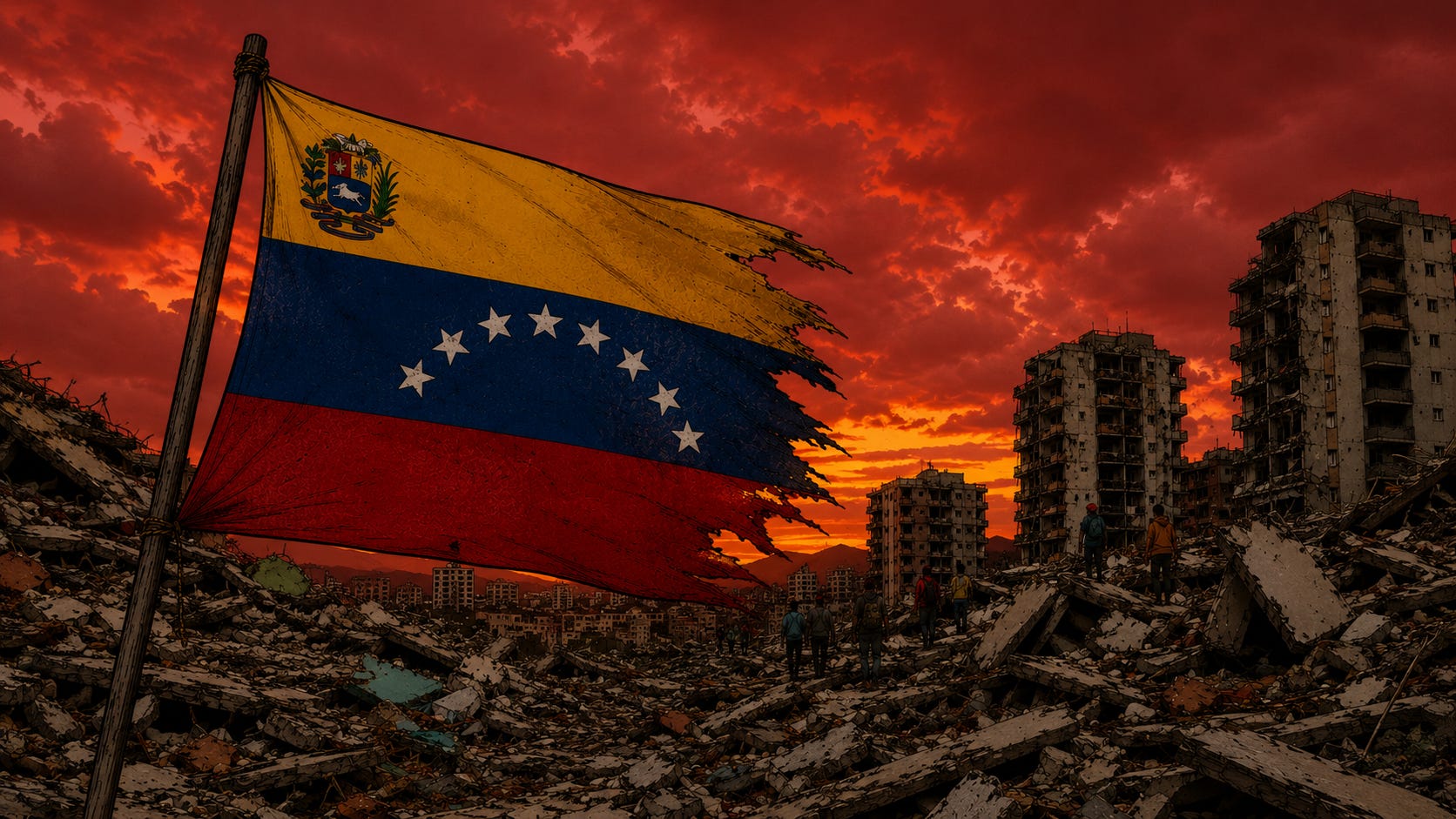
When the earth shook twice in fury on June 24, it didn’t just devastate Venezuela. It also dealt a heavy blow to an already-failed chavista state and its U.S. protectorate and left citizens facing deep uncertainty amid an already complex crisis.
As survivors flee to other parts of the country, the death toll and social and political tensions keep climbing. As this article went to press, the official death toll had already passed 3,300, though news reports put the number of missing above 31,000 and counted more than 16,000 people left homeless.
Meanwhile, rescue efforts were winding down as hope faded of finding survivors under the rubble of more than 400 collapsed buildings and over 1,300 more severely damaged by the twin quakes. Unofficial estimates put the number of damaged properties above 58,000.
Why did the quakes cause so much damage? The answer lies not only in their extraordinary magnitude but in years of regime corruption. Some analysts even wonder how many buildings were built flouting codes that have existed for more than half a century.
In Venezuela, the devastation actually began years earlier, alongside the loosening of building codes. Investigative reporting produced with editorial support from CONNECTAS found that public hospitals lack even basic services, leaving patients to endure precarious care or pay exorbitant sums to access one of the country’s few operating rooms.
Political decisions drove experts across every field to flee the country in search of better opportunities, and Venezuela’s scientific output sank to the bottom of the continent’s rankings, with researchers surviving on salaries below four dollars a month. Entire industries vanished: aluminum production, which hit a record of more than 210,000 metric tons in 1998, had disappeared by 2020, after the government sold off hundreds of industrial plants and their machinery for scrap.
We invite you to become a sponsor of the 2027 edition of the CONNECTAS – Martin Baron Editors’ Intensive Training Program, the most important in the Spanish-speaking world.
Even before the quakes, 7.9 million people had already “left the country in search of protection and a better life,” according to the UN Refugee Agency (UNHCR). It is “one of the largest displacement crises in the world. People fleeing violence, insecurity, threats, and shortages of food and medicine, facing grave dangers along the way.”
In an analysis for eldiario.es, Jesús A. Núñez, co-director of the Institute for Conflict and Humanitarian Action Studies, agrees that the current devastation “is explained both by chavismo’s own failures and by the effect of international sanctions and Washington’s military interventionism.” Gross Domestic Product (GDP) has fallen 80% over the past 15 years. It is “a failed state, with runaway inflation, unable to guarantee the well-being of most of its population, and with corruption pervasive at every level of power.”.
Since January 3rd, when the Trump administration captured Nicolás Maduro, Venezuela has entered “a de facto situation,” with authorities lacking legitimacy, as Óscar Murillo, general coordinator of the Venezuelan Education-Action Program on Human Rights (Provea), puts it.
Since then, even though Washington left Delcy Rodríguez in charge of the country under a kind of guardianship, Venezuela has become an even more “ill-equipped, resource-poor” state, writes Katrin Bennhold in The New York Times. It has turned into a “vassal” of the U.S. administration, which “controls most of the country’s export revenue through a Citibank account in New York.”

EL PAÍS@el_pais
📺 Trump: "Venezuela se apoderó unilateralmente del petróleo de Estados Unidos (...) Se llevaron nuestras propiedades, eran nuestras. Nosotros construimos Venezuela" shorturl.at/MReT0
5:06 PM · Jan 3, 2026 · 1.46M Views
781 Replies · 1.01K Reposts · 2.17K Likes
The United States handles Venezuela’s oil revenue however it pleases, charges Brian Naranjo, a former senior U.S. Foreign Service official. “We don’t know how much they’re making, how that money moves, or how it’s used inside the country.” Critics note that while the Trump administration donated more than USD 300 million for the emergency, that sum is negligible next to what it has already appropriated and what it will keep extracting in coming months. A Council on Foreign Relations study estimates that in the first four months, the United States took nearly 100 million barrels of crude, worth roughly USD 8 billion.
Though the Trump administration has repeatedly framed this control as beneficial to both countries, it has not disclosed how much Venezuelan oil it has sold, how much revenue it has collected, or how those funds have been used, according to an investigation by Roxanna Vigil. Repairing the damage from the quakes will cost at least USD 10 billion, according to an estimate by The New York Times.
Washington’s priority is making sure the tragedy doesn’t spiral into chaos or anarchy. It needs the recovery of bodies and relocation of victims to “go well,” Murillo warns. The Trump administration wants the oil and gas industries left untouched, since it “needs to keep extracting oil and expanding production capacity,” the Provea official says.
All of this remains unpredictable, since natural disasters of this scale tend to trigger social change, says journalist June Carolyn Erlick, author of Natural Disasters in Latin America and the Caribbean. Though it’s still too early to know exactly what will happen in Venezuela, Erlick lays out three hypothetical scenarios.
In the first scenario, the Rodríguez government cracks down even harder on civil society and the press. In the second, it opens up to civil society, “if only out of necessity,” triggering social reorganization and free, honest elections. The third hinges on Washington pumping in enough money that people settle for a slightly better life—a scenario that would keep the chavista regime afloat for a long time to come.
The regime’s authoritarian streak surfaced within hours of the twin quakes, in more than one way. Murillo cites one example: right after the disaster, the Rodríguez government barred foreign and local journalists from the affected area for 48 hours.
Naranjo criticizes the government for sending soldiers to seal off access to the disaster zone instead of rescuers. What it wanted, he says, was to “control the narrative so that no ugly or difficult information came out.” With no further explanation, the restriction was lifted just 24 hours after it was imposed.
At a July 3 press conference, Delcy Rodríguez pushed back, calling it “miserable, heartless and inconsiderate” to criticize her administration while the public is “in anguish.” She dismissed the criticism as an attempt to “stir up trouble and create chaos” and demanded that journalists “tell the truth.”
Become a sponsor of the CONNECTAS – Martin Baron Editors’ Intensive Training Program.
The Venezuelan government’s central challenge is simply survival, and the U.S. presence is “of supreme importance” to that, Murillo adds. If Washington “pulls the oxygen mask off the [Venezuelan] government, it will collapse,” he believes, since it “lacks the independent capacity to hold onto power, let alone respond to an emergency of this scale.” In that scenario, he says, “pre-existing tensions will escalate.”
The Rodríguez government faces another pressure point: July 3 marked 180 days since the head of state’s disappearance, the deadline by which, as acting president, she must call elections. “We’re in a transitional moment. We don’t know whether this will lead to a technocratic model, an authoritarian technocracy, or an authoritarianism convenient for the United States,” or whether “concrete steps will be taken toward a credible path to institutional democratization,” Murillo notes. But he doubts elections will actually be called, since that doesn’t suit Washington’s interests.
The crisis is also a major test for the opposition, particularly for Nobel laureate María Corina Machado. Even Trump himself has called her attempt to return to political opportunism. Having endorsed the U.S. intervention, she now finds herself in “an uncomfortable position,” struggling to represent a genuine political process in Venezuela, Murillo says.
Machado also made “an extremely serious strategic mistake” by leaving Venezuela, Naranjo argues. The former diplomat is equally unimpressed that she handed her Nobel medal to Trump and announced her planned return on Fox Morning, at 9:45 on a Sunday morning. “Who’s watching Fox News at that hour? Nobody. That’s the same show Defense Secretary Pete Hegseth used to appear on. It was a message meant for one person: Trump. Because everyone knows he has Fox News on all the time.”
Amid the drama, the Trump administration instead turned to another opposition figure, Dinorah Figuera, calling her back from exile in Spain to open negotiations with Rodríguez. Figuera told the press she is seeking to build a “credible electoral authority.” Her arrival “was a setback for María Corina, who clearly appears to have lost the U.S. administration’s backing,” Murillo interprets.
None of this guarantees a path toward democracy, though. According to Murillo, the tragedy has forced Washington to abandon its original plan and prioritize stabilizing the country instead—meaning “guaranteeing a political actor on the ground with control of the institutions,” while heading off the anarchy and social chaos that could stem from “deep public discontent with the authorities” and Venezuela’s ongoing legitimacy crisis. Murillo doesn’t rule out Washington lifting the harshest sanctions on the regime so Venezuela can rejoin global markets.
That would let Trump revive the oil industry and attract foreign investors to boost production and capitalize on Venezuela’s geographic advantages. But caution is warranted, Erlick notes, because the U.S. president “is very transactional.” He might only help Venezuela if he sees “that it’s going to generate wealth for him and his family—because that’s what this is really about.”
For now, everything remains speculation and political tension, while thousands fight to survive amid the wreckage. The coming weeks will prove decisive for this South American nation, suspended in one of the darkest chapters of its history.
Comments
Nothing yet. Say the first thing.
Sign in to join the conversation.