
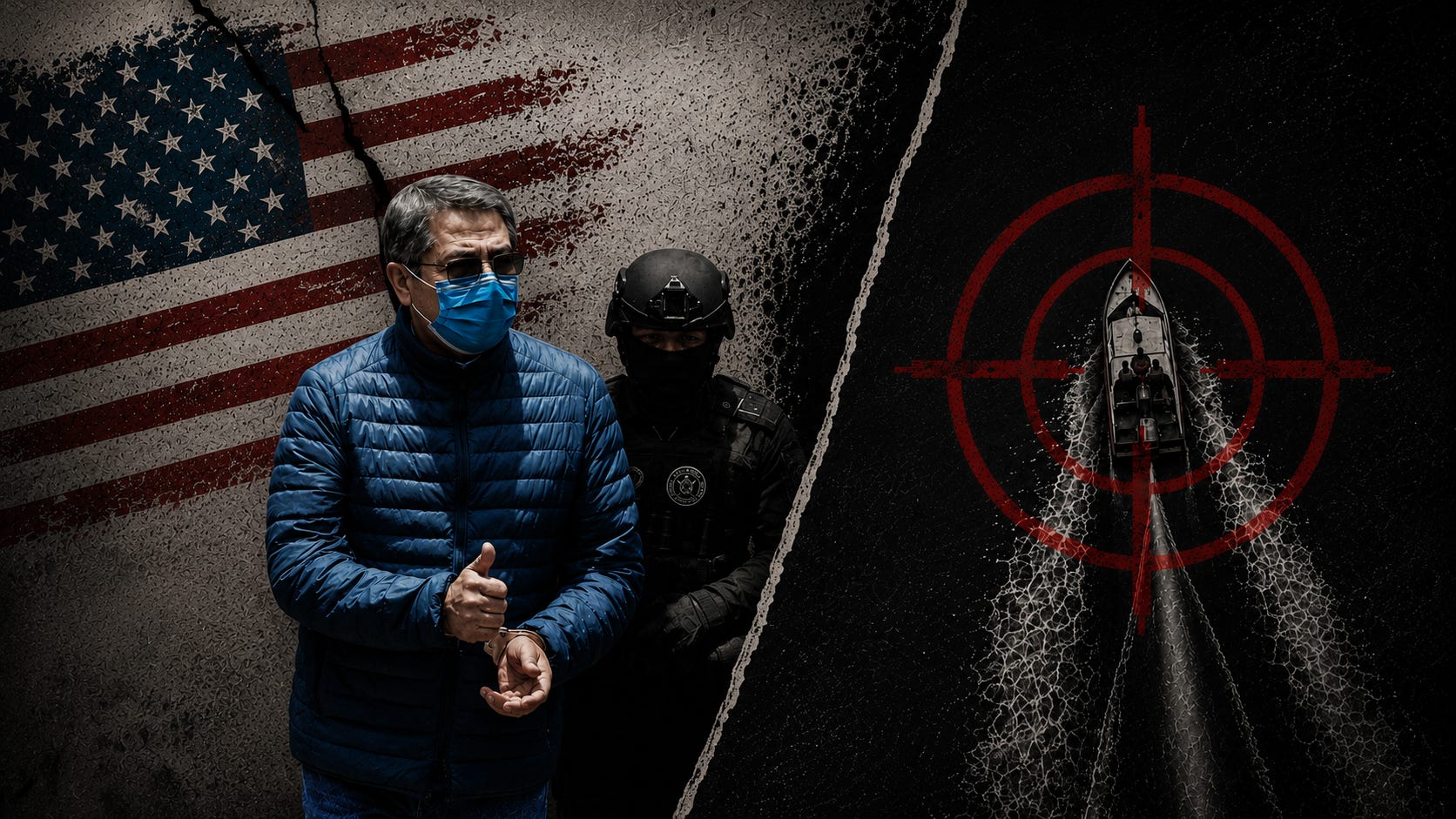
Barring any last-minute hitch, former Honduran president Juan Orlando Hernández will stand before a judge again on August 3rd. This time it will be in Tegucigalpa, and without handcuffs, unlike April 2022, when Honduran police arrested him for extradition to the United States, where a court later sentenced him to 45 years for drug trafficking. He will appear as a free man, pardoned by President Donald Trump, this time facing charges of fraud and money laundering in a case Honduran prosecutors reopened the moment his release became known. Hernández himself announced in a social media video that he will return on Sunday, July 26th, after Honduras’s Supreme Court lifted the Interpol red notice against him, clearing the way for his return without arrest.
Until recently, this scenario was unthinkable. In 2024, a federal jury in Manhattan found him guilty of conspiring to smuggle hundreds of tons of cocaine into the United States. Prosecutors described him as responsible for one of the largest state-sponsored drug-trafficking operations ever tried in a US court. Cooperating traffickers testified against him, ledgers surfaced showing payments to “JOH and his people,” and prosecutors detailed a million-dollar bribe delivered personally by drug lord Joaquín “El Chapo” Guzmán. The Justice Department’s case was strong enough to secure a 45-year sentence, effectively a life term, against the former Honduran president.
But in the Trump era, anything is possible. In December 2025, the sentence was voided when the US president signed a pardon, and Hernández walked out of a maximum-security prison in West Virginia the same day. Trump swept aside the evidence and justified the controversial move by claiming the Honduran, “according to many people I deeply respect, has been treated very harshly and unjustly.”
Our journalism is committed to protecting democratic values, reporting unbiased facts, verifying and contrasting, being independent.
In other words, #InvaluableJournalism
A letter, a lobbyist and a presidential election preceded the pardon. Five weeks earlier, Hernández wrote to Trump, addressing him as “your excellency”, claiming he was a political target of Joe Biden’s government. But that letter wasn’t the only thing that softened Trump’s stance. Roger Stone, a political consultant and lobbyist with enormous sway over Trump, had spent months pushing for the case to be revisited, arguing Hernández was a victim of lawfare orchestrated by Honduras’s left. Stone told Axios that on the day of the pardon, he told Trump that forgiving his old ally would boost Nasry Asfura’s electoral chances, the National Party’s candidate, just two days before the presidential vote.
Beyond the pardon and the boost to Asfura, the move showed that not all traffickers are equal in the White House’s eyes, and that Washington’s drug policy also serves geopolitical interests. By the time of Hernández’s pardon, Trump had already ordered more than two dozen drone strikes on suspected drug boats in the Caribbean, killing over 100 people. A month later, he deployed a military operation in Venezuela to capture then-president Nicolás Maduro on narco-terrorism charges. Rebecca Bill Chavez, president of the Inter-American Dialogue and a former US deputy secretary of defense, told the BBC that these actions make the anti-drug mission “look far more selective and politically motivated.”

Conclusión@ConclusionRos
👀 Narcoterrorismo para unos, indulto para otros El bombardeo de Estados Unidos contra Venezuela y el posterior secuestro del presidente Nicolás Maduro y su esposa para ser juzgado en un tribunal de Nueva York se concretó con la excusa del combate al narcotráfico y el llamado
5:00 PM · Jan 5, 2026 · 614 Views
1 Repost · 3 Likes
None of this is entirely new, but Trump’s second term has radically changed how the US confronts drug trafficking. Days after returning to the White House in January 2025, he signed an executive order designating major criminal organizations from Mexico, Colombia and Venezuela —including the Sinaloa Cartel, the Jalisco New Generation Cartel (CJNG) and the Cartel de los Soles— as foreign terrorist organizations.
Adam Isacson of the Washington Office on Latin America (WOLA) notes that 18 organized crime and drug-trafficking groups now sit on that terrorist list—a designation that legally puts them on par with threats like Al-Qaeda or Islamic State, opening the door to fighting them with the military rather than the courts. That shift underpins Trump’s new national counterterrorism strategy, which ranks eliminating cartels across the Americas as the country’s top security priority, ahead of jihadism.

EL IMPARCIAL@elimparcialcom
Trump exige cooperación pero no ofrece reciprocidad La Casa Blanca dio a conocer la nueva Estrategia Nacional Antiterrorista de Donald Trump. En sus 16 páginas, los cárteles mexicanos quedan elevados a la primera prioridad de seguridad nacional y se advierte que Washington
2:42 PM · May 19, 2026 · 192 Views
2 Replies · 1 Repost · 1 Like
“They don’t seem to have the same drive to fight drug trafficking,” Isacson says—especially, he adds, when it involves people with political ties to movements Trump or his allies support. Those traffickers, he says, are getting “a much softer treatment.”
Hernández’s pardon isn’t the first time the drug war has bowed to geopolitics. In 2020, during Trump’s first term, the DEA arrested Mexico’s former defence secretary, General Salvador Cienfuegos, in Los Angeles on charges of protecting a cartel for bribes. A month later, the Justice Department dropped the charges under heavy pressure from Mexico’s government, then led by Andrés Manuel López Obrador. Cienfuegos returned home, where he was cleared and later decorated. Tim Golden reconstructed the episode for ProPublica through interviews with DEA agents and Eastern District of New York prosecutors who had built the case. According to their accounts, then-Attorney General William Barr acted on his own, without consulting Trump, convinced that drug cooperation with Mexico mattered more than the case itself.

Milenio@Milenio
#DudaRazonable | "ProPublica y The New York Times publicaron un extenso y documentado reportaje de Tim Golden sobre la investigación, arresto y posterior liberación del general Salvador Cienfuegos" 🎙️ La columna de Carlos Puig (@puigcarlos) mile.io/3FEOWUc

2:35 PM · Dec 9, 2022
1 Reply · 12 Reposts · 25 Likes
Isacson also pointed to two more recent examples: former Paraguayan president Horacio Cartes and Venezuela’s acting president, Delcy Rodríguez. Neither was directly accused of running a drug scheme, but both were sanctioned for their ties to governments accused of enabling trafficking. Cartes was sanctioned for corruption and for obstructing a cross-border crime investigation to protect himself and an unnamed associate. Rodríguez, meanwhile, was sanctioned as a key figure in Maduro’s inner circle. The Trump administration has since lifted sanctions on both.
“The message is: if you’re a politician, or maybe a trafficker who behaves better, isn’t as violent, supports the MAGA movement, and perhaps has important contacts like Roger Stone, you can dodge any sanction and be seen as a friend of the United States,” Isacson told CONNECTAS.
There’s also the case, though for a different purpose, of Efraín Campos and Francisco Flores, Maduro’s so-called “narco-nephews,” who were serving an 18-year drug-trafficking sentence. In 2022, then-president Joe Biden freed both in exchange for seven Americans held in Venezuela for political reasons. Isacson distinguishes the cases: Biden’s move followed the logic of a humanitarian swap rather than an unconditional pardon. “The Honduran state wasn’t asking for Juan Orlando Hernández back, at least not under (Xiomara) Castro’s government. So I do think it’s different,” he said.
Your contribution makes a difference. Support CONNECTAS’s investigative journalism.
The clearest expression of the White House’s shift came on January 3rd, 2026, when a military operation in Caracas captured Maduro, who declared himself a “prisoner of war” and denied narco-terrorism charges as the alleged leader of the Cartel de los Soles. But Isacson sees no hope of a pardon for Maduro. “Marco Rubio hates Nicolás Maduro so much that I don’t see it happening. And Venezuela’s stability matters a great deal — bringing Maduro back could destabilize the country to the point where the Trump administration feels it needs to send in troops.”

Perú21@peru21noticias
🔴 Nicolás Maduro y Cilia Flores volverán mañana ante una corte federal de Nueva York ➡️ La audiencia fue reprogramada para este 22 de julio debido a dificultades para garantizar el traslado y la seguridad de los detenidos. La comparecencia no representa el inicio del juicio ni
4:32 PM · Jul 21, 2026 · 1.11K Views
1 Repost · 1 Like
Isacson adds a scenario that sounds surreal but, given the precedents, can’t be ruled out: “If I were Nicolás Maduro or someone close to him, I’d be contacting Roger Stone and everyone close to Trump who could push for a better deal. If Maduro starts putting on a MAGA cap, taking photos and speaking well of Trump... who knows, who really knows.”
Genaro García Luna, the highest-ranking Mexican official ever prosecuted by the United States, is another striking case. Courts found him guilty of taking millions of dollars from the Sinaloa Cartel while officially leading a war against it, and sentenced him to 38 years. He’s still appealing, with little hope, since his case never drew the same diplomatic pressure Cienfuegos’s did.
The biggest casualty in all this is the US judicial system itself, whose rulings now bend to interests other than justice. Regional governments may grow more reluctant to extradite high-profile criminals, since nothing guarantees their efforts won’t end in a presidential pardon. As Isacson notes, landing in a US prison is no longer the worst possible outcome, unlike in the 1980s, when the Medellín Cartel’s Los Extraditables coined their famous line: “I’d rather a grave in Colombia than a cell in the United States.”
That’s why lawmakers from both parties have questioned the pardon of Hernández, a man the Justice Department described, just a year earlier, as responsible for “one of the largest and most violent drug-trafficking conspiracies in the world.” An unwritten rule is taking hold: law enforcement can be negotiable. The former Honduran president understood that before anyone else; all it took was a letter, a lobbyist and an election for 400 tons of cocaine to vanish as if by magic.
This text was translated with the assistance of AI.
Comments
Nothing yet. Say the first thing.
Sign in to join the conversation.