
For six long months after the Carney government took office, barely anything appeared to move on Canada’s defence front.
It was a nerve-racking period. Half the world understood where the “51st state” rhetoric and tariff threats were coming from. Watching the Department of National Defence remain extraordinarily quiet while the world seemed to catch fire every few months was deeply unsettling.
The first real jolt came on October 9, 2025, when Canada announced that it would restructure its military.
To be honest, that announcement came as one heck of a shock to us at the Concis. It took us some time to absorb what we were seeing. Many Canadians will probably struggle to understand why the restructuring matters so much—and it is not an easy plan for the government to explain cleanly.
Canada faces two overarching threats.
The first lies in the Arctic. The abundance of resources beneath the continental shelf is turning the region into an increasingly contested strategic zone. That brings Russia and China into the equation as threats that Canada can never afford to dismiss.
The second lies along the southern border.
If the authoritarian takeover of the United States is completed, what was once unimaginable could suddenly become imaginable. There was a time when much of the world looked up to institutions such as the FBI and CIA. In eight short years, MAGA has managed to make people question whether those institutions—and the power behind them—could eventually be directed against America’s own allies.
That possibility cannot simply be dismissed.
Canada must therefore plan around three major military powers—China, Russia and the United States—as potential sources of pressure or threat.
How exactly is a country with fewer than 68,000 Regular Force personnel supposed to defend 243,000 kilometres of coastline and an 8,891-kilometre continental border?
Even if we count the entire Regular Force and Primary Reserve, the ratio works out to roughly:
One CAF member for every three kilometres of national perimeter.
And, obviously, most of those personnel cannot be stationed along that perimeter. They must crew Canada’s ships and aircraft, operate its bases, maintain its equipment, manage logistics, train new recruits and fulfil the country’s overseas commitments.
So no—a traditional military structure will not work. Canada is simply too large, its exposed approaches are too extensive and the threats it faces are too varied.
That is what makes the October 9 announcement so important.
Strictly speaking, Canada did not announce a restructuring of its entire military. It announced a fundamental reorganization of the Canadian Army under a plan called Inflection Point 2025.
Its central admission was unusually blunt:
“The Army we have is not the Army we need.”
The existing structure will be reorganized into four major formations:
A Defence of Canada Division, responsible for homeland defence and national mobilization.
A Manoeuvre Division, designed to concentrate fully equipped, deployable combat power for major military operations.
A Support Division, responsible for bases, logistics, maintenance and direct connections to Canada’s national supply network.
A Training Formation, responsible for turning recruits into soldiers, soldiers into functioning units and officers into capable commanders.
On paper, these may look like administrative changes.
They are not.
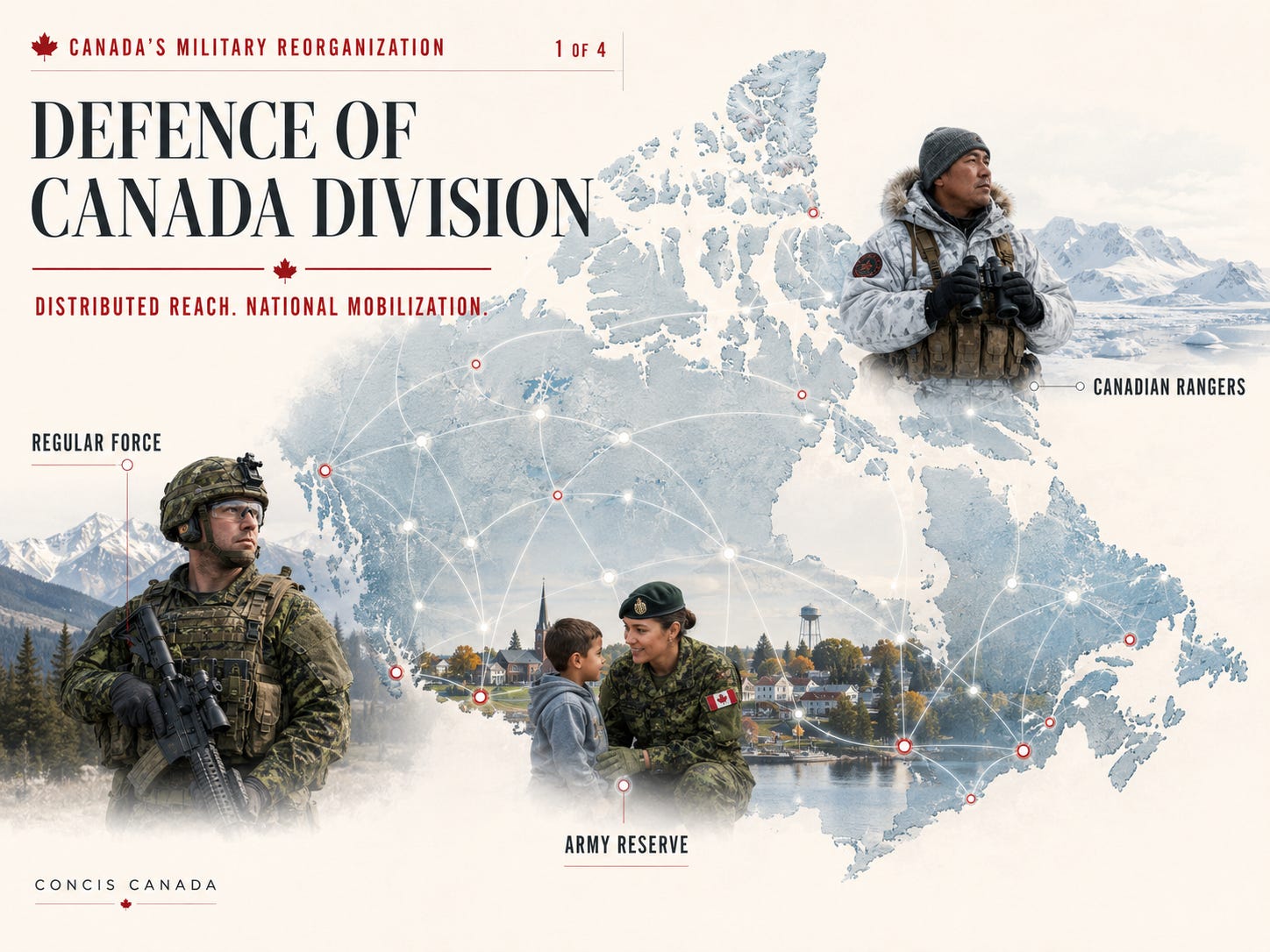
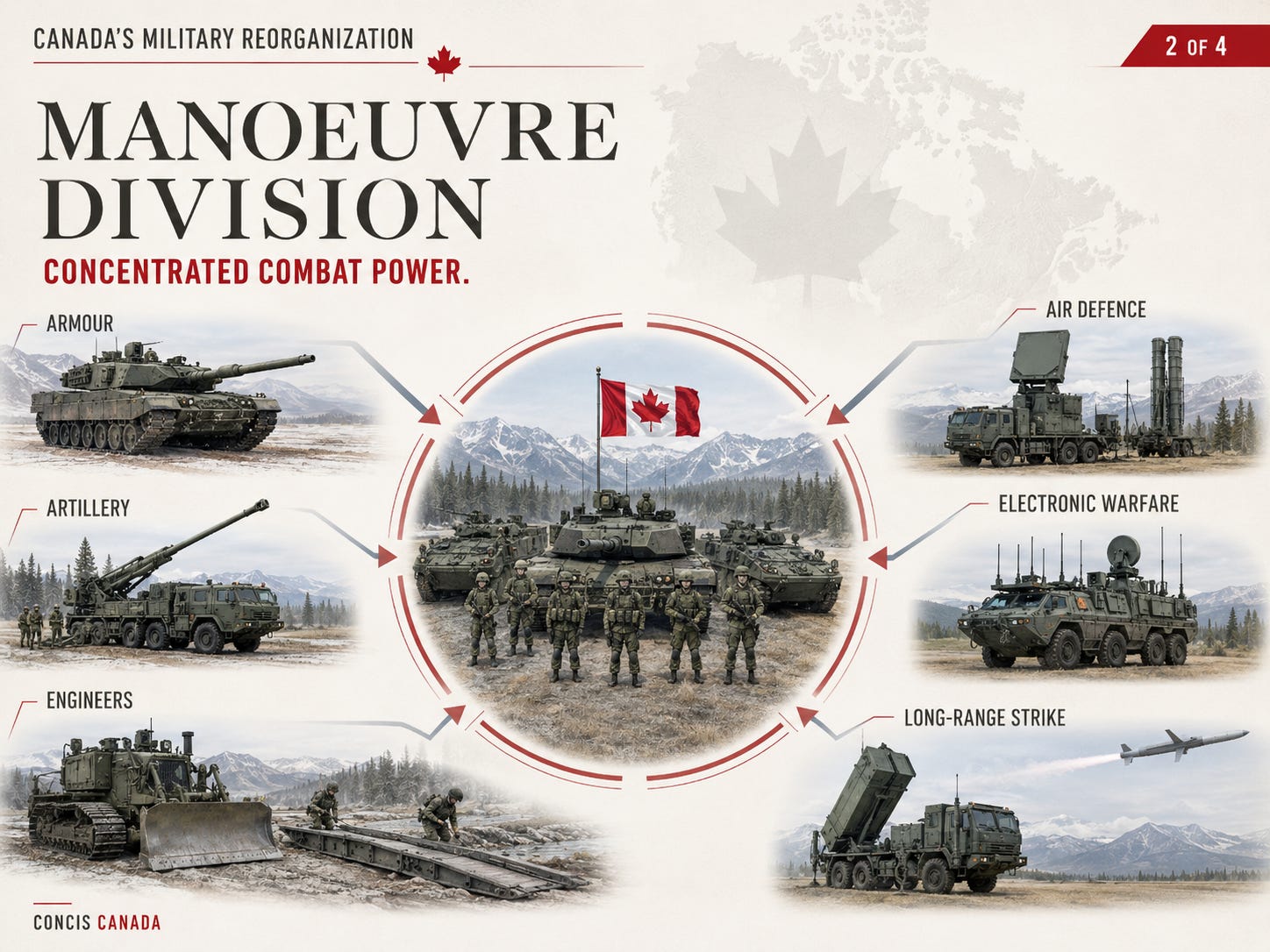
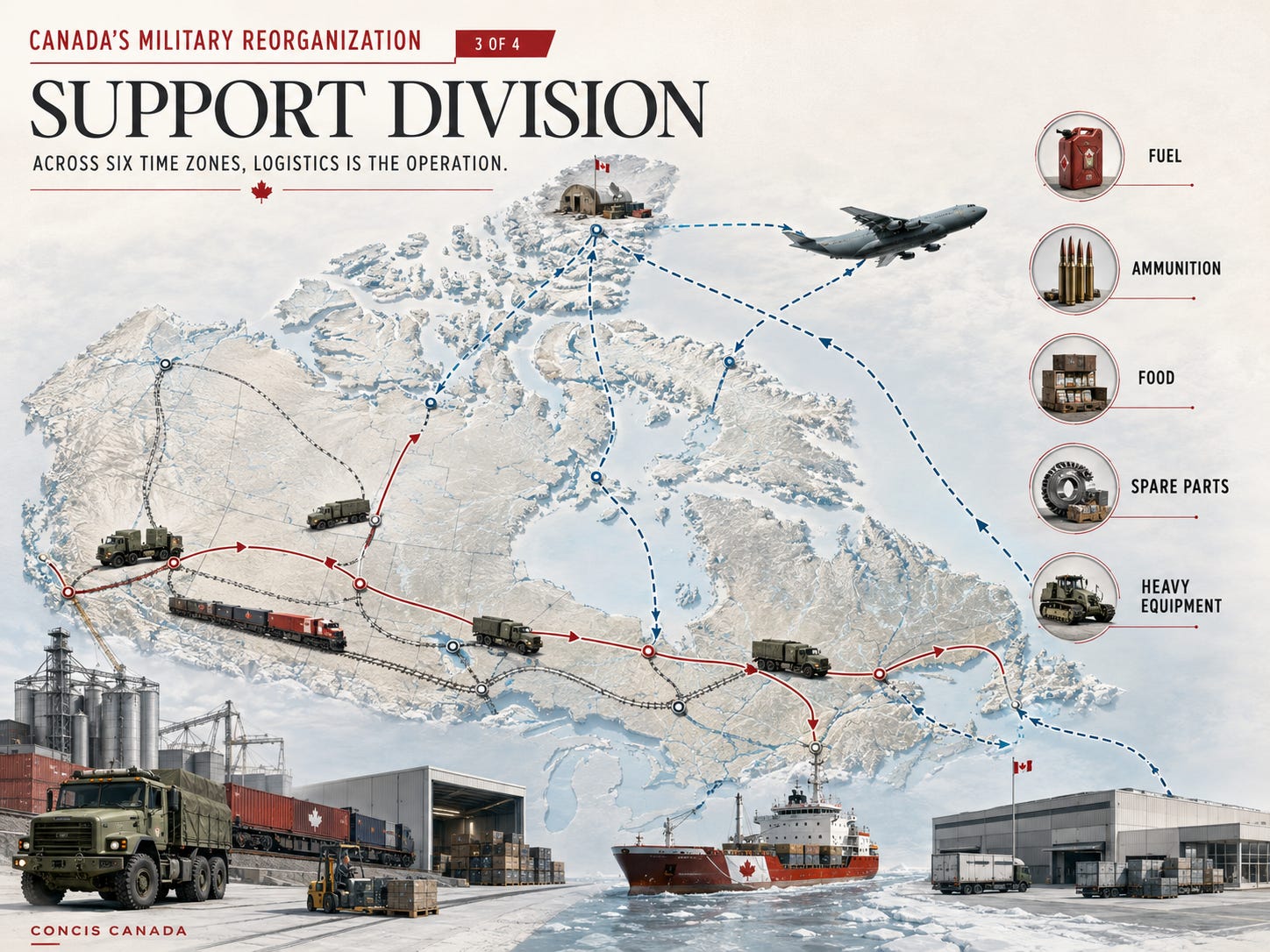
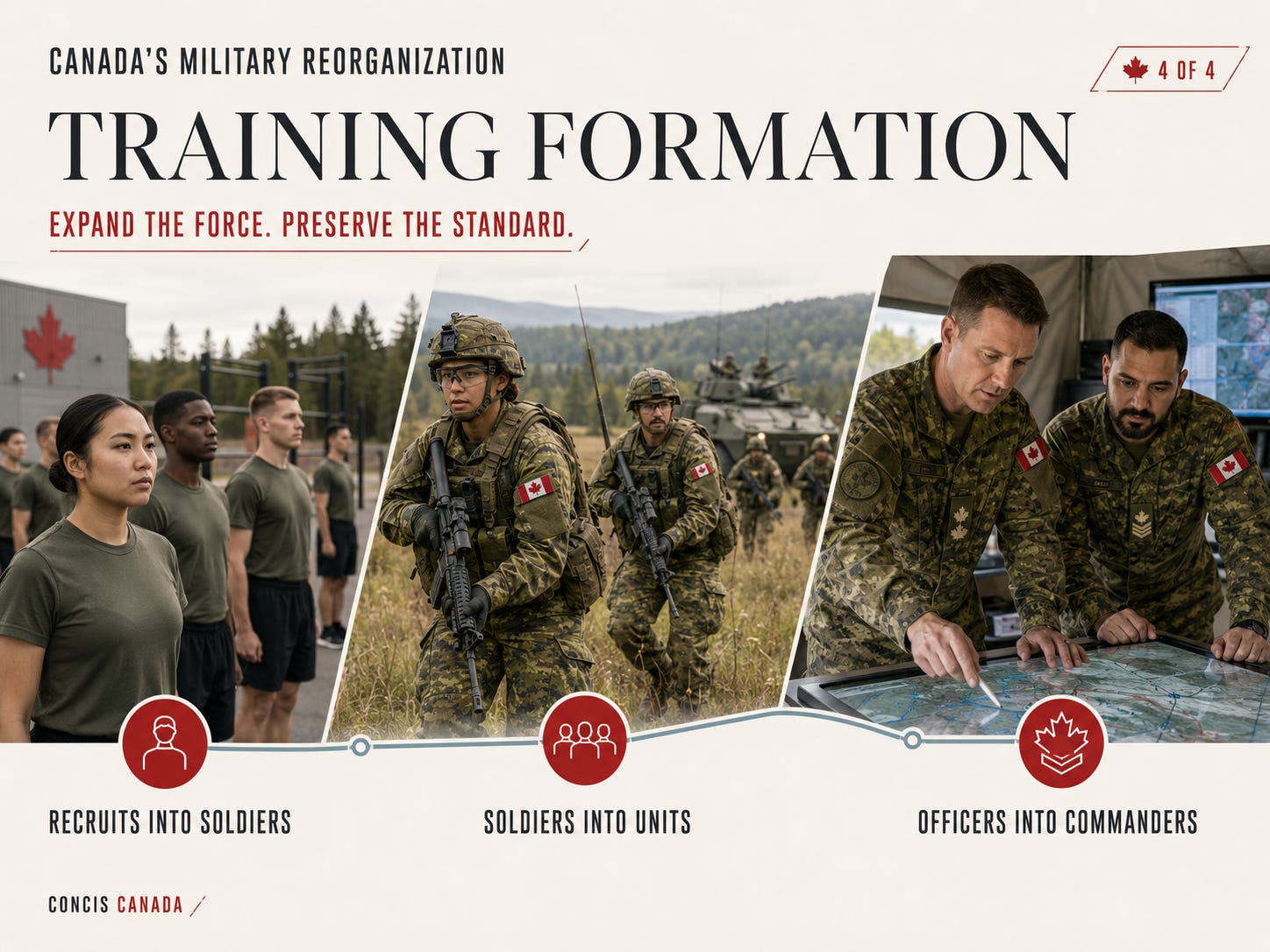
The old structure was organized largely around where forces were based. The new structure is being organized around what those forces must actually do, with operational authority moving down to the divisional level while Army Headquarters concentrates on national strategy, sovereignty and force development.
That separation makes sense for a country of Canada’s size. Canada cannot station soldiers along every stretch of coastline, across every northern approach or throughout its continental border. It needs a distributed force capable of maintaining a presence and mobilizing locally, while retaining the ability to concentrate serious combat power rapidly wherever a threat emerges.
The Army cannot defend those approaches alone. But this reorganization gives Canada a stronger land component around which its naval, air, space and surveillance capabilities can operate.
The CAF still needs to grow. But Canada does not need to match much larger powers soldier for soldier. If the Regular Force, Primary Reserve and Rangers operate as one connected system—and its strongest combat assets can be concentrated quickly—Canada can defend a vast territory without pursuing an enormous standing-force expansion.
That is the real promise of the reorganization: a force that remains lean but can become extremely mean when the situation demands it.
And that choice carries an unavoidable consequence.
Comments
Nothing yet. Say the first thing.
Sign in to join the conversation.