
Woof.
What a relief.
And no, that does not mean we are against a trade deal. Heck, we are not even against buying American weapons.
Our Procurement Watch position at The Concis still holds: Canada can spend 20 cents of every defence-procurement dollar on weapons from the United States. The NORAD complication makes that a perfectly reasonable position.
At the end of the day, Canada has no need whatsoever to stop trading with the United States—or with China, for that matter.
What Canada must stop doing is depending on either of them.
The rule is simple: no single supplier and no single customer should account for more than 20 cents on the dollar.
Any deal that increases Canada’s dependency, concentrates it in one country or pushes Canada back above that threshold is a strict no-go. And when the dealmaker sitting across the table is extremely unreliable, Canada should receive an unreliability premium for accepting the additional risk.
That is not where the CUSMA negotiations ended up.
The proposed deal attempted to reverse the entire requirement. It pushed Canada to pay a premium in return for increasing its dependence on an unreliable MAGA administration.
No, thank you.
So, yes, when Canada dug in its heels and the negotiations collapsed, we breathed a sigh of relief.
The collapse will create problems. We understand that. But the problems created by refusing this deal are still better for Canada than the much larger problems it would have inherited by giving in.
The one paragraph in Prime Minister Carney’s statement that caught our eye was this:
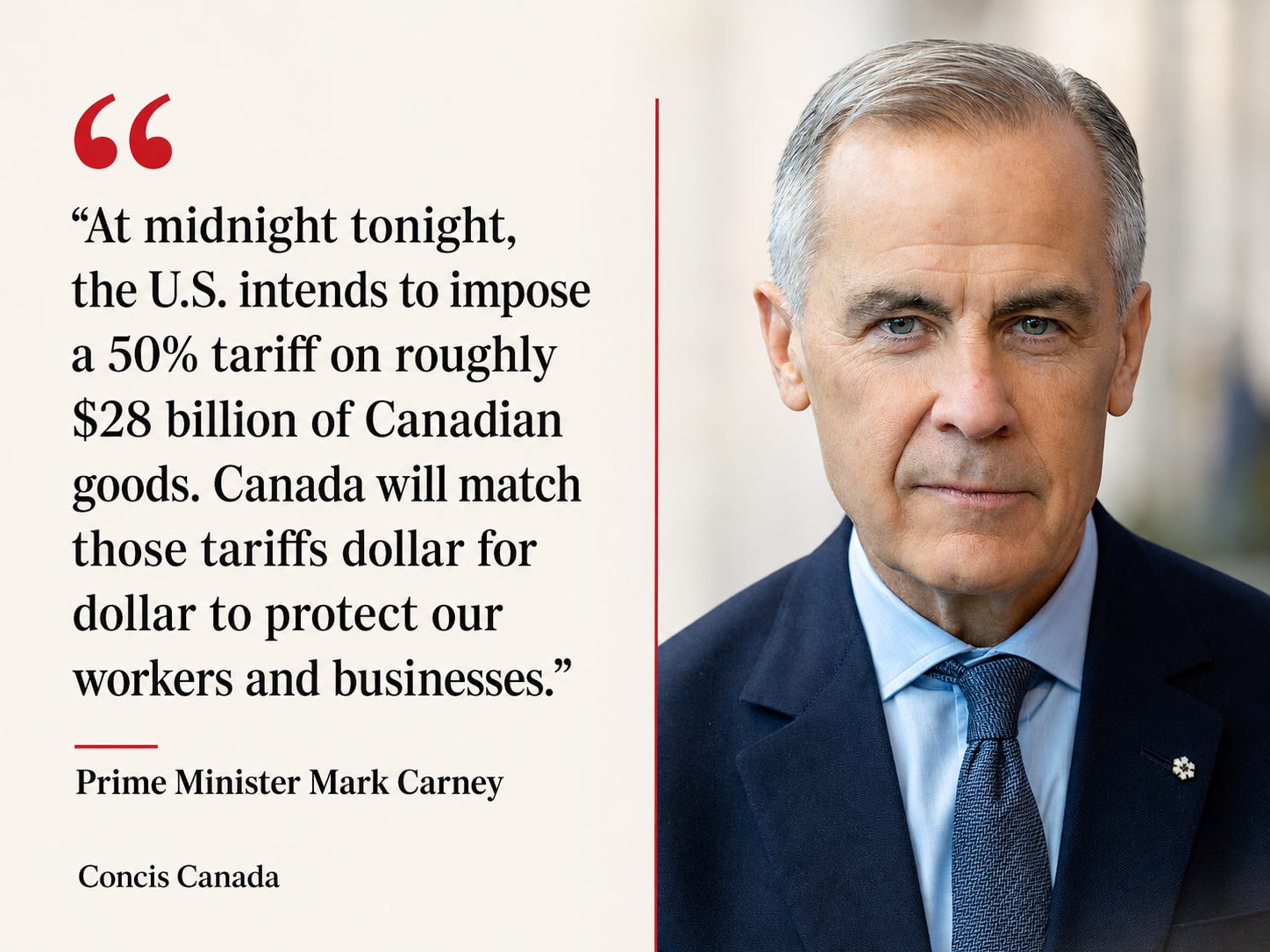
Dollar for dollar is the best option available, because anything less sends one very clear message: hurting Canada is cheap.
If the United States can impose one dollar of pain on Canada and receive only 50 cents in return, it has been given a discount. That is not restraint.
It is an invitation to return with another demand.
Canada cannot prevent the United States from choosing confrontation. What it can do is ensure that confrontation carries an immediate and equivalent price. Every dollar of tariff pressure directed at Canada must produce a dollar of retaliatory pressure inside the United States.
Otherwise, Washington learns that tariffs work—and that Canada can be pushed again.
So, after India, Canada has joined the we are going to dig in list.
And Canada has done this considerably better than India.
The Indian government adopted something close to a we will ignore your actions strategy. It would not retaliate, it would not ask for relief, and it would use its relationships with Russia and China to push Washington onto the back foot.
That is what New Delhi did after Trump imposed 50% tariffs on India, supposedly because India continued buying Russian oil—even as the United States continued importing Russian uranium year after year.
Canada’s exposure to the United States is much larger than India’s. Despite that pressure, Canada has decided not to retreat under economic coercion.
That is a brave position.
Carney also used his statement to explain why Canada can afford to take it:
“Canadian economic growth is accelerating, and we are on course to have the second-fastest growth in the G7 over the next two years. Our economy is creating jobs at four times the rate of the United States. Our exports to non-U.S. markets are on track to double over the next decade. Foreign direct investment in Canada is at its highest level in two decades, running at twice the rate of our nearest G7 competitor. Canada now ranks as the most attractive country in the world for infrastructure investment.
Canada has what the world wants. And we will not allow any nation to determine our future. We will set our own course to keep building Canada strong for all.”
So, what happens next?
Nothing.
Canada does not need to rush back to the table. Let Washington return with a fair and reliable offer—or let it enjoy the job losses created by its unfair, illegal and agreement-breaking policies.
Until then, Canada has one job: increase its exports to every other available market and keep reducing its exposure to the United States.
Carney needs to start flying again.
Poilievre needs to start complaining about his trips again.
Concis Canada has fewer than 2,000 subscribers.
That is not scale.
That is where the algorithm decides to dig, bury and landfill the story.
In the current media environment, getting reality in front of people is extraordinarily difficult. Every free subscription expands our reach. Every paid subscription strengthens this desk and gives stories like this the visibility they need.
No posts
Comments
Nothing yet. Say the first thing.
Sign in to join the conversation.