
Canadians seem convinced that crude oil exports are quietly driving the country’s recent economic surge. But are they?
That question kept nagging at us. So, we took a scalpel to the numbers.
Let’s dig in.
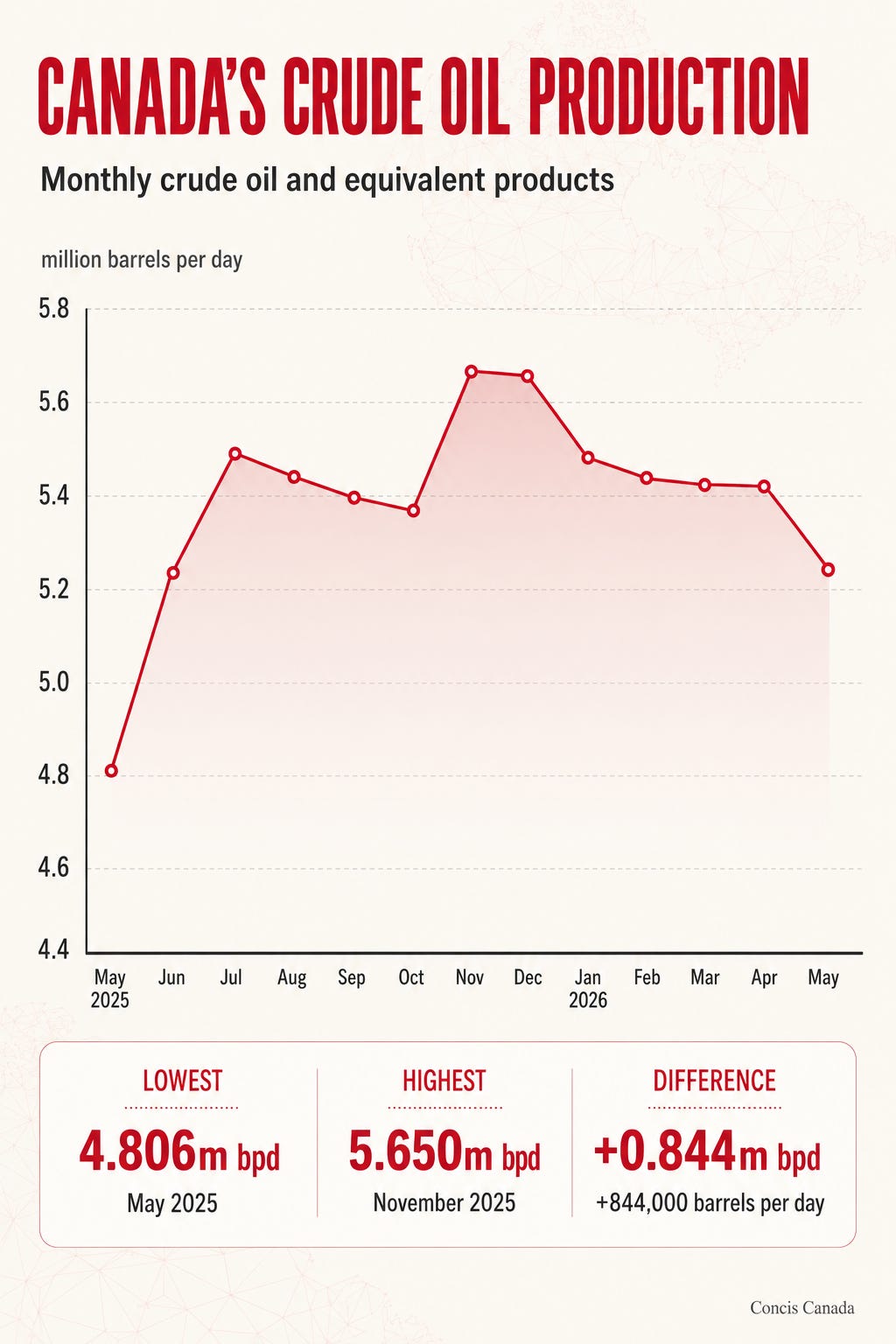
Apart from the May 2025 dip, Canadian crude oil production has remained within a fairly narrow band of roughly 5.2 million to 5.65 million barrels per day. Higher oil prices would certainly have helped. At 5.6 million barrels per day and US$90 per barrel, the gross market value of that production would approach US$46 billion over a full quarter.
Canada’s nominal GDP in Q1 2026 was approximately US$610 billion. That puts the gross value of one quarter’s crude production at roughly 7.5% of quarterly GDP.
That is a meaningful amount—but it is also the limit of the argument. The US$46 billion represents gross production value, not the oil sector’s actual contribution to GDP, which is based on value added. More importantly, crude production did not surge, nor did oil remain extraordinarily expensive throughout the period.
Canada’s economy is trying to break out for a broader reason. The movement cannot be explained by crude oil alone. It is clearly being driven by a combination of factors.
And that brings us to the next question: it has been more than a year, so why hasn’t Canada increased crude oil production more rapidly?
Because production cannot be expanded by political instruction. In Canada, additional supply largely requires producers to expand or debottleneck existing oil-sands facilities, improve recovery rates, add processing capacity and secure enough pipeline space to move the crude to market. Some additional drilling is involved, but this is primarily an infrastructure-and-capacity story. It takes time. No country can simply snap its fingers and create millions of barrels of new production—not even Saudi Arabia.
Canada has, however, set the stage reasonably well.
In the short term, two approved pipeline projects could add 240,000 barrels per day of export capacity by 2027:
Enbridge Mainline Phase One Optimization: 150,000 barrels per day
Trans Mountain drag-reducing-agent project: 90,000 barrels per day
The proposed second wave is considerably larger:
Trans Mountain Mainline Optimization: 210,000 barrels per day by 2028
South Bow–Bridger Prairie Connector: 550,000 barrels per day by 2028
Enbridge Mainline Phase Two Optimization: 250,000 barrels per day, with no confirmed completion date
If all three proceed, they would add another 1.01 million barrels per day. Combined with the approved projects, Canada could gain approximately 1.25 million barrels per day of additional export capacity during the first phase of the buildout.
Then comes the longer-term move: the proposed Alberta West Coast pipeline, designed to carry another 1 million barrels per day to the Pacific by 2033–34.
Altogether, the six projects could expand Canada’s oil-export pipeline capacity by 2.25 million barrels per day by 2035. But that number requires a large asterisk: only 240,000 barrels per day has been approved. The remaining 2.01 million barrels per day is still proposed.
These are pipeline-capacity numbers, not guaranteed production increases. But pipelines determine how much additional crude producers can move—and therefore how much new production they can justify developing. Canada has not yet delivered the increase. It has begun constructing the conditions that could make it possible.
If you have not yet read the story we published earlier today at The Concis, please take a moment to do so. It contains a detailed comparison of the Canadian and American economies—and explains one of the central reasons we have recommended that Canada refuse to blink during the trade negotiations.
Canada has the capacity to hold its ground. It should dig in.
No posts
Comments
Nothing yet. Say the first thing.
Sign in to join the conversation.