
Wow.
At the end of yesterday’s story, we finished by saying Carney should start flying again. Carney is like, naa. We need to drop the camp. Just flying ain’t gonna cut it.
I have seen ambitious plans. I have also seen aggressive plans. But the Prime Minister has just rolled both into a single file. The past 18 months were already extraordinarily aggressive by Canadian standards. Canada moved faster, reached further and attempted more than it had in decades. But Carney is now asking his government to treat even that period as the slow lane.
What he has laid out for the next six months is not simply more aggressive. It is a different order of intensity altogether. So now we have to see how his ministers respond to what the PM is asking of them.
The plan looks very clear to me: no more days off—including as many weekends as necessary—for the next six months.
That appears to be the new job description for his ministers. To be clear, that is not what Carney said. It is my reading of the plan he just placed before his government. If I were a member of his ministry or national-security team, I would have called in my staff within minutes of that speech and asked them to tell their friends and families that they would not be as available as before for the next six months.
Before we begin, let us get one important point out of the way, because many of our readers kept circling this question.
Canada has decided to match the American tariffs dollar for dollar. That means matching the value of trade targeted: if the United States applies tariffs to $50 billion worth of Canadian goods, Canada will apply retaliatory tariffs to $50 billion worth of American goods.
For returning the favour, the PM identified sectors including “steel, dairy, appliances, agricultural equipment, pulp and paper, and electronics.”
Electricity, oil and gas were kept outside the retaliatory package he announced. The demarcation is clear, and we deeply respect it. Canada is building a new global brand. That brand is now under attack—and that is precisely why Canada must go out of its way to protect it.
So, what exactly is the plan Prime Minister Carney is now pushing?
In its simplest form, it looks like this:
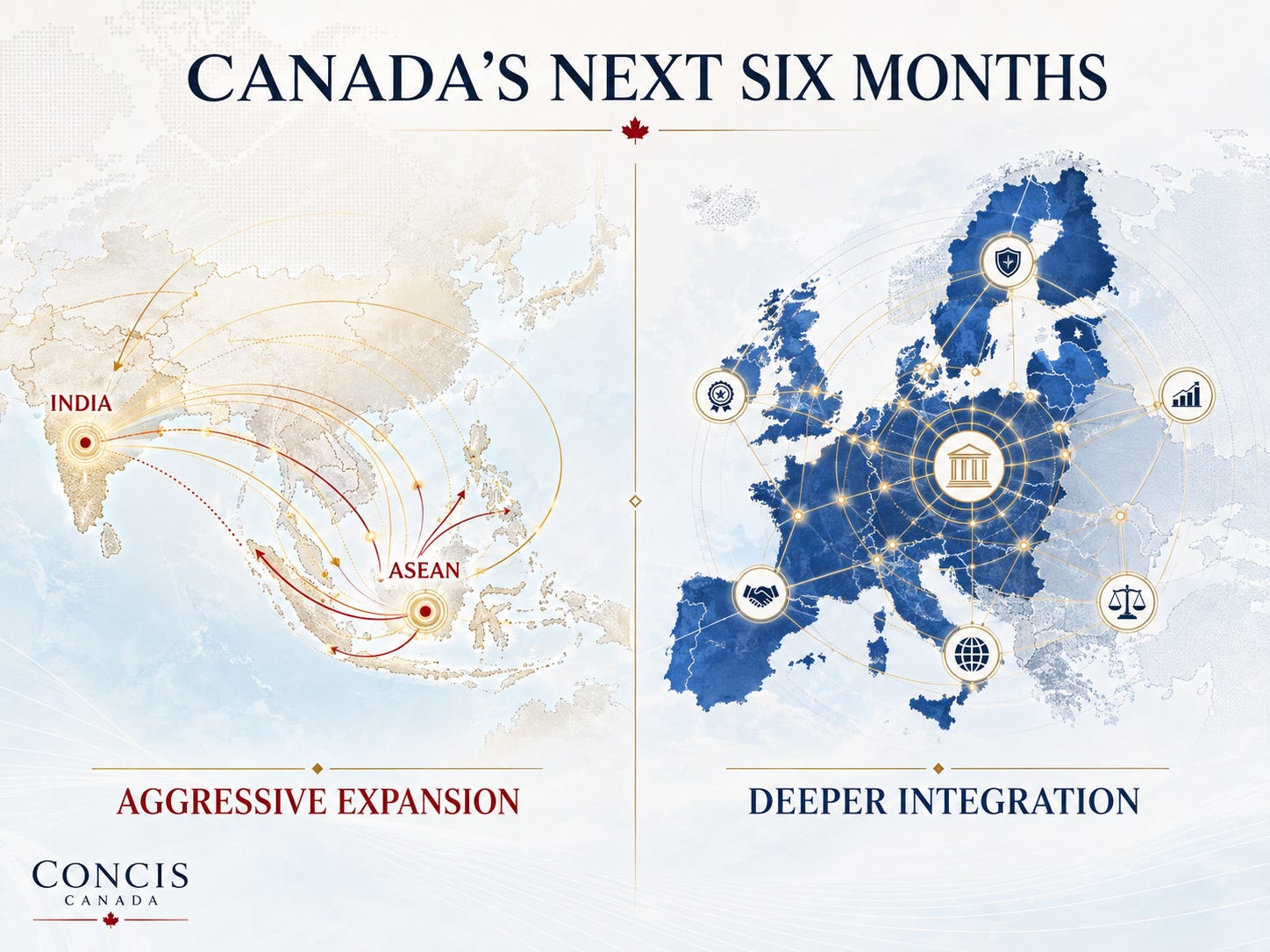
Carney’s base plan appears to be clearing as many trade barriers across Asia as possible.
It will probably look like one paper being signed after another. And this is most likely where the hatewing—both inside Canada and south of the border—will coordinate its attacks on the effort.
Think about what happens during this signing spree.
It is no different from a government speaking to landowners, negotiating compensation for the land it needs, and securing the permissions required to begin building a road.
You know exactly how the attack will work.
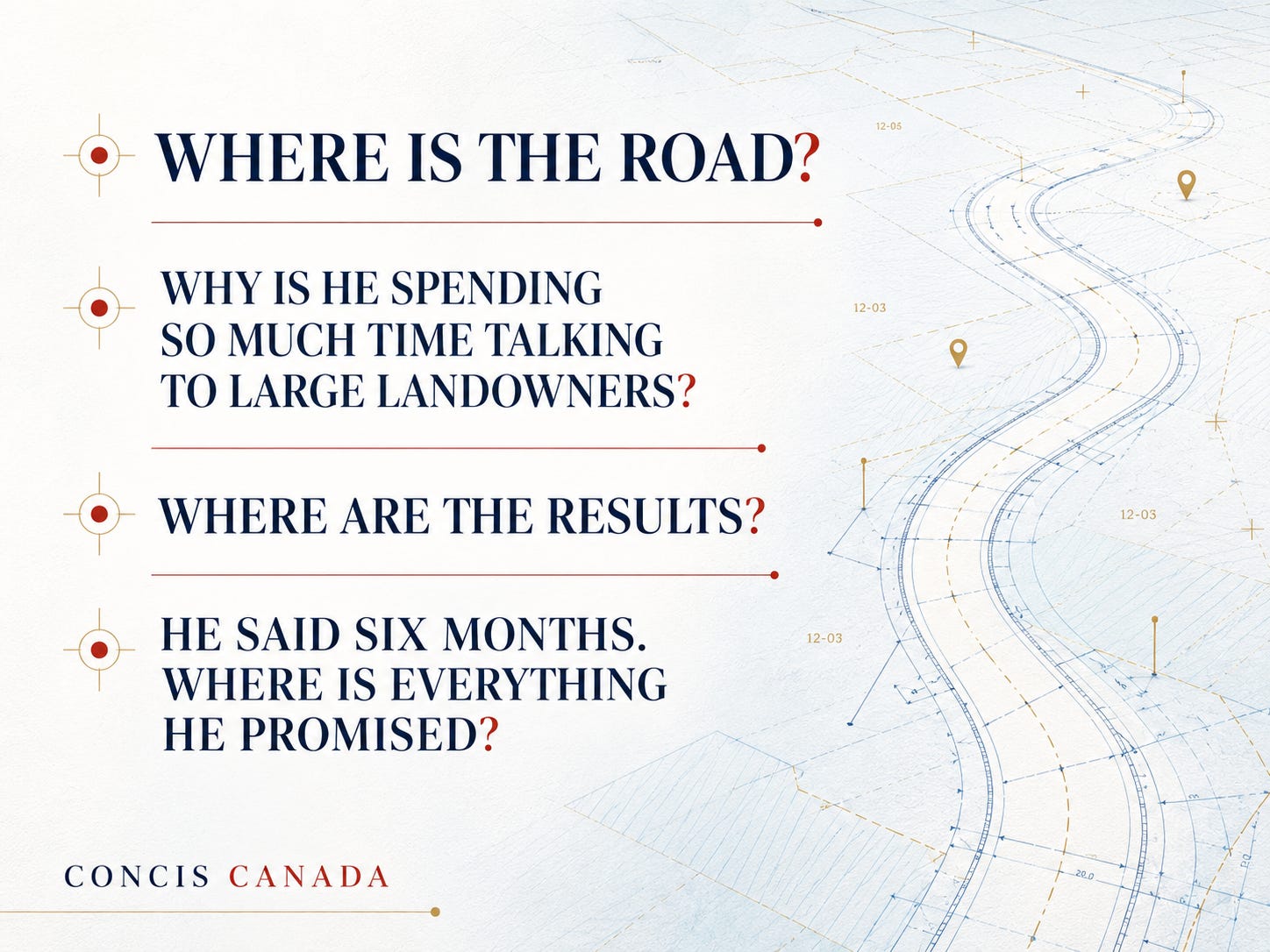
But if Canada does not spend the next six months building these relationships and clearing these barriers, who will Canadian business owners continue talking to?
The same people they were talking to before. And it was Canada’s exposure to that familiar group—the “people we have always dealt with” group—that helped push the country into this position in the first place.
If Canada wants to undo that dependency, it cannot jump from step one to step four. It must first plant its foot firmly on step one, then move to step two.
So expect a lot of flight hours to India and ASEAN—and most likely Japan as well. I am not yet sure why South America was not included in the aggressive-expansion side of the plan. Perhaps Carney wants to concentrate his government’s resources on one region. Or perhaps there are structural reasons that make Asia the more immediate opportunity. We will start digging in that direction and find out why.
The second part of the plan is deeper integration with the European Union. This is almost exactly the textbook recommendation we made for Spain.
Not that Spain listened to us. It remains far too busy freeloading on Europe’s largesse. Once a country becomes conditioned to operate that way, changing its behaviour becomes extraordinarily difficult.
When Spain refused to make its bases available to support Trump’s war, the United States immediately pivoted towards bullying Spain. As early as March 19, 2026, we warned very clearly that the MAGA administration would not sit still—that it would target Spain in as many ways as it could.
Europe stood by its member.
What did The Concis recommend to Spain?
We asked Spain to stop freeloading and help Europe fight the war on the eastern front. More importantly, we asked it to deepen its relationships with Canada, France and Denmark. Tie yourself more tightly to those three countries, we argued. Those relationships will prove useful when the pressure arrives.
That same logic explains why, despite Canada already moving so much closer to Europe, Prime Minister Carney has placed deeper integration with the European Union at the centre of his next six months.
This is aggressive positioning.
But the two components he identified—rapid expansion across Asia and deeper integration with Europe—make one thing clear:
Carney had a backup plan when he walked into Washington.
And he is ready to go hard at it.
Concis Canada has fewer than 2,000 subscribers.
That is not scale.
That is where the algorithm decides to dig, bury and landfill the story.
In the current media environment, getting reality in front of people is extraordinarily difficult. Every free subscription expands our reach. Every paid subscription strengthens this desk and gives stories like this the visibility they need.
No posts
Comments
Nothing yet. Say the first thing.
Sign in to join the conversation.