
The performance of commodities so far this year, is intriguing. Cocoa and robusta coffee soared because of shortages. In contrast, precious and base metals surged when hedge and commodity funds piled in.
But despite the impressive increases, all the winners have fallen below their 2024 peaks.
The CRB and GSCI commodity indices are up by 17 and 12 percent respectively. The S&P 500 has risen by 12 per cent and Dow Jones by 2 per cent.
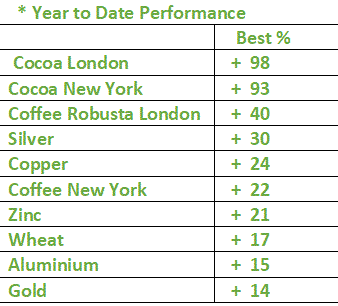
* 2 January to 29 May 2024
The worst performers signal that the bulls are in a risky place.
Key losers are cyclical commodities that are dependent on a strong global economy.
They are indicators of an industrial slowdown. Iron ore’s decline illustrates slack demand in China. Lumber, slower US construction and cotton a jittery textile industry. Hedge and commodity funds have dumped sugar.
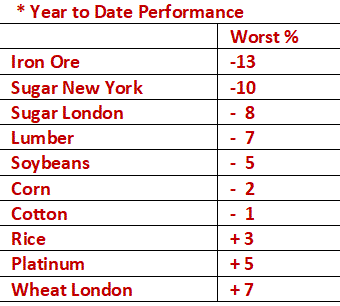
* 2 January to 29 May 2024
On the face of it, copper, zinc and aluminium scuttle pessimistic views. They are also dependent on global industrial demand. But speculation has obscured that relationship. So much so that base metals beat gold.
How Excessive Speculation distorts markets--- A primer for Commodity Outsiders.
Talk to any metals dealer. They will tell you that hedge and commodity funds have been dominant. Chinese speculation in gold, silver and copper has soared.
The following primer is for commodity newcomers. Professionals can skip these paragraphs if you wish. You can continue reading from the headline: “How a group of speculators boosted gold, silver and copper.”
A Brief Primer
The Commodity Futures Trading Commission regulates the market. The CFTC’s data illustrates the extent of speculation in US futures and options. These markets are trading derivatives of actual, physical commodities.
Speculation helps keep markets liquid. The proviso is that it doesn’t dominate trading.
Speculators take on considerable risks. The margin or deposit for dealing in futures or options is a fraction of a commodity’s value. This leverage boosts gains for speculators. But if they are wrong, a price move of only 5 to 10 per cent can wipe them out. To keep going the speculator must either sell at a loss or deposit more money with the broker.
Hedging is a form of insurance
The derivatives are futures because the purchase or sale contracts expire at a future date. The derivatives market helps producers and manufacturers “hedge” their products. Hedging is an insurance. It ensures that mines, farms and other producers can be profitable. Hedging helps manufacturers manage the cost of raw materials.
Producers will sell futures to ensure a certain price for their gold, oil, wheat or coffee. Speculators will buy futures when they expect prices to rise in the future. In market parlance these bulls are “long”.
Manufacturers hedge by buying futures. They lock in the price of their raw materials.
Short Selling
Bearish, pessimistic speculators can sell “short”. The “shorts” sell futures hoping that prices will fall. They aim to buy or close the futures contract at a lower price. If prices fall they make a profit. But if prices surge, they lose.
Take a simple example:
The cash price of gold is $2340 an ounce. A single gold futures contract comprises 100 ounces of gold. The miner decides to sell 50 contracts or 5,000 ounces at the October futures price of $2,385 an ounce. By October the price has fallen to $2,100. The miner delivers the 5,000 ounces and receives a price of $2,100 or $10.5 million for the 5,000 ounces. He closes the hedge by buying 50 contracts at $2,100. The profit on the hedge i.e. $285 or $1.43 million, ensures that he receives his $2,385 an ounce.
Say the price rises to $2485. The miner receives $2485 or $12.43 million for his gold when he delivers the 5,000 ounces. But he has to close the hedge at a loss of $100 an ounce. The guaranteed price is $2385. The miner receives $11.9 million regardless whether the physical price rises or falls. A jeweller who buys the physical gold will also buy futures to guarantee her costs.
Commodity Options
Buyers and sellers also use options to lock in a price. The miner can buy October “puts” i.e. the right to sell gold in October at $2385. The jeweller can buy “calls” i.e. the right to buy gold at $2385. The premium or price of the option is 3 per cent. At current prices this is $73 per ounce or $365,000 for the 5,000 ounces. The miner and jeweller pay the option premium as an insurance to get a desired price.
Issuing i.e. selling calls and puts can be dangerous
Of course, the above primer is very basic. There are various futures and options strategies for producers and industrial buyers. Also banks and metals firms issue i.e. sell options. They receive the options premium to take on this risk. In the example above it is 3 per cent. But the option sellers encounter unlimited risks. If they issue calls and the price rises, they can lose a lot of money. This brings us to:
“How a group of speculators boosted gold, silver and copper.”
The London Bullion Market Association surveyed 25 precious metals analysts and traders early January.
Chantelle Schieven of Capitalight Research was the only one who predicted $2,400 an ounce. Only five forecast $2,300. All expected gold to peak in the second half of the year. Gold soared over $2,400 in April and reached an all-time record of $2450 on May 20. These strategists live and breathe precious metals. So why were they wrong?
Exceptional Speculation! According to the CFTC Hedge and commodity funds were “short” of gold mid-February. The price then was under $2,000. The price began to rise and the funds began to build up long positions.
How mystery big time speculators used call options to push up prices
Read my Gold Post to see why gold confounded the experts and soared above $2,400. Some mystery speculators bought a lot of call options. These call purchases were on the untransparent over the counter market. The call options gave the speculators the right to buy gold at a specific time. The bullion houses issued i.e. sold these options to the fund speculators. The houses had sold these options to get a juicy option premium i.e. income.
But according to dealers the banks were uncertain. Would they be able to receive the gold from the mines in time? Could they deliver the gold? In the meantime, the speculators were buying more and more call options. Since the bullion houses had issued i.e. sold the call options, they were “short”. If the price rose, they could lose a lot of money. They decided to hedge and bought futures. This buying pushed up prices further. But the group continued to buy call options and the banks continued to hedge. As prices rose more investors and speculators joined the bandwagon.
This process, of course, could not last. There is no shortage of gold
Indian jewellers and other consumers of physical gold bought less. Long term holders of gold bullion began selling. Prices tumbled below $2,300.
More recently Chinese speculators joined the funds. They played a big part in boosting prices to a record $2450 an ounce towards the end of May. But that price was brief and could not last. Sellers took advantage of high prices.
The CFTC says that hedge and commodity funds now hold futures and options equal to 19.8 million ounces. Other US speculators 7.4 million. The total of 24.7 million is 15.5 per cent of global physical demand. Including China and elsewhere, huge amount of speculative holdings are overhanging the market.
Silver speculative holdings amount to 271.6 million ounces. This is more than 20 percent of global silver demand.
The copper speculative strategy has been similar.
But there have been delivery problems and that helped the big speculators. The copper speculative net futures and options holdings fell 131,000 tonnes to 723,000 at the end of May. Prices are down from their peak.
The funds have also begun to take profits on their gold.
Draw your own conclusions.
© copyright Neil Behrmann All Rights Reserved. Publications can use parts of the article but must attribute the author and Commodities Predict. Others who want the entire article must seek permission.
No posts
Comments
Nothing yet. Say the first thing.
Sign in to join the conversation.