
The South African rand appears to be bottoming out at last.
Investors hope that the new coalition government will counter corruption and institute reforms.
The African National Congress (ANC) has formed a Government of national unity. The key partner in the GNU is the pro-business Democratic Alliance (DA). This could be the most significant political change since Nelson Mandela became President.
The ANC had lost its majority in parliament in the recent elections. A disenchanted populace voted against persistent poverty, unemployment, inflation. Crime, corruption and income and health inequalities are other complaints.
The nation needs political, economic and social reforms. Mismanagement and Corruption are rife. They are evident in government, local authorities and para-state energy and water companies. Cyril Ramaphosa now has a second term as President. Before the election, the DA was especially critical of Ramaphosa. But since there is now a deal between the ANC, the DA has sidelined that criticism. Some observers now say that the DA leaders are hypocrites.
The hope now is that the DA will have key cabinet posts. South African optimists hope that the party will help improve governance.
In response to the momentous political developments the rand and stock market soared. But within days the currency dipped from its seventeen-month highs. Investors are uncertain about key cabinet posts. They appreciate that it will take time to right the country. Opposition parties are also against the ANC alliance with the DA. They argue that the white community tends to vote for it and will seek more control.
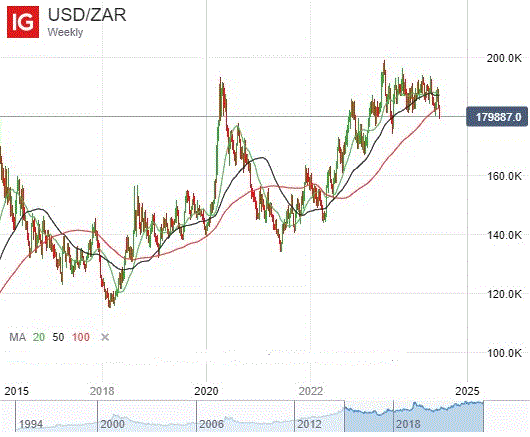
The chart illustrates that the US dollar may be topping out against the rand. In recent years the rand has proved to be one of the weaker emerging market currencies. On the face of it the currency is cheap. South Africa has considerable commodity resources. They include gold, diamonds platinum, uranium, iron ore and coal. The agriculture sector produces corn, wheat, sugar, avocados and fruit for export. The business and financial sectors are well established. Famous companies include Anglo American and De Beers.
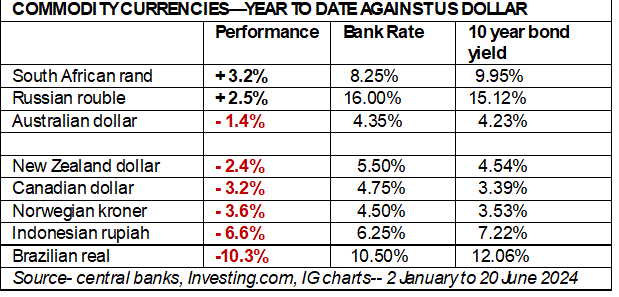
The table shows that South African ten year bond yields are almost 10 per cent. The real yields are high as they are almost double the inflation rate. In the past few months it has fallen to 5.1 per cent. This is close to the South African Reserve Bank’s target. Government debt to GDP is 72 per cent, well below levels of Japan eurozone nations, the UK and US. The downside is that unemployment is 32 per cent. The black population jobless level is over 40 percent; the white people, less than 10 per cent.
But reforms will take some time and the ANC and DA could fall out. Since the rand has proved to be a very weak currency, bonds are speculative. High yields are prevalent for good reason.
The most traded commodity currencies are the Canadian and Australian dollars.
They each account for around 6 to 7 per cent of global currency trade. They have weakened by a small percentage this year. But they have been steady and have traded sideways against the strong US dollar.
They will improve if China’s economy improves.
The Russian rouble is the second surprise. It has also appreciated against the dollar this year.
High interest rates underpin the currency. Export deals with China, India, Middle Eastern and emerging nations, also.
·
27 MAR
© copyright Neil Behrmann—All rights reserved. Other publications can use parts of this piece if they quote the author and commoditiespredict.substack.com . They must email neilbeh@gmail.com if they wish to use the entire piece.
No posts
Comments
Nothing yet. Say the first thing.
Sign in to join the conversation.