
Rashied Ali was not a sideman who preserved John Coltrane’s legacy — he was the drummer who made Coltrane’s final and most radical music possible, accompanying him past meter, past structure, and past the boundaries of what jazz audiences were willing to follow. This essay examines their relationship not as a footnote to the classic quartet years, but as a distinct and largely unexamined chapter in which Ali served as both musical architect and solitary witness to a transformation most of the jazz world still refuses to enter.
Rashied Ali was the drummer of the final ascent.
He arrived in John Coltrane’s life after the canon had already been written. After A Love Supreme. After the critical consensus. After audiences started leaving clubs confused or angry. He entered at the moment when Coltrane no longer seemed interested in compromise, accessibility, or continuity with jazz as most listeners understood it.
That context matters, but it is not the story. The story is what happened inside the music.
The relationship started around 1965. Coltrane first brought Ali into the group as a second drummer alongside Elvin Jones during the Meditations sessions. The decision destabilized the band immediately. McCoy Tyner later said he could no longer hear harmonically inside the music. Elvin Jones felt the music had moved beyond the rhythmic conception he and Coltrane had built together. Jones famously said of the late music, “only poets can understand it.”
Ali represented something radically different from Jones.
Elvin Jones played tidal rhythm. Polyrhythmic, volcanic, grounded in swing even at maximum intensity. When Jones played, you felt the earth move beneath a fixed center. Ali removed the center entirely. His approach became known as “multi-directional rhythm.” Instead of anchoring time, he dispersed it. Cymbals, snare, toms — accents, textures, fragments arriving from unexpected angles. A listener entering that music for the first time often could not locate the pulse. That was the point. Time stopped behaving vertically. The music floated.
Coltrane wanted exactly this.
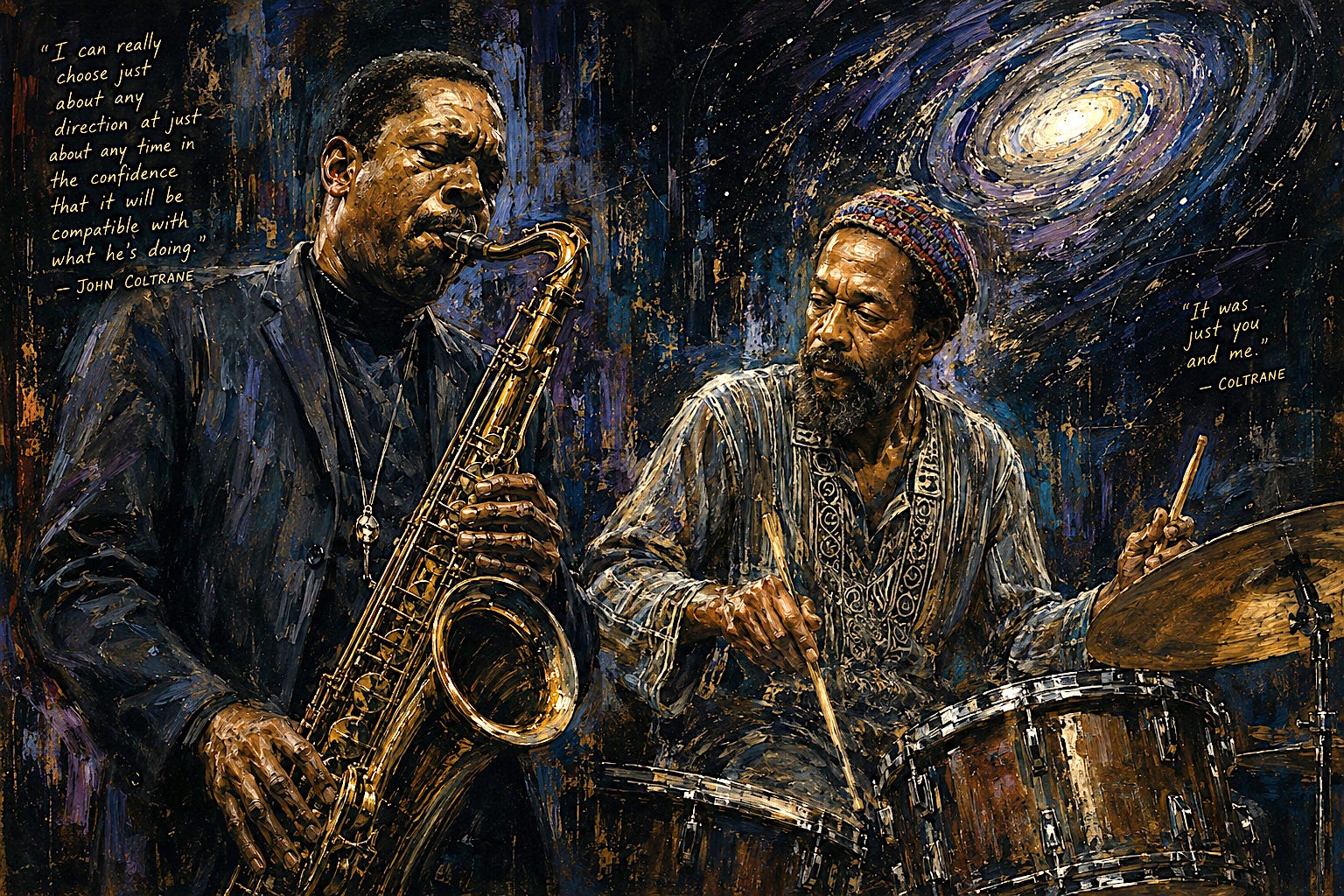
He said of Ali: “I can really choose just about any direction at just about any time in the confidence that it will be compatible with what he’s doing.”
That sentence deserves to sit for a moment.
It is not a statement about rhythm. It is a statement about freedom. Coltrane was describing a musical relationship without gravitational constraint. With Jones, even at maximum intensity, there was a center of gravity — the polyrhythmic swing that grounded the classic quartet’s controlled explosions. With Ali, Coltrane was describing something else entirely: the ability to move in any direction without losing coherence. Not because Ali imposed a new structure, but because Ali’s multi-directional approach could absorb and reflect whatever Coltrane generated.
Ali gave Coltrane freedom from meter itself.
The earlier quartet still relied on tension between freedom and structure. With Ali, Coltrane moved toward pure energy flow. Not chord changes. Not song forms. Not even conventional rhythmic cycles. The music became process instead of composition.
The duo recording Interstellar Space is the clearest evidence. Recorded on February 22, 1967, only months before Coltrane’s death, it was saxophone and drums alone. No piano. No bass. No harmonic center. Almost no safety net.
Ali did not even know beforehand that the session would be a duo. According to Ben Ratliff’s account, Ali asked, “Ain’t nobody coming?” Coltrane replied, “No, it’s just you and me.”
That exchange feels small. Historically it is enormous.
Coltrane had reduced the ensemble to pure interaction between breath and percussion. Matter and motion. The old jazz hierarchy disappeared. No comping. No walking bass. No harmonic frame. Only two musicians moving through open space together.
Ali later said the session revealed “the direction he was headed in.”
Ali had already seen that direction from close range. The 1966 Japan tour produced some of the most ferocious performances of Coltrane’s career. Live in Japan captures music so extended and spiritually intense that many listeners still find it overwhelming. Ali was the rhythmic engine of every one of those performances. He described Coltrane during this period as intensely disciplined, constantly practicing, endlessly refining technical exercises even after becoming the most influential saxophonist alive. The image is remarkable: a dying man at the far edge of his language, still running exercises before the concert.
Coltrane trusted Ali because Ali did not resist the direction.
Many others did. Critics mocked the late music. Audiences walked out. Even sympathetic musicians sometimes viewed the final groups as excessive or undisciplined. Ali stayed. He was younger, he came directly from the avant-garde world Coltrane was moving toward, and he did not need Coltrane to remain “John Coltrane.” He accepted transformation as the point.
Ali also witnessed Coltrane physically deteriorating. That part remains frustratingly undocumented — Coltrane kept his suffering private — but Ali was present through the final concerts, including the Olatunji performance in April 1967, now released as The Last Live Recording. That recording is almost unbearable at moments. Coltrane sounds exhausted, straining, pushing through something that goes beyond ordinary fatigue. Yet the intensity never breaks. Ali is right beside him through the entire performance.
What Ali said about those final concerts, if he spoke about them in detail, has not been widely preserved. That silence is itself a kind of wound in the historical record. The man closest to Coltrane at the end, the one whose drums accompanied the last music, left relatively few intimate accounts of what those nights felt like. What survives is the music itself, and Ali’s consistent insistence afterward that Coltrane knew exactly where he was going.
He was not accompanying decline. He was accompanying transformation.
That distinction shaped everything that followed.
After Coltrane died in July 1967, Ali spent decades in a cultural environment that largely refused the music he had helped make. The jazz establishment — critics, institutions, mainstream listeners — had already decided which Coltrane mattered. Blue Train. Giant Steps. My Favorite Things. A Love Supreme. The late recordings were treated as an embarrassing epilogue, the work of a genius who had lost his way. Ali lived inside that dismissal for years.
He pushed back through action. He opened Ali’s Alley in New York, one of the few venues consistently committed to avant-garde jazz. He founded Survival Records with saxophonist Frank Lowe, to document music the major labels would not touch. He continued making duo recordings that traced directly back to the vocabulary of Interstellar Space. He spoke in interviews about the late Coltrane music with the authority of someone who had been inside it, not observing from a distance.
He also remained spiritually marked by Coltrane in ways that went beyond professional loyalty. In interviews, Ali spoke about dreaming of him after his death — not as memory, but as presence. Listening to Ali in those conversations, you sense that Coltrane never fully receded. He remained psychologically present, not as a legend to be maintained, but as something closer to a living force.
The saddest dimension of their relationship may be this: Ali understood where Coltrane was going, and spent the rest of his life trying to bring others to that threshold, and most of them declined to cross.
He was the witness. He carried the testimony. The music he protected still frightens many listeners.
That was the role. He held it until his own death in 2009.
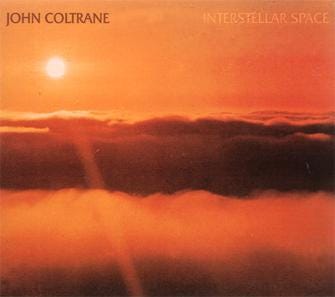
Mr. Ali said this after the recording was released: "You can just about tell what that music was headed for — he had a handle on it. It really told you the direction he was headed in. That record was one of the last things that he did. It's really something that has to be listened to and something that has to be felt. Musicians are just starting to look into the playing of this kind of a thing now."
Thanks for reading Coltrane Code! This post is public so feel free to share it.
No posts
Comments
Nothing yet. Say the first thing.
Sign in to join the conversation.