
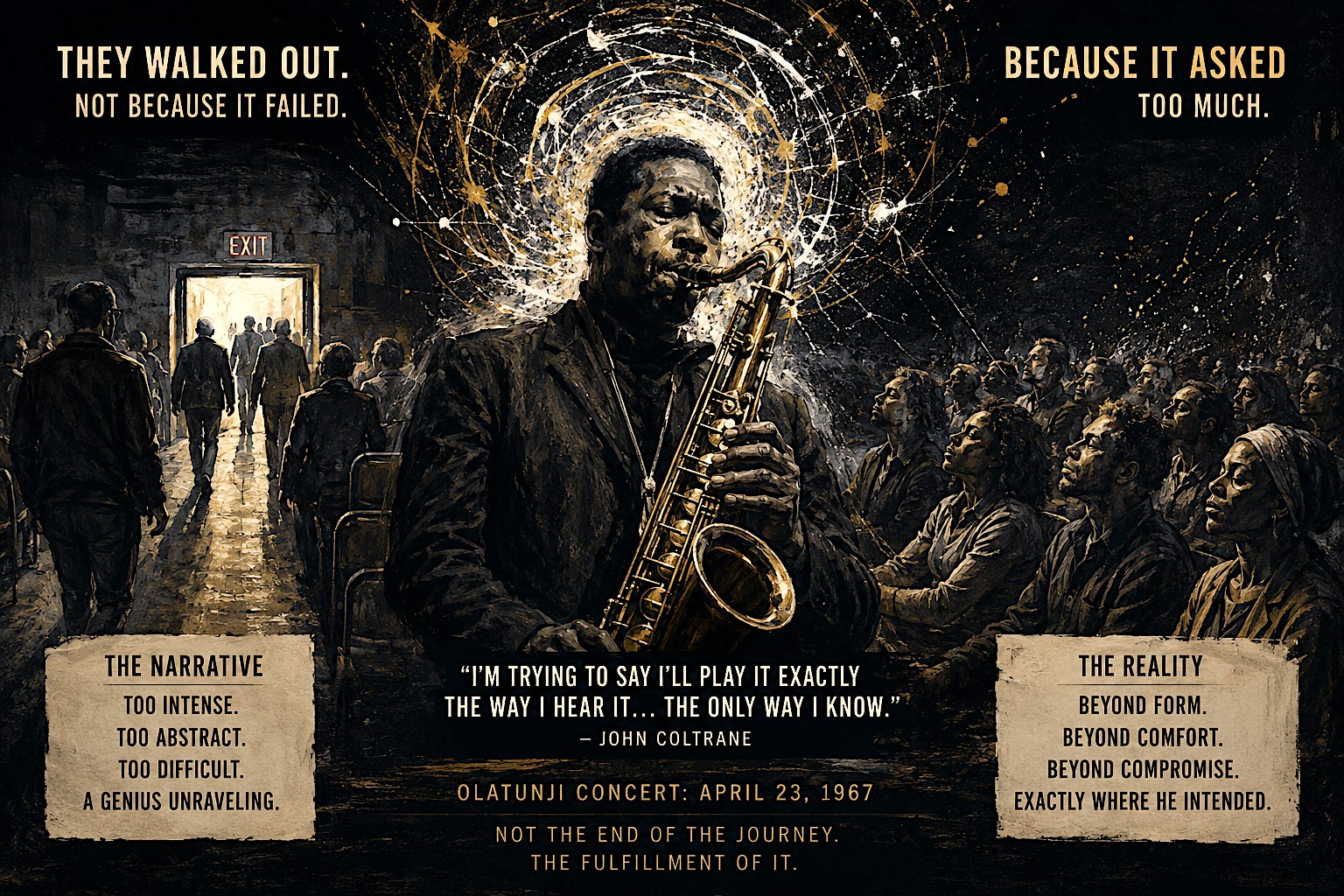
Coltrane’s final year is typically framed as artistic collapse, but the evidence — from the Olatunji Concert to his own stated intentions — suggests the opposite: a musician who reached precisely where he was headed, abandoning the aesthetic compromises Western music culture depends on. The audiences who walked out weren’t witnessing a genius self-destructing; they were encountering music that demanded total surrender, and most of them weren’t ready to give it.
For most critics, the final year of John Coltrane represents collapse.
The records become too dense. The solos too long. The structures dissolve. The audiences thin out. The clubs empty. Even sympathetic writers describe the period with the language of deterioration, exhaustion, spiritual overload, self-destruction.
A genius burning himself alive in public.
But what if the opposite is true?
What if Coltrane’s final year was not the failure of his search, but the completion of it?
That possibility terrifies people because it forces a harder question. What if the music did not break down? What if the listeners did?
On April 23, 1967, Coltrane played the Olatunji Center of African Culture in Harlem. It was one of his last public performances. The recording that survives runs nearly an hour on a single piece. There is no conventional melody statement. No return to a head. The rhythm destabilizes early and does not recover in the way Western ears expect. Pharoah Sanders moves in and out of register, sometimes playing what sounds like pure air pressure rather than notes. Coltrane’s own lines extend far past any harmonic logic the earlier quartet had established.
By every standard measure of jazz performance, nothing resolves.
But listen past the first fifteen minutes — past the point where the nervous system stops waiting for the music to behave — and something else begins to emerge. The band is listening. There is call and response happening at a level below melodic phrase, at the level of breath and density and collective weight. The architecture is still there. It has simply stopped explaining itself.
This is the music critics called chaos. What they were actually hearing was a different principle of organization.
By 1967, Coltrane had already conquered everything the jazz establishment understood how to reward. Technical mastery. Harmonic innovation. Prestige. Critical canonization. He had transformed the tenor saxophone so completely that entire generations spent decades trying to escape his shadow.
And still he kept moving.
That is the part many histories flatten into pathology. The assumption is that no artist would willingly abandon public approval unless something had gone wrong psychologically or physically. Once audiences started walking out, the narrative was already written. Trane had gone too far.
But “too far” according to whom?
The same audiences who once thought bebop was noise. The same critics who dismissed free jazz as anti-music. The same cultural machinery that initially treated Ornette Coleman as a fraud and later placed him in museums.
When DownBeat’s reviewer heard Coltrane’s quartet in 1961 — then still playing inside recognizable structure — he wrote that the performance was “a horrifying demonstration of what appears to be a growing anti-jazz trend.” That was “My Favorite Things.” The complaint was not about chaos. It was about length. About refusal to contain. The same complaint, issued with different vocabulary, followed Coltrane for the rest of his life.
The history of jazz criticism is filled with people confidently announcing the death of forms they simply lacked the ears to hear yet.
Coltrane understood something uncomfortable. Once an artist reaches the edge of a language, refinement becomes repetition. The only honest direction left is rupture.
He said it himself, more than once. “I want to be a force for real good,” he told Frank Kofsky in 1966. “I know that there are bad forces, forces that bring suffering to others and misery to the world, but I want to be the opposite of that. I want to be a force which is truly for good.” This was not the statement of a man losing his bearings. It was a man who had decided, precisely and deliberately, what music was for.
What it was not for was entertainment. Not for cocktail-hour appreciation. Not for the elegant transaction between performer and passive audience that the jazz club economy depended on.
He had written in the liner notes to A Love Supreme that he wanted to “pursue the goal of transcendence.” People treated that as poetry. He meant it as a technical instruction.
Listen carefully to the late recordings. Not casually. Not while answering emails or driving through traffic. Sit with them long enough for your nervous system to stop demanding resolution every fifteen seconds.
The music is not chaotic. It is post-structural.
There is still listening inside the band. Still momentum. Still architecture. The architecture has simply stopped reassuring you.
This is not unprecedented. When Beethoven’s late string quartets were first performed, audiences found them incomprehensible — the Grosse Fuge in particular was described by critics as “incomprehensible, like Chinese” and dismissed as the work of a man too deaf to know what he was writing. We now understand those quartets as among the most fully realized music in the Western tradition. The scandal was not in the composition. The scandal was in the gap between what Beethoven had reached and what the available listening culture could yet absorb.
Coltrane was doing something similar, at a different extreme. Western listeners are trained to hear musical order through symmetry, return, and containment. Coltrane’s late work often rejects all three. The result feels frightening because the music stops behaving like a controlled object and starts behaving like weather, ritual, or collective prayer.
People describe the performances as “angry” because they do not know what transcendence sounds like once it abandons politeness.
This is why the final groups matter so much. Particularly the configurations with Pharoah Sanders, Rashied Ali, and Alice Coltrane. They were no longer interpreting compositions in the traditional sense. They were creating sustained states of spiritual intensity through sound.
Archie Shepp, who was present for some of this work and close enough to Coltrane to understand what was being attempted, said later that what Coltrane was pursuing in the final period was nothing less than a new relationship between music and consciousness. Not a new style. Not a new technique. A new function for sound itself. Shepp understood it because he was working in the same territory, though from a more explicitly political direction. He did not hear a man falling apart. He heard a man arriving somewhere.
That distinction matters.
Many listeners wanted the elegance of A Love Supreme forever. They wanted revelation packaged in recognizable form. But Coltrane kept stripping the forms away. He moved past melody as decoration and toward sound as direct transmission.
For some audiences, this felt liberating.
For others, intolerable.
The walkouts became part of the mythology. Stories of confused crowds leaving clubs early get repeated as evidence that Coltrane had lost touch with reality. But there is another interpretation.
The audiences were encountering music that demanded something they had never been asked to give.
Total surrender.
No ironic distance. No cocktail-hour appreciation. No passive consumption disguised as cultural sophistication.
The late music cornered listeners psychologically. Either you entered it fully or you rejected it defensively. There was little middle ground.
That is often the sign of art operating ahead of consensus.
People prefer the tragedy narrative because tragedy restores order. The genius flew too close to the sun. The body failed. The obsession consumed him. The artist self-destructed.
Clean. Familiar. Reassuring.
The alternative is harder to process.
Maybe Coltrane reached exactly where he intended to go.
Maybe the final recordings document a musician abandoning nearly every commercial and aesthetic compromise Western music culture depends on.
Maybe the discomfort listeners feel is not evidence of artistic collapse, but evidence that the music still threatens the structures through which most people organize perception itself.
And maybe the audiences walking out were not witnessing failure.
Maybe they were witnessing arrival.
John Coltrane at the Olatujnji Center
1. Introduction By Billy Taylor
2. Ogunde
3. My Favorite Things
John Coltrane (ts, ss), Pharoah Sanders (ts), Alice Coltrane (p), Jimmy Garrison (b), Rashied Ali (ds), Algie DeWitt (bata drum) and Jumma Santos (per)
April 4, 1967
0:00
-1:03:44
Thanks for reading Coltrane Code! This post is public so feel free to share it.
No posts
Comments
Nothing yet. Say the first thing.
Sign in to join the conversation.