
Game this out with me: What would happen if you cut off 30% of the world’s oil supply? If you could physically destroy and cutoff that amount of global oil supply, it would cause extreme price spikes, severe transportation paralysis, and widespread economic collapse.
Due to heavy reliance on these fuels for diesel (not to mention natural gas for fertilizer), we could expect massive food shortages, and millions of deaths as a result. It would be catastrophic.
Why then is the United States engaging in policies that edge us towards that result? The United States is funding a proxy war with Russia and engaged in a war with Iran. Between banning Russian exports, attacks on their infrastructure, and the closure of the Straight of Hormuz, we are seeing a disruption of 30% of global crude oil supplies.
It’s bad, but a few things are mitigating the situation. Global strategic oil reserves set up for this very scenario are making up for some of the loss, although those reserves are finite and can’t permanently replace these other channels of oil supply.
There’s also been some redirections. Russian exports to Europe have shifted to China. Saudi Arabia has diverted oil through pipelines to the Red Sea. The United States and others have ramped up oil production to meet some of these demands.
After all of this scrambling, the net loss has not be a total loss of 30% of global oil supply. However, this all might be tantamount to rearranging the deck chairs on the Titanic.
The Saudi supplies going to the Red Sea are now under attack by the Houthis in Yemen. Pipelines making up for the workarounds, and other oil infrastructure are now potential targets for Iran.
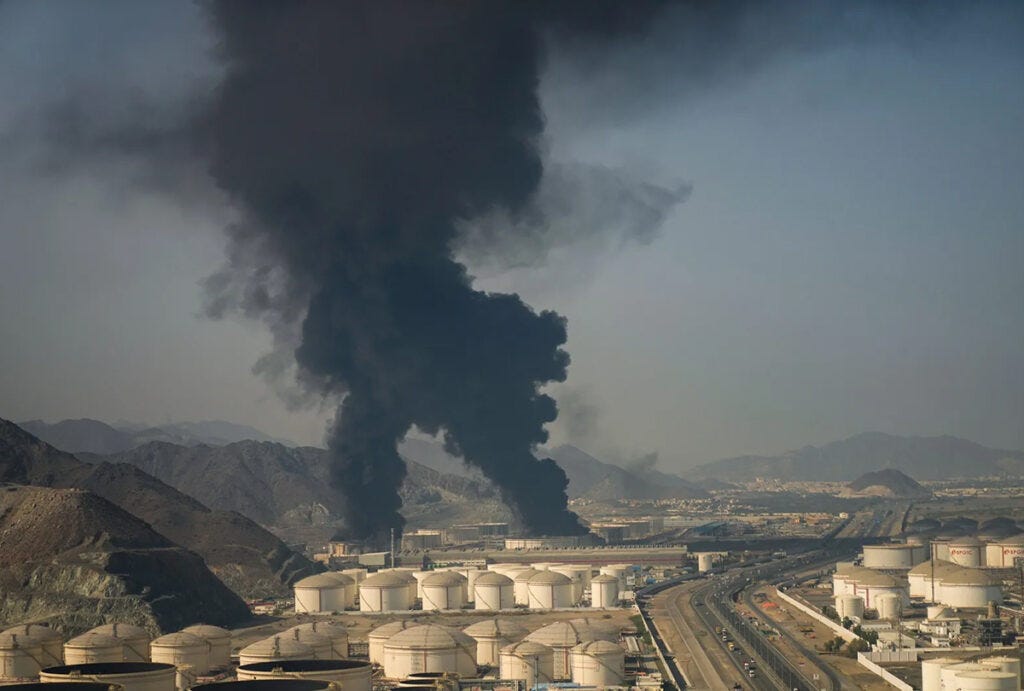
As Trump escalates the war with Iran, threatening to blow up bridges and power plants, Iran has threatened to match by attacking oil infrastructure.
All of this being perfectly foreseeable, why would U.S. officials enact such policies that lead to the disruption of global oil supplies and create economic havoc?
People might come up with numerous scenarios, everything from incompetence, to some sort of human depopulation conspiracy theory.
To name a few of the more sinister plots:
Hyper-inflation and collapsing supply chains wipe out small and medium businesses, allowing state-backed monopolies to buy up core infrastructure for pennies.
Widespread energy blackouts, food shortages, and skyrocketing fuel prices inevitably lead to mass civil unrest, justifying nationwide military deployment, curfews, and emergency powers.
We’ll get to my primary theory and who benefits, but suffice it to say because all of this was foreseeable, either the risks were seen as acceptable (harder to imagine for me), or they were the very design of the operations.
The reason why its hard for me to imagine blockage of oil supply lanes was an acceptable risk was because the payoff doesn’t make much sense. Look at the timeline.
We are supposedly fighting Iran because of their nuclear capabilities? Last year Trump’s Director of National Intelligence Tulsi Gabbard stated that U.S. intelligence assessed Iran was not actively building a nuclear weapon or rebuilding its enrichment program.
Iran’s Ayatolla even issued a fatwa making the possession of nuclear weapons was strictly forbidden.
Trump bombed Iran’s facilities in the summer of 2025 and declared their program had been knocked back decades.
What happened next?
Trump then invades Venezuela and takes over their oil industry. I must say… good timing for an oil shortage.
Then they invade Iran 6 months after they destroyed the nuclear program?
Sorry, I’m not buying what you’re selling me. So now, as promised, here is my alternative hypothesis.
If it’s intentional, what’s the end game?
Take the basic premise of the current administration’s campaign slogan: Make America Great Again. At its core, it represents the belief that America’s power in the world had been waning, dangerously so, and the need for Washington to act in whatever ways would regain that power.
They aren’t entirely wrong about U.S. power waning. Several of the core elements of U.S. global dominance have been in decline. But the idea was based on a more cooperative global landscape where trust and reciprocity would replace hegemony and conflict.
I believe for MAGA, this sort of belief in global cooperation would be characterized as a Kumbaya fantasy. It reflects perhaps the inherent distrust of globalism and foreign actors that define the nationalist movement.
The United States wields enormous global power less because of the might of its military, and more because of the global hegemony of the U.S. dollar.
The dollar is the global reserve currency. This means foreign governments and central banks hold the U.S. dollar in massive quantities to back their own currencies, pay international debts, and facilitate all types of global trade (electronics, agriculture, manufacturing).
Reserve status gives the U.S. the “exorbitant privilege” of printing the asset the rest of the world needs to save. The related petrodollar system creates a perpetual demand for those dollars, forcing nations that import oil to maintain dollar balances. Oil profits wind up back into U.S. banks and government debt.
If this global dollar base system collapses, so does the U.S. economy. No question it means a drastically waning influence of the U.S. over the rest of the planet.
Central banks have slowly reduced dollar holdings from roughly 71% in 2000 to around 58% today, moving moderately into other currencies and record amounts of gold.
Oxford expert Dennis J. Snower believes the current administration’s policies are accelerating that collapse.
“The dollar’s dominance - long seen as unassailable - is now under real strain as global investors, central banks, and even US allies start hedging against a post-dollar world.”
For decades, America’s “exorbitant privilege” has allowed it to borrow cheaply, finance deficits without fear, and print money without stoking inflation. Foreign governments willingly held US Treasuries, trusting that they were the world’s safest asset. That trust underpinned the entire global financial order.
But a reserve currency must rest on six pillars: macroeconomic stability, liquid financial markets, central bank independence, capital mobility, rule of law, and geopolitical trust.
The current US administration has weakened every one of them.
Debt and deficits are exploding. Tax cuts without spending restraint have pushed public debt to record levels.
Financial market trust has been shaken by repeated threats of default during debt-ceiling standoffs.
Federal Reserve independence has been eroded by open political pressure and loyalty tests for central bankers.
Dollar access has become a political weapon—used to sanction rivals and even punish allies.
Rule of law is no longer seen as impartial when executive orders freeze foreign assets or impose tariffs at whim.
Geopolitical trust has collapsed under “America First” disengagement from international institutions.
Add to this an unpredictable foreign policy and erratic fiscal management, and the world begins to ask a dangerous question: if the dollar can no longer be trusted, what comes next?
A realignment away from the dollar is unlikely to happen smoothly. It would erupt like a financial tsunami. Investors would dump US Treasuries, yields would soar, and the dollar would plunge. Central banks would scramble into euros, yuan, or gold.
As alternative systems like digital currencies and oil trading agreements like BRICS emerge, so do the threats to U.S. currency dominance and thus its global hegemony.
This is where my hypothetical Operation Last Stand comes in. The U.S. economy is said to be insulated from global oil supply crunches in a way that its geopolitical rivals are not.
China imports roughly 75% of its crude oil, much of it passing through the Strait of Hormuz. Europe is highly vulnerable to energy price spikes after losing cheap Russian gas.
By causing these oil supply lane collapses in Russia and the Strait of Hormuz, Washington forces an existential economic contraction on Beijing and Brussels. While the U.S. suffers high inflation and painful prices at the pump, its domestic energy abundance allows its industrial base to survive (or so the theory says). It is a strategy of deliberate global impoverishment where the U.S. intends to be the last economy standing.
If the global oil market is systematically fractured and starved, the sheer desperation for remaining energy forces an unprecedented liquidity squeeze. Nations are forced to liquidate other assets and scramble for U.S. dollars to pay the exploding costs of remaining oil contracts. By triggering a catastrophic supply shock, the U.S. artificially extends the lifespan of dollar hegemony by burning down the alternative trading systems before they can mature.
With Russian refining paralyzed and Middle Eastern routes choked, Europe and East Asia have no choice but to rely on American energy exports. This creates a dependence that the U.S. can exploit.
This is not all that different than tactics already used by Trump with the tariffs. Similarly, but with far more urgency, this strategy forces other nations to accept U.S. terms on trade, defense spending, and geopolitical alignment.
Washington is playing a game that collapsing empires often play. As Jared Diamond puts it, they tend to double down on things that once made them powerful, but no longer are as effective. Elites focus on short-term gains for themselves rather than on the longterm well-being of everyone.
We aren’t in a post WWII world anymore. The world is fundamentally different. To think we can play a 1950s playbook with our global rivals is a refusal to accept the fundamentals of the present.
Sure, an energy war might support the dollar in the short term, but truly dismantles trust in it over the long term. Sanctions, asset freezes and coercion give other countries an even stronger incentive to build alternative payment systems.
Operation Last Stand might therefore be exactly that… a strategy that temporarily reinforces American power while accelerating its eventual fragmentation.
I write this piece not because I care about U.S. hegemony, or am clinging to the economic world order, oil, supply chains or the rest. The entire system is unsustainable ecologically. But it’s collapse has serious consequences and ties directly into what I’ve been writing about here for a few years now.
It’s about collapse. This is what collapsing empires do. As trust is lost in the dollar, the world is fractured, conflicts will arise and so with authoritarianism. We are watching collapse in real time, but it is a slow reveal. I’m just here to give you a heads up.
We will not be able to rest on our laurels, or depend on a relative peace that has existed, nor the global supply chains and cheap goods for much longer. The world is going to change dramatically.
Stop caring about wealth, affluence and the like. Start caring about the basics. People, clean water, clean air, food, shelter, nature. None of this other stuff matters. But it is coming for you, and you should be ready.
I will leave you with a thought my friend Max Wilbert related to me, who he attributes to Atonio Gramsci:
“Pessimism of the intellect, optimism of the will.”
Yes, see the world as it truly is. Do not use fake hope. Study hard facts, risks, and hard problems with an honest mind.
But refuse to give up. Act with strong purpose and hope. Believe that people can work together to make a better future, even when the odds are very bad.
If you’ve this far, thank you for your support of this publication. I always appreciate the comments, likes and shares. Protect the Earth!
Comments
Nothing yet. Say the first thing.
Sign in to join the conversation.