
I have been thinking about roads lately… or more specifically about the places where there aren’t any.
The absence of a road isn’t the typical environmental victory most people think of. Roads are so ordinary that they are practically invisible to us. Of course we complain when one is bad. When one is improved, we might cheer. When one seems too small to handle traffic anymore, we’ll ask when this one will be made larger or another will be built along an alternative route.
Roads mean access, and access is one of those words, like development and progress, that has acquired such an obviously positive meaning that questioning it can make you sound like a kook. Who could possibly be against access?
Call me crazy, but maybe there should still be places we cannot easily get to.
I don’t mean places humans must never enter. People have been walking through, hunting in, gathering from, living in and loving many of these landscapes for thousands of years. A roadless forest is not necessarily a forest without people. The goal is rather to bar easy entry for the industrial world.
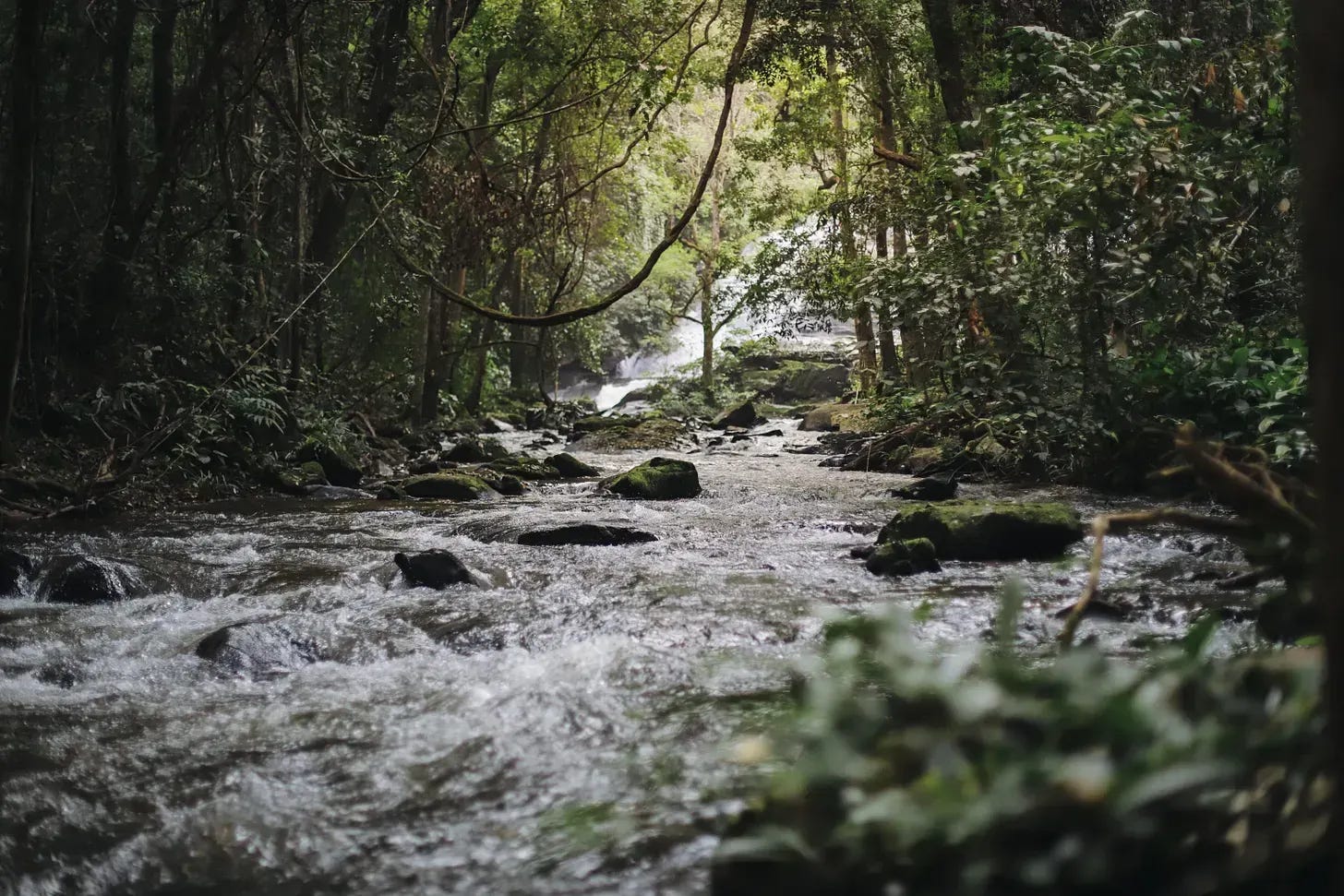
A road changes the terms of our relationship with a forest. Before the road, you can only travel at the speed of human. Distance, terrain, weather, rivers and so on, have real meaning. They can stop you or slow you down. We have become so accustomed to overcoming physical limits that we rarely consider whether those limits might have value of their own.
The natural world has always presented us with boundaries, but our culture prides itself for defeating them. That is unfortunate.
Again, I’m not making an argument that humans should disappear from nature. We couldn’t if we tried. We are animals ourselves, dependent upon soil, water, plants, fungi and countless other beings whose lives make ours possible. The problem is not that humans have relationships with forests. The problem is the particular relationship industrial civilization increasingly insists upon having with everything it encounters.
Rather than having a healthy relationship, industrial civilization commodifies nature. The natural world is measured, mapped, made accessible, extracted from, and managed, all to turn a profit.
That is why roadless places and the Roadless Rule matter to me. They represent something increasingly rare in this culture… a self-imposed limit.
We draw a line and say here is a place where the rest of the living world retains some measure of refuge from us.
But apparently, even that has become too much to ask.
On August 18, the U.S. Forest Service filed a proposal to rescind the 2001 Roadless Area Conservation Rule in its entirety.
You can view the proposal and comment until September 21, 2026 here.
The rule has been around for twenty-five years with the basic purpose of designating roadless areas of our national forests where road construction and reconstruction are generally prohibited, as is most timber harvesting. The original rule covered roughly 58.5 million acres. Because Idaho and Colorado now operate under separate state-specific roadless rules, the current proposal would remove the national rule’s protections from nearly 45 million acres of National Forest System land.
Forty-five million acres is difficult to comprehend. Numbers that large tend to become meaningless. We can understand an acre, maybe a hundred acres well enough. But tens of millions of acres become another abstract number passing through the news. What matters more is that those acres represent places where for the last quarter century, the federal government has maintained a simple presumption that roads and timber extraction should not automatically follow wherever they are technically possible.
The Forest Service now wants to remove that presumption.
Look… the government is not proposing to build a road into every roadless forest. Not yet anyway. But it is proposing to remove a rule whose purpose is to make building those roads difficult in the first place.
Why? They’ll talk about fires (disingenuously), economic development, timber, etc. Their PR is deception or the typical manipulative language of progress. But what they’ll fail to mention, let alone emphasize, is that the forest has interests too. Our laws and economics rarely speak that way.
What do the salmon, elk, bears and owls need? What conditions are best for thriving growth of trees, or for soil that nurtures undergrowth.
None of these beings gives a heck about timber targets or economic development. That is our language, imposed upon a living place. And to me, that’s just wrong.
Maybe what troubles me most about the attempt to rescind the Roadless Rule is this assumption that a place protected from industrial access is somehow a waste.
Over the coming weeks, I plan to visit and photograph some of the roadless areas affected by this proposal near me. I want to see what these places actually look like from the ground, walk as far as I can into them, and photograph what I see.
I don’t know exactly what I’ll find. That’s part of the point.
Maybe I’ll find forests that complicate what I’ve written here. I hope so. There are old logging scars and recovering forests, burned landscapes and old growth, human histories stretching back thousands of years. I’m not an expert at any of those things. But perhaps paying attention is a place to begin.
When our culture looks at land it immediately asks what can be done with it. It first asks about timber yields, mineral extraction, construction projects, productivity and revenue.
I’d like to take some time to ask different questions.
What is able to exist in this area because the roads stop? What are the signs of life, the sounds of streams, the smell under forest canopy when you don’t have machines, engines, roads and fewer people?
Those are the questions I’ll be carrying with me, along with my camera. I’ll bring what I find back here.
There is still time, at least for now, to argue about what happens next. The proposal to rescind the Roadless Rule has not yet become final. People can comment, organize, object, and insist that the absence of a road is not a problem the administration needs to “fix.”
This probably needs to go beyond administrative policy and become a permanent fixture of law. Restraint deserves a far more prominent role in our decisions.
In the coming weeks, I'm going to go looking for some of these places while they're still roadless. I'll take my camera, spend some time there, and bring back what I find.
Comments
Nothing yet. Say the first thing.
Sign in to join the conversation.