
I was scrolling the stories that cold January day in 2025 with a bit of anxiousness. One headline read “Trump signs executive order ending birthright citizenship.” A video of the signing in the Oval Office appeared on my feed. I watched out of curiosity.
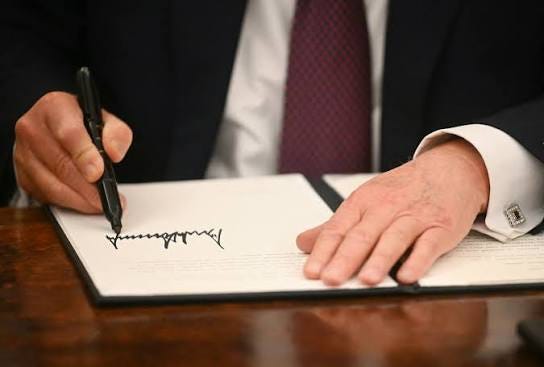
“Birthright, that’s a big one” Trump says as someone hands him a fancy leather binder containing the order he would soon sign.
“Ridiculous…” he says as he finishes his rather lengthy signature and closes the book. “We’re the only country in the world that does this with birthright, as you know.”
Mere hours after swearing in, Trump signed an executive order titled “Protecting the Meaning and Value of American Citizenship”, which sought to deny automatic U.S. citizenship to children born on American soil whose parents were undocumented or in the country on temporary visas.
Won’t it be challenged? He responded to the journalist’s question: “it could be. It could be. But we have good grounds.”
I wondered about that. The conventional wisdom, everything I had been taught in school and by my father who is a retired professor of Constitutional law is that the standard procedure in our legal system had been to honor citizenship for any person born on U.S. soil for well over a century.
Thinking back, I don’t remember anyone making much of a stink about birthright citizenship until the 2010 rise of the Tea Party when I first heard the term “anchor baby.”
Although it turns out Senator Harry Reid once put up a bill in the 1990s to end birthright citizenship for the children of undocumented immigrants.
It seems like this all starts in the 1980s with immigration from south of the border and amnesty deals during the 1980s under President Ronald Regan. The racial demographics in the country start to shift. People grow concerned.
It’s not all that different than earlier periods of immigration from places like Ireland and Italy.
So what gives? How could a sitting president think he could override the Constitution by an executive order? Is this real life?
Here’s the thing… immigration isn’t the existential issue for me that it is for others. And what our government is allowed to do by law is plenty horrifying enough for me in several respects. But what of brazen violation of the laws and the Constitution by our government? This might put us into new and even more dangerous territory.
I thought this worth exploring here. So I investigated.
I spent the next several evenings reading congressional debates from 1866. The language felt strangely modern. Politicians were arguing over citizenship, national identity, and who belonged almost exactly the way we still do today.
I looked at case law going back to the beginning of U.S. nationhood. I consulted with my father. I looked at what other nations do. What I found was intriguing.
The answer to this question truly surprised me. Virtually every country in the Americas has exactly the same unrestricted birthright citizenship the United States does, including granting citizenship to children of people with temporary visas. So if you travel to Mexico and have a baby, its a Mexican citizen and gives you a path to Mexican citizenship. True story. Same in Canada.
All in all it’s 38 nations worldwide.
European nations have birthright citizenship with restrictions… such as a requirement that at least one parent already be a citizen.
It’s not hard to see why many Americans would like similar restrictions to what Europe has. Babies becoming citizens because their parents were visiting on vacation does seem a little odd, if I’m being honest.
I was speaking to someone this morning about their thoughts. “It’s absurd that someone could simply travel here, have a baby, and that child would be a Citizen of the United States” he said. He wondered if they could return to their country, get trained by ideological and military forces, and return years later with full citizenship in the United States with the same rights of Americans who’ve lived and worked here their whole lives. Could a rival of the U.S. play a long game and bring these children back for nefarious purposes?
The Court previously ruled that Congress could not legislate away birthright citizenship, even when that child went on to become a citizen in another country, even serving in their army (see Afroyim v. Rusk, 1967).
Consequently, we have 5 or 10 members of congress that are also citizens of a foreign country. Ted Cruz, Michelle Bachmann among those who once were, and currently Congressman Randy Fine.
Maybe it’s a mess and some of it should be changed. But…
Whether or not unrestricted birthright citizenship is sensible, can a president override a Constitutional Amendment? Does anyone think that? Of course not, right?
Maybe so. I wrote a post here on Substack last year, assessing the history of the Fourteenth Amendment and birthright citizenship. My findings were quite clear. Despite that, I predicted the outcome of the case was far from certain. Given a 6 member conservative majority on the land’s highest Court, I gave it a 65% chance of overturning the executive order on the grounds that it violates the Constitution.
18 months later, they did. The Court’s record indicates that by a 6-3 decision, the Court ruled that the president couldn’t restrict citizenship from children of undocumented immigrants or people here on temporary visas. The majority opinion in Trump v Barbara, written by Chief Justice John Roberts, ruled that unrestricted birthright citizenship has always been the law of the land, apart from the racial exceptions created by Dred Scott. The Fourteenth Amendment was passed to make it permanent and void of any exceptions, including racial ones.
Long ago in the 1600s, the law was established that anyone born on British soil, that wasn’t exempt from its jurisdiction (such as foreign diplomats with immunity), were subjects of the King and British citizens. It’s been part of the British common law ever since. Known as the doctrine of Jus Soli (right of the soil), it was adopted in the United States, as was any common law not legislated out of existence.
Rather than being “subjects of the king,” Americans became “subjects of U.S. jurisdiction.” It sort of makes sense why they call it the “rule of law.”
Jus Soli included all children, not just children of citizens. In a landmark 1844 case Lynch v. Clarke, a New York court ruled that a girl born to Irish parents who were merely temporary visitors was a full U.S. citizen. The court declared that anyone born within the territory of the U.S., regardless of their parents’ status, was a natural-born citizen.
John Roberts wrote in the majority opinion that any evidence of limiting birthright citizenship outside children of foreign diplomats is scant. There isn’t a single court in U.S. history that ever ruled that children born here, whose parents are on a temporary visa, or are here without authorization, are not citizens.
Senator Jacob Howard, who authored the Fourteenth Amendment, stated that the Amendment was codifying what was already law while removing any racial exceptions, when he introduced the citizenship clause:
“This amendment which I have offered is simply declaratory of what I regard as the law of the land already, that every person born within the limits of the United States, and subject to their jurisdiction, is by virtue of natural law and national law a citizen of the United States.”
They included “subject to the jurisdiction” mirroring the British common law that it would not grant citizenship to the children of foreign diplomats and soldiers, because they literally aren’t subject to U.S. jurisdiction because they have diplomatic immunity.
That diplomatic exception had always been the exception in both British common law and U.S. law.
He even continued to explain this in the next sentence:
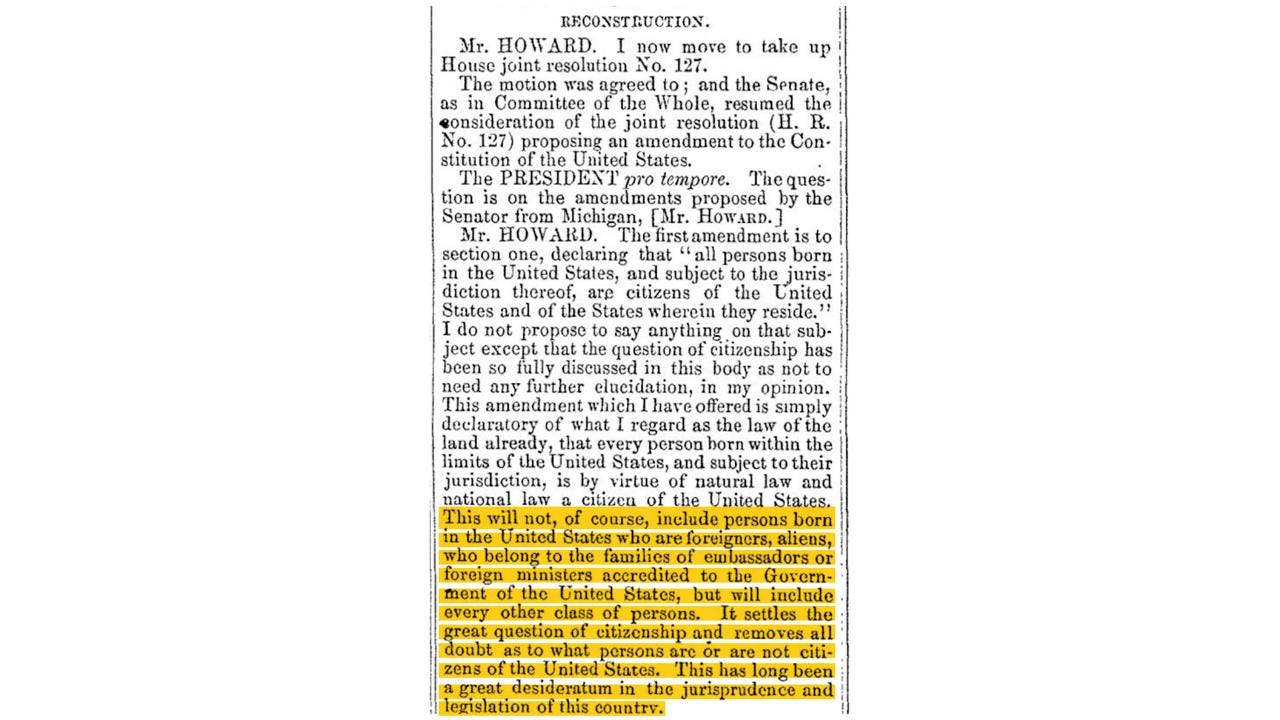
Oddly, defenders of the President’s order have taken this to social media as proof that the Fourteenth Amendment wasn’t meant to apply to children born of foreign nationals. I looked at the original source and found it is a transcript of a speech. Read as a complete sentence, “foreigners, aliens, who belong to the families of ambassadors or foreign ministers…” outlines those who aren’t subject to the jurisdiction of the United States, not children of visiting foreigners on visas who are.
Justice Clarence Thomas wrote in his dissent that citizenship was routinely denied to children of foreign visitors for decades after the Fourteenth Amendment. He’s correct that executive policies did deny citizenship to people. Still, no court ever made a ruling that such exclusions were legal.
Since the 1898 case United States v. Wong Kim Ark, the legal status of children born of undocumented and temporary foreign visitors has been citizenship. That’s over 125 years.
Is the reaction by many prominent Republican political leaders to this decision concerning? They’ve called the conservative justices who upheld this well-established view of the Constitution everything from traitors to corrupt. People like Nancy Mace, Ted Cruz, Mark Levin, Randy Fine and a long list of other elected and conservative personalities have taken very strong positions against the ruling.
Even on the Supreme Court where the justices are trained and experienced legal experts, the results raise an eyebrow (although not totally unexpected). Clarence Thomas and Samuel Alito were firmly in favor of upholding the executive order.
While Brett Kavanaugh joined the majority, in his separate opinion he thought the executive order was too much, but believed the legislative branch could make some of the changes intended by the order.
Gorsuch seemed to limit his dissent, but thought there could be cases where children born by foreign nationals wouldn’t be citizens, particularly if they weren’t residents (domiciled) in the United States.
Digging into some articles on the SCOTUS blog, I did find interesting there are some points made about domicile, what subject to the jurisdiction means, and other places where legal scholars and elected people in the Nineteenth Century made statements that support a more restricted reading of the Fourteenth Amendment. It’s not a total vacuum. But Justice Roberts found this to be scant and cherry picking compared to the mountain of evidence in the other direction.
When I started looking into this, my intent wasn’t to wade into the center of the immigration debate. Reasonable people can disagree about what U.S. immigration laws ought to be. Congress, states and voters can debate those questions.
I was more interested in knowing whether the Constitution would be able to withstand significant pressure in a time when voters demand changes and politicians make promises.
Following the history from British common law to the Fourteenth Amendment, from early court decisions to modern Supreme Court precedent, I kept arriving at the same place. Whether someone likes unrestricted birthright citizenship or not is a policy question. Whether the Constitution currently protects it is a legal one. Those aren’t the same thing.
This investigation also reminded me that constitutional government depends on more than written words. It depends on a shared willingness to accept that some questions are answered through the constitutional process rather than by executive decree. If we decide a constitutional provision no longer reflects our values, the Constitution provides a way to change it. That process is difficult by design.
Maybe that’s the real lesson here.
The issue isn’t whether birthright citizenship is wise. People will continue to argue about that, and they probably always will.
The deeper question is whether we’re willing to distinguish between the laws we wish we had and the laws we actually live under. Once that distinction disappears, every constitutional protection becomes conditional on whoever happens to hold power.
I started this investigation because I watched a president confidently sign a document that many legal scholars believed conflicted with more than a century of constitutional practice. I finished it less concerned with one executive order than with something larger. For nearly 250 years, the Constitution has endured because Americans have repeatedly returned to the idea that power itself has limits. If we ever stop believing that, how much longer will it endure?
Comments
Nothing yet. Say the first thing.
Sign in to join the conversation.