
I woke up this morning with the usual scrolling on social media, easing into consciousness with yawns, stretches and a dry mouth. I drink some water and scroll some more.
Outside Magazine, like I’m sure many others, has a social media presence on Facebook and recycles posts from the past. Why not? Old doesn’t mean irrelevant.
Case in point, I see a post “Man in a Can” on their page and immediately think… they must have found another body at Lake Mead. Alas, the article was old, but it brought back memories.
It was on a spring morning in 2023 that I finally got out to the continually receding shoreline of Lake Mead to track down the infamous Monument of Lake Mead. I parked on top of a hill at the end of a dusty road in a place called Government Wash.
My mother and her two dogs joined me that day, as they often did on desert adventures. They took one look at the steep descent down towards the shoreline, which still couldn’t be seen, and decided it wasn’t worth it for them.
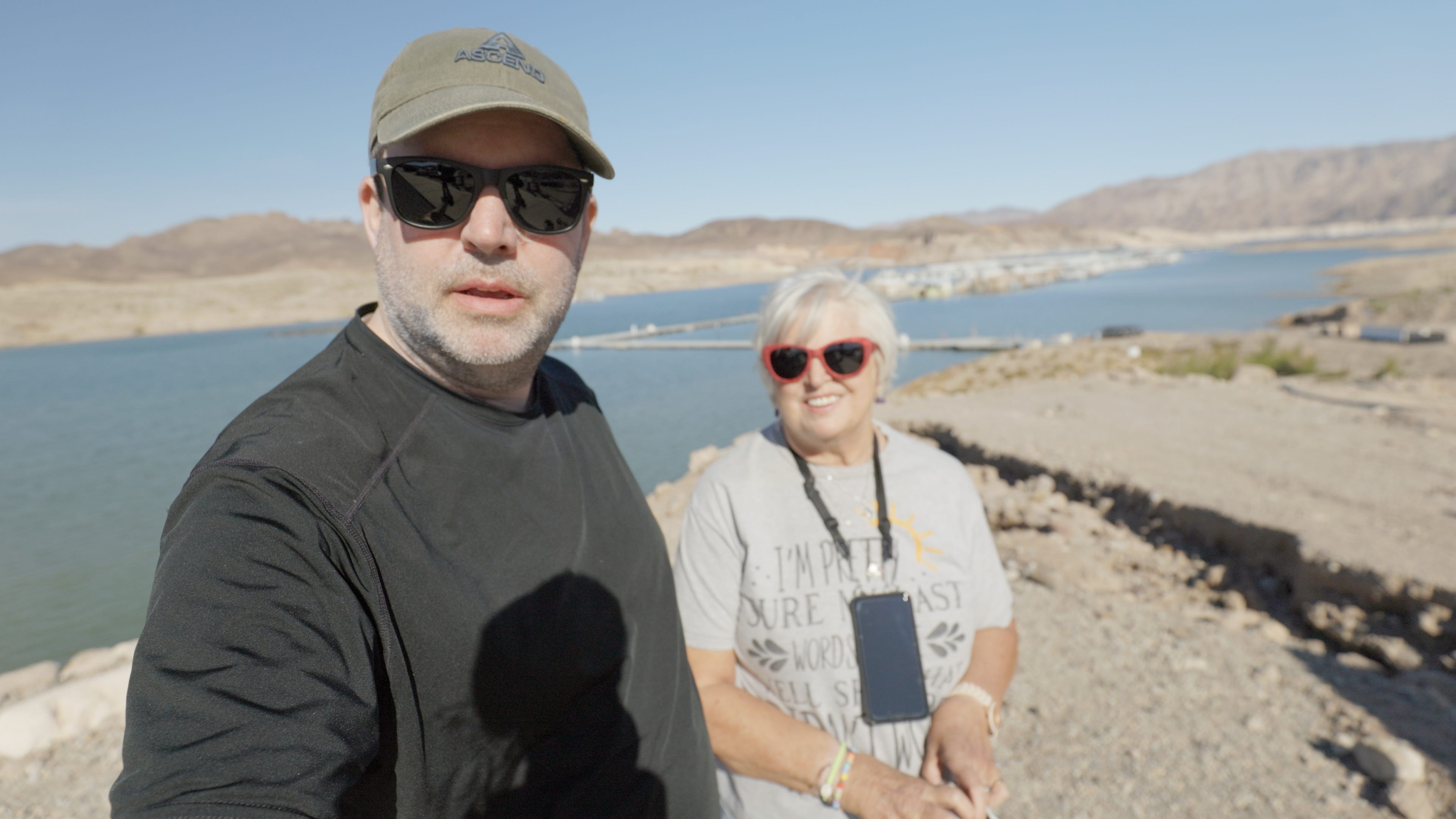
So with my camera in hand, I headed down alone. I looked back up the hill at my mom and still couldn’t see the shore. I hope my one bottle of water will suffice. It’s hot, even in spring.
I walk out of sight from the car and get lost down the wash, my feet sinking in the loose gravel at the bottom. I come up out the other side of the wash where I start to see more vegetation.
There it is!
I could see it sticking up out of a shallow pool of water like a headstone in a flooded cemetery. The smell of the water reaches me… cool but somewhat musty. Maybe it’s dying vegetation too.
I walk slowly towards it. On the other side of the shore arrives other spectators perhaps from a different dirt road.
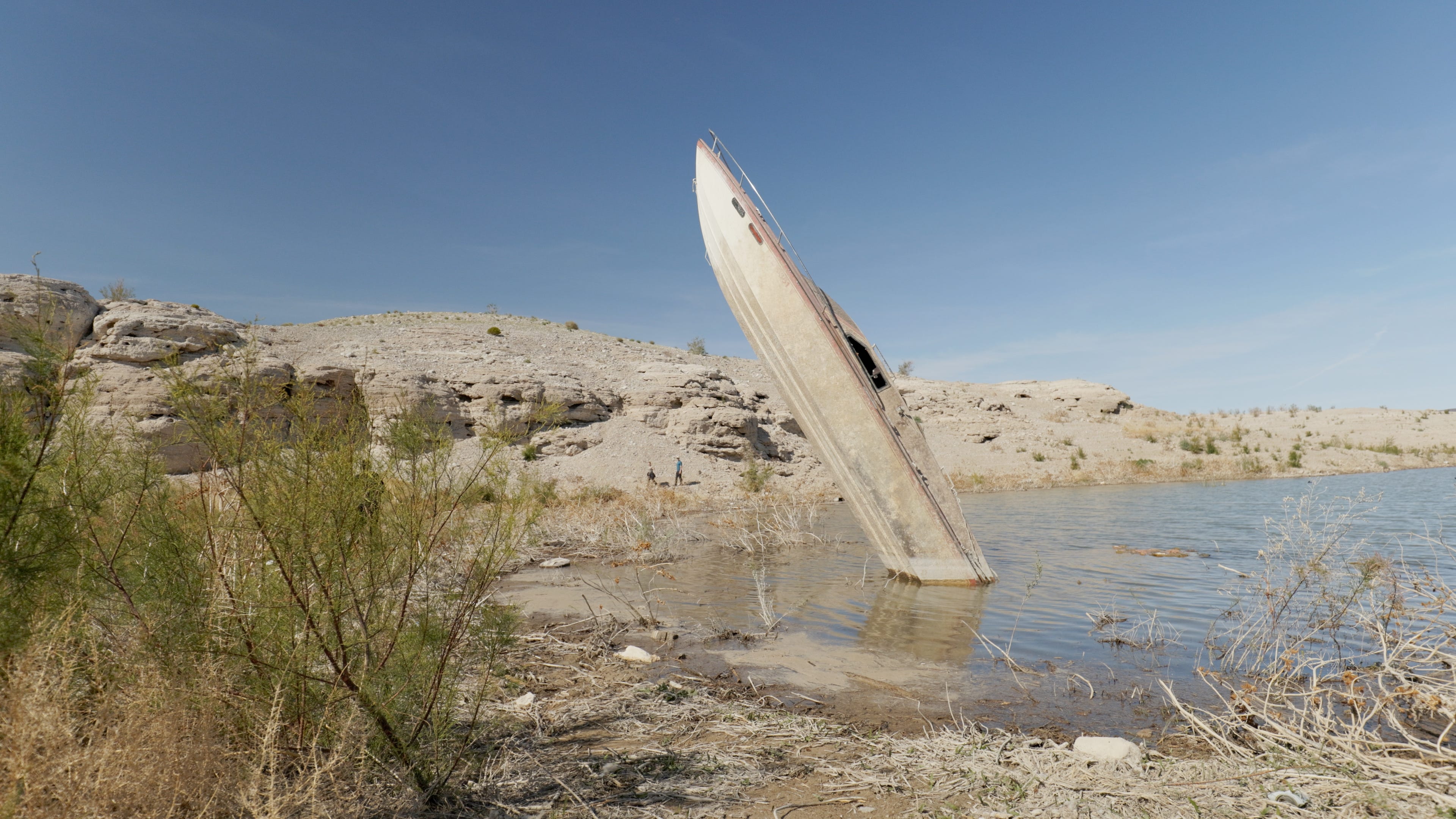
I wait to do my diatribe on camera until after they leave. I take some photos and video for a YouTube film I made back then.
I remember my mother waiting back at the car and make my way back through the hot sandy wash.
The speedboat had sunk sometime in the 1970s, but was fully submerged in the lake since that time until now. I Googled to find out how long it had been there, and was oddly saddened to find out they have actually hauled it off as of 2025.
Sure, it’s a vertically buried boat sticking up in the air for all to see at one of our National Park lands. Was its removal cleanup, or is it sad that we lost this stark reminder of things that need confronting?
The boat is a symbol. What once was at the bottom of the lake is now the shoreline. It’s a reminder that the growth and expansion of the human footprint is increasing the demand for fresh water from the Colorado River to a point that’s long past sustainable. That climate change is causing longer periods of higher temperatures and reducing the snowpacks that feed this river.
Maybe most importantly it’s a reminder that no one in charge is doing anything about it except finding ways to maintain the status quo. Instead, local officials spent nearly one and a half billion to construct a third straw, enabling water retrieval even if the lake goes deadpool.
Lake Mead recovered some after that 2022-2023 low spell. But here in 2026 we’re back in the danger zone. Witnessing the up and down rollercoaster of Lake Mead’s water level is tough emotionally. Get on with it already!
Do I want Lake Mead to go empty? No, I want the conflict to be over. Either we can have a Lake Mead, or we can’t. It sounds like the evidence is overwhelming that we can’t. The most aggravating thing is the persistent insistence by those with power that we can and we must.
I get why they cling to that. So much is at stake. Not only municipal water.
Many years ago, as a child of 3, I lived in the Imperial Valley’s largest city, El Centro.
My father was fresh out of law school and working for a fancy law firm out of San Diego. His firm sent him there to work on labor cases between farm owners and workers. It’s big business down there.
Who would have thought there’s so much agriculture in the middle of that desert? It’s quite large. In fact some 90% of the winter vegetables grown in the United States comes from the Imperial Valley, Yuma, and Coachella, all of which rely on water from the Colorado River to make that happen.
A lot of people don’t realize that 80% of Colorado River water goes towards agriculture. Over 60% of that agricultural water use is for growing animal feed. 20-30% of that animal feed is exported overseas.
As much as I’d love to blame urban sprawl for the water problems, the biggest contributor to demand is rural agricultural sprawl. Las Vegas has made enormous efforts to recycle its water. It puts most of the water it uses back into Lake Mead.
Do you think agriculture is expected to find more efficient methods than flood irrigation? Anyone suggesting that would be responsible for the rising cost of food… although that seems to be happening just fine on its own.
No, they’ll just keep doing what they’ve been doing until someone starts shutting off the faucet going through the Hoover Dam. Then we’ll see how much the food prices will go up.
I wonder what will happen to those places as water allocation drops way down. I wonder if other factors will make even the third straw a realistic solution for growing water demands in Las Vegas? If it’s so iron clad, why is the water authority constantly looking at other options like water pipelines?
There’s an ongoing discussion thread on my Facebook Messenger where all my family members discuss moving somewhere to buy land and be able to grow food. They are looking at places like Arkansas and Kentucky, Ohio, and other places known for water and land availability.
They all live in Las Vegas, except for me. I left 3 years ago so my wife could work on a PhD in Oregon.
I often think about going back. I miss the Mojave Desert. It’s a wondrous wilderness stretched out for hundreds of miles, often with zero human development for as far as the eye can see. That’s changing too. Energy demand is bringing in enormous utility-scale solar and wind projects, along with associated power stations, buzzing power lines, roads and heavy machinery. But there’s still valleys to find solace and natural spaces unspoiled by industrial civilization.
But I also miss my family. My three brothers, mom and dad, and all the grandchildren and spouses. They are a riot. But most importantly they are connection. Connection is not a given, unfortunately. It hasn’t come easy in Oregon.
But do I return to a place where even my normy family thinks isn’t going to last? The question weighs heavy on me as my wife enters her final year in her program.
I suppose the question of do we stay or do we go weighs heavily on anyone who sees what’s coming down the pipeline as 7 of 9 planetary boundaries have been breached, business-as-usual proceeds full speed ahead, and the social conditions continue to erode.
I wish I had all the answers about where to live in collapse. The answer is very case dependent. There’s both practical and emotional factors to consider.
Meanwhile even here in temperate Oregon, as I get ready for work, I’m so hot. My apartment has a window AC unit. I have a fan in my office to help, but it’s hot!
Most places built here never anticipated AC needs. Its a new phenomenon. Might be a good time to get into HVAC if you are looking for work in the PNW.
At least I’m not choking on smoke… yet. I dread what might be for this year’s fire season.
Maybe nowhere is safe to go. Maybe connection is a higher priority.
I’m curious to know what its like where you live. Do you think about relocating for climate disruption? What are your fears and your priorities?
If you’ve read this far, I appreciate it. I hope my thought train was helpful somehow. Maybe relatable.
I’m going to keep looking at places through this lens: not just where collapse may hit hardest, but where a person might still belong.
Comments
Nothing yet. Say the first thing.
Sign in to join the conversation.